When a company is looking for an Internet telephony solution, two expressions often come to mind: VoIP operator and VoIP provider. And very quickly, a question arises. Are they the same thing? Or is there a real difference behind these words?
In practice, most executives, IT managers or sales managers are not looking for an “operator” in the historical sense of the term. They’re looking for a simple solution. A cloud switchboard. Reliable inbound and outbound calls. Integration with their CRM. And above all, something flexible, with no onerous commitments or complicated installation.
The problem is that the vocabulary can be confusing. “Operator” may evoke a classic telecom player, with network, hardware and long-term contracts. “Provider” sounds more software, more cloud. And yet, in search results, both terms are often used to designate the same reality: a VoIP telephony solution for the enterprise.
Points to remember :
- The terms VoIP operator and VoIP provider are often used synonymously in searches, but the real difference lies in the model offered: traditional telecom infrastructure or 100% cloud VoIP solution.
- A modern VoIP business telephony solution requires no on-site installation, no hardware requirements, and immediate activation via the Internet.
- The key criteria in 2026 are contractual flexibility (no commitment, pro rata billing), pricing transparency and the absence of hidden charges.
- For sales teams and in-house call centers, the value is in productivity: predictive dialer, real-time supervision, statistics included and native CRM integration.
- The “best VoIP operator” depends on the company’s real needs: technical infrastructure, omnichannel platform or specialized cloud telephony solution.


Boostez la productivité de vos équipe commerciales grâce à Kavkom, le logiciel de téléphonie d’entreprise 100% cloud.
Planifier une démo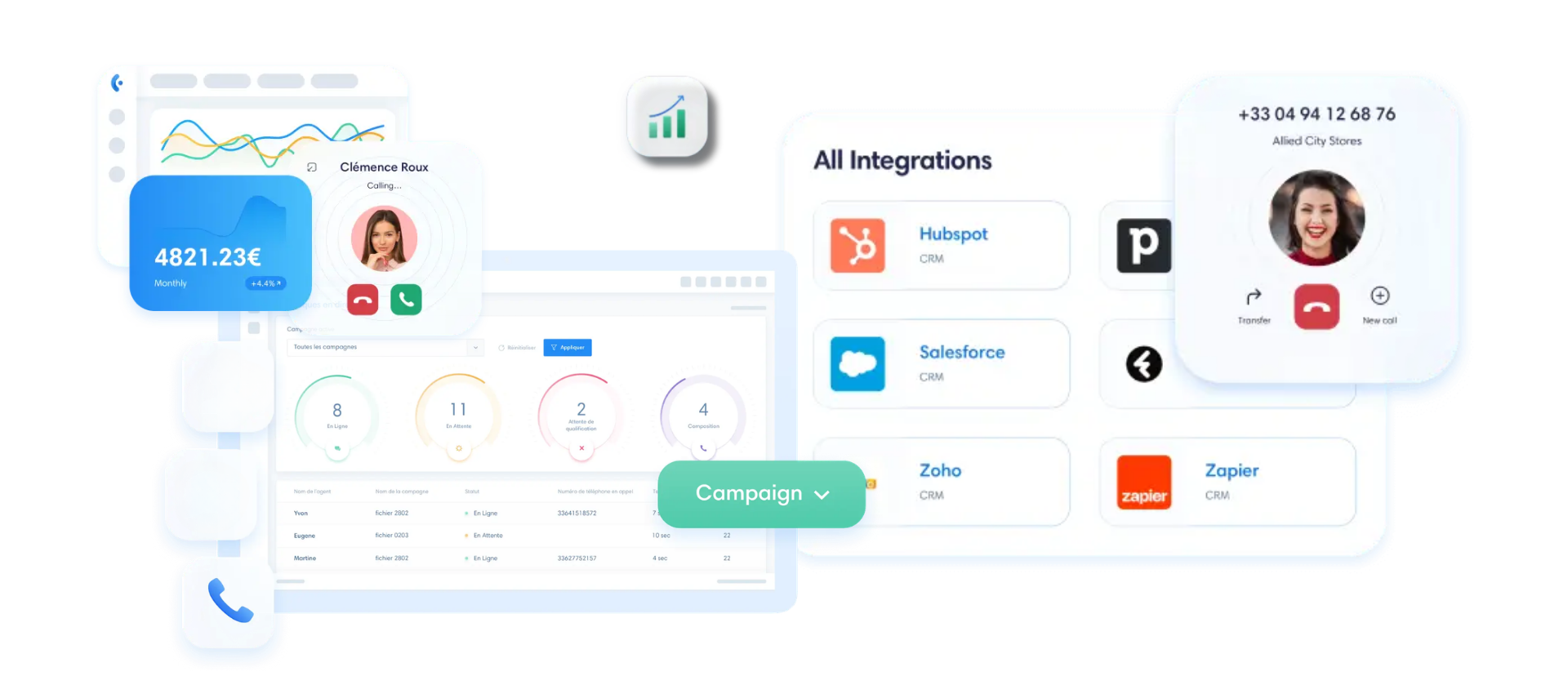
What is a VoIP operator?
Today, many companies looking for a “VoIP operator” are not looking for a telecom operator in the traditional sense of the term. They’re looking for a turnkey solution, available immediately, with no on-site installation required.
This is the case with solutions like Kavkom.
Kavkom is a 100% cloud-based enterprise telephony solution, focused on business productivity.
This is not a network operator with a physical infrastructure. No hardware is imposed. No switchboards are installed in your offices.
Everything works via the Internet.
Activation is immediate.
Lines can be configured in just a few minutes.
This is a no-commitment solution, with pro rata billing.
In other words, the epitome of a “VoIP operator” in the modern sense of the term: a cloud platform specialized in professional call management.
What many call a “VoIP operator
In common parlance, the term “VoIP operator” refers to :
- A provider of fixed geographical numbers
- A cloud switchboard solution
- A tool to manage incoming and outgoing calls
- An enterprise telephony platform
In other words, a solution that replaces a conventional telephone system, but with an Internet version.
But be careful.
The important nuance to understand
A VoIP provider is not necessarily a network operator in the traditional sense of the term. A VoIP provider is not necessarily a network operator in the traditional sense of the term.
A classic telecom operator :
- Owns and operates a physical network infrastructure
- Sometimes installs equipment on site
- Often works with long-term contracts
Conversely, many of today’s “VoIP operators” are actually 100% cloud solutions. They don’t supply fixed hardware. They don’t pull cables into your office. They offer a turnkey software platform that can be activated in minutes.
That’s where the confusion comes in.
The word “operator” may suggest a traditional telecom player. But in most of our current research, companies are looking for a flexible, cloud-based solution tailored to their teams.
What is a VoIP provider?
A VoIP provider is a company that provides a telephony solution via the Internet, usually in the form of a cloud software platformVoIP provideris a company that provides a telephony solution via the Internet, usually in the form of a cloud software platform.
The logic is service-oriented.
We’re not talking about a network infrastructure to manage. We’re talking about a ready-to-use tool, accessible online, that enables a company to manage its telephone communications.
A 100% cloud software solution
In most cases, a VoIP provider offers :
- A cloud switchboard
- Geographic fixed-line numbers
- Incoming and outgoing call management
- A web interface for users and managers
No equipment is required. No on-site installation. Everything works via the Internet.
Teams can call from a computer, softphone or compatible IP phone. Activation takes just a few minutes.
Call management and internal organization
A VoIP provider doesn’t just “make calls”.
It allows you to :
- Create agent groups
- Set up an interactive voice server
- Automatic call distribution
- Monitor activity in real time
In other words, it replaces a physical standard with a more flexible and controllable cloud platform.
CRM and business logic integration
Another key point.
A modern VoIP provider integrates with existing CRM systems. When a customer calls, his or her details can be automatically displayed on the screen. Calls can be recorded and associated with the sales history.
So we’re no longer just talking about telephony.
We’re talking about a tool connected to the company’s business ecosystem.
VoIP provider vs. VoIP operator: a fine line between the two
In practice, the two terms often overlap.
Many companies use “VoIP operator” and “VoIP provider” as synonyms. The difference is mainly one of vocabulary. The intention of the search remains the same: to find an Internet telephony solution adapted to the company’s needs.
What really counts is not the word used. It’s the model behind it.
VoIP operator vs. VoIP provider: is there a real difference?
This is the central question.
On Google, the two terms are often used synonymously. In fact, many companies use the term “VoIP operator” when they’re actually looking for a turnkey cloud solution.
So the real difference isn’t the word. It’s about the model.
To understand this, we need to compare not terms… but approaches.
Model comparison
| Criteria | Traditional telecom operator | VoIP cloud provider |
| Infrastructure | Physical network | 100% cloud |
| Hardware | Often imposed | No equipment required |
| Commitment | 12 to 36 months | Often without obligation |
| Flexibility | Limited | Pro-rata billing possible |
| CRM integration | Rare | Native |
What this means in concrete terms
Historically, a traditional telecom operator operates with :
- A physical network infrastructure
- On-site installations
- Hardware
- Long-term contracts
The logic is heavy. Structured. Unflexible.
Conversely, a VoIP cloud provider works like SaaS software.
- Immediate activation.
- Online interface.
- No equipment required.
- Scalable in real time.
Add or remove users as needed. Adapt your lines. Manage your teams from a dashboard.
So… is there a real difference?
Yes. But it’s not just about vocabulary. It has to do with the operating model.
When a company types in “VoIP operator”, it’s rarely looking for a network operator in the historical sense. They’re looking for a modern solution to manage their calls more efficiently.
So the real issue isn’t :
“Operator or supplier?”
The real question is: Rigid infrastructure or flexible cloud solution?
To illustrate this difference, let’s take a concrete example. A solution like Kavkom epitomizes the modern VoIP cloud provider approach.
This is not a traditional telecom operator with physical infrastructure or on-site installation.
Kavkom is a 100% cloud VoIP telephony platform, designed for immediate business use.
In concrete terms :
- Instant activation
- No equipment required
- No obligation
- Pro-rata billing
- Compatible IP phones can be used at no extra cost
The logic is simple: you activate your lines, configure your teams, and you’re up and running in minutes.
This model is particularly suited to sales teams and in-house call centers that need flexibility, real-time supervision and native CRM integration, without having to depend on a long-term contract.
What are the criteria for choosing a VoIP operator or supplier in 2026?
In 2026, the question will no longer be “Does VoIP work?”.
The real question is: which solution is right for your organization?
Because not all offers are created equal. And some differences can only be seen in production.
Here are the criteria that really count.
1. 100% cloud solution or hybrid infrastructure?
First point to check.
Is the solution really 100% cloud?
A cloud solution means :
- Immediate activation
- No on-site installation
- No PABX to maintain
- No technical intervention in your offices
Everything is configured from an online interface.
You create your users. Assign your numbers. You’re up and running fast.
Conversely, a hybrid infrastructure may involve :
- Hardware
- Network configuration
- Deployment times
If you have distributed teams, telecommuting or multiple sites, the pure cloud simplifies everything.
2. Contractual commitment
This point is often underestimated. Many traditional operators still operate on 12- to 36-month contracts.
A modern solution must offer :
- No obligation
- Pro-rata billing
- Lines can be adjusted upwards or downwards
Case in point.
- You close your office in August.
- You cut 10 lines for 30 days.
- You only pay for the days you actually use.
This flexibility changes budget management, especially for seasonal or fast-growing companies.
3. Sales team productivity
This is where the real difference lies. A simple call solution is no longer enough.
In 2026, a B2B company is waiting:
- A predictive dialer to automate call campaigns
- Real-time supervision
- Coaching functions to support agents
- Detailed statistics included
It’s not just about making a phone call.
The aim is to increase the number of useful calls.
- Measure performance.
- Monitor KPIs.
If your solution doesn’t offer these tools, you’ve just moved your standard to the cloud. You haven’t structured your performance.
4. Native CRM integration
Today, isolated telephony doesn’t make much sense. The solution must integrate with your existing CRM.
Important: this does not mean that it should replace your CRM.
A good VoIP solution :
- Connects to Salesforce, HubSpot, Pipedrive, Zoho and others
- Displays the contact card on the call
- Automatically synchronizes calls and recordings
- Centralize notes in your business tool
Avoid double entry. You save time. Keep full traceability.
5. Transparent pricing
Last but not least.
Check :
- Are there any installation costs?
- Are there any optional pay-as-you-go modules?
- Is unlimited really unlimited?
- Are there hidden ceilings or disguised conditions of use?
Some offers seem attractive at first. Then the options add up.
A clear solution must offer :
- Real unlimited calls
- All necessary features included
- No hidden costs
- No minimum number of lines
In short, the choice is not between “operator” or “supplier”.
It is done on :
- The cloud model
- Contractual flexibility
- The ability to save teams time and improve performance
- Cost clarity
And in 2026, these criteria became non-negotiable for structured companies.
The best VoIP providers for businesses
When you type in “best VoIP operator”, you often expect a simple ranking.
But in reality, the “best” depends mainly on your business model.
A tech startup doesn’t have the same needs as a call center.
A multi-site SME isn’t looking for the same thing as a team of developers.
Here are the three main approaches on the market.
Solution 1: VoIP platform for developer infrastructure
Positioning
These players offer a programmable telecom infrastructure.
We’re talking about APIs, SIP lines and customized integration.
The logic is technical. Flexible. Powerful.
But designed primarily for developers.
For whom?
- Companies with in-house IT teams
- Projects requiring custom integration
- SaaS applications that integrate telephony into their products
If you want to build your own call system, it’s consistent.
Limits
- Not turnkey
- Requires technical skills
- Low commercial productivity out-of-the-box
- Supervision and business tools often to be developed in-house
It’s an infrastructure brick.
Not always an immediate operational solution for a sales team.
Solution 2: Omnichannel VoIP solution
Positioning
Here, telephony is part of a broader platform.
This often includes :
- Call
- Cat
- SMS
- Sometimes social networks
The promise is to centralize communication channels.
For whom?
- Multi-channel customer service
- Companies with a high volume of digital interactions
- Organizations looking for a unified platform
This may be relevant if your strategy relies on several channels simultaneously.
Limits
- Telephony is not always the heart of the product
- Some advanced features may be optional
- Higher complexity
- Sometimes modular pricing
If your priority is pure telephone performance, this model may be wider than necessary.
Solution 3: Specialized business telephony
Positioning
These solutions are centered on enterprise cloud telephony, with a strong focus on sales performance.
They include :
- Cloud switchboard
- Advanced management of incoming and outgoing calls
- Predictive Dialer
- Real-time supervision
- Native CRM integration
The logic is simple.
Everything is geared towards business use.
For whom?
- Sales teams
- In-house call centers
- Growing SMEs
- Multi-site organizations
If your aim is to increase the number of useful calls, monitor your KPIs and maintain a flexible structure, this model is often the most suitable.
Limits
- Less focused on complex custom development
- Not designed as a complete omnichannel platform
- Specialization in telephony
But for many B2B companies, this very specialization is an advantage.
So which is the “best VoIP operator”?
There is no universal answer.
The best choice depends on :
- Your organization
- Your in-house skills
- Your level of digital maturity
- Your priority: infrastructure, omnichannel or telephone performance
So the term “best VoIP operator” shouldn’t just point you in the direction of a word. It should point you towards a model adapted to your reality on the ground.
Why companies now prefer VoIP cloud solutions
Ten years ago, corporate telephony was often tied to a physical location.
- An office.
- A standard.
- On-site equipment.
Today, this model has changed.
Teleworking and hybrid teams
The teams are no longer all in the same place.
- Sales representatives on the move.
- Teleworking agents.
- Managers in several cities.
A VoIP cloud solution enables everyone to connect from anywhere via the Internet, using the same company number and routing rules.
The system is no longer attached to a building. It’s attached to the organization.
Multi-sites and rapid growth
Companies are opening new offices. Or merge teams. With a traditional solution, each site involves its own facilities, equipment and deadlines.
With the cloud :
- We add users
- We create groups
- Numbers are assigned
- Deployment in minutes
The infrastructure keeps pace with growth. Without technical complexity.
Centralized communications
Previously, each site could have its own system.
Result: little overall visibility.
A VoIP cloud solution centralizes :
- Incoming calls
- Outgoing calls
- Recordings
- Statistics
A sales manager can see the activity of all teams, even if they are geographically dispersed.
Real-time control
This is probably the most structuring change.
Modern solutions offer :
- Real-time dashboards
- Queue tracking
- Agent availability
- Call volumes
- Individual performance
We no longer discover the figures at the end of the month. We take things one day at a time.
For a sales team or an in-house call center, this visibility changes the way you manage.
In short, if companies today are opting for VoIP cloud, it’s not to follow a technological trend.
That’s because the model fits better:
- To hybrid organizations
- Multi-site structures
- Centralization needs
- Real-time control requirements
The cloud is no longer a marketing argument. It has become an operational standard.
Some solutions have been designed from the outset on this 100% cloud model. Such is the case with Kavkom, a business performance-oriented VoIP telephony platform.
The solution works entirely via the Internet.
No on-site installation.
No hardware requirements.
Teams can connect from any browser, application or compatible IP phone, at no extra cost.
But the key point is not limited to the cloud.
Kavkom integrates :
- A cloud switchboard
- A native predictive dialer
- Real-time supervision
- Native CRM integration
- Flexible line management without commitment
- Pro-rata billing
In other words, the cloud model is not just technical.
It’s designed for operational productivity.
For a sales team or an in-house call center, this means :
- Immediate deployment
- Rapid adaptation to workforce changes
- Full visibility of KPIs
- Responsive human support
This kind of approach illustrates why companies today prefer specialized VoIP cloud solutions to traditional telecom infrastructures.
Boostez la productivité de vos équipe commerciales grâce à Kavkom, le logiciel de téléphonie d’entreprise 100% cloud.
Planifier une démoFAQ : VoIP Operator / VoIP Provider
These are the questions most frequently asked when a company compares a VoIP operator or VoIP provider.
What’s the difference between VoIP and IPBX?
VoIP (Voice over IP) is the technology used to make calls over the Internet.
An IPBX (IP switchboard) is the system that organizes these calls internally. It manages routing, transfers and agent groups.
Today, most business VoIP telephony solutions offer an integrated cloud switchboard.
It’s no longer a physical box installed on your premises, but an online hosted system.
In a nutshell:
- VoIP = the technology
- IPBX = the call management tool
Do I need a physical phone?
No.
A VoIP cloud solution works via :
- A webphone (browser interface)
- A desktop application
- A mobile application
- Or a compatible IP phone if you wish
No equipment is required.
You can equip an entire team without installing an on-site switchboard. Everything is accessible via the Internet.
How secure is VoIP?
Yes, if the solution complies with current standards.
Serious platforms offer :
- Communication encryption
- Secure hosting
- Access rights management
- RGPD Compliance
As with any cloud tool, security depends on the provider you choose. You need to check the guarantees offered.
Can I keep my geographic number?
Yes. Most VoIP solutions offer number portability.
You can keep your existing geographic fixed-line number.
This allows you to modernize your telephony without disrupting your customers.
Does VoIP work without fiber?
Yes. VoIP works with a stable Internet connection. Fiber is a nice-to-have, but it’s not required.
In most cases, a professional connection of the right size will suffice. Quality depends above all on network stability, not just on the technology used.
Advanced SEO optimization
1. Intent stacking
This article is designed to capture several close intentions:
- VoIP Operator
- VoIP provider
- Enterprise VoIP solution
- Business VoIP telephony
- Best VoIP operator
- VoIP comparison
The aim is to cover both :
- Informational intent
- Comparative intent
- Decision-making intent
In a single structured content.
2. Recommended internal linking
To reinforce SEO authority, the article must point to complementary pages:
- Business VoIP telephony
- Cloud switchboard
- Virtual number
- Call center cloud
- CRM integration
This mesh reinforces cluster coherence and increases semantic depth.
3. Differential angle to be respected
To remain clear and consistent:
Never :
- Talking about SIM
- Talking about mobile packages
- On-site installation
- Reminiscent of a traditional telecom network operator
Always highlight :
- 100% cloud
- No obligation
- Pro-rata billing
- Commercial productivity
- CRM integration
- Human support
The positioning is not “telecom operator”.
Positioning is a business performance-oriented VoIP cloud telephony solution. It’s this consistency that enables us to capture requests while remaining strategic.
Conclusion
Basically, the difference between a VoIP operator and a VoIP provider is one of vocabulary. What companies are really looking for today is not a network operator in the traditional sense. They’re looking for an enterprise VoIP telephony solution capable of integrating with their organization, keeping pace with their growth and improving team productivity. The real choice, then, lies not in the word used, but in the model proposed: rigid infrastructure or 100% cloud solution, long commitment or no-commitment flexibility, basic tool or platform designed for real-time sales management.
If your priority is centralization, supervision and CRM integration, then a business-use-oriented VoIP cloud solution will generally be more suitable than a traditional telecom model. Compare offers, analyze pricing transparency, check contractual flexibility and make sure key features are included. When it comes to VoIP comparisons, the “best VoIP operator” is simply the one that matches your operational reality.