Many offers feature ‘unlimited international calls’. However, actual conditions vary widely from operator to operator.
Unlimited international VoIP calls are often a well-packaged marketing promise. Behind it, you’ll find fair use clauses, mobiles excluded from the package, and included destinations that don’t really cover the countries where your customers are.
The result: additional costs you hadn’t anticipated, and a bill that rises without warning.
This guide gives you a practical method for decoding any offer, checking what “unlimited” really covers, and avoiding unpleasant surprises, fixed versus mobile, real destinations, usage limits included.


Boostez la productivité de vos équipe commerciales grâce à Kavkom, le logiciel de téléphonie d’entreprise 100% cloud.
Planifier une démo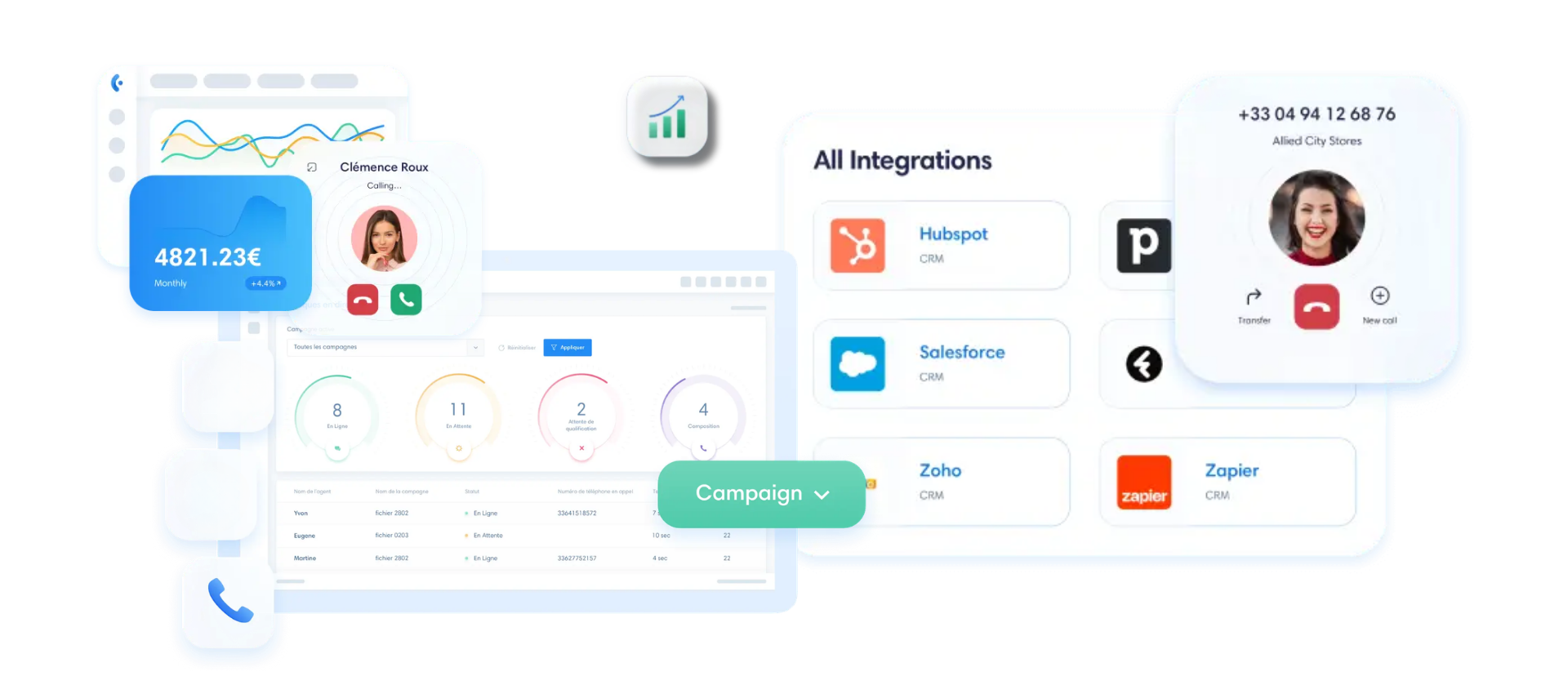
What’s really behind unlimited international VoIP offers?
Unlimited to 110 destinations. But before you sign up, ask yourself one simple question: unlimited according to whom, and under what conditions exactly?
Because in the general conditions, reality is often more nuanced than the landing page title.
Here are the three grey areas you’ll find in almost every offer on the market.
Fair use, that ceiling we don’t show you.
Most “unlimited” packages include a reasonable usage clause. In concrete terms, if you exceed a certain volume of calls per month or per day, your operator may restrict your line, bill you for additional minutes, or suspend access without notice.
For a salesperson making around thirty calls a day, the limit may be invisible. For a call center with 15 agents running at full speed, it’s a different story. Always check whether the contract mentions a ceiling in minutes per user or per line.
Fixed-line included, mobile excluded: the distinction that changes everything.
This is the most common pitfall. A package can cover landline numbers 80 countries, but exclude mobiles altogether. So if you call customers in Spain, Morocco or Poland, chances are they’ll answer on their mobile.
As a result, every call to a cell phone is charged by the minute. The bill goes up fast.
The destinations included are not all equivalent.
An offer may claim“50 countries included” but only cover fixed lines in these countries, with exclusions on certain prefixes or local operators. Entire zones, such as sub-Saharan Africa or certain South-East Asian countries, are often absent from lists or billed separately.
Before comparing offers forunlimited international VoIP calls, always ask for the full list of destinations, with the fixed/mobile distinction, and look for the fair use clause in the GTC. This is where the real differences lie between a serious switchboard VoIP solution and a well-packaged marketing offer.
Landlines, mobiles and countries included: the limits of unlimited free international calls
You’ve already been sold a “free unlimited international call” package. And then, on your first bill, you discover lines you weren’t expecting.
This is where the details really count. Here are the three most common exclusions.
Special and premium numbers: always out of the package, no exceptions.
Whatever your operator, whatever your plan: premium rate numbers (0800, 0900, short numbers, local emergency numbers abroad) are never covered by an unlimited plan.
If your team calls customer services, government departments or partners on this type of international number, each call is billed by the minute. No alert, no visible cap.
Fixed and mobile: the distinction that offers minimize.
This is the most underestimated point. A package may cover landline numbers in 40 or 50 countries, but exclude mobiles in those same countries altogether.
Case in point: your sales rep calls a prospect in Germany. The prospect answers on his mobile. Result: the call goes out of the bundle and is billed by the minute, sometimes the cost varies depending on the operator and the destination.
Multiply that by 20 agents calling all day, and the “bargain” quickly becomes an uncontrolled cost item.
The myth of free international calls without Internet.
Some people are still looking for “free international calls”, as if a classic operator like Bouygues could offer unlimited international calls via the GSM network.
The reality is simple: on traditional telecom networks, international calls are generally billed by the minute or included in limited packages.
VoIP, on the other hand, uses your Internet connection to route calls. This is precisely what makes it possible to offer unlimited international VoIP calls at controlled rates, provided you choose a plan that covers landlines and mobiles in the countries you’re targeting.
With Kavkom, VoIP telephony for business includes geographic numbers in over 50 countries, with no commitment and no hidden charges. But as with any serious offer, always check the list of destinations and the fixed/mobile distinction before validating your choice.
Free international call application vs. professional cloud telephony: which to choose?
WhatsApp, Skype, FaceTime. These applications work very well for the occasional personal call.
But for a call center or sales team making dozens of international calls a day? That’s a different story.
The risks of a free VoIP number for your brand image
A free VoIP number seems attractive at first glance. No cost, quick activation, available on your mobile. Except that what you gain in savings, you lose elsewhere.
First problem: audio quality. Free applications are designed for personal use. They don’t generally offer team supervision, CRM integration or management tools adapted to sales activities. The result: latency, echo, cuts right in the middle of a sales pitch. Ever tried to close a prospect when the line cuts off three times in two minutes?
The second problem, and often the most underestimated, is the total absence of technical support.
Imagine: your team of 8 salespeople can’t make any more calls on a Monday morning. With a free solution, you open a ticket. You wait for the response time, which may be uncertain.
For a business that depends on the telephone, this is a real operational risk. And your customers hear degraded quality, or get a generic voicemail with no professional identity. Your brand image takes a direct hit.
VoIP cloud telephony for sales teams
Here’s what free apps can never give you, no matter how premium they are.
A cloud telephony solution like Kavkom brings together all the tools needed to manage call activity: dialer, real-time supervision, conversation recording and CRM integration. Not just a channel for making calls.
In concrete terms, here’s what it means for a sales team:
- Native predictive dialer: your sales reps no longer dial manually. The system automatically calls and connects the agent only when someone picks up. On a day of international prospecting, the time savings are immediate.
- Call recording: every conversation is archived, accessible for coaching, training new agents, or simply to find out what a customer said last week.
- Real-time supervision: your manager can see live who’s on the line, who’s available, and what the average waiting time is. They can intervene, coach and adjust without waiting for the next day’s report.
- CRM integration: every time a call comes in or goes out, the contact record is automatically transferred to Salesforce, HubSpot or Pipedrive. Zero manual entry.
And on the mobile side: With a cloud telephony solution like Kavkom, your sales reps can call from a webphone, iOS/Android mobile app or IP phone.
That’s the real difference. A professional softphone and webphone solution doesn’t just replace a free application. It structures your team’s entire sales performance, with measurable KPIs, reachable human support, and stable HD audio quality whatever the destination.
A free application is a personal tool used for business purposes. A dedicated cloud solution is a commercial infrastructure.
The question isn’t really “free or paid”. It’s: how much is the lack of supervision, reliability and data on your international calls costing you?
I’ve received an international call: how do I manage routing and costs?
Your team receives a call from Germany, Spain or Canada. First question: will it cost anything? And will the right agent pick up?
Good news: with a well-configured VoIP cloud solution, both answers are reassuring.
The principle of local virtual numbers changes everything for your foreign customers.
Instead of giving your international contacts a French number, you assign a virtual number local to their country. A Spanish customer sees a Spanish number. He calls as if he were reaching a local office.
Result: In most cases, the call is billed as a local call by the caller’s operator. For them, it’s a standard local call. And for you, the call arrives directly in your cloud system, with no additional cost for reception.
This is an often underestimated point. Your customers call more easily when they’re not afraid of an international bill. Contact rates rise. So do customer relations.
“Kavkom virtual number (hosted in the cloud)” -> “IVR: voice menu, orientation by language or service” -> “Agent available in France or telecommuting”. Arrows between each step, clean design, light background.} alt: international incoming call routing via local virtual number and Kavkom IVR”>
Intelligent routing is what turns an incoming call into a seamless experience.
Once the call is received, your IVR (Interactive Voice Response) takes over. It automatically directs the caller to the right service, according to language, time of day, or agent skill.
Case in point: a German customer calls at 9am. The IVR detects the language and redirects the call to your available German-speaking agent. If no-one is available, the call is queued with a personalized message, then transferred as soon as an agent becomes available.
No lost calls. No haphazard manual transfers. No customers hanging up after two minutes of silent waiting.
And what about the cost to your company?
With a local virtual number, your customers call a number in their own country. For them, the call is usually billed as a local call by their operator. The call is then routed to your Kavkom system in the cloud. The call is then routed to your Kavkom system in the cloud. Depending on your number and subscription configuration, incoming calls may be included without per-minute billing.
One of the strengths of unlimited international VoIP calls is symmetry. You control the costs of outgoing calls AND incoming calls, with no surprises at the end of the month.
Kavkom: commitment-free VoIP telephony for your international calls
You’ve read about the pitfalls, exclusions and fair use clauses. Now, here’s what a serious solution should offer you in concrete terms for your international calls.
Kavkom provides a straightforward response to these issues.
Call Center €50/month: designed for intensive use.
If your team makes international calls all day long, Kavkom’s Call Center offer is just what you need. The Call Center offer is designed for teams who make a high volume of calls every day. Calls are included in the subscription, with no fair use clauses or hidden limitations during the month.
In concrete terms: 15 agents prospecting at full speed, all week long. No nasty surprises at the end of the month.
No commitment, pro rata billing: true flexibility.
This is something many people underestimate until they need it. With Kavkom, you don’t sign a long-term contract. You activate, you use, you suspend if necessary.
Here’s a concrete example: your international prospecting team stops in August. You cut the lines. You only pay for the days you actually use. Compare that to a competitor who offers you a 25% discount in the summer, but continues to charge. The difference is significant over a year.
No installation fees. No cancellation fees. No minimum number of lines. Immediate activation from any browser.
Physical IP phone at no extra cost, human support without chatbot.
Two differentiators that you won’t find everywhere at the same price level.
- Physical IP phone: if your team already uses compatible IP phones, they can be connected to Kavkom at no extra cost.
- Reachable human support: email, phone, WhatsApp. No chatbot, no mandatory self-service. When a problem blocks your production on a Monday morning, you have a real, fast, French-speaking contact.
And for teams who need a complete VoIP switchboard with intelligent routing, IVR and real-time supervision, everything is included in the subscription. No separate modules to buy.
That’s what a transparent telephony solution is all about: clear rates, included features, and support that answers when you need it.
Things to remember
The promise of unlimited international VoIP calls often conceals additional costs. Your priority is to decode the offer before committing yourself. Ask for a list of destinations, clearly distinguishing between fixed and mobile lines, as this is the most common pitfall.
Also check for a “fair use” clause that could limit your teams’ call volume. Unlike free applications, a professional solution guarantees stable quality, supervision tools and human support to ensure your productivity.
To better understand the infrastructure behind these solutions, explore the concept of Centrex VoIP telephony.