

In many companies, telephony has been built up over time, without any real strategy. A sales rep uses his personal mobile. Support answers from an old office number. The manager receives some calls on his direct line. At first, it worked. Then business picks up, teams telecommute and calls multiply. And that’s when things get a little fuzzy.
Calls are scattered. Some are missed. It’s hard to keep track of who answered which call. It’s also impossible to get a clear picture of the business. And in terms of image, it’s not always reassuring for your prospects to be referred to a different personal number or cell phone depending on the caller.
It’s often in this context that the search for a more structured solution begins. And where the term “virtual number” comes into play.
But let’s make one important point clear right away. A virtual number is not a SIM card. It’s not a traditional landline phone installed on your premises. And it’s not a simple mobile package.
In this article, we’ll look at exactly what a virtual number is, how it works technically, why companies use it and when a professional cloud solution becomes more relevant than just another number.
The aim is simple: to help you understand whether a virtual number is just a convenient second number… or a real lever for structuring and managing your corporate telephony.
Points to remember
- A virtual number is a business number that operates via the Internet, without a physical line or SIM card, and is based on VoIP technology.
- It centralizes a team’s calls on a single number, while remaining accessible from a computer, smartphone or compatible IP phone.
- Integrated with a cloud switchboard, it offers advanced functions such as automatic routing, real-time supervision, call recording and CRM integration.
- The cloud model provides flexibility and budget control, thanks to immediate activation, no long-term commitment and pro rata billing.
- For a company, the virtual number is not just about receiving calls: it becomes a structuring tool for sales performance and operational management.

What is a virtual number?
Simple definition
A virtual number is a telephone number accessible via the Internet.
It does not depend on a physical telephone line installed on your premises. It operates entirely online.
Technically, it’s based on VoIP, or Voice over IP. In concrete terms, voice is transformed into digital data and transmitted via your Internet connection. This principle enables you to make and receive calls without a traditional telephone infrastructure.
The company no longer needs to install a physical telephone line on its premises. No special wiring. No on-site switchboard. Everything is hosted in the cloud.
Another important point is that there are no hardware restrictions. You can use a computer, smartphone or compatible IP phone if you wish. But you don’t have to install a heavy system or any special equipment.
In short, a virtual number is a business number that operates via the Internet, without a traditional fixed line and without physical installation. It offers greater flexibility while retaining the functionality of a traditional number for your customers.
Difference between fixed, mobile and virtual numbers
When we speak of a virtual number, many managers simply think of an additional number. In reality, the difference lies not in the number itself, but in the infrastructure that makes it work.
A geographic numberA geographic number, often called a landline number, begins with an area code, such as 01, 02, 03, 04 or 05 in France. Historically, these numbers were connected to a physical telephone line installed on the company’s premises. Their operation therefore depended directly on the on-site infrastructure.
A mobile number, on the other hand, generally begins with 06 or 07, and is associated with a SIM card and a mobile package supplied by a telecom operator. This type of number is practical for individual use, but limited when it comes to organizing team telephony.
The VoIP virtual number, on the other hand, can look like a fixed or mobile number. The difference is not apparent to the caller. It lies in the technology used.
A virtual number operates via the Internet using VoIP. It is not connected to a physical line or SIM card. It’s hosted in the cloud and can be used from multiple devices: computer, smartphone or IP phone.
One point needs to be clarified: a fixed number does not necessarily mean a fixed line. Today, a geographic number can operate entirely in the cloud while retaining its area code. It’s this technological evolution that enables companies to keep their number while modernizing their telephone infrastructure.
Virtual number vs. SIM card: not to be confused
This is one of the most common confusions.
When companies hear the term “virtual number”, they often think of a dematerialized SIM card. Or an eSIM. Or a slightly different mobile package. But they’re not the same thing.
- A VoIP virtual number does not rely on a SIM card.
- It does not depend on a conventional mobile network.
- It is not linked to a traditional operator package.
In concrete terms :
- No physical SIM to insert into a phone
- No eSIM to activate
- No mobile package to manage
- No dependence on the GSM network
The number only works via the Internet.
This is a key point.
Let’s take a simple example. If you equip 10 sales representatives with SIM cards, each line is attached to a specific device. If a phone breaks down, the line is temporarily unusable. If an employee leaves the company, you have to manage the SIM and number transfer.
With a virtual number, the logic is different.
The number is not attached to a device. It is attached to your cloud account. You can use it via :
- A softphone, i.e. an application installed on a computer
- A webphone, directly from a browser
- A compatible IP telephone, if you prefer a physical extension
Case in point.
A sales manager starts his day at the office on his computer. In the afternoon, he visits a customer and switches to the mobile application. In the evening, if he wishes, he can consult his call history from his web interface.
The number remains the same, but access has changed.
It’s this flexibility that distinguishes a VoIP cloud solution from a simple mobile package.
A virtual number is therefore not an alternative to a SIM card.
It’s another way of structuring corporate telephony, by dissociating the number from the device and centralizing management in the cloud.
How does a virtual number (VoIP) work?
The VoIP principle
A virtual number is based on VoIP technology, for Voice over IP. This means that voice is transmitted via the Internet rather than the traditional telephone network.
In concrete terms, when you make a call, your voice is converted into digital data, which travels over your Internet connection before being converted back into sound at the other end. The process is instantaneous and totally transparent to the user.
In a business VoIP system, the telephone infrastructure is hosted in the cloud. Calls no longer pass through a physical switchboard installed on the company’s premises, but through secure remote servers accessible online.
In particular, this architecture enables :
- quickly activate new users
- access telephony from different devices
- manage remote calls
- add advanced functionalities without technical installation
VoIP also enables intelligent call routing. Companies can define rules to automatically direct calls to the right department, organize queues or manage different scenarios according to opening hours.
This architecture enables companies to manage their calls more efficiently and track team activity in real time.
On which appliances can it be used?
One of the advantages of a VoIP virtual number is that it is not associated with a single device. The number is attached to a cloud platform and can be used from a variety of devices, depending on the company’s organization.
Computer
Users can make and receive calls from a softphone or webphone accessible directly from a browser. The interface also provides access to call history, contacts and conversation information.
Smartphone
A mobile application lets you use your business number on the move. This keeps business calls separate from personal communications, while maintaining access to the platform’s features.
IP phone
Companies wishing to keep a physical telephone can use a VoIP-compatible IP phone. This connects directly to the cloud infrastructure and works just like a conventional office phone, without the need to install a telephone line.
This flexibility means that teams can be reached from any working environment, whether in the office, at home or on the road.
Integrated cloud switchboard
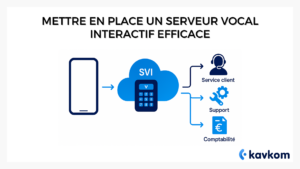
A business virtual number does more than just receive calls on a device. It is usually integrated into a cloud switchboard, which organizes and controls call management within the company.
Rather than managing a simple telephone line, the company has a platform capable of automating reception, directing calls and supervising team activity.IVR – Interactive Voice Response
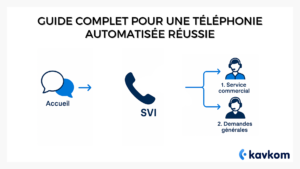
The interactive voice response (IVR) corresponds to the welcome menu that callers hear when they contact the company.
For example, it offers several options:
- Press 1 for commercial service
- Press 2 for support
- Press 3 for administration
This system allows calls to be directed from the very start of the conversation, avoiding manual transfers.
Intelligent call routing
Routing determines to which user or service the call should be directed.
Depending on the configuration chosen, calls can be :
- distributed among several agents
- sent to the first available agent
- redirected to another employee in case of absence
- This streamlines call management and reduces the risk of missed calls.
Queues
When all agents are busy, calls can be placed in a queue.
The caller can then hear a greeting or music on hold while waiting for an agent to become available. This avoids busy signals and improves the customer experience.Agent groups
Companies can also organize their teams into user groups according to function:
- sales team
- customer service
- technical support
- administration
Each group can have its own call distribution rules and availability schedules.
Thanks to these features, a virtual number becomes much more than just a telephone line. It becomes part of a system capable of structuring call management and improving team organization.
Why do companies use virtual numbers?
Centralize sales team calls
In many companies, each salesperson uses his or her own number to contact prospects or respond to customers. This organization can quickly create a lack of visibility: it becomes difficult to track telephone activity, identify missed calls or measure team performance.
With a virtual number integrated into a cloud switchboard, the company can set up a single number for the entire sales team. Incoming and outgoing calls are then routed via the same infrastructure, enabling structured communications management.
This organization offers several advantages:
- a single point of contact for customers
- better distribution of calls among sales staff
- continuity of service even in the event of an employee’s absence
- a global view of the telephone business
Sales managers can also access monitoring indicators such as :
- number of calls made and received
- dropout rate
- average communication time
- missed calls
This data makes it easier to identify periods of activity, adjust team organization and improve prospect follow-up.
In this context, the virtual number is no longer just used to receive calls: it becomes a management tool for sales activity.
Managing an in-house call center
In an organization with an in-house call center, telephony isn’t just about answering calls. It must be able to handle a large volume of communications while maintaining a constant quality of service.
A virtual number integrated into a cloud solution automates the distribution of calls between agents. Calls can be directed according to several criteria:
- agent availability
- the skills or department concerned
- the priority of certain calls
This system allows calls to be distributed among available agents, ensuring a smoother flow of calls within the team.
Managers can also monitor call center activity with real-time performance indicators, such as :
- number of incoming and outgoing calls
- average processing time
- Drop-out rate
- caller waiting time
This data can be used to adjust team organization and quickly identify periods of high activity.
Call recording can also be used to improve service quality. Supervisors can listen back to certain conversations to analyze exchanges and support agents in improving their practices.
In this context, telephony becomes a management tool for monitoring activity and improving call center operations.
Rapid deployment without hardware
One of the major advantages of a virtual number is its ease of deployment. Unlike traditional telephony, there’s no need to install a physical infrastructure on company premises.
The solution works entirely in the cloud. Once an account has been set up, users simply need to be added and they can start making and receiving calls.
This model allows you to :
- quickly activate new users
- equip teleworking teams
- add collaborators without technical intervention
- deploy telephony across multiple sites
Users can access the platform from their computer, smartphone or compatible IP phone.
This approach greatly simplifies the implementation of corporate telephony. Deployment depends more on internal organization than on the installation of a technical infrastructure.
Control costs with no obligation
Traditional telephony solutions often involve long-term contractual commitments, sometimes for 12, 24 or 36 months. These models can limit companies’ flexibility, especially when business is changing rapidly.
With a cloud telephony solution, operation is generally more flexible. Companies can adjust the number of users according to their needs, and evolve their configuration over time.
In many cases, billing is based on a monthly subscription with no long-term commitment. This makes it possible to add or remove lines according to the company’s actual activity.
Pro-rata billing can also offer greater flexibility. For example, a company can activate additional users for a given period, then adjust its subscription once the workload returns to normal.
This approach transforms business telephony into a more flexible cost, better adapted to variations in activity.
Free virtual number or business number: what’s the difference?
When looking for a virtual number, it’s common to come across free services. These solutions can be used to quickly test a number or receive a few calls. They may be suitable for one-off or personal use. However, in a professional context, these offers often have several limitations. Functionalities are generally limited, and do not allow for structured call management within a team.
That’s why many companies are turning to specialized cloud solutions like Kavkom.
The platform offers professional virtual numbers combined with a cloud switchboard, supervision tools and CRM integrations. The aim is not simply to obtain an additional number, but to structure the company’s entire call management.
What free solutions have to offer
Free services generally offer basic functionality:
- limited call reception
- number shared by several users
- little or no supervision
- lack of integration with business tools
They can be useful for one-off tests, but are rarely suitable for structured professional use.
Limits for a company
For a company, these solutions can quickly show their limits. Without management tools, it becomes difficult to monitor telephone activity or analyze team performance.
Companies may also encounter difficulties in terms of safety and compliance, particularly with regard to :
- user access management
- data protection
- RGPD compliance
These elements become important as soon as telephony becomes an integral part of customer relations.
The benefits of a professional cloud solution
A professional cloud telephony solution offers a more complete environment for managing business communications.
It generally entitles you to :
- a cloud switchboard
- supervision and statistics tools
- call recording
- CRM integrations
- advanced user and access management
Companies also have access to dedicated technical support to help them configure and use the solution.
In a business context, companies generally prefer a specialized cloud telephony solution. The objective is no longer simply to obtain an additional number, but to structure call management and team collaboration.
Platforms like Kavkom, for example, enable the deployment of a virtual number linked to a cloud switchboard, with call supervision, recording, real-time statistics and CRM integration. Companies can thus centralize their communications and monitor the activity of their sales or support teams from a single dashboard.
How much does a virtual number for business cost?
The price of a virtual number can vary according to the type of solution chosen and the level of functionality included. Some offers include only the technical infrastructure, while others integrate a complete cloud telephony environment.
Existing pricing models
Several approaches are available on the market.
Technical infrastructure
Some platforms provide VoIP infrastructure only. The company buys a number and pays for communications on a pay-as-you-go basis. This model is best suited to technical teams capable of integrating telephony into their own tools.
All-in-one SaaS solution
Many companies opt for a turnkey cloud solution. The virtual number is integrated into a platform that generally includes :
- a cloud switchboard
- supervision tools
- call statistics
- CRM integrations
Pricing is generally based on a monthly subscription per user.
Incoming call packages
Some offers are designed primarily for incoming calls. This model may be suitable for companies whose business is based mainly on customer service or assistance.
Inbound and outbound packages
For sales teams, offers that include both inbound and outbound calls are the most common. They provide a more predictable budget when call volumes are high.
Beware of “unlimited” offers
Some offers feature unlimited calls, but may include reasonable usage conditions or limitations depending on the destination.
Before choosing a solution, it is therefore important to check :
- features actually included
- any pay-as-you-go modules
- conditions of use of calls
In a business context, the main criterion should not be the price of the number alone, but the associated management and control tools.
Example of a flexible cloud model
Many cloud solutions today offer no-commitment subscriptions, with monthly billing per user.
This model allows you to :
- add or remove users according to activity
- adapt configuration over time
- control telephony costs
Invoicing can also be on a pro rata basis, allowing expenses to be adjusted according to actual usage.
Beware of false unlimited
The word “unlimited” can be confusing.
In some cases, unlimited use is subject to a fair use policy, i.e. “reasonable” use. Above a certain volume, restrictions may apply.
Other points to check:
- Some modules are billed as optional extras
- Advanced statistics can be paid for
- Call recording can be limited
- Installation charges may apply
Not to mention the hidden costs:
- Early termination
- Minimum number of lines
- Mandatory commitment
So before comparing prices, it’s important to check what’s really included. In a B2B context, the criterion shouldn’t just be the monthly price of the virtual number, but the level of supervision and integration it provides. An inexpensive number without supervision or CRM integration can quickly become an operational hindrance.
Example of cloud pricing without commitment
In a modern cloud model, the logic is different.
You can find :
An annual inbound offer
Suitable for companies that only wish to receive calls. Annual billing. Incoming calls included.
A no-obligation SME offer
Monthly subscription. Incoming and outgoing calls included to certain zones. No long-term contract.
A dedicated call center offer
Designed for intensive use. High call volume. Advanced supervision features. One of the key features is prorated billing.
In concrete terms :
- You can activate additional lines for a campaign
- Then deactivate them
- Pay only for days actually used
For example, some cloud platforms offer several levels of service depending on the company’s usage.
At Kavkom, for example, you’ll find :
- an €8/month offer (billed annually) for incoming calls only
- a €30/month offer with no commitment for unlimited incoming and outgoing calls in France
- a dedicated offering for high-use call centers
All offers are non-binding, with pro rata billing, making it easy to adjust the number of lines according to activity.
How do I get a professional virtual number?
Setting up a business virtual number is generally a multi-stage process. The aim is to choose the right type of number, then configure call organization and integration with the tools used by the company.
Step 1: Choose the type of number
The first choice concerns the number format.
Several options are available:
- geographical number (01, 02, 03, 04 or 05) to maintain a local presence
- mobile number (06 or 07) for certain activities requiring greater mobility
- international number to develop a business in another country
The choice depends mainly on the sales strategy and the geographic area targeted.
Step 2: Configure your cloud switchboard
Once the number has been activated, the company can configure call management via the cloud switchboard.
This makes it possible to set up :
- interactive voice response (IVR)
- call routing rules
- agent groups by department
- different timetable scenarios
This configuration allows you to structure your telephone reception and automatically route calls.
Step 3: Connect your CRM
For sales or customer service teams, connecting with a CRM can improve the follow-up of exchanges.
Calls can then be synchronized with the contact record, allowing :
- identify the caller
- access exchange history
- centralize customer interactions
Step 4: Train and supervise your teams
Once the solution is in place, managers can monitor telephone activity using a dashboard.
Supervision tools can be used to analyze :
- call volume
- dropout rate
- communication times
- team performance
This visibility facilitates the organization of work and the continuous improvement of customer service.
Real-time dashboard
A real-time dashboard provides an immediate overview of business activity.
You can follow :
- Number of incoming and outgoing calls
- Average communication time
- Drop-out rate
- Customer waiting time
- The number of agents available
But they’re not just numbers.
Let’s take a concrete example.
It’s 11:30 am. The dashboard shows a spike in incoming calls and an increasing waiting time.
The manager can :
- Temporarily reassign a salesperson to the reception desk
- Adjust automatic distribution
- Identify whether an agent has been on break too long
Without real-time visibility, these adjustments would be impossible. The dashboard enables you to move from reactive to proactive management.
Call recording
Recording is not a control tool.
It’s a tool for analysis and progress.
Calls can be recorded for :
- Training new employees
- Understand why a prospect hasn’t converted
- Check compliance with a script or sales pitch
- Handling customer complaints with precision
For example.
A customer complains about misinformation received over the phone.
Rather than assuming, the manager listens to the call again and analyzes the situation objectively.
Another case.
A new salesperson joins the team. Rather than just providing him with a theoretical script, we make him listen to successful calls. He understands tone, rhythm and how to handle objections.
Learning becomes concrete.
Coaching and continuous improvement
Supervision is not just about observing. It’s about providing support.
A supervisor can :
- Listen to a live call
- Intervene if necessary
- Analyzing exchanges after the fact
- Identify areas for individual improvement
Let’s take the example of the salesperson struggling to close.
By analyzing several calls, the manager notices:
- Too long a presentation
- A lack of open-ended questions
- Hesitation when proposing the next step
Rather than giving vague feedback, it can be based on specific situations. A number of cloud solutions now enable you to create a virtual number in just a few minutes.
With Kavkom, for example, it’s possible to activate a virtual number directly from a cloud platform, then configure a switchboard, call routing and team supervision from a single dashboard.
Activation requires no hardware or technical installation. Once a number has been created, users can make and receive calls from their computer, smartphone or IP phone.
Real-life use cases
The impact of a virtual number varies according to the size and organization of the company. Let’s look at three typical situations.
Growing startups
A start-up evolves fast, with rapid recruitment, new markets to address and teams often split between office and telecommuting.
In this context, a cloud solution like Kavkom enables you to rapidly deploy a complete enterprise telephony solution.
A start-up, for example, can create a single company number, connect its telecommuting sales force and supervise call activity from a centralized dashboard.
With a cloud solution :
- New employees are added in minutes
- No hardware installed
- Accesses are created remotely
For example.
A SaaS startup recruits 6 salespeople in two weeks. Instead of installing physical lines, it creates 6 user accounts. On the same day, the whole team can make calls using the company’s main number.
Another challenge: multi-sites.
Teams can be divided into :
- In Paris
- In Marseille
- Teleworking
- Abroad
The number remains unique. Management remains centralized.
Finally, the budget must remain under control.
A startup can :
- Adjust the number of lines according to growth
- Activate additional users for a campaign
- Temporarily reduce canopy if necessary
Telephony keeps pace with growth, without contractual rigidity.
Call center manager
For a call center manager, the objective is different. It’s not just about being reachable. It’s about maximizing performance.
A key tool in this context: the predictive dialer.
This system automatically dials several numbers and connects the agent only when a prospect picks up.
Result:
- Less time wasted on ringtones
- More successful calls
- Increased productivity
Add to that live supervision.
The manager can :
- See agents online in real time
- Track the number of calls made
- Listen to conversations if necessary
KPIs become actionable.
For example.
A prospecting campaign is underway. The contact rate is lower than expected. By analyzing the data live, the manager adjusts the call time slot or modifies the target list. Telephony becomes a direct lever for sales performance.
IT Manager
For an IT manager, priorities are different.
He is looking for :
- A stable solution
- A secure infrastructure
- Seamless integration with existing systems
The API plays a key role here.
It enables :
- Connect telephony to an ERP system
- Automate ticket creation
- Synchronize internal data
Safety is also central.
A professional solution must offer :
- Encrypted communications
- Secure cloud hosting
- Precise access management
RGPD compliance is not a detail.
It must be possible :
- Export user data
- Delete records
- Trace access
Finally, rights management enables roles to be clearly defined:
- Agent
- Supervisor
- Director
Each profile has its own access level.
For the IT manager, the virtual number is not just a communication tool. It’s a component of the company’s overall architecture, which must integrate seamlessly with the existing system, while respecting security and compliance requirements.
Security, RGPD and compliance
When a company uses a cloud telephony solution, data security becomes a central issue. Calls, communication histories and recordings can contain sensitive information linked to customers or business activity.
Secure cloud hosting
Cloud telephony solutions are based on infrastructures hosted in secure data centers. These environments ensure service availability and protect systems against intrusions or technical incidents.
Server redundancy and backup mechanisms also help guarantee service continuity.
These environments ensure service availability and protect systems against intrusions or technical incidents.
Server redundancy and backup mechanisms also help guarantee service continuity.
Role-based access management
Cloud telephony platforms generally allow different levels of access to be defined according to user roles.
For example:
- agents: access to their calls and data
- supervisors: access to statistics and certain records
- administrators: complete configuration management
This organization provides greater data security while structuring telephony management within the company.
Why choose a specialized telephony cloud solution rather than a traditional operator?
When a company is looking for a business telephone number, it can naturally turn to a traditional telecom operator. These operators generally provide the essentials: a number, a line and a communication package.
However, their role usually ends with access to the telephone network.
A cloud solution specialized in corporate telephony goes a step further. It doesn’t just provide a number: it structures and controls call management within the organization.
A cloud telephony platform can offer :
- real-time call supervision
- detailed business statistics
- conversation recording
- group management and call routing
- integration with CRM tools
These features enable companies to analyze telephone activity and improve team organization.
So there’s a big difference: an operator mainly provides network access and a telephone line, while a specialized cloud solution provides a complete environment for managing, analyzing and optimizing business communications.
In this context, telephony is no longer just a simple communication tool. It becomes a management and performance tool for sales and customer service teams.
FAQ
Can I get a free virtual number?
Yes, some services offer free virtual numbers. They generally allow you to receive a few calls or test a service over a short period.
However, these solutions often remain limited for professional use. They offer little supervision, few integrations with business tools, and a reduced level of support. For companies wishing to structure their telephony, a professional solution is generally more appropriate.
Is a virtual number legal in France?
Yes, using a virtual number is perfectly legal in France. VoIP technology is now widely used by businesses to manage their communications.
Nevertheless, it’s important to choose a provider that complies with regulatory obligations, particularly in terms of user identification and data protection in line with the RGPD.
Can I keep my existing number?
Yes. In most cases, you can keep your number thanks to the portability mechanism.
This allows you to migrate to a cloud telephony solution while keeping the number your customers already know. The transition is generally seamless.
Can I make international calls with a virtual number?
Yes, cloud telephony solutions generally allow international calls.
Depending on the offer chosen, calls to certain countries may be included in the package or billed according to destination. Some platforms also allow you to obtain local numbers in different countries.
Is a virtual number compatible with my CRM?
Yes. Most cloud telephony solutions can connect to a CRM. When a customer calls, his or her record can automatically appear on the screen. Call history, notes and sometimes recordings can be synchronized with the CRM.
Can I suspend my subscription to a virtual number?
A conventional switchboard generally relies on an infrastructure installed on the company’s premises.
A cloud switchboard works entirely online. It lets you manage calls via a web interface, add users quickly and integrate telephony with other tools such as a CRM.
Conclusion
Today, virtual numbers represent a simple, flexible solution for modernizing business telephony. Based on a VoIP infrastructure hosted in the cloud, it enables calls to be managed without the need for a physical line or complex hardware, while remaining accessible from different devices such as a computer, smartphone or IP phone.
In addition to receiving calls, a virtual number can be integrated into a cloud switchboard capable of organizing call distribution, supervising team activity and connecting telephony to business tools such as CRM. This approach gives companies greater visibility of their business and facilitates day-to-day communications management.
If you’d like to put this type of solution to the test, you can try out a platform like Kavkom, which lets you set up a virtual number and a cloud switchboard in just a few minutes, with no hardware and no commitment.