Call centers occupy a special place in the collective imagination. Many people have an intuitive image of them, forged by experience or past clichés. And yet, once you delve deeper, the subject reveals an unsuspected richness. Behind the term lie very different realities, varied models and uses that have profoundly evolved.
In this guide, you’ll discover what a call center really is today, the forms it can take, its day-to-day operation and the changes that are transforming this model into a flexible, measurable and useful tool for managing organizations.
Points to remember :
- A modern call center goes beyond simple call management to become a structuring tool for customer relations, sales performance and team management.
- There are several types of call center: in-house, outsourced, physical, virtual or hybrid, each responding to different objectives and organizational contexts.
- Call center costs can be analyzed both in terms of resources mobilized and value created for the company.
- Recent innovations, notably the cloud and data-driven management, are making call centers more flexible, scalable and adapted to today’s uses.


Boostez la productivité de vos équipe commerciales grâce à Kavkom, le logiciel de téléphonie d’entreprise 100% cloud.
Planifier une démo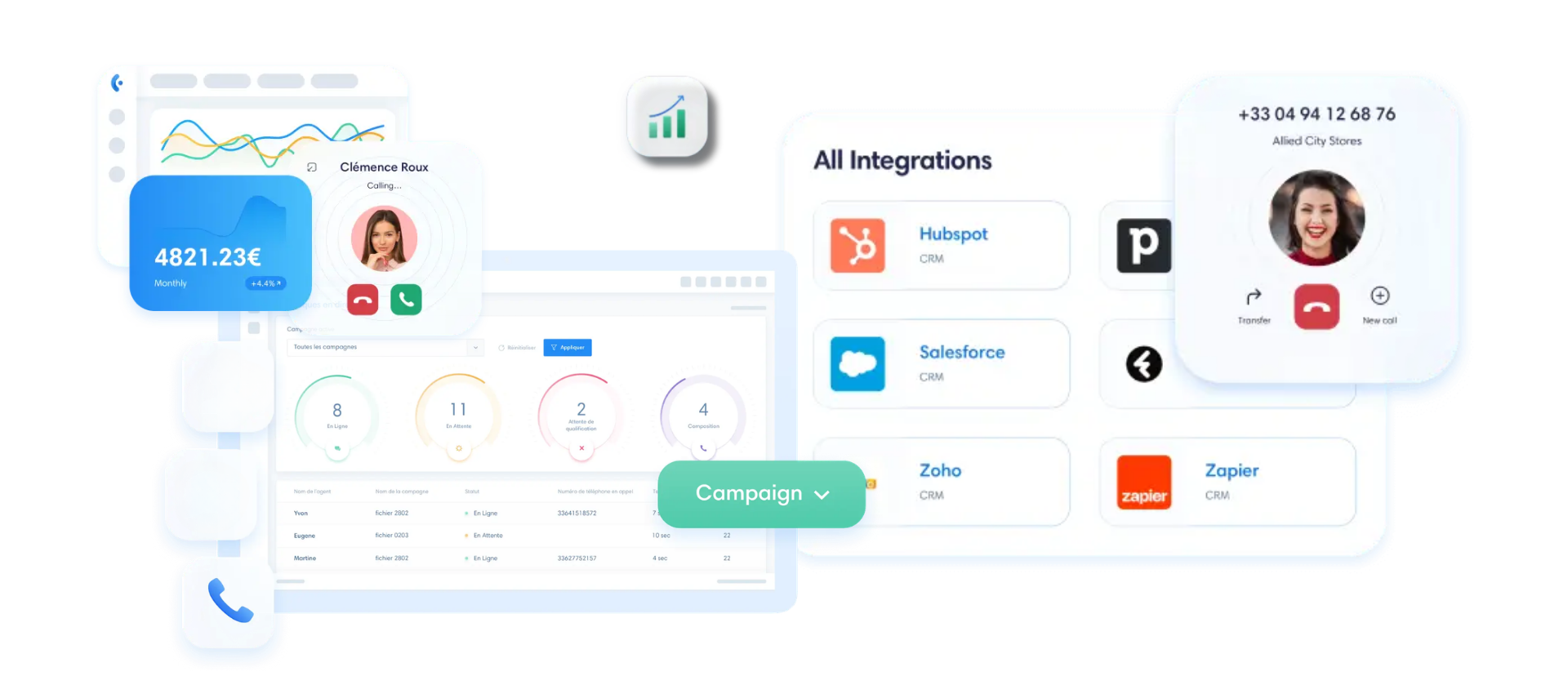
What is a call center today?
Current call center definition
A call center is an organization in charge of managing telephone exchanges between a company and its contacts. These exchanges cover inbound calls, outbound calls or a combination of both, depending on the objectives pursued.
Over time, the call center has moved away from the rigid framework of large centralized call centers. They are now integrated into a variety of working environments, operating remotely and adapting to both small teams and larger structures.
The call center’s role in the company
Today, the call center occupies a cross-functional position. It is involved in customer relations, supporting sales development and helping to build customer loyalty. Each telephone interaction feeds into a more detailed understanding of expectations, objections and customer journeys.
Call data can also be used for precise business management. The call center thus becomes a meeting point for communication, operational performance and understanding needs.
The profiles that make up a call center
A call center is based on complementary roles. Agents handle daily exchanges with callers. Supervisors support teams, monitor activity and intervene when necessary. Managers define objectives, analyze results and set priorities. Alongside them, support functions ensure training, quality and the correct use of tools.
The main types of call center
Incoming and outgoing calls
The first distinction concerns the nature of the exchanges.
Inbound call centers handle requests initiated by customers or prospects. Support, assistance, information or orders are all part of the routine.
Outbound call centers are part of a proactive approach. Prospecting, contact qualification, surveys or follow-ups punctuate the activity.
Some organizations opt for a mixed model, with teams able to alternate between these two approaches depending on the period and the objectives.
In-house or outsourced call center
Two main organizational approaches coexist.
The internalized call center relies on teams integrated into the company. This configuration favors in-depth knowledge of internal offerings and challenges.
The outsourced call center relies on a specialized service provider. It offers rapid implementation and the ability to adapt to changing volumes.
| Model | Main assets | Points of attention |
|---|---|---|
| Internalized | Operational mastery, business expertise | Structuring and managing resources |
| Outsourced | Flexibility and rapid deployment | Coordination, shared management |
Physical, virtual or hybrid call center
- The physical call center brings teams together on the same site. It facilitates direct exchanges and local supervision.
- The virtual call center operates with geographically distributed agents. Cloud tools coordinate and monitor activity.
- The hybrid model combines on-site presence and remote working, offering a balance between cohesion and flexibility.
Regardless of the model chosen, the call flow is configured entirely through the software. The call center software page details the corresponding features available from Kavkom: IVR, queues, and monitoring.
Setting up a call center today: a simple and immediate approach
For a long time, setting up a call center was a structuring project, often taking a long time to launch and reserved for highly equipped environments. Today’s approach is radically different. Some solutions have chosen to transform the experience, drawing on what users are already familiar with in their daily digital lives.
This is exactly the philosophy behind Kavkom.
With Kavkom, a call center is approached as a tool to be put into operation, not as an infrastructure to be built. The logic is reminiscent of installing software on a computer. You create an account, add users, define your rules, and the team can get to work.
A logic designed for business uses
Kavkom has been designed for line managers, managers and field teams. The tool adapts to real needs, without imposing prior technical expertise.
Configuration follows an intuitive logic.
Parameters correspond to concrete situations.
Teams quickly get their bearings.
With Kavkom, the call center is activated in just a few easy-to-understand steps.
From hardware to plug and play
Kavkom’s approach emphasizes flexibility. Agents work from a computer, a browser or a compatible telephone, depending on their organization. The heart of the system lies in the tool itself, and in the way teams use it on a daily basis.
This flexibility transforms the way a project is launched. A manager can test an organization, adjust workflows, and develop the structure, without blocking activity or overburdening existing operations.
A grip that changes team dynamics
The simplicity of use produces very tangible results.
- Agents gain in autonomy.
- Supervisors drive more easily.
- Managers have a vision that can be used without intermediaries.
The call center thus regains its primary function. A tool at the service of teams, designed to support activity and sustain performance, rather than complicate the organization.
The practical benefits of this approach
With Kavkom, the call center becomes an evolutionary device. It adapts to the company’s rhythm, accompanying growth and enabling continuous adjustments. This approach explains why today’s modern call center fits naturally into organizations of all sizes.
The most striking difference is not the spectacular functionality, but the simplicity of the system. A straightforward, fluid and accessible way of equipping teams, without unnecessary detours.
Boostez la productivité de vos équipe commerciales grâce à Kavkom, le logiciel de téléphonie d’entreprise 100% cloud.
Planifier une démoHow does a call center work on a day-to-day basis?
A typical call
Each call follows a structured path. A number is dialed or received, the system directs the call according to defined rules, the agent handles the exchange with the relevant information, and then the interaction is traced and analyzed.
Each step contributes to the quality of the experience and overall performance.
Team organization
Clear organization promotes efficiency. Time slots are defined according to expected volumes. Teams are consistently sized. Prioritization rules direct calls to the right people.
Flexible scripts accompany agents and structure exchanges without freezing them.
Supervision and support
Supervision plays a central role. It provides real-time visibility of activity, facilitates support for agents and encourages collective progress. This proximity also contributes to team commitment and stability.
Key indicators for managing a call center
Giving meaning to data
Indicators transform telephone activity into usable information. They are used to understand trends, adjust the organization and guide decisions.
The most frequently used KPIs
Indicators frequently tracked include call volume handled, pick-up rate, average handling time, first contact resolution rate and productivity per agent.
Finding the right balance
Effective management is based on a limited number of indicators monitored over time. This approach makes decisions easier to understand and more coherent.
Cost and value of a call center
Major cost categories
A call center mobilizes several types of resources. Human costs account for a large share. Tools and software are another. Training, support and infrastructure complete the picture.
Reading costs
Fixed costs include structural elements. Variable costs evolve according to business volume.
| Type of cost | Examples |
|---|---|
| Landline | Framing, tools |
| Variable | Agent time, campaigns |
A value-oriented vision
Call center evaluation goes beyond simply adding up costs. It includes customer satisfaction, quality of interactions and contribution to business objectives.
Innovations shaping modern call centers
The role of the cloud
The cloud has transformed the deployment and operation of call centers. Remote access, continuous updates and rapid adaptation of capabilities facilitate an agile organization.
Automation and support
The automation of certain repetitive tasks frees up time for higher-value exchanges. The human element remains at the heart of the relationship, supported by assistance tools.
Data-driven management
Call data fuels continuous improvement. It helps identify friction points, adjust scripts and refine call paths.
FAQs on call centers
What exactly is a call center?
A call center is a structure organized to manage telephone exchanges between a company and its contacts. Today, it is part of a global approach to customer relations and operational performance.
What does a call center do on a daily basis?
The day-to-day work of a call center revolves around managing calls, monitoring interactions and analyzing activity. Teams rely on structured processes and management tools.
What kind of call centers are there?
Call centers come in a variety of models. Inbound calls, outbound calls, in-house or outsourced organization, physical, virtual or hybrid operation.
How much does a call center cost?
The cost depends on many parameters, such as the size of the team, the volume of calls and the tools used. Each organization builds its model according to its objectives.
Do call centers only concern large companies?
Call centers adapt to structures of all sizes. SMEs, start-ups and local organizations all find formats adapted to their needs.
What does the future hold for call centers?
Call centers now play a central role in the organization of customer relations and sales performance teams. Their role goes far beyond simply handling calls. They are becoming spaces for coordination, analysis and continuous improvement, where every interaction contributes to a better understanding of expectations and uses.
This is the logic behind Kavkom’s approach, which makes call centers accessible, easy to activate and easy to manage, whatever the size of the team.
CTA => Test Kavkom for free