Your sales reps are making calls, but appointments aren’t being scheduled. The problem is rarely the volume of calls; rather, it’s that the method, the script, and the phone system aren’t working together.
B2B telemarketing becomes profitable when every link in the chain works: precise targeting, a flexible conversation script, a structured follow-up schedule, and a calling infrastructure that doesn’t hold your teams back. Without these elements, even the best salespeople spend their time dealing with friction rather than qualifying leads.
This guide provides a comprehensive step-by-step approach: from building your contact list to choosing your VoIP phone system, including scripts, common objections, and the KPIs that really matter.
I recommend without hesitation
With Kavkom, I was able to easily resolve the issue of communication costs to my regular customers. My agents, too, were no longer restricted in their mobility, because even when on the move, communications are managed.

How about you?
Request a demo nowWhat is B2B telemarketing, and when should you use it?
You have a sales team, a contact list, and appointment targets to meet. Yet results vary from week to week without anyone really knowing why. This uncertainty often stems from confusion about what cold calling actually entails and in which situations it delivers real results.
Let’s start by clarifying the terms. B2B telemarketing involves contacting targeted companies by phone to assess their needs or secure a meeting. It is not telemarketing (where the sale is closed during the call), nor is it a simple cold call made without preparation. The objective is clear: to determine whether your contact has a project, a budget, and a timeline, and then to pass this qualified lead on to a field sales representative or an account executive.
And that’s where the phone channel really comes into its own in B2B. Three use cases stand out:
- Lead qualification: Check in just a few minutes whether a lead from a trade show, a web form, or a purchased list actually matches your target audience.
- Follow-up after an email: An email alone rarely generates a response. When combined with a follow-up call, the rate of appointments scheduled over the phone can increase by 25 to 35 percent, according to feedback from numerous sales teams in the field.
- Project identification: identifying, during the conversation, a latent need that the prospect would never have expressed in writing.
B2B cold calling remains one of the few channels where you get an immediate response. No waiting, no algorithms standing between you and your prospect. Just a conversation that, when handled well, moves a deal forward faster than a series of five ignored emails.
The Legal Framework and GDPR for B2B Telemarketing
Before picking up the phone, one question often comes up: Is it okay to call a prospect who hasn’t asked for it? In B2B, the answer is yes, but with certain conditions. Here’s what you need to know to launch your outbound calling campaigns without legal risk.
On the B2C side, the rule shifted to requiring prior consent on August 11, 2026. Details can be found in our guide on the rules for telemarketing effective August 11, 2026.
Unlike B2C (where prior consent is the rule), business-to-business telemarketing is based on a different legal basis: legitimate interest. Specifically, the CNIL considers that contacting a business to offer a service related to its operations is legitimate, provided that the message pertains to its professional activities and not to its private life.
Two requirements apply from the very first second of the call:
- Identify yourself clearly: name, company, reason for the call. No beating around the bush, no false pretexts. The prospect needs to know who they’re talking to before they even answer your first question.
- Respect the right to opt out immediately: if the person you’re speaking with tells you they do not wish to be contacted again, you must make a note of it and remove them from your contact list. Not “at the end of the campaign,” not “during the next database cleanup.” Right away.
This framework provides reassurance for teams organizing their cold calling efforts: as long as you target professionals, are transparent, and handle refusals promptly, you’re in the clear. GDPR compliance isn’t a barrier to B2B prospecting; it’s simply basic best practice that, incidentally, boosts your credibility from the very first interaction.
How to Organize an Outbound Calling Campaign in 5 Steps
Calling without a strategy is a bit like sending out resumes without reading the job posting: a lot of energy wasted, very little return. Most teams that struggle with cold calling don’t have a motivation problem; they have a sequencing problem. Good results rarely come from a salesperson who’s “good on the phone”; they come from a clear, consistent process that’s fine-tuned week after week.
Here is a five-step method for structuring an outbound calling campaign that generates qualified appointments, not just call volume.
Step 1: Identify and segment accounts
Everything hinges on the first call. A sales rep who picks up the phone without knowing exactly who they’re talking to will waste time on people who lack the budget, the need, or the authority to move things forward. B2B targeting isn’t just a formality: it’s the filter that separates profitable campaigns from exhausting ones.
Start by defining your ideal customer profile (ICP). Ask yourself three specific questions:
- What size of business gets the most value from your offering? (number of employees, revenue, number of locations)
- In which industry do you currently see your highest conversion rates?
- Who, within the organizational chart, makes the purchasing decision or recommends it internally?
Using this ICP, create two or three target personas: the sales director looking to streamline their prospecting efforts, the IT manager responsible for approving tools, and the SME executive who wants concrete results without unnecessary complexity. Each persona will require a different approach. Segmenting your prospecting efforts upfront is what allows your sales reps to tailor their pitch within the first ten seconds, rather than reciting a generic sales pitch.
Step 2: Prepare the contact file
Brilliant targeting is useless if your contact list is full of outdated numbers or duplicates. That’s the kind of detail that, in a campaign involving 2,000 calls, can cost you entire days.
Before you do anything, clean up your workspace:
- Delete contacts that don’t have a direct phone number (a general switchboard number doesn’t count).
- Break it down by company and contact person.
- Fill in the missing information in the records: job title, company size, industry. Tools like Societeinfo, Dropcontact, or Kaspr let you complete this data in just a few clicks.
Next, organize everything in your CRM. Each contact should have a clear status (to call, pending callback, qualified, out of scope) and an accessible communication history. Kavkom integrates natively with the leading CRMs on the market (Salesforce, HubSpot, Pipedrive): the contact record is automatically updated with every call, and notes sync without manual entry. Your sales reps spend their time making calls, not filling out fields in a spreadsheet.

Boost the productivity of your sales teams with Kavkom, the 100% cloud-based business telephony software.
Schedule a demo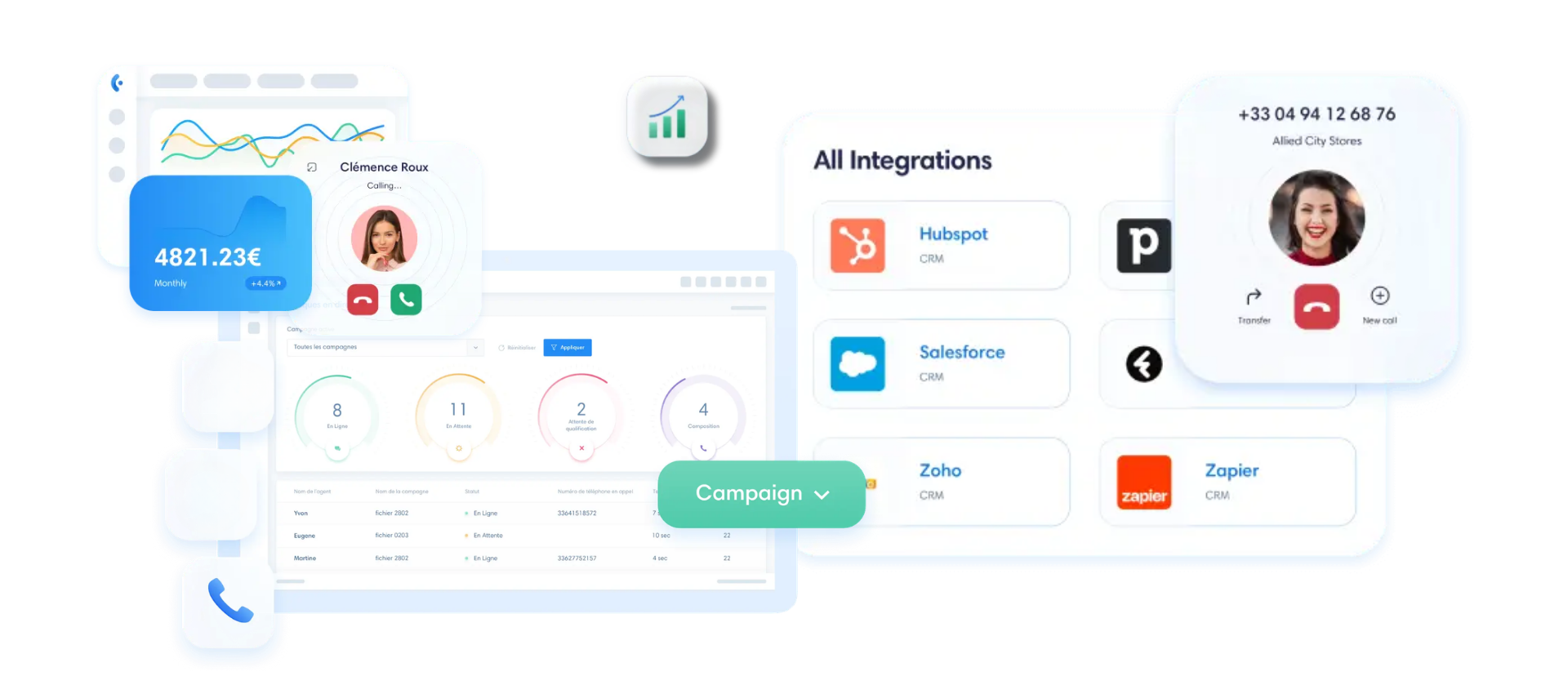
Step 3: Draft the appeal brief
An effective B2B phone sales pitch isn’t a script to be read word for word. It’s a conversational framework: a guiding thread with key points, but flexible enough to adapt to what the prospect says.
Here is what your outline should include:
- A personalized opening line (10 seconds max): mention something specific about the prospect, their industry, a recent development at their company, or something they have in common with an existing client.
- An open-ended question: not “Are you looking for a solution?” but “How are you currently handling [specific problem]?” Active listening starts here.
- A pivot to your value proposition: in one sentence, connect what the prospect just said to the problem you can solve.
- A clear call to action: suggest a specific time slot (“Tuesday at 2:30 p.m.?”) rather than a vague “we could check in later.”
Tailor your opening line to the specific segment. A sales director doesn’t respond to the same triggers as an IT manager. Prepare two or three versions of your sales pitch, test them during your first fifty calls, and then stick with the one that generates the most conversations lasting longer than a minute.
Step 4: Run the call cadence
You have your target audience, your database is clean, and your campaign is ready to go. The only question left is the one everyone asks: when should you call, and how often?
The time slots that consistently come up in feedback from B2B sales teams are 9:30–11:00 a.m. and 2:30–4:00 p.m. Before 9:30 a.m., your contacts are dealing with their morning priorities. After 4:00 PM, they’ve already mentally checked out. Monday mornings and Friday afternoons are best avoided (team meetings, winding down for the weekend).
In terms of volume, a sales representative making manual calls typically handles around 40 to 60 calls per day. With a predictive dialer like the one built right into Kavkom, that volume can triple: the system dials multiple numbers at once, detects voicemail, and only connects the agent when a prospect picks up. Your SDRs spend their day talking, not listening to ringing tones.
Establish a clear outreach schedule: for example, three calls spaced 48 hours apart, with a follow-up email sent between the first and second calls. Without a defined schedule, each sales rep will improvise their own pace, making it impossible to manage SDR productivity.
Step 5: Analyze and follow up
A prospect who doesn’t pick up on the first call isn’t a lost prospect. Field data shows that, on average, it takes 5 to 7 attempts to get a decision-maker to respond in B2B sales. Most teams give up after two tries. That’s where structured persistence makes all the difference.
Set up a multi-touch lead nurturing process:
- Attempt 1: Call + short voicemail.
- Attempt 2 (Day 2): A personalized email referencing the call.
- Attempt 3 (Day 5): another shot, from a slightly different angle.
- Attempt 4 (Day 8): LinkedIn interaction (comment or message).
- Attempt 5 (Day 12): Final call with a revised offer.
For this process to work, every interaction must be tracked. With Kavkom,call recording and CRM synchronization allow any team member to pick up a case without starting from scratch. Managers, meanwhile, can listen back to calls to identify what’s holding things up: is it the opening line? Handling objections over the phone? The timing of the appointment proposal?
Review your key metrics every week: reach rate, number of qualified conversations, and appointment conversion rate. These figures—not your intuition—will tell you whether the problem lies with your targeting, your message, or your timing.

Telemarketing Script: Outline, Secretary Barriers, and Objections
You have your list, your sales pitch, and your CRM synced up. But when the prospect picks up the phone (or when their assistant answers), everything hinges on the first twenty seconds. And that’s often where things go wrong: the salesperson hesitates, stumbles over their words, or gets shut down before even asking a question. What follows are concrete scripts for every situation, tested in the field.
The opening that catches the eye
The person on the other end decides within 10 to 15 seconds whether to listen to you or hang up. A good cold-calling script never starts with “Hello, I’m calling because…”. It sounds salesy, and the prospect picks up on that right away.
Here’s a headline that works in B2B:
“Hello [First Name], this is [Your First Name] from [Company]. I’m calling because I saw that [contextual detail: ongoing recruitment, fundraising, opening of a new location]. Among your peers in [industry], we often see [specific issue]. Is this something you’re dealing with right now?”
Three elements make all the difference here: the prospect’s first name (not “Dear Director”), a verifiable piece of context that shows you’ve done your homework, and an open-ended question that encourages conversation. You’re no longer an unwelcome stranger: you’re someone who understands the context.
Get past the secretary without making a fuss
Call blocking software blocks a significant portion of B2B cold calls. It’s tempting to try to get around it or lie about the reason for the call. Bad idea: it will backfire on you as soon as the prospect finds out how you got through.
The approach that yields the best results is transparency combined with precision:
“Hello, this is [First Name] from [Company Name]. I’d like to speak with [Decision-maker’s First Name] for a couple of minutes about [specific topic—not just “a partnership”]. Is he available right now, or when would be the best time to call him back?”
Two things to keep in mind. First, use the decision-maker’s first name (which you can find on LinkedIn, the company’s website, or through your contact management software). Second, offer an alternative: now or later. The assistant is no longer a roadblock; she becomes a liaison.
Handling objections without reciting a script
“I don’t have time.” “We already have a vendor.” “Send me an email.” These objections come up in 80% of calls. The worst reaction: arguing. The best: acknowledging the concern, then refocusing the conversation.
| Objection | Standard response | Method used |
|---|---|---|
| “I don’t have time” | “I understand; that’s exactly why I’ll keep this brief. Just one question: how are you handling [the issue] today?” | Rephrasing + needs assessment |
| “We already have a service provider” | “Very well, and are you satisfied with [specific criterion]? Our clients in [industry] often tell us that [common pain point].” | BANT Qualification (Latent Need) |
| “Send me an email” | “Sure. To make sure the email is relevant, is [quick qualification question] okay? I’ll send it to you within the hour.” | Micro-engagement + lead qualification over the phone |
The idea behind the BANT method (Budget, Authority, Need, Timeline) is to turn every objection into a qualifying question. Does the prospect say “no budget”? Ask them when the topic will come up again. Do they say “I’m not the decision-maker”? Ask who the right person is and if you can mention it to them on your end. Every “no” contains useful information—if you look for it.
WithKavkom’s IVR system, your incoming callback requests are automatically routed to the right sales representative—the one who initiated the conversation. When the prospect calls back, they speak with someone who already knows their situation, not a generic operator. It’s details like this that turn a “call me back” into a confirmed appointment.
Key Performance Indicators (KPIs) for Evaluating Your B2B Cold Calls
You make 200 calls a day, your sales reps are on the phone from morning to night, and yet the appointments aren’t coming in. The problem is probably not the volume. It’s that no one is looking at the right metrics, or that no one knows what to do with them. Measuring the performance of your outbound calls with the right metrics is what turns a cold calling campaign into a manageable process.
Here are the KPIs that really matter, along with the targets to aim for:
| KPI | What it measures | B2B Performance Threshold |
|---|---|---|
| Pick-up rate | Percentage of calls answered | 10 to 15% |
| Conversion rate | Calls that have been answered and last longer than 60 seconds | 30 to 40% of dropouts |
| Qualification rate | Contacts identified as matching your ICP | 15 to 25% of conversations |
| Appointment conversion rate | Qualified leads converted into appointments | 15 to 25% |
| Number of calls per hour | Agent’s gross productivity | 12–15 (manual) / 35–45 (dialer) |
What matters is cross-referencing the data. A drop-off rate below 8% points to an issue with the database (outdated numbers, poor time slots) or with how the caller ID is displayed. A decent qualification rate but a low conversion rate to appointments? Your opening line works, but the transition to the value proposition is faltering. Each weak KPI tells a different story, and it’s by cross-referencing these metrics that you identify where to intervene.
To manage these metrics on a daily basis, every call must be automatically tracked. With Kavkom, campaign dashboards display call volume, answer rates, and average call duration per agent in real time. All these statistics are included at no extra cost, regardless of your plan. Your sales manager can see at a glance whether the issue stems from targeting, the script, or timing, and adjust the campaign within the day, not at the end of the month.
Should you handle your telemarketing in-house or outsource it?
It’s a question that comes up every time a team wants to scale up its call volume: should we hire internally, or outsource it? The answer depends less on personal preference than on three very concrete factors: your budget, your call volume, and the level of control you want to maintain over the sales pitch.
Bringing your outbound calling in-house means staying in control of everything. Your sales reps know your product offering, pick up on subtle cues during the conversation, and improve their skills call after call. Feedback is immediate: a manager who listens to a call in the morning can adjust the script by the afternoon. For an SME with a complex sales cycle or a technical product, this close connection to the front lines often makes the difference between a qualified appointment and one that goes nowhere.
Outsourcing (to an agency or a freelance telemarketer) makes the most sense when you need to scale up quickly without hiring new staff. Launching a test campaign in a new market, handling a seasonal surge, or covering an additional geographic area: these are situations where the flexibility of an external service provider outweighs the time required for hiring and training.
Here’s what should guide your decision:
- Fewer than 100 calls per day and a technical sales pitch → handle it in-house. The investment in training your SDRs will pay off in the quality of the appointments.
- More than 300 calls a day for a simple task (scheduling appointments, basic qualification) → outsource or combine the two.
- On a tight budget but need to test the waters? Start in-house with telemarketing software that natively integrates a dialer, CRM, and monitoring tools. Kavkom lets you launch a B2B telemarketing team with no commitment and no heavy infrastructure: activation in minutes, prorated billing, and all features included from the very first agent.
In either case, it would be a mistake to make a decision without first laying out the relevant data. How much does a qualified lead cost when generated internally versus externally? What is your current conversion rate? This data is your guide for making decisions—not a matter of personal preference.
Which phone system should you choose for your sales team?
You have the script, the pace, and the KPIs. But if your sales reps are making calls from their personal cell phones with a hidden number, all that hard work goes to waste. Your calling infrastructure is the invisible backbone of your outbound sales: when it works, no one thinks about it. When it glitches, the whole process slows down.
The following will help you choose the right cloud telephony tool without piling on unnecessary software, keeping your stack simple and manageable.
The essential duo: CRM and business landlines
Calling a prospect from a cell phone number puts you at a disadvantage from the start. Business landline numbers inspire more confidence: the person you’re calling sees a local area code that matches your business location, not a +33 6 number that they associate with cold calling. This has a direct impact on the answer rate.
But the number alone isn’t enough. What really makes a difference is native synchronization with the CRM. When a sales rep makes a call, the contact record should automatically appear, showingthe call history, notes from the last conversation, and the qualification status. Without that, every call starts from scratch, and your prospect can tell from the very first sentence.
It is this combination (landline numbers + CRM integration) that forms the foundation of a robust telemarketing stack. Everything else—the dialer, monitoring, and recording—is built on top of that. Not the other way around.
Equipment: webphone, softphone, or physical IP phone?
Once the software solution is in place, the question of hardware remains. There are three options available, and the right choice depends largely on how your sales team uses the system.
- The webphone: a call interface right in your browser. No installation or configuration required. Perfect for remote teams or sales reps who frequently switch workstations. Just open a tab and make a call.
- The softphone: an app installed on a computer or mobile device. It offers superior audio quality, keyboard shortcuts, and better call transfer management. It’s the most common choice for SDRs who handle 50 calls a day from a fixed desk.
- The physical IP phone: a traditional handset connected via VoIP. For salespeople who prefer the feel of a real phone (and there are more of them than you might think), it offers the best calling experience during long calls.
Please note this last point: many VoIP providers charge an additional fee for the use of a physical IP phone. This extra cost can add up quickly when you’re setting up ten workstations. Be sure to check this before signing anything.
Kavkom: VoIP Telephony Designed for Performance
If you’re bringing your telemarketing in-house (or have already done so), Kavkom brings together everything we’ve just described into a single platform—with no surprises on the bill.
In practice, two options cover most cases:
- The SME plan for €30/month per user: unlimited incoming and outgoing calls to landlines and cell phones in France, no contract required, with prorated billing. Going on vacation in August? Just pause your service—you’ll only pay for the days you use it.
- The Call Center plan for €50/month: for teams that spend their days on the phone (up to 500 minutes/day), with the native predictive dialer that dials multiple numbers simultaneously and only connects the agent when someone picks up.
In both cases: no hidden fees, no setup fees, and no minimum number of lines. And compatibility with physical IP phones is included at no extra cost (whereas other providers charge for it as an optional feature). All features—monitoring, recording, statistics, and click-to-call—are available starting with the first extension.
Honestly, for a team of 5 to 30 sales reps looking to launch or streamline their B2B cold calling without spending three weeks setting up a complicated system, this is exactly the kind of VoIP solution that saves time from day one.
Boost the productivity of your sales teams with Kavkom, the 100% cloud-based business telephony software.
Schedule a demo
The Essentials for Effective B2B Telemarketing
- The Trinity of Success: Profitability depends on the alignment of ultra-targeted outreach, a script that prioritizes active listening, and VoIP telephony that is seamlessly integrated with your CRM.
- Data-Driven Decision-Making: Don’t rely on intuition. Monitor your reach rate (aim for 10–15%) and your conversion rates to adjust your messaging frequency in real time.
- Agile Infrastructure: Choose business landline numbers and a no-contract plan with prorated billing to stay flexible.
Honestly, performance is all about the details: one less click to make a call or a customer profile that loads instantly can make all the difference for your teams. To refine your tech arsenal, check out the best sales prospecting software.