When you’re evaluating a solution to modernize your call center, you’ve got several questions on your mind. How can you absorb variations in volume without disrupting your teams? How can you monitor activity in real time? How can you simplify reception, reduce waiting times and give agents the means to be efficient? And above all, how do you achieve all this without technical complexity or excessive structural costs?
Cloud-based contact center solutions meet precisely these challenges. They replace rigid architectures with a flexible, scalable platform that can be accessed from anywhere. They enable your teams to work under better conditions, your supervisors to control more precisely, and your organization to adapt much more quickly.
This guide has been designed to give you a concrete overview of what a cloud solution can do for your day-to-day business, what features are really useful, what operational benefits you can expect, and what criteria should guide your choice.
Points to remember :
– A cloud-based call center solution simplifies communications management by centralizing all interactions in a flexible, scalable platform.
– Essential features such as intelligent routing, IVR, dialer and supervision boost team efficiency and enhance the agent experience.
– Real-time monitoring and detailed statistics provide better visibility of activity and facilitate operational decisions.
– The cloud enables the organization to adapt quickly to changes in volume without technical constraints or heavy infrastructure.


Boostez la productivité de vos équipe commerciales grâce à Kavkom, le logiciel de téléphonie d’entreprise 100% cloud.
Planifier une démo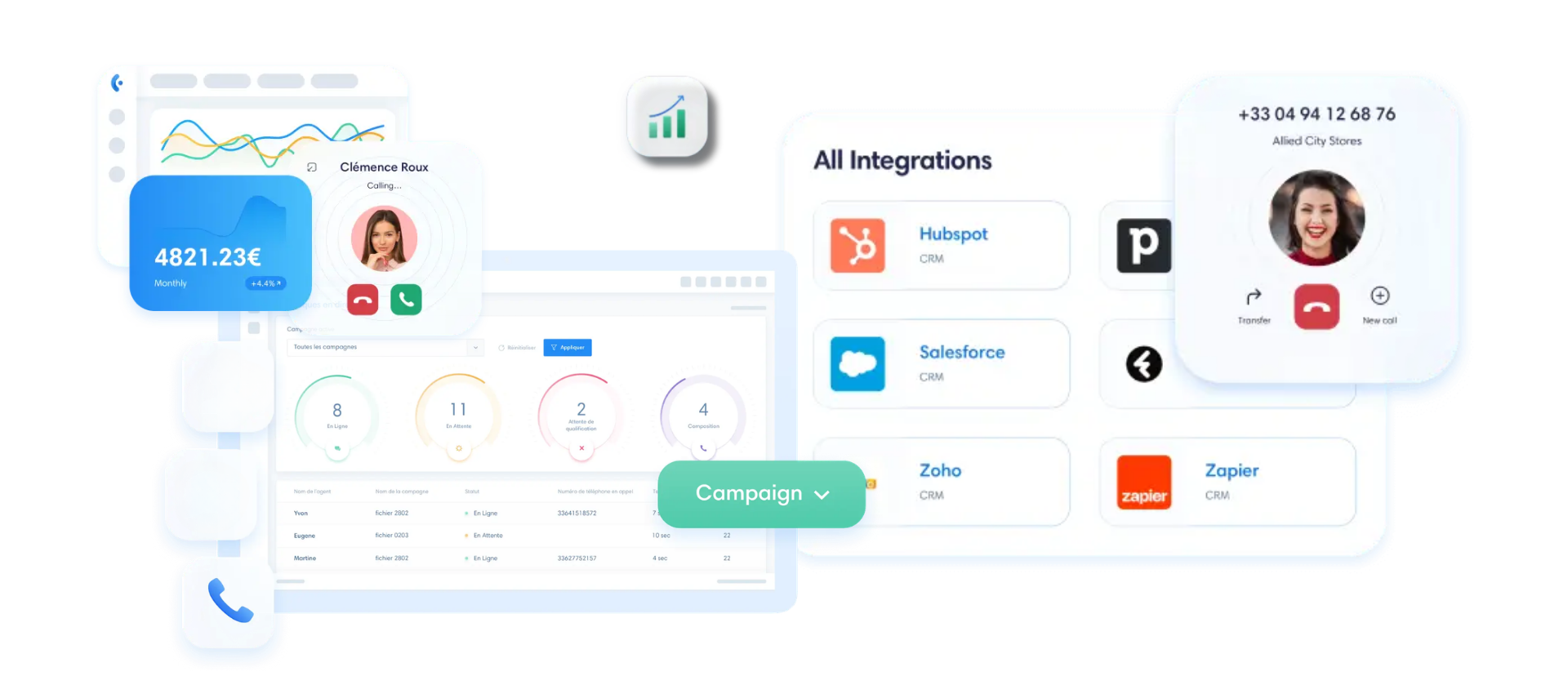
Understanding what a cloud call center solution entails
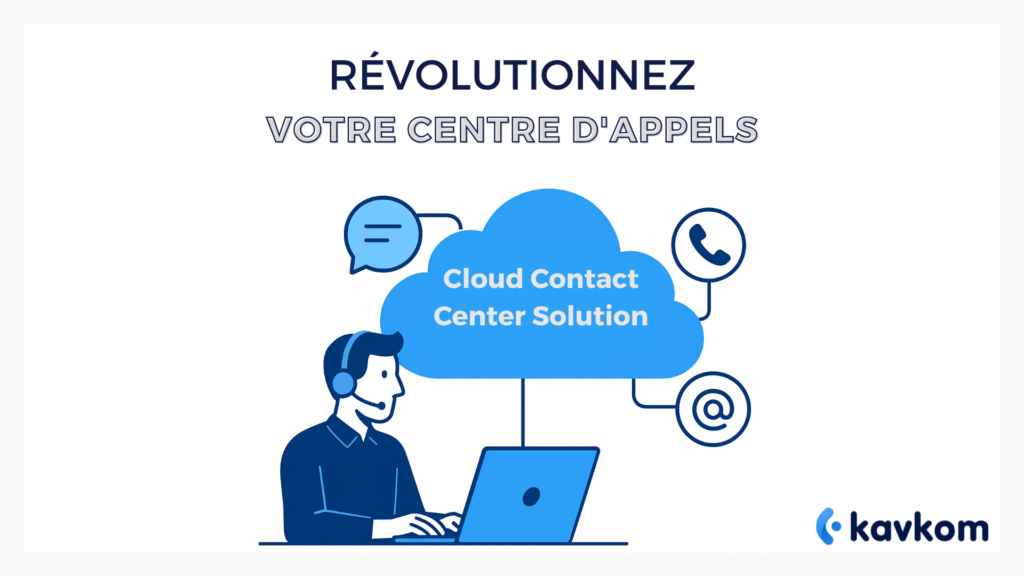
A cloud-based call center solution is an online hosted platform that centralizes the management of your telephone communications. It replaces traditional physical systems with a much more flexible digital environment. Incoming and outgoing calls are managed via the Internet, teams connect from any workstation, and supervisors control everything in real time.
The principle is simple: telephony becomes a software service. You no longer need a dedicated infrastructure or complex configuration. Everything is done in a single interface, customizable to suit your organization.
According to JDN(journaldunet), this development reflects a general trend whereby the call center now occupies an increasingly strategic position in customer service.
Contact centers are adopting this model because it enables smoother management and better distribution of the workload. It becomes much easier to deploy a group of extra agents, create a temporary queue, set up a welcome menu or track activity over a busy day.
The major benefits of a modern call center platform
Cloud solutions are gaining ground today because they meet real needs. They support performance without adding complexity. They make life easier for agents and supervisors alike. They help organizations absorb peak workloads without sacrificing quality.
Operational flexibility
Call volumes never follow a linear trajectory. A marketing campaign, a technical incident or a seasonal period can cause an immediate spike. A cloud platform naturally adapts to these fluctuations. You can adjust the number of connected agents, redefine routing rules or create a temporary queue in a matter of minutes.
This flexibility makes the call center much more responsive. It enables a consistent service to be maintained even when the situation changes rapidly. Teams can also work in hybrid mode without changing the organization. Access to the platform remains the same, whether the agent is on-site or remote.
Real-time control
A call center is an instantaneous environment. Being able to track minute-by-minute activity is not a convenience, it’s a prerequisite. The dashboards provided by cloud solutions give an immediate view of volumes, queues and agent availability.
This monitoring enables supervisors to adjust the organization without waiting until the end of the day. They identify points of tension, move resources and improve call distribution. They also quickly detect situations requiring intervention, whether an agent is in difficulty or a queue is getting longer.
Performance and agent experience
The performance of a call center depends heavily on the working conditions of its agents. A simple interface, rapid access to customer history and well-integrated productivity tools make their day-to-day work more fluid. When the platform reduces technical friction, the agent can concentrate on the exchange, improving the customer experience.
Cloud solutions also enable more effective skills upgrading. Supervisors can listen in live, coach discreetly or analyze recordings to guide teams. Learning is continuous, integrated into day-to-day activity, and contributes to enhancing service quality.
Essential features for a high-performance call center
Not all platforms offer the same tools. Some focus on call management, others on supervision or productivity. To evaluate a solution, it’s essential to identify the features that will have a direct impact on your business.
Intelligent routing
Intelligent routing sends each call to the most appropriate agent according to precise rules. This type of automation reduces unnecessary transfers, improves customer satisfaction and optimizes workloads. You can define criteria such as skills, language, seniority or availability.
This flexibility makes it possible to harmonize reception, especially in multilingual environments or when several teams share the same queue. Configurations can evolve according to your needs, without the need for major intervention.
Interactive Voice Server
The IVR serves as the first step in customer care. It quickly directs requests to the right departments and avoids saturating agents with recurring transfers. A well-designed IVR reduces waiting time, improves team efficiency and contributes to a more structured experience.
Productivity tools: dialer and click-to-call
For sales teams, or those handling large numbers of outgoing calls, productivity depends on reducing the time lost between calls. A dialer automates dialing and connects the agent only when the call is answered. Click-to-call, on the other hand, enables a call to be launched from any business tool, simply by clicking on a displayed number.
These tools increase the volume of useful conversations and reduce the fatigue associated with repetitive tasks. They generally integrate with CRM to facilitate note-taking and information updating.
Supervision and coaching
Real-time supervision enables agents to be listened to, advised and supported. Supervisors can intervene without interrupting the call, improving service quality while helping teams to progress. This feature is particularly useful for new agents or in complex situations.
Call recording provides a basis for ongoing training. It enables us to analyze exchanges, identify areas for improvement and organize targeted coaching sessions.
Statistics and analysis
Modern call centers rely on precise indicators. A cloud-based platform gives you access not only to real-time statistics, but also to detailed historical data. You can track call pick-up rates, average handling times, individual performance and call distribution.
This data helps us to better plan resources, anticipate needs and adapt the organization. It plays an essential role in continuous improvement.
Features summary
| Functionality | Objective |
|---|---|
| Intelligent routing | Reduce transfers and improve orientation |
| IVR | Structuring reception and streamlining requests |
| Dialer | Speed up outbound calls |
| Click-to-call | Simplify calls from business tools |
| Supervision | Supporting agents directly |
| Statistics | Managing and optimizing performance |
How to choose the right contact center solution
Choosing a platform is not simply a matter of comparing prices. One solution may be effective for one company, but unsuitable for another. It all depends on your organization, your teams and your way of working.
Define your priority uses
Before evaluating a solution, identify exactly what you’re looking for. Your priority may be reception management, prospecting, technical support, supervision or integration into your CRM. A good internal analysis will help you avoid choosing a platform that is either too large or, on the contrary, too small.
Assess ease of deployment
A cloud solution must be simple to implement. Activation must be fast, agents must be able to connect easily, and the interface must be intuitive enough to limit the amount of training required. The smoother the deployment, the more natural the adoption.
CRM integration review
Your CRM is the heart of your customer relations. A call center platform must integrate naturally with it to bring up contact records, synchronize calls and facilitate note-taking. Well-designed integration can save you a lot of time.
Anticipating load growth and pricing flexibility
Adaptability is essential. Your solution must be able to absorb seasonal variations, peaks in activity and the evolution of your team. You should also check the flexibility of the proposed pricing models. A truly efficient platform must be able to support your growth without heavy constraints.
A cloud option designed for demanding teams
If you’re looking for a platform that’s easy to deploy and suitable for intensive use, Kavkom is one of the solutions that respond directly to the needs of sales teams and call centers. The solution is 100 percent cloud-based, works without commitment, and is easy to adjust thanks to prorated billing, useful when your activity fluctuates.
Kavkom enables you to activate virtual numbers, manage all web and mobile calls, and support your outbound campaigns with a predictive dialer. CRM integration makes it easy to retrieve contact records, history and automatically update information. No hardware is required, and teams who prefer a dedicated extension can use a physical IP phone at no extra cost.
All this is backed up by responsive human support, on hand to help configure the most effective environment for your teams.
Boostez la productivité de vos équipe commerciales grâce à Kavkom, le logiciel de téléphonie d’entreprise 100% cloud.
Planifier une démoCommon mistakes when switching to a cloud solution
Migration to a new system can go smoothly if certain stages are properly anticipated. Mistakes often occur when the organization underestimates the changes involved.
Insufficient onboarding
Even if the platform is intuitive, onboarding remains essential. It explains new workflows, introduces best practices and ensures consistent use. Partial or hesitant adoption limits the expected benefits.
Overly technical settings
A call center is not designed to manage complex parameterization on a daily basis. If the initial configuration is not well done, or if it relies on technical elements that are difficult to maintain, the solution loses effectiveness. Rules must be clear, comprehensible and easy to modify.
Overlooking the role of supervisors
Supervisors are the first users of real-time control. They need to be involved early in the project to understand the possibilities and identify the necessary adjustments. Their involvement guarantees better overall performance.
FAQs
Can a cloud solution replace a traditional system?
Yes. Cloud platforms cover all essential call center functions and require no complex infrastructure.
Is it suitable for teleworking?
Yes. Agents can connect from any work environment, with no impact on the organization.
Can sales teams use this type of solution?
Yes. Integrated productivity tools, such as the dialer or click-to-call, make their day-to-day work easier.
Do supervisors have an immediate view of activity?
Yes. Real-time control is a major advantage of cloud platforms.
Can the solution be integrated with a CRM?
Most platforms offer native connectors or APIs for data synchronization.
Conclusion
Contact center cloud solutions are redefining the way organizations manage their telephony. They provide greater flexibility, better supervision, a smoother agent experience and the ability to absorb load variations without friction. They also offer a more precise and immediate view of business activity, facilitating operational decisions.
Choosing the right solution for your organization means selecting a tool that grows with you. A tool capable of supporting your teams, streamlining your processes and accompanying your growth. This guide gives you the keys you need to make the right choice and define the functionalities that will really serve your business.
If you want to structure the management of your incoming flows, support your outgoing campaigns or simplify the management of your business, you can rely on a platform designed to absorb your operational needs without technical complexity.