Today’s businesses are looking for a more agile telephony solution, capable of supporting modern uses without burdening infrastructure or complicating day-to-day operations. In this context, VoIP has emerged as a powerful alternative to traditional telephony. Understanding how it works, what it brings and what it requires from a technical point of view will help you assess its relevance to your organization.
This guide lays the foundations, describes the essential mechanisms, explores the benefits and limitations, then details the steps to a successful transition. The aim is simple: to help you make informed decisions tailored to your business environment, whether it’s a call center, a sales team or a multi-site enterprise.
Points to remember :
– VoIP is based on the conversion of voice into digital data, making it possible to make calls over the Internet without the hardware constraints of traditional systems.
– Its operation is based on precise protocols and technical mechanisms, including SIP, RTP and the central role of the VoIP server, which are essential to understanding its reliability and limitations.
– VoIP offers tangible benefits to businesses, including mobility, cost reduction, scalability and the availability of advanced functions that are useful in everyday life.
– Call quality is directly dependent on network configuration, bandwidth and connection stability, making it an essential point of attention before any transition.


Boostez la productivité de vos équipe commerciales grâce à Kavkom, le logiciel de téléphonie d’entreprise 100% cloud.
Planifier une démo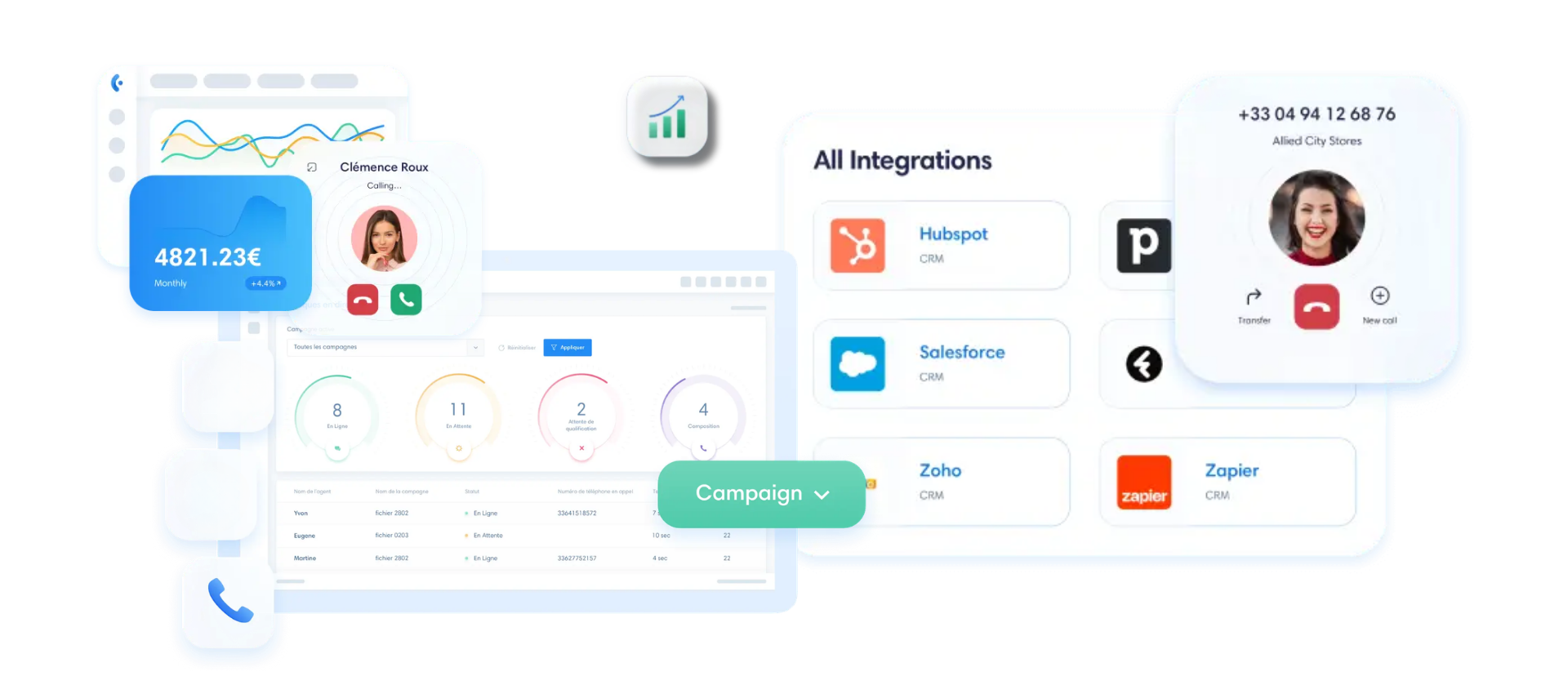
What is VoIP and why are companies interested?
At a glance
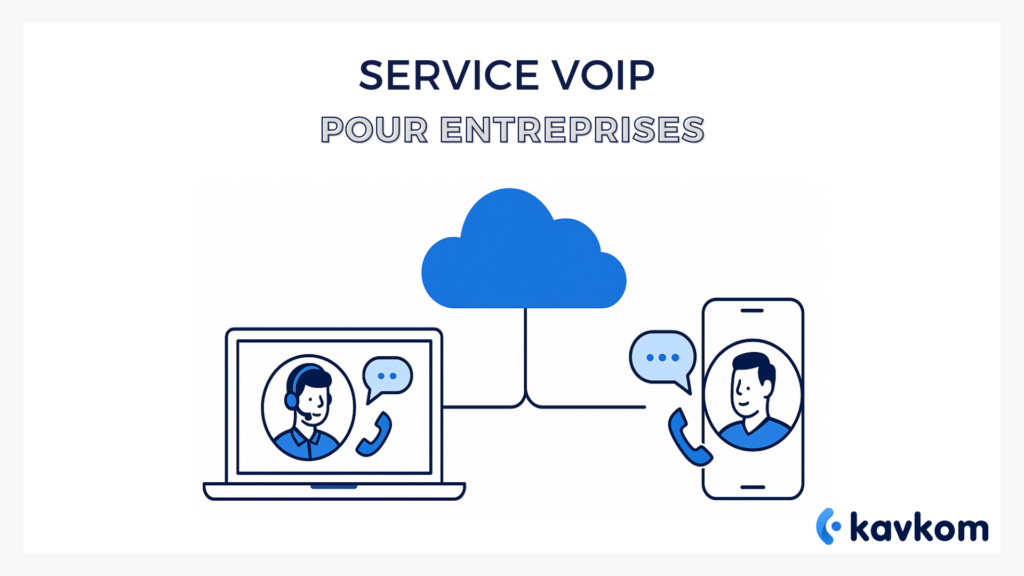
A VoIP service enables you to make and receive calls over the Internet, transforming voice into digital data. It replaces physical telephone lines with fully IP-based operation, providing flexibility, cost reduction and advanced functionality.
From analog voice to voice over IP
For decades, telephony relied on the switched network, designed to carry analog signals from point A to point B. The arrival of VoIP has introduced a radically different approach: voice is digitized, broken down into packets of data and then transmitted via the Internet. This technological evolution follows the broader transformation of businesses, which are moving many systems to dematerialized environments.
So VoIP is no gadget. It represents an infrastructure change comparable to the switch from paper mail to email: the same end use, but with incomparable efficiency and flexibility.
VoIP service: an operational definition
In concrete terms, a VoIP service provides :
– telephone access via the Internet
– software for making calls (softphone, webphone or mobile app)
– user accounts linked to business numbers
– a call management server (IP PBX) that applies routing rules
– advanced functions for organizing workflows
This makes true IP telephony telephony that no longer depends on a physical location. A user can call from a laptop, tablet or VoIP-compatible phone, provided a connection is available.
Reasons for growing interest
The massive adoption of SaaS tools has familiarized companies with hosted services. VoIP services follow the same logic: they eliminate hardware maintenance, streamline user management, and facilitate teleworking. For organizations that evolve rapidly or have to absorb peak seasons, this flexibility becomes a decisive advantage.
How VoIP works: the technical basics
The role of the SIP protocol
VoIP is based on a central protocol: SIP, for Session Initiation Protocol. It manages :
– set up calls
– modify sessions (hold, transfer)
– close calls
SIP doesn’t transport voice: it orchestrates interactions. It’s a bit like an orchestra conductor who coordinates the musicians without playing an instrument himself.
RTP and voice transmission
Once a session has been established, the voice is transmitted using the RTP protocol, which manages the sending of audio packets. The codecs used (Opus, G.711, G.722…) have a direct influence on :
– sound quality
– packet weight
– ability to maintain a stable flow
A high-performance codec, combined with a good connection, delivers convincing HD quality, often superior to analog communications.
VoIP servers and call management
A VoIP service always relies on an IPBX(Private Branch Exchange) server. It applies the rules defined by the company: redirections, queues, transfer to an available user, time rules, group management, log archiving. The server also plays a central role in supervision and history, facilitating team management.
Call quality: the real factors
Perceived quality depends on precise technical variables:
– available bandwidth
– latency (transmission delay)
– jitter (reception irregularity)
– packet loss
– network configuration (QoS prioritization)
When a network is correctly dimensioned, VoIP calls are stable and clean. This is often the misunderstood part: VoIP is not inherently unstable, it depends on the Internet foundations on which it is built.
Practical implementation of a VoIP service in a business environment
Understanding how VoIP works is the first step. The second is to see how these principles take shape in a ready-to-use solution.
This is the background to Kavkom, a 100 percent cloud solution designed to facilitate the adoption of IP telephony within companies. It applies the mechanisms described above in an immediately usable form: activation of virtual numbers, organization of incoming flows, automation of outgoing calls with a predictive dialer, and native integration with market CRMs to synchronize calls, contacts and history, without replacing the existing CRM.
The system operates without any hardware requirements, with the option for teams to use their own compatible IP telephones.
Unlike many historical solutions, Kavkom operates with no commitment, no installation costs and transparent pro rata billing, enabling companies to adapt their telephony to their actual activity, without contractual constraints.
Boostez la productivité de vos équipe commerciales grâce à Kavkom, le logiciel de téléphonie d’entreprise 100% cloud.
Planifier une démoVoIP service benefits for businesses
VoIP vs. traditional telephony
| Criteria | VoIP | Traditional telephony |
|---|---|---|
| Infrastructure | No special wiring | Physical installation |
| Mobility | Total | Limited to the office |
| Scalability | Quick addition of users | Major modifications |
| Features | Routing, supervision, integration | Simple calls |
| Costs | Reduced | Material expenses and maintenance |
Lower operating costs
A VoIP service eliminates dependence on telephone hardware. Updates are made online, accounts are created in minutes, and calls are routed over an existing network. For multi-site companies, this reduction in logistical constraints represents a substantial advantage.
Mobility and hybrid working
Teams can use their professional line:
– from a computer
– from a smartphone
– on the move
– working from home
This continuity is essential for organizations where agents alternate between the office and mobility.
Flexibility and scalability
As your business evolves, VoIP absorbs the growth without technical work or delays. Adding a user is as simple as creating an account, not installing physical equipment.
Advanced features for everyday use
A VoIP service can include :
– intelligent routing
– interactive menus
– dashboards
– call recording
– real-time supervision
– integration with work tools
These functions transform telephony into a genuine management tool, capable of improving team coordination and productivity.
VoIP limits and points of attention
Short list: Points to watch
– stable Internet connection
– good security practices
– adapted equipment
– network quality management
Dependence on Internet connection
VoIP requires a reliable connection. Insufficient bandwidth or a saturated network can cause :
– robotic voice
– cuts
– latency
Companies therefore need to assess the capacity of their infrastructure before any migration.
Business continuity
Network redundancy (secondary connection, 4G or complementary fiber) secures service availability. This is essential for businesses that rely heavily on the telephone.
Safety and compliance
IP telephony must be protected by :
– flow encryption
– access management
– action logging
– network segmentation
The aim is to protect communications against intrusions and ensure reliable monitoring of voice exchanges.
Quality varies according to equipment
A low-end microphone or unsuitable headset can degrade the experience. Workplace acoustics also play an important role, especially in open spaces.
VoIP versus traditional telephony
Sidebar: When VoIP makes its mark
VoIP becomes particularly interesting when teams are distributed, mobile or subject to significant variations in workload.
Technical models
Switched telephony relies on a proprietary physical infrastructure. VoIP, on the other hand, uses the Internet as a transport network, opening the door to more modular environments.
Features
VoIP is more than just calling. It enables :
– queues
– supervision
– software integration
– partial automation
These possibilities are changing the way companies manage their telephone relationships.
Maintenance and management
Maintenance becomes essentially software-based. Technical teams can control telephony from a web interface, without relying on heavy hardware intervention.
Key steps to a successful VoIP transition
Step 1: Assess internal needs
Identify :
– call volume
– team structure
– supervision needs
– business requirements
This analysis avoids underestimating operational expectations.
Step 2: Check network infrastructure
This involves checking bandwidth, WiFi quality, the availability of a wired network and router capabilities. Stable VoIP depends on a solid network foundation.
Step 3: Preparing the teams
Users need to understand the new interfaces, available tools and associated procedures. A change in telephony often involves organizational changes.
Step 4: Define the rules of communication
A structured call plan reduces caller waiting times and improves internal coordination.
Step 5: Managing a test phase
The best way to evaluate VoIP is to use it in a limited scope. User feedback can be used to adjust the configuration.
Step 6: Gradual deployment
The transition must follow a controlled logic: team after team, service after service, with regular checkpoints.
How to measure VoIP service performance
Key KPIs
| KPI | Usefulness |
|---|---|
| Latency | Measures transmission speed |
| Jitter | Stability indicator |
| Packet loss | Direct impact on quality |
| Drop-out rate | Measures operational efficiency |
| Response time | Organization indicator |
| Average call duration | Analysis of internal processes |
Perceived quality
User perception remains a decisive indicator: audibility, comfort, absence of interruptions. These elements do not replace technical metrics, but complement them.
Technical indicators
A high-performance VoIP platform has low latency, minimal jitter and very low packet loss. These data provide information on network stability.
Operating indicators
VoIP enables much more precise monitoring than conventional telephony. Managers can analyze team behavior, adjust schedules and streamline call flows.
FAQs
What is a VoIP service?
A VoIP service enables you to make and receive calls over the Internet, using Voice over IP technology.
What is a VoIP server?
It’s an IPBX server that manages calls, applies routing rules and centralizes user parameters.
Can VoIP be used without the Internet?
No, VoIP depends entirely on a connection. Network redundancy is recommended to ensure business continuity.
What are the disadvantages of a VoIP service?
Network dependency, technical requirements, and sometimes the need to train teams.
Does VoIP offer good call quality?
Yes, if the network supports packet transmission correctly. With a modern codec and a good infrastructure, audio quality is excellent.
Conclusion
VoIP services are profoundly modernizing business telephony. It combines flexibility, cost reduction and advanced features that are transforming the way companies manage their communications. The transition requires structured preparation, but in return offers an environment better adapted to today’s uses: mobility, supervision, integration and scalability.
This article has given you a comprehensive overview of the mechanisms, benefits, limitations and necessary steps. You now have a solid foundation on which to assess the relevance of VoIP in your organization and prepare for an effective transition.
If you want to put these principles into practice and have an environment capable of unifying your business phone calls and centralizing voice interactions related to your sales or customer service activity, a cloud solution can accelerate this evolution.