In many companies, telephony has been built up in successive layers. A switchboard installed ten years ago, IP phones added as new staff are recruited, professional cell phones for field teams, and a few digital tools that gravitate around them without really being connected.
The result: scattered costs, heavy dependence on technical service providers, and an organization that is sometimes poorly aligned with current practices (telecommuting, hybrid teams, multi-sites).
Cloud-based business telephony addresses this gap. It refocuses communications around a unified service, accessible via the Internet, scalable, and designed to interact with your CRM, your support tool or your business applications.
This guide gives you a structured overview of what cloud telephony can achieve, the savings it can generate, the operational gains it can deliver, and the key criteria for choosing the right solution for your organization.
Points to remember :
– Professional cloud telephony replaces a fragmented telephone system with a unified platform that centralizes numbers, routing and supervision.
– Moving to the cloud means lower hardware costs, better adjustment of subscriptions to actual usage, and less time spent on maintenance.
– Administration via a web console simplifies day-to-day operations, giving operational teams control over queues, schedules and greetings.
– Advanced routing, IVR and time-of-day scenarios structure a more consistent welcome and reduce lost calls.
– Real-time supervision tools provide an immediate readout of call volumes, waiting times and team performance.


Boostez la productivité de vos équipe commerciales grâce à Kavkom, le logiciel de téléphonie d’entreprise 100% cloud.
Planifier une démo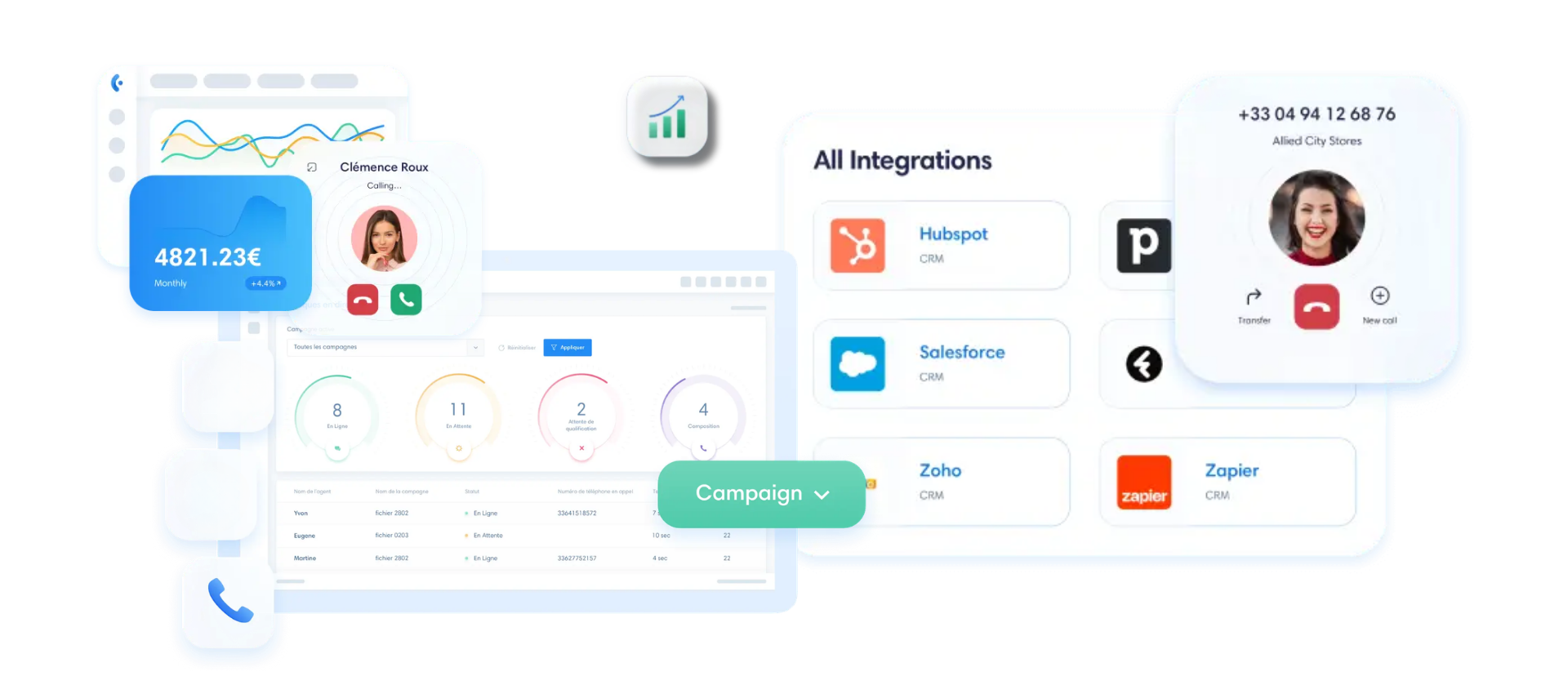
What is cloud telephony?
Professional cloud telephony is based on a central principle: move telephony intelligence away from your premises and host it on a platform accessible via the IP network.
Switchboard, routing rules, queues, greetings, statistics and supervision tools no longer depend on hardware installed in a technical room. They become software bricks that can be configured via a web interface.
Your teams can then call and receive calls via:
- An IP phone connected to the network.
- A computer softphone.
- A web or mobile application.
The device becomes secondary. What counts is the service to which the employee connects, with its rights, queues, numbers and history.
Overview of main bricks
For a decision-maker, it’s useful to visualize the solution as a set of blocks:
- Virtual numbers (geographic or non-geographic) for your services, sites and countries.
- A hosted virtual switchboard that manages routing, queues, schedules and scenarios.
- User applications (softphone, webphone, mobile application).
- An advanced routing module (IVR, queuing, overflow, skills).
- Supervision and reporting tools.
- Connectors or APIs to integrate telephony with CRM and other tools.
This base integrates telephony as an integral part of the information system.
Compare classic telephony and cloud telephony
Before talking costs or projects, it’s useful to compare the two models: traditional business telephony, based on an on-site PBX, and cloud business telephony, based on a hosted switchboard.
The difference isn’t just where the hardware is located. It’s how you bill, how flexible you are, how integrated you are, and how you really control your system.
Two approaches to corporate telephony
| Dimension | Conventional telephony (on-site PABX) | Professional cloud telephony |
|---|---|---|
| Hosting | Standard on your premises | Switchboard hosted by service provider |
| Deployment | Hardware project, technical interventions | Online activation, remote configuration |
| Developments | Slow, integrator-dependent changes | Quick settings, controlled by your teams |
| Mobility | Limited use outside the office | Various devices, native teleworking |
| Multi-site | Site-specific configurations, complex interconnections | Centralized management for all sites |
| Initial investment | High CAPEX (hardware, licenses, installation) | Subscription, more linear costs |
| Supervision | Ad hoc reporting, little real time | Detailed statistics, real-time views |
| Tool integration | Specific projects, variable costs | Ready-to-use connectors, API |
In the first model, you manage a piece of equipment. In the second, you manage a service. It’s this shift that enables us to rethink costs, uses and governance.
Reduce your costs with professional cloud telephony
The question of budget comes up in almost every business telephony project. But it’s not just a question of “paying less per minute”. It’s about understanding how migration to the cloud is changing the very structure of spending.
There are three main categories:
- Legacy technical costs: standards, licenses, maintenance, workstations.
- Recurring costs: subscriptions, communications, options.
- Operational costs: time spent managing telephony, lost calls, lack of supervision.
Cloud telephony works on all three.
You reduce hardware investments, tailor subscriptions more closely to actual usage, and reduce the amount of time spent managing technical or organizational problems.
Reduce material investment
In a traditional model, the heart of the system is a physical standard, with its cards, licenses and extension modules. Its lifecycle requires costly renewals, and each major change (relocation, site opening, scalability) becomes a project in its own right.
A professional cloud telephony solution removes most of these constraints:
- The standard is shared by the service provider’s infrastructure.
- You can restrict IP phones to the extensions where they are needed.
- Some employees use softphones or webphones, with a simple headset.
In this way, you move from heavy sporadic investment to a more linear model, centered on user licenses.
Adapting telephony to your actual business
In many companies, the telephony system remains designed for periods of maximum load, even when business activity slows down for several weeks or months.
The cloud brings expenses closer to actual activity:
- Create and delete accounts in just a few clicks.
- Adaptation of the number of issues to current campaigns.
- Modulation of usage profiles according to teams (prospecting, support, support functions).
This elasticity is particularly useful for seasonal structures, call centers subject to strong variations or fast-growing companies.
Better control over communications
Communications remain a major cost item, especially when there are a lot of mobile or international calls. A modern cloud platform offers different models:
- Packages including volume to certain zones (landlines, mobiles, countries).
- Special rates for intensive use.
- Detailed tracking of volumes, by user or by department.
The key point is the link between consumption data and the structure of your packages. Hosted business telephony enables you to keep a close eye on what your teams are consuming, identify any drift and make regular adjustments.
Simplify operational management
Once you’ve got the bill under control, it’s time to get down to day-to-day business. A good business cloud telephony solution should make life easier for teams, not the other way around.
The system needs to be understandable by operational staff, controllable without systematic dependence on IT, and flexible enough to absorb organizational changes.
Simpler administration, closer to the field
Administration is via a centralized web console:
- Users and their profiles.
- Professional numbers and their assignment.
- Groups, queues and scenarios.
- Time rules and greetings.
IT retains control over general architecture, security and advanced rights. Managers, on the other hand, can intervene on matters that fall within their scope: adding or removing employees from a queue, modifying an information message, adapting reception hours.
This distribution of roles reduces delays and avoids turning every adjustment into a technical ticket.
Call routing: structuring a consistent welcome
Routing is at the heart of modern business telephony. It’s no longer a matter of simply “ringing” an extension, but of organizing a logical path for each type of call.
Common approaches include:
- An IVR that guides sales, support and billing.
- Queues by team or product.
- Skill-based routing, useful in technical environments.
- Different scenarios for different time slots or holidays.
- Spillover to another team or external service provider.
Properly designed, this routing reduces dropped calls, improves the perception of your reception and facilitates the work of your in-house teams.
Supervision: from printing to measuring
Supervision transforms professional telephony into a management tool. It enables you to move from an impression (“it sounds a lot”) to a measured reality.
Real-time dashboards and historical reports, for example:
- Number of calls in progress, queued and answered.
- Average waiting time.
- Drop-out rate per file and per team.
- Agent availability.
- Volumes by time slot.
This data is used to adjust staffing levels, identify bottlenecks and objectify decisions (recruitment, organization, working hours).
Supervision before and after cloud telephony
| Aspect evaluated | Traditional model | Cloud model |
|---|---|---|
| Data access | One-off reports, manual consolidation | Real-time views, direct export |
| Reactivity | Late decisions, often by the week | Adjustments during the day |
| Quality of welcome | Subjective perception | Precise indicators (waiting times, dropouts, duration) |
| Coaching | Spot listening | Recordings, discreet listening, accompaniment |
With these elements, telephony ceases to be a simple channel and becomes a lever for operational management.
How to choose your cloud telephony solution
Once you’ve made your strategic decision, there’s one more important step: choosing the right cloud telephony solution from the market.
The challenge is not to check off all the boxes on a list of functionalities, but to align the platform with your uses, your internal culture and your technical constraints.
Criteria for evaluating an offer
You can use this grid to structure your comparison:
- VoIP service quality and network stability.
- Simple administration for your teams.
- Rich, easy-to-read supervision tools.
- Level of integration with your business tools (CRM, support, ERP).
- Flexible licensing and commitment models.
- Security devices, encryption, access management.
- Deployment assistance and day-to-day support.
This framework allows you to go beyond the sales sheet and focus on what will really impact your teams.
Technical criteria and reliability
On the technical front, a few points deserve particular attention:
- VoIP and voice-over-IP flow management.
- Redundancy and failover mechanisms in the event of an incident.
- Capacity to absorb peaks in activity.
- The quality of the connection between your local network and the solution’s infrastructure.
Without going into architectural detail, it’s a good idea to ask concrete questions about service continuity and backup scenarios.
Functionality tailored to your needs
Not all companies have the same relationship with telephony. A call center will have different needs from those of a consulting firm or an industrial SME.
Among the features to be examined:
- Virtual switchboard with flexible routing rules.
- Allocation and management of virtual numbers (France and international).
- Configurable IVR and queues.
- Detailed supervision, with filters by team and period.
- Configurable call recording (can be activated by service, for example).
- CRM integration: file feedback, call logging, click-to-call.
- Applications for teleworking and teams on the move.
The aim is to provide a coherent foundation, not a collection of rarely-used functions.
Security, RGPD and governance
Telephone communications contain sensitive information: customer data, contractual information, financial data. A professional telephony solution must offer:
- Encryption of communications and recordings.
- Fine-tuned management of access rights to administration and eavesdropping.
- Recording retention time settings.
- Administration action logging.
When it comes to RGPD, you need to be able to explain to your teams and customers:
- Why some calls are recorded.
- How long these recordings are kept.
- Who can access it, and how.
Well-configured cloud telephony helps you structure this governance.
Integration with your business tools
Finally, modern telephony doesn’t work alone. It gains in value when it connects to your ecosystem:
- CRM: automatic opening of contact sheet, call logging, opportunity tracking.
- Support tools: link between tickets and calls, chronological view of interactions.
- Internal applications: trigger actions from a call, feed information back into your IS.
By linking business telephony to your existing tools, you reduce duplicate data entry, improve data quality and make interactions smoother for teams and customers alike.
A professional telephony solution adapted to today’s needs
When it comes to evaluating different approaches to business telephony, many companies are looking for a tool that truly centralizes their day-to-day management. It’s not just a question of having a virtual switchboard, but an environment capable of unifying numbers, routing, mobility and supervision in a single, easy-to-administer space.
This is precisely what Kavkom offers, a cloud platform designed to support sales teams and call centers alike. Hosted switchboard, virtual numbers, multi-device applications and monitoring tools work together to deliver a seamless experience, whether you’re in the office, telecommuting or at another site.
What distinguishes a platform designed for teams
- Centralized administration, with no technical dependency.
- Flexible routing to structure reception according to your teams.
- Real-time supervision to control volumes and performance.
- CRM integration to link calls and customer files.
This approach reduces the usual complexity of telephony, while supporting a variety of uses: prospecting, support, multi-site coordination or hybrid team management. Managers gain an easy-to-understand tool, and users gain telephony that follows their needs rather than their hardware constraints.
Boostez la productivité de vos équipe commerciales grâce à Kavkom, le logiciel de téléphonie d’entreprise 100% cloud.
Planifier une démoFAQ : professional cloud telephony
Does cloud telephony require a complex infrastructure?
No. In most cases, stable Internet access and a properly sized local network are all that’s needed. Hardware requirements are more modest than for a physical PBX, although a network quality check is still recommended.
Can I keep my existing numbers when I migrate?
Yes, number portability is a standard mechanism. It allows you to switch from one operator or system to another without forcing your customers or partners to change their number.
Is cloud telephony right for hybrid teams and teleworking?
This is one of its strengths. Employees can connect from a laptop, IP phone or mobile app, while retaining their business number and place in the queue.
Is call recording compulsory?
No. Registration is an optional module, which may or may not be activated according to your needs. It must be backed up by an internal policy and clear information for teams and customers, particularly on the purposes and duration of storage.
Is call quality on a par with a standard landline?
With a good connection, VoIP call quality is at least equivalent to that of traditional landlines, and often better. Stability depends above all on the quality of the network and the way the solution handles voice flows.
Conclusion
By replacing a physical switchboard with a hosted service, you simplify the infrastructure, make costs more transparent and give operational teams concrete management tools: more flexible administration, finer routing, more precise supervision, more natural integration with business tools.
Telephony becomes once again what it should always have been: a working tool at the service of teams, not an isolated object in a technical room. Once this foundation has been laid, it’s much easier to support your organization’s growth, open up new markets or support hybrid working methods.
For companies wishing to modernize their telephony environment without complexity or heavy investment, a cloud platform offers a direct route to smoother, more structured management.