Call interception is a business telephony feature that enables a user to answer an incoming call intended for another extension, during the ringing phase. It is used in call centers, sales teams and support departments to prevent a call from going unanswered while employees are available.
The principle may be simple, but the way it’s used varies from one context to another. Direct or group interception, access rules, impacts on team organization and call supervision – each configuration choice has concrete effects on day-to-day operations.
This article explains what call interception is, how it works, when it makes sense and how to implement it consistently. You’ll find a structured view of the functionality, examples of professional use and best practices for effectively integrating it into your call management.
Points to remember :
- Call interception lets you answer an incoming call intended for another extension while it’s ringing, without manual transfer or automatic forwarding.
- This feature is particularly useful in environments where calls need to be handled quickly, such as call centers, sales teams or customer support.
- There are several forms of call interception: direct, group or targeted, each meeting different organizational needs.
- Cloud telephony greatly simplifies the implementation of call interception by removing hardware constraints and complex configurations.


Boostez la productivité de vos équipe commerciales grâce à Kavkom, le logiciel de téléphonie d’entreprise 100% cloud.
Planifier une démo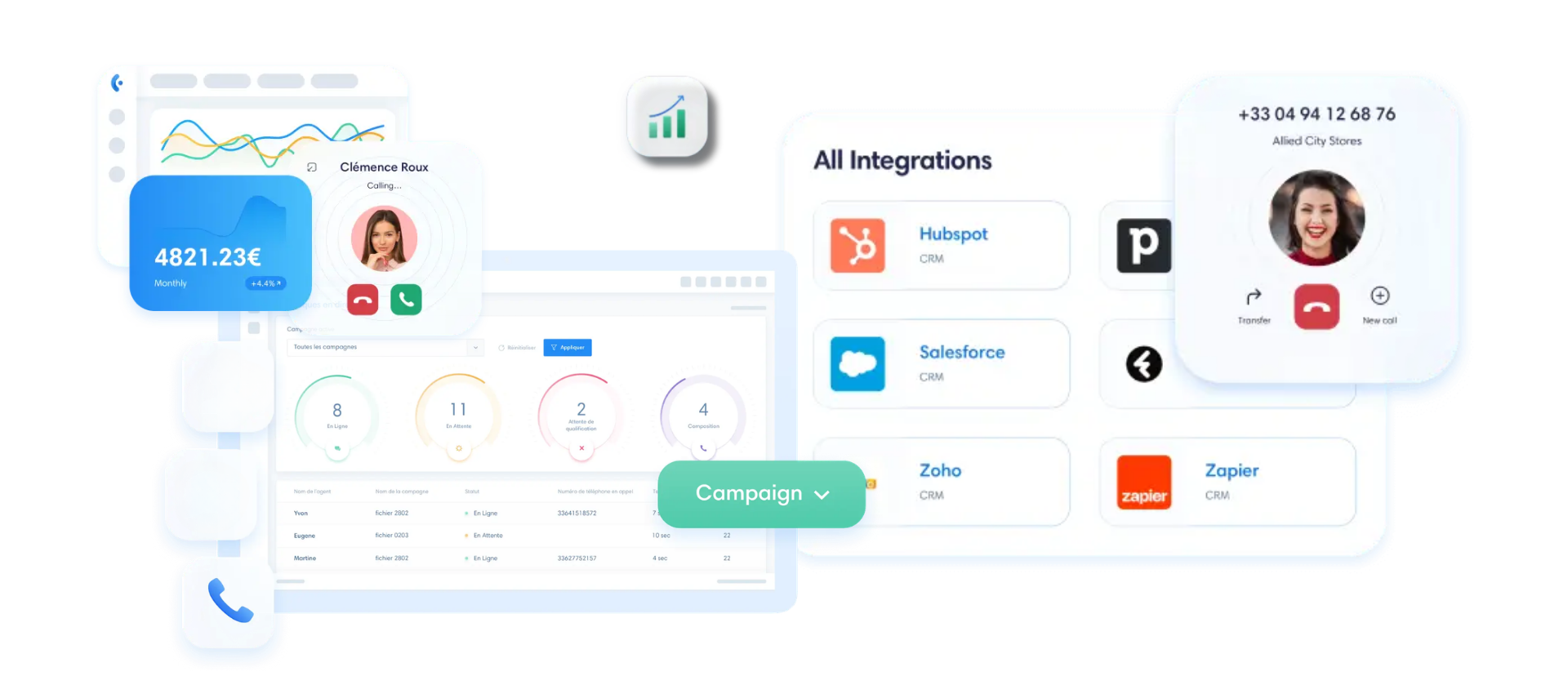
Definition and general principle
Call interception is a business telephony feature that allows a user to answer an incoming call intended for another extension. The call is neither manually transferred by the called party nor automatically forwarded. It is answered by an authorized colleague during the ringing tone.
In concrete terms, a telephone rings in an office or on a softphone. Another user, often belonging to the same group, dials a code or presses a dedicated key. The call immediately switches to his or her extension.
This logic meets a simple objective: to limit missed calls when the team remains available.
Interception, transfer, return: clearing up the confusion
The terms are similar, but the uses differ.
| Function | Trigger | Moment of action | Typical use |
|---|---|---|---|
| Call barring | By a third party | During ringing | Available team |
| Call forwarding | By the recipient | During the call | Turn to an expert |
| Call forwarding | Automatic | Before the bell | Planned absence |
Interception takes place before the line is connected. It is based on a collective logic, whereas transfer and forwarding are based on an individual or automated decision.
Why this function exists
In business environments, every call counts. A missed call can result in a lost business opportunity, customer dissatisfaction or an extra charge later on.
Functionality acts as a discreet but structuring continuity mechanism.
Set up call interception simply with cloud telephony
Once the rules have been defined, a very practical question remains: how cancall interception be made available without turning telephony into a technical construction site?
In most organizations, this functionality needs to work immediately, without complex installation or dependence on a heavy infrastructure.
Cloud telephony, when designed for sales productivity and team supervision, provides a direct response to this need. It no longer depends on specific hardware or local settings on each workstation.
With a cloud telephony solution like Kavkom, call interception is available as soon as lines are activated, subject to the definition of groups and associated access rights. Teams, for their part, intercept calls from their IP phones, PCs or browsers, without modifying their work habits.
This approach allows us to remain pragmatic while maintaining a clear managerial vision. In Kavkom, call interception is part of a set of supervision tools enabling team managers to monitor activity in real time and intervene when availability becomes an issue.
Cloud telephony allows you to :
- activatecall interception without on-site installation
- centralize user and rights management
- use the functionality on multiple devices, depending on usage
- maintain a clear organization, even when teams change
This makes call interception a simple function to deploy, consistent with distributed, mobile or telecommuting teams. It integrates naturally into day-to-day call management, without weighing down the organization.
Boostez la productivité de vos équipe commerciales grâce à Kavkom, le logiciel de téléphonie d’entreprise 100% cloud.
Planifier une démoThe different types of call interception
Direct interception
Direct interception lets you answer any ringing extension, without group restrictions. A single code is all you need.
This approach is well suited to small structures or close-knit teams. It remains sensitive on a large scale, because everyone can answer to everyone else.
In brief
- Quick to set up
- Maximum flexibility
- Risk of confusion in extended organizations
Group interception
Group interception limits call acceptance to a defined perimeter. Users belong to the same intercept group.
This model can be adapted to call centers, support teams or sales centers organized by skill or function.
The main advantage lies in scope control: each team manages its own calls without encroaching on the others.
Targeted interception
Some configurations allow you to intercept a specific extension via a dedicated code. The user explicitly selects the call to be intercepted.
This approach responds to specific scenarios, such as assisting a manager, ensuring continuity in a sensitive position, or providing one-off support for an employee.
Real-life corporate use cases
In call centers
On a call center, every ring has an impact on performance indicators. Call interception enables an available agent to answer an incoming call on an extension that is busy, on break or temporarily absent.
Pick-up rates are up, queuing remains under control and supervisors maintain a fluid overview of activity.
In a sales team
One salesman is in a meeting, another in the office. The phone rings on the company’s landline number. Thanks to call interception, the conversation starts without delay.
The prospect gets an immediate response, without having to deal with the team’s internal organization.
Customer support
Some calls require fast or expert handling. Interception allows an experienced agent to answer the call before it is automatically forwarded.
This logic enhances perceived quality while maintaining simple routing scenarios.
How call interception works technically
The role of the switchboard
Call interception is based on a switchboard capable of managing multiple extensions and access rules. The system identifies the incoming call, checks authorizations and applies the switchover in real time.
There is only one active call. The call is moved from one extension to another, without duplication.
Codes and function keys
Depending on the configuration, interception is activated via :
- a universal code
- a group code
- a programmable key on the telephone or softphone
Action is immediate, without leaving the work interface.
Activation conditions
To work properly, several elements must be present:
- interception rights assigned
- belonging to a defined group or perimeter
- call still ringing
A call that has already been answered is no longer intercepted.
Set up call interception step by step
Step 1: Define perimeters
Before any configuration, you need to identify :
- the teams involved
- authorized positions
- any exceptions
Simple cartography is enough. Too many rules complicate use.
Step 2: Choose the interception mode
| Context | Recommended mode |
|---|---|
| Small team | Direct interception |
| Call Center | Group interception |
| Management | Targeted interception |
This choice determines the readability and adoption of the functionality.
Step 3: User training
A useful feature remains ineffective without adoption. A short demonstration, a few concrete scenarios and a visual reminder will suffice in most cases.
The aim is to make the gesture natural, almost a reflex.
Best practices for effective call interception
Laying down simple rules
Interception works best with understandable rules:
- priority to the first available
- respect for defined perimeters
- coordination between colleagues
A shared implicit rule is often better than an overly formal framework.
Avoiding undesirable effects
Without a frame, interception can lead to :
- simultaneous responses
- unnecessary interruptions
- confusion over responsibilities
Measured settings limit these situations.
Measuring impact
Call interception influences operational indicators:
- drop-out rate
- ringing time
- customer satisfaction
Regular monitoring means that adjustments can be made without jeopardizing the organization.
Call interception and supervision
A tool for managers
For a team manager, interception provides an immediate reading of activity. A long ringing call signals a point of tension or a lack of availability.
Human intervention takes over from automation, with greater flexibility.
Real-life coaching
When an agent hesitates, a more experienced colleague can answer the call. Learning takes place through indirect observation, without unnecessary exposure.
This mechanism encourages skills upgrading, without the need for cumbersome training programs.
Safety and legal framework
Access rights and confidentiality
Call interception implies responsibility. Rights must correspond to users’ actual roles. Not everyone has access to every call.
Fine-tuned access management protects sensitive exchanges and limits abuse.
Internal transparency
Informing teams about the existence and rules of use of interception avoids misunderstandings. The feature is best presented as a collective, service continuity-oriented tool.
Call interception FAQs
What does call interception mean in business telephony?
Call interception is the ability for an authorized user to answer an incoming call intended for another extension during the ringing phase. The call is answered before the original recipient responds.
Does call barring work on a landline number?
Yes. Call interception works when the landline number is connected to a professional switchboard capable of managing multiple extensions and access rules.
What’s the difference with an automatic return?
Call forwarding acts automatically, according to pre-defined rules. Interception relies on the voluntary action of a third party, when the call rings.
Is this function suitable for small structures?
Yes. In a small organization, call interception provides flexibility when roles overlap and employees alternate between several tasks, without having to multiply referral scenarios.
Is the caller informed of the interception?
From the caller’s point of view, interception remains transparent. The line is seized normally, without any indication of the extension initially called.
Can we limit who has the right to intercept calls?
Yes. Call interception permissions can be configured on a per-extension or per-group basis. This restriction helps ensure compliance with functional boundaries, preserve confidentiality, and prevent one department from accidentally answering calls intended for another.
Conclusion
Call interception is one of those discreet functions that structure the day-to-day management of business communications. Simple in appearance, it meets the real challenges of availability, coordination and quality of service.
When it’s correctly configured, it facilitates exchanges without weighing down the organization. When poorly managed, it generates noise and confusion. The difference lies in having the right rules and adopting them collectively.
To give you a concrete idea of howcall interception is used on a day-to-day basis, Kavkom is offering a free demonstration, based on real-life use by sales and support teams.