In the face of all this, traditional infrastructures are running out of steam. They require substantial investment, ongoing maintenance and an organization that struggles to keep up with the reality on the ground. The result is a system that no longer keeps pace with current usage, and no longer effectively supports teams.
This article helps you better understand modern enterprise telephony solutions, so you can identify the one that will really support your organization and the way your teams work.
Points to remember :
– Modern business telephony is based on a number of distinct approaches, from VoIP to cloud PBX, each of which meets specific operational needs.
– Traditional systems are showing their limitations in the face of telecommuting, fast-paced customer journeys and fluctuating call volumes.
– The cloud, hybrid solutions, software call centers and UCaaS offer different levels of flexibility, control and integration.
– Companies can structure their calls with routing, queuing, supervision or virtual dialing to support their teams.
– Integrating telephony with a CRM and analyzing calls boosts productivity and the quality of customer relations.
– Modernizing telephony means providing teams with a more fluid environment, capable of keeping pace with the field and supporting growth.


Boostez la productivité de vos équipe commerciales grâce à Kavkom, le logiciel de téléphonie d’entreprise 100% cloud.
Planifier une démo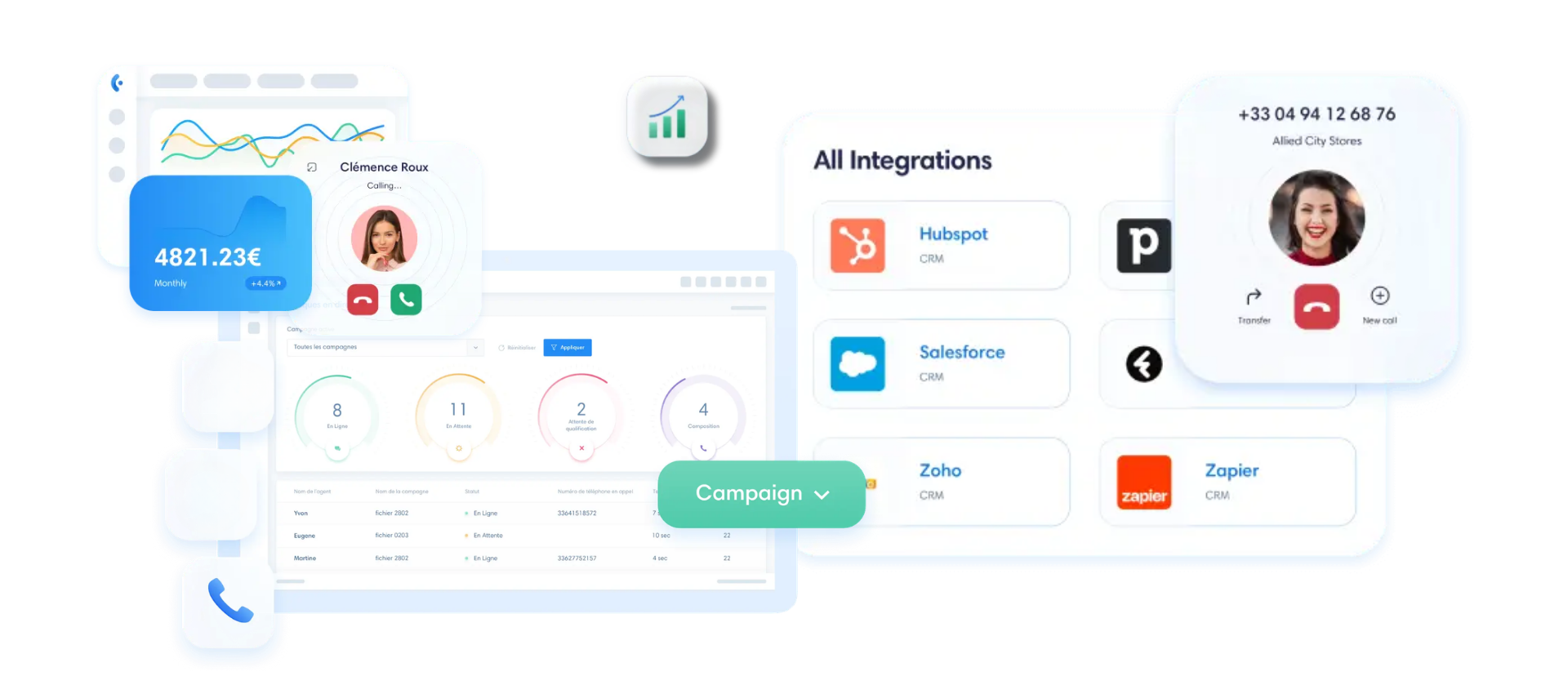
1. Enterprise IP telephony (VoIP)
IP telephony, or VoIP (Voice over Internet Protocol), is based on a simple principle: voice travels over the Internet instead of the traditional telephone network. It’s the basis of most modern business telephony technologies, but not every company uses it in the same way.
Why this solution exists
It enables us to move away from the costly and inflexible legacy infrastructure to a more flexible, scalable and easy-to-administer model.
Benefits
– Reduced costs thanks to the Internet
– More flexible calling, accessible from any device
– Immediate scalability: users can be added or removed easily
Limits
– Requires a good Internet connection
– Not sufficient on its own to manage incoming calls in a structured way
In brief
VoIP is the foundation of modern telephony. It offers significant cost savings and total freedom over the devices used, but it is not a complete solution for managing calls from a team or department.
2. Hosted cloud PBX
The cloud PBX (Private Branch Exchange hosted in the cloud) replaces the old physical switchboard installed in a technical cabinet. Here, everything is done online: routing, queuing, voice greeting, group management, scheduling and supervision.
Why companies turn to it
A cloud PBX makes it possible to centralize communications without hardware. Teams can work in the office, at home or on the road, while benefiting from a solid structure for calls.
Benefits
– Central administration from a browser
– Possibility of configuring fixed or international numbers
– Advanced routing for teams (skills, service, schedules)
– Operation compatible with softphones and IP telephones
– Rapid set-up
Limits
– Requires a minimum of internal organization to structure the call plan
– Some companies need to reconfigure their internal processes
| Function | Main purpose | Ideal profile |
|---|---|---|
| Routing | Send to the right department | SMEs, support centers |
| IVR | Automated welcome | Multi-service companies |
| Queues | Handling calls during busy periods | Call centers |
| Supervision | Real-time vision | Operational managers |
3. The cloud: a complete solution for sales teams and call centers
When you’re looking for an enterprise telephony solution capable of supporting sales teams or call centers, you need a comprehensive, flexible and easy-to-use tool. That’s precisely the approach taken by Kavkom, a 100% cloud platform, accessible without any hardware requirements, that works equally well on softphones and physical IP phones, at no extra cost.
Activation is immediate, and subscriptions are non-binding, with pro rata billing. Teams benefit from virtual numberspredictive dialer, CRM integration, total mobility and responsive human support to accompany deployment. The whole package is designed to streamline calls, boost productivity and give managers a clear view of activity.
Boostez la productivité de vos équipe commerciales grâce à Kavkom, le logiciel de téléphonie d’entreprise 100% cloud.
Planifier une démo4. Hybrid systems (IP + existing infrastructure)
Some companies still have a local infrastructure that they don’t want to give up immediately. Hybrid systems make it possible to connect a local PBX with external VoIP services.
Why this solution exists
It enables a gradual transition without interrupting operations.
Benefits
– Gradual migration
– Retention of some existing hardware
– Cost savings through VoIP use
Limits
– Partially local maintenance
– Higher complexity
– Persistent hardware dependencies
5. Soft Call Centers
The software call center is designed for teams who make a high volume of outgoing calls or manage a high pressure of incoming calls. The value lies in the ability to supervise activity, support agents in real time and optimize productivity.
Key features
– Advanced queuing
– Real-time supervision
– Whispered coaching
– Automatic recording
– Customized dashboards
– Automated call campaigns
– Performance analysis
Why this solution works
It meets the day-to-day needs of call center managers: keeping a constant eye on activity, providing live support for agents, and improving productivity.
Typical cases
Typical use cases
– Support centers
– Sales prospecting platforms
– Dunning and collection services
– Multi-site service teams
6. SIP Trunking
SIP Trunking lets you connect a local telephone system to the Internet, replacing traditional analog or digital lines. It’s the solution of choice for companies wishing to control their own infrastructure.
Benefits
– Significant reduction in communications costs
– Compatibility with existing PBX
– Suitable for complex environments
Limits
– Technical administration often in-house
– A strong IT team is needed to manage the platform
7. UCaaS (Unified Communications as a Service)
UCaaS solutions offer a complete suite combining telephony, video conferencing, messaging and collaboration. They are ideal for companies needing to bring their tools together on a single platform.
Why it’s useful
Teams spend less time juggling multiple interfaces. Continuity of exchanges is facilitated, especially for companies with a strong focus on internal collaboration.
Benefits
– Complete centralization of exchanges
– Integration with calendars, contacts and office tools
– Cloud-based operation
Limits
– Telephony functionalities sometimes secondary
– Higher costs for teams that don’t need advanced modules
| Need | UCaaS relevant? |
|---|---|
| Strong internal collaboration | Yes |
| Structured calls + supervision | Partially |
| Intensive prospecting | No, too general |
8. Telephony integrated with CRM
-illustration => Vector image of a small vertical block entitled “Ideal for”, containing three visual lines, each composed of a simple icon followed by a written keyword: a handshake accompanied by the text “Sales teams”, a bubble or helmet accompanied by the text “Customer services”, and a small stylized building accompanied by the text “Small structures”.
Some solutions place telephony directly at the heart of CRM. The aim is to enable sales and support teams to centralize all their interactions in one place.
Key benefits
– Contact record that automatically appears when a call is made
– Complete history of interactions
– Centralized recording and notes
– Sales follow-up measurement
Limits
– Less flexible than a dedicated cloud PBX
– Highly dependent on the CRM platform
9. Telephony for multi-site companies
-illustration => Vector image of a vertical diagram containing four text levels, each accompanied by an icon. At the very top, a building pictogram with the word “Headquarters”. Below, an arrow leads to a screen icon with the text “Administration Console”. Another arrow leads down to three small buildings in a row, each labelled “Site A”, “Site B” and “Site C”. Finally, a final arrow leads to a group of silhouettes accompanied by the word “Local Teams”.
Organizations spread over several sites need to unify their practices. Multi-site telephony guarantees consistent rules, centralized administration and continuity of service.
Benefits
– Centralized management
– Reduced inter-site costs
– Standardized reception
– Consolidated reporting
Limits
– Requires a minimum of internal structuring
– Imposes a harmonized call plan
10. Monitoring and analysis solutions
These solutions focus on analyzing telephone activity: optimizing performance, understanding behavior and anticipating workloads.
Key features
– Detailed dashboards
– Real-time analysis
– Historical reports
– Identification of bottlenecks
– Monitoring of conversation and off-hook times
Benefits
– Operational management
– Continuous improvement
– Decisions based on reliable data
| Indicator | Usefulness |
|---|---|
| Pick-up rate | Measures service quality |
| Conversation time | Assess agent workload |
| Waiting time | Detects periods of tension |
FAQs
Is IP telephony enough for your business?
IP telephony transports voice over the Internet, but is not a complete solution for organizing team calls. It does not manage reception, routing, queuing or supervision. It’s a useful technological base, but it needs to be combined with a telephony platform designed for professional use.
Does a cloud PBX really replace a physical switchboard?
Yes. The cloud PBX offers all the features of a traditional PBX, but without the hardware: an automated attendant, menus, groups, time-based rules, monitoring, and call recordings. Administration is handled through a web interface, which simplifies management and supports remote work.
Is it possible to work from home using company telephony?
Yes. Modern solutions work with web or mobile apps, or with a remotely configured IP phone. This allows teams to take calls from anywhere, without any loss of audio quality, as long as they have a stable connection.
Are cloud solutions right for small businesses?
Yes, as soon as there are several employees involved in call management. Even a modest structure benefits from a more professional welcome, simpler transfers and centralized administration.
What’s the budget for professional telephony?
The cost depends on the number of users, the volume of outgoing calls, the need for supervision and any international options. Online solutions generally operate on a flexible monthly subscription basis, making it easy to adjust according to business activity.
Can CRMs be connected to telephony?
Yes. This integration makes it possible to automatically display the customer record during a call, add notes, centralize the history, and improve sales tracking. It is standard practice in customer-relationship-oriented environments.
Conclusion
Modernizing corporate telephony is not just a technical issue. It’s an organizational, commercial and operational challenge. Today’s solutions do more than just make a phone ring: they manage customer relations, streamline exchanges, boost productivity, connect teams and adapt to modern uses such as telecommuting and multi-site management.
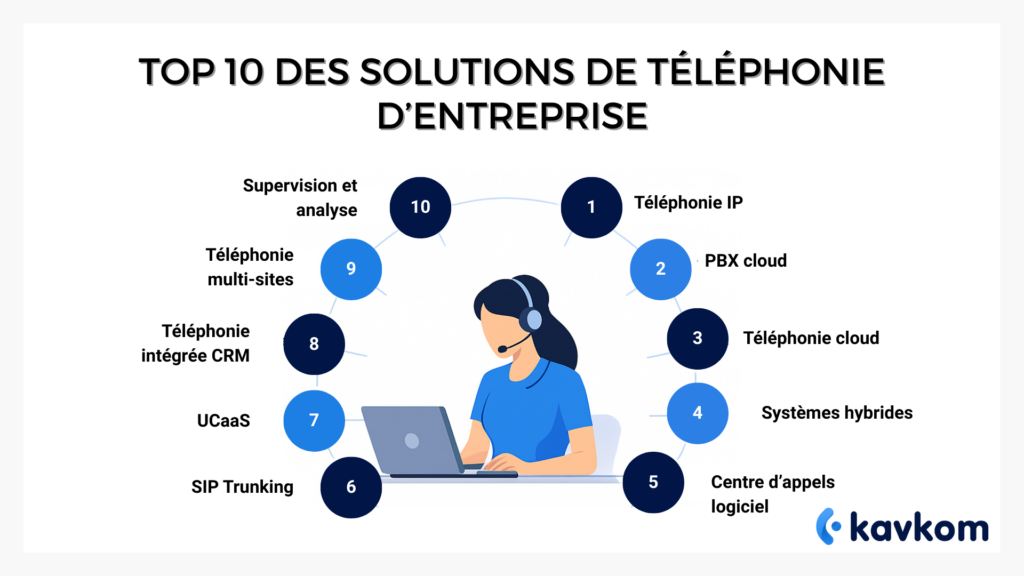
By exploring the ten main solution families, you now have a complete picture of the options available. Each approach addresses a specific need. The key is to identify the solution that fits your structure, your priorities and your organization.
By adopting enterprise cloud telephony, you can offer your teams a more flexible, responsive environment that’s better adapted to their day-to-day needs.