
At every customer relations conference, new concepts emerge: AI, voice bots, chatbots, automation. And each tool promises to transform the way your customers contact you.
But when it comes to making a concrete choice for your call center, the questions get overwhelming. Which technology really enhances the customer experience? Should you bet on artificial intelligence or stick with tried-and-tested solutions?
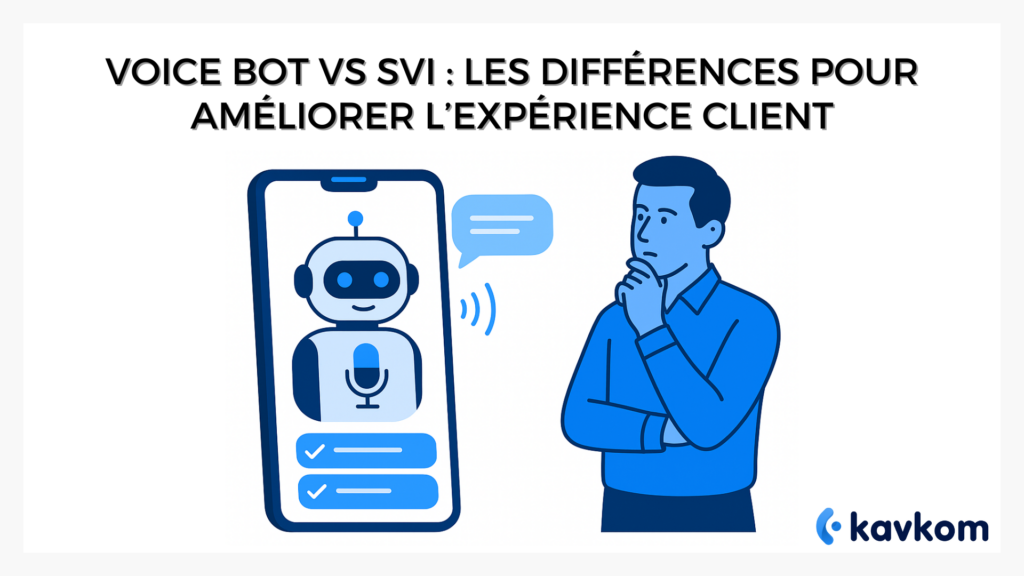
In this article, we’ll decode the differences between voice bot and interactive voice response (IVR). You’ll see how each works, its strengths and limitations, and above all: which one best meets the real expectations of today’s customers.
Points to remember :
- A voice bot dialogues in natural language thanks toAI, and is particularly suitable for high volumes, repetitive requests and multilingual contexts.
- The IVR structures telephone reception and quickly directs calls. Its strength lies in its simplicity, stability and rapid implementation for contact centers that want to automate without losing the human touch.
- The cost of a voice bot depends on the model and on ongoing training.
- The best choice is often a hybrid: combining IVR for sorting and speed, and targeted AI bricks where they bring real value.

What is a Voice bot?
A voicebot is a conversational voice assistant powered byartificial intelligence (AI). It understands spoken requests through natural language processing (NLP ) and responds in real time.
The process is based on three technological building blocks:
- Voice recognition. The caller’s voice is converted to text.
- Linguistic analysis. The bot understands intentions and extracts relevant keywords.
- Voice synthesis. It rephrases a natural, fluent spoken response.
Each conversation enriches its database. As it interacts, the voice bot refines its understanding of human language.
The advantages of the voicebot
The voice bot handles hundreds of simultaneous calls without breaks or overload. It responds to simple requests, leaving complex cases to human agents.
Its main assets:
- 24-hour availability for customers.
- Personalized responses based on CRM data.
- Automatic data collection for reporting and supervision.
It’s a virtual assistant designed to streamline customer relations and reduce the workload on human teams.
Voice bot limits
On the other hand, the voice bot remains dependent on the data and its quality.
Training a voice bot requires time, testing and regular adjustments.
Each interaction consumes technical resources. Costs increase with the number of calls and the complexity of exchanges.
And despite its progress, it remains limited in its ability to understand emotions and context.
AI does not yet replace the intuition of a human advisor. It automates, but does not improvise.
What is Interactive Voice Response (IVR)?
Visit interactive voice response (IVR)is the automated telephone answering service we’re all familiar with. A voice guides the caller through a voice menu to the right service.
Unlike the voice bot, the IVR doesn’t try to “converse”. It guides, filters and structures incoming calls.
How an IVR works
The principle is simple:
- The customer calls your business number.
- The IVR broadcasts a greeting and offers several choices.
- The caller selects an option (by pressing a key or using a keyword).
- The call is transferred to the right department or a suitable message.
What a modern IVR does
| Function | Profit |
|---|---|
| Customizable menus | Adapting to the customer journey |
| Automatic routing | Less waiting and fewer errors |
| CRM integration | Data available before stall |
| Hourly messages | Smooth closure management |
| Call statistics | Precise performance monitoring |
The benefits of IVR
The IVR impresses with its ease of installation and stability. It requires neither AI training nor custom development.
It can handle a large number of calls without the need for additional staff. Agents save time, and every customer is greeted in the same way, whatever the time of day or volume of calls.
A solution like Kavkom lets you create an IVR in just a few minutes, with graphic configuration, personalized messages and automatic redirections.
The limits of IVR
IVR doesn’t have the flexibility of a conversational bot.
It’s based on a fixed script: if the request goes outside the box, the call is redirected to a human.
But this simple structure remains an asset. It guarantees a smooth, predictable experience, with no misinterpretations or AI-related costs.
VoiceBot vs. IVR: the real differences
The two technologies share the same objective: to improve call management and relieve teams.
But their logic of action differs profoundly.
Voice Bot vs. IVR
| Criteria | Voice Bot (AI) | IVR (classic / cloud) |
|---|---|---|
| Technology | AI, NLP, speech recognition | Menus and audio scripts |
| Personalization | Dynamic, data-dependent | Controlled and predictable |
| Implementation | Long and costly | Quick and easy |
| Customer experience | Natural, sometimes unstable | Smooth and consistent |
| Maintenance | Continue | Minime |
| Human contact | Optional | Direct and reassuring |
Things to remember
The voicebot seduces with its futuristic look and potential for personalization.
The IVR seduces with its stability and accessibility.
One relies on artificial intelligence, the other on operational logic.
And in many companies, this pragmatic logic remains what best serves the customer experience.
When to choose a Voice Bot, when to use an IVR?
Choosing between a voice bot and an IVR depends on your business, your call volumes and how much room you want to leave for the human element in your customer service.
Voicebots are ideal for organizations handling large numbers of repetitive or multilingual queries. It ensures a consistent welcome, even when teams are small.
When voice bot makes sense
- You manage an international contact center.
- Your requests are simple, standardized or seasonal.
- You have a technical team to monitor the tool and train its AI.
The voice bot helps to absorb peaks in activity without human overload. It can also act as a filter before an agent takes over.
When IVR remains the best option
The IVR is perfect for SMEs and call centers that want to automate without losing the human link.
It’s a lightweight, stable solution that’s quick to deploy, suitable for structures that place a premium on conversational quality.
Agents save time, customers get a faster response.
Typical use cases
Voice bot: multilingual after-sales service, automatic order tracking, interactive voice forms.
IVR: company reception, management of opening hours, redirection to internal services, intelligent voice messaging.
So it’s not just a matter of choosing the latest technology, but the nature of your customer interactions.
The limits of Voice Bot and the real costs of AI
Artificial intelligence impresses with its capabilities, but its deployment comes at a price.
Every call handled by a voice bot relies on servers, models and calculations. And as call volume rises, so do costs.
The invisible costs of voice AI
Cloud licenses, model maintenance and upgrades all weigh heavily on the bill.
Added to this is the time needed to train the bot in your business vocabulary.
Mistakes are still common
Even when trained, a voice bot can make mistakes.
An unusual accent, a blurred sentence, background noise… and comprehension collapses.
The customer, frustrated, asks for a human or hangs up.
Research confirms this trend.
According to PwC, 82% of customers want more human interaction in their support journey.
The real issue is not the technology itself, but how it is used.
Effective customer service combines automation and empathy, not one at the expense of the other.
Modern IVR: efficient automation with a human touch
The modern IVR is nothing like the switchboard of yesterday.
Hosted in the cloud, it integrates with your business tools and supports your teams in real time.
A tool for your advisors
Connected to your CRM, it automatically identifies the caller, retrieves his or her history and transmits the information to the agent.
Result: fewer repetitions and faster handling.
The IVR becomes an intelligent routing assistant.
It filters out simple calls, collects useful data and leaves advisers to deal with situations with a high human value.
What a modern cloud IVR can do
- Context-sensitive routing by service, language or availability.
- Live supervision to monitor volumes and performance.
- Automatic statistics to measure waiting time and resolution rate.
Technology supports human work without ever replacing it.
IVR simply creates the conditions for a more efficient exchange, where technology supports dialogue rather than replacing it.
In short: choose the technology that serves your customers
The voice bot represents the quest for total autonomy.
The IVR embodies controlled automation, designed to serve teams and customers alike.
One shines for its ability to dialogue, the other for its reliability and simplicity.
But in both cases, the real challenge is not to replace your advisors: it’s to give them back time for the exchanges that count.
- The voice bot is ideal for high-volume, multilingual structures.
- IVR remains the ideal solution for smooth, human automation.
- The future belongs to hybrid tools: systems that unite AI and human voice to deliver a more natural customer experience.
FAQ: everything you need to know about Voice Bots and IVRs
Voice technologies often raise the same questions. Here are some simple, concrete answers to help you see things more clearly.
What’s the difference between IVR and voice bot?
The IVR follows a defined scenario: it directs calls via voice menus or telephone buttons.
The voice bot, on the other hand, understands phrases spoken in natural language and can conduct a mini-conversation thanks toconversational AI.
In short: the IVR guides, the voice bot dialogues.
Do modern IVRs incorporate AI?
Yes, partially. Some cloud IVR systems already integrate artificial intelligence bricks to recognize voice, prioritize calls or adapt menus according to the caller’s profile.
But their aim remains to simplify call management, not to replace the human agent.
Will voice bots replace human agents?
No. Customers still want to talk to a real person when their situation becomes complex or emotional.
Voice bots are designed to automate repetitive tasks and redirect calls, not to substitute for listening or empathy.
What’s the right solution for SMEs?
For most SMEs, IVR remains the best compromise between automation and proximity.
It can be installed quickly, without heavy infrastructure, and adapts to the size of the team.
Costs are kept under control, and the customer experience remains seamless.
Can an IVR be connected to a CRM?
Yes. A cloud IVR like Kavkom ‘s connects easily to your CRM (HubSpot, Salesforce, Pipedrive, etc.).
Customer records open automatically as soon as a call is received, enabling your advisors to respond faster and more accurately.
Conclusion: true innovation is the solution that serves your business
Too many technologies make customer relations more complex than they need to be.
Performance depends not on the sophistication of a tool, but on its ability to adapt to your operational needs.
Today’s successful companies are those that put people back at the heart of the conversation, while relying on simple, stable tools.
With a cloud-based IVR like Kavkom, automation becomes a proximity asset, not a substitute.
Your customers are heard, your agents save time, and every call finds its natural place.