

Business telephony has come a long way in recent years. On-site switchboards and traditional telephone lines are gradually giving way to more flexible solutions. Today, many companies use VoIP solutions, i.e. telephony that operates via the Internet rather than the traditional telephone network.
With VoIP, business calls can be made and received from a computer, IP phone or mobile application. Teams can work from different locations while using the same phone system. This approach also makes it possible to centralize call management, track team activity and connect telephony to business tools such as CRM.
But not all VoIP solutions are created equal. Features, ease of deployment, integrations and flexibility of offerings can vary greatly from vendor to vendor. In this guide, we’ll look at how a VoIP solution works, why companies are adopting it, and how to choose the platform best suited to your organization.
Points to remember
- A VoIP solution enables companies to make and receive calls via the Internet, without having to install a physical switchboard on their premises.
- It offers greater flexibility in the organization of communications: teams can use their business number from a computer, an IP phone or a mobile application.
- Modern VoIP solutions often include call management features such as cloud switchboard, call routing, activity statistics or CRM integration.
- They are particularly well-suited to sales teams, customer service teams and multi-site companies that have to manage large volumes of inbound and outbound calls.
- Some platforms, such as Kavkom, offer 100% cloud-based business telephony that can be activated quickly, without commitment, with features designed to structure team call management.

What is a VoIP solution?
A VoIP solution is a telephony system that enables calls to be made and received via the Internet, rather than the traditional telephone network. VoIP stands for Voice over IP. In concrete terms, voice is converted into digital data, then transmitted over the Internet before being converted back into an audio signal at the recipient’s end.
For the user, operation remains simple. Calls are made from a software interface, often called a softphone or webphone, or from an IP phone connected to the Internet. Teams can thus use a business number without relying on a physical phone line.
In a business context, a VoIP solution does more than just make calls. It generally brings together several communication management tools: cloud switchboard, call routing, conversation recording, activity statistics and CRM integration. The aim is to centralize call management and facilitate team work.
VoIP vs. traditional telephony
The main difference between VoIP and traditional telephony concerns the infrastructure.
With a traditional telephone system, the company uses telephone lines connected to a physical switchboard installed on the premises. Any modification to the system (adding an extension, configuring call forwarding, opening a new line) often requires technical intervention.
A VoIP solution works differently. The switchboard is hosted in the cloud. Users simply connect to the platform via the Internet to make or receive calls. Parameters can be modified from an administration interface, without on-site technical intervention.
This model provides greater flexibility for companies wishing to rapidly adapt their organization, deploy new lines or equip teams working remotely.
How does a VoIP solution work?
The principle behind a VoIP solution is quite simple.
When a user makes a call, their voice is picked up by their handset’s microphone. This voice is then converted into digital data and sent via the Internet to the recipient.
On arrival, this data is converted back into an audio signal, so that the other party can hear the conversation.
The whole process takes place in just a few milliseconds. For the user, the call works just like a conventional telephone call.
Within a company, this system is generally based on a telephony platform hosted in the cloud. Users connect to this platform via a web browser, an application or a compatible IP phone.
The components of a VoIP solution
A professional VoIP solution relies on several components to manage calls and organize corporate communications.
VoIP solutions assign business numbers that are not associated with a physical line.
These numbers can be used from different devices, as long as the user is connected to the Internet.
Companies can also keep their existing numbers thanks to portability.
Cloud switchboard
The switchboard is the system that organizes call management.
In a modern VoIP solution, this standard is hosted in the cloud. In particular, it enables :
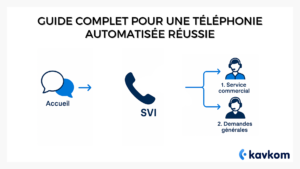
- create a voice menu (IVR)
- direct calls to different departments
- manage queues
- configure time-based rules
Everything is configured from an online administration interface.
Telephony applications (softphone or webphone)
Users make their calls via a software interface called a softphone. This interface can take various forms:
- browser-based web application
- software installed on computer
- mobile application
You’ll find all the classic phone functions: dial a number, put a call on hold, transfer a call or consult your call history.
Call management and analysis
Most VoIP solutions also include tools for monitoring and analyzing telephone activity.
For example, team managers can consult :
- call volume
- Drop-out rate
- average length of conversations
- agent availability
This data enables us to better manage our teams’ activities, particularly in sales departments and customer relations centers.
Why companies are adopting VoIP solutions
If VoIP telephony has become an established part of the business world, it’s not just to replace traditional telephony.
Above all, it’s a response to changing working practices. Teams are more mobile, organizations are changing faster, and companies need more flexible communication tools.
A VoIP solution enables business calls to be managed from a centralized platform, accessible via the Internet. Companies can deploy their telephone system rapidly, without the need for a heavy infrastructure or on-site technical installation.
But the benefits of VoIP don’t stop there. It also brings features that facilitate team work and business management.
Reduce telephony costs
With a traditional telephone system, companies have to manage several elements: telephone lines, physical switchboard, maintenance and sometimes technical interventions for each modification.
A VoIP solution is based on a cloud infrastructure. The company uses a software platform to manage its calls. This approach often reduces the cost of installing and maintaining the telephone system.
Pricing is also more flexible, depending on the provider. Some solutions, for example, offer no-commitment subscriptions or pay-as-you-go billing.
Flexibility and remote working
VoIP enables teams to use their business numbers from different devices and locations.
A salesperson can make calls from his or her office computer, then continue to use the same system from home or on the road. Calls remain associated with the company’s business number.
This flexibility facilitates the organization of work, particularly for hybrid teams or companies with several sites.
Centralized communications
A VoIP solution allows you to consolidate call management on a single platform.
Companies can :
- organize incoming calls
- distribute calls between different departments
- monitor team activity
- keep communication history
This centralization simplifies communications management and gives you better visibility of your telephone activity.
Better team management
In sales teams or customer relations centers, telephone calls account for a significant proportion of activity.
Modern VoIP solutions often include monitoring tools to track activity in real time: number of calls made, call times, response rates or agent availability.
This information makes it easier for managers to identify areas for improvement, and to support teams as they progress.
Integration with business tools
VoIP telephony can also be connected to other company tools, such as CRM.
When a customer calls, his or her details can be automatically displayed on the agent’s screen. Call-related information can then be recorded in the contact history.
This integration makes it easier to keep track of exchanges with customers, and avoids manual tasks such as entering information after each call.
VoIP solutions vs. traditional telephony: what are the differences?
For a long time, companies used telephone systems based on physical lines and switchboards installed on their premises. This model still works in some organizations, but is gradually becoming less adapted to new ways of working.
A VoIP solution is based on a different logic. Telephony is carried out over the Internet, and the phone system is generally hosted in the cloud. Users simply connect to a platform to make or receive calls.
This difference in infrastructure changes several aspects of how telephony works in the workplace.
Infrastructure
In a traditional telephone system, the company must install a physical switchboard (often called a PABX) and manage dedicated telephone lines.
With a VoIP solution, the switchboard is hosted in the cloud. Users access the platform via the Internet, without the need for on-site telephone equipment.
This approach makes it easier to deploy a telephone system and modify its configuration without any technical intervention on the premises.
Flexibility
Traditional telephone systems are often more rigid. Adding a new extension or changing the switchboard configuration can require technical intervention.
With a VoIP solution, these changes can usually be made directly from the platform’s administration interface. Companies can thus add new users or adapt their organization more quickly.
This flexibility is particularly useful for companies with multiple sites or who use telecommuting.
Scalability
VoIP solutions are designed to grow with the business.
As a team grows, new users can be added in a matter of minutes. Conversely, some organizations can also reduce the number of lines, depending on their activity.
This model is often better suited to fast-moving companies or those wishing to retain a degree of organizational flexibility.
Quick comparison
Here are the main differences between a VoIP solution and a traditional business telephone system.
| Traditional telephony | VoIP solutions |
|---|---|
| On-site standard | Cloud switchboard |
| Physical telephone lines | Internet calls |
| Technical configuration | Parameter setting from an interface |
| More complex user addition | Fast user addition |
Today, many companies are turning to VoIP solutions to benefit from a more flexible, easier-to-manage telephone system.
Key features of a modern VoIP solution
A VoIP solution doesn’t just replace a traditional telephone line.
In most companies, it becomes a communications management tool used on a daily basis by sales teams, customer support or administrative departments.
Cloud telephony platforms therefore offer several features that help organize calls, improve team productivity and track activity.
Here are the main features of a professional VoIP solution.
Cloud switchboard
The switchboard is the heart of the system.
In a VoIP solution, it is hosted in the cloud rather than in equipment installed on the company’s premises.
This switchboard manages the reception of incoming calls and organizes their distribution. For example, a company can configure :
- a welcome voice menu
- call transfers to different services
- queues
- rules for opening hours
The entire system is configured via an online interface, with no on-site technical intervention required.
Intelligent call routing
Call routing automatically directs calls to the right person or team.
Depending on the configuration, a call can be directed according to several criteria:
- agent availability
- department concerned
- caller’s language
- order of priority
This organization reduces waiting times and improves incoming call management.
Virtual business numbers
VoIP solutions make it possible to assign business numbers that operate via the Internet.
These numbers can be used from different devices. A user can, for example, receive a call on his office computer and then continue the conversation from his mobile application.
Companies can also obtain numbers in different countries to facilitate exchanges with international customers or partners.
Call recording
Conversation recording is often used in sales teams or customer service departments.
In particular, it allows you to :
- analyze certain interactions
- train new employees
- check the quality of exchanges with customers
Recordings are generally stored in the cloud and accessible from the telephony platform.
Statistics and activity monitoring
Modern VoIP solutions offer dashboards for monitoring telephone activity.
Team managers can consult various indicators, such as :
- number of incoming and outgoing calls
- drop-out rate
- average call duration
- activity by user
These data enable us to better understand the activity of our teams and identify periods of heavy workload.
Tools for call campaigns
Some VoIP solutions also include features dedicated to sales teams.
There are, for example, automatic dialing tools that can be used to launch outgoing call campaigns from a list of contacts. These tools can help teams string calls together more efficiently and reduce the time spent between two conversations.
These functions are particularly used in prospecting activities or in customer relations centers.
Who is a VoIP solution for?
A VoIP solution can be used in many business contexts. As soon as a company handles a regular volume of calls, cloud telephony can simplify the organization of communications and improve business monitoring.
Usage varies according to company size and the nature of customer exchanges. Some sectors use VoIP primarily to manage incoming calls, while others rely on telephony to manage outgoing call campaigns.
Here are the company profiles for which a VoIP solution is particularly well suited.
Sales teams
In sales teams, the telephone remains a central tool for prospecting, chasing up prospects or talking to customers.
A VoIP solution enables sales reps to make calls from a single interface and access various information during the conversation, such as exchange history or notes associated with a contact.
Sales managers can also monitor team activity using call statistics and dashboards. This gives a clearer picture of call volumes, communication times and response rates.
Customer services and customer relations
Support or customer relations teams often receive a high volume of incoming calls.
A VoIP solution allows you to organize the reception of these calls with a range of functions: voice menu, call distribution between agents, queues or even forwarding to another department if necessary.
Managers can also analyze certain conversations or consult activity statistics to identify areas for improvement in the management of customer requests.
SMEs and growth companies
For SMEs, VoIP telephony means you can set up a professional telephone system without having to deploy an on-site technical infrastructure.
Companies can quickly equip their teams and adapt the configuration as they grow. Add a user, create a new service or modify call routing rules directly from the platform.
This flexibility is particularly useful for fast-moving structures.
Multi-site companies
Companies with several offices often need to manage communications between different departments or sites.
A VoIP solution enables telephony to be centralized on a single platform. Teams can then use the same system, regardless of their location.
Calls can be routed to the right department, even if employees work in different offices or remotely.
How to choose the right VoIP solution for your business
Not all VoIP solutions offer the same features or the same level of ease of use. Before choosing a platform, it’s a good idea to identify your company’s real needs and the way your teams use the telephone on a daily basis.
A sales team making several hundred calls a day will not have the same expectations as a customer service department handling mainly inbound calls. The choice of a VoIP solution must therefore take into account the company’s organization, call volume and the tools already in use.
Here are the main criteria to analyze before choosing a solution.
Simple deployment
Some telephony solutions still require complex technical installations or time-consuming configurations.
Cloud telephony platforms are generally simpler to deploy. Users can create their accounts, configure their numbers and start making calls from a web interface.
For companies, this simplicity means they can quickly equip their teams and avoid on-site technical interventions.
Team-friendly features
The functionalities offered by a VoIP solution must match the needs of your teams.
In a sales or customer relations context, certain functions are particularly useful:
- inbound and outbound call management
- automatic call routing
- conversation recording
- business statistics
- tools for call campaigns
These functions help structure telephone activity and facilitate performance monitoring.
Integration with existing tools
Telephony is often used alongside other tools, such as CRM.
A VoIP solution that integrates with these tools can connect calls to customer information. For example, a contact’s record can be displayed automatically when a call comes in.
This connection eliminates the need for manual tasks, and enables teams to quickly retrieve the history of exchanges with a customer or prospect.
Flexible offers
Pricing models may vary between VoIP solution providers.
Some platforms work with long-term contracts, while others offer more flexible packages. For a company, the ability to easily add or remove users can be an advantage, especially as teams evolve.
The flexibility of the offer also enables the telephone system to be adapted to periods of greater or lesser activity.
Support quality
Telephony remains a critical tool for many companies. In the event of a technical problem, it is important to be able to contact competent support quickly.
Before choosing a VoIP solution, it’s a good idea to check out the support conditions on offer: availability of support, documentation, assistance with configuration, and support for system upgrades.
Responsive support can make all the difference in the day-to-day use of the platform.
Example of a VoIP solution for businesses: Kavkom
Among the VoIP telephony solutions used by businesses, some platforms are designed to meet highly operational needs. Such is the case with Kavkom, a 100% cloud-based enterprise telephony solution that enables teams to manage their calls from a centralized platform accessible via the Internet.
The solution works without the need to install a telephony infrastructure on the premises. Users can make and receive calls from a web browser, application or compatible IP phone. This approach makes it possible to rapidly deploy a professional telephone system and equip teams spread over different sites or working from home.
Kavkom is primarily aimed at companies that use the telephone as a daily work tool, such as sales teams, customer services or customer relations centers.
Cloud telephony for operational teams
The Kavkom platform brings together several functions to structure call management within a company.
Teams can use :
- a cloud switchboard to organize incoming calls
- business numbers that can be used from a variety of devices
- supervision tools to monitor team activity
- call recording for analysis or training purposes
These features enable team managers to monitor telephone activity and more easily identify areas for improvement.
Tools for sales teams
Some features are particularly useful for teams with a high volume of outgoing calls.
Kavkom, for example, offers tools that enable call campaigns to be launched from a list of contacts, and calls to be chained together more easily. Managers can then track team activity using call statistics and dashboards.
These tools are often used by prospecting teams or customer relations centers managing call campaigns.
A flexible solution for companies
The Kavkom solution is non-binding and can be activated quickly. Companies can add or remove users as their teams grow.
Billing can also be adapted to usage, enabling companies to adjust their phone lines according to their activity.
This type of operation may be of interest to organizations wishing to retain a degree of flexibility in their telephony management.
FAQ : VoIP solution
What is a VoIP solution?
A VoIP solution is a telephony system that enables calls to be made and received via the Internet. The voice is converted into digital data, then transmitted over the Internet before being converted back into an audio signal at the other party’s premises.
A company’s VoIP solution generally includes several tools: cloud switchboard, inbound and outbound call management, activity statistics and CRM integration. The aim is to centralize communications management and facilitate teamwork.
What’s the difference between VoIP and traditional telephony?
Traditional telephony is based on physical telephone lines connected to a switchboard installed on the company’s premises.
With VoIP, calls are made over the Internet. The phone system is usually hosted in the cloud, and users connect to a platform to manage their calls. This approach makes it easier to change system configuration, and to rapidly equip new users.
Does a VoIP solution require hardware?
No. Most VoIP solutions can be used directly from a computer or smartphone via an application or softphone.
Some companies also use VoIP-compatible IP telephones, but this equipment remains optional. In a cloud telephony system, the switchboard is hosted online and requires no equipment installed on the premises.
Can VoIP be used for teleworking?
Yes. A VoIP solution enables employees to use their business number from any location with an Internet connection.
Calls can be made from a PC, mobile application or IP phone. This means that teams stay on the same phone system, whether they’re working in the office, at home or on the road.
Is a VoIP solution right for customer relations centers?
Yes. Customer relations centers often use VoIP solutions to handle high volumes of inbound and outbound calls.
These platforms can be used to organize the distribution of calls between agents, monitor activity in real time, record certain conversations and analyze call statistics. These functions facilitate communications management and team supervision.
How much does a VoIP solution cost?
The cost of a VoIP solution generally depends on the number of users and the features included in the platform.
Some solutions offer monthly subscriptions per user. Others offer more flexible formulas with integrated functionalities for sales teams or customer services. Before choosing a solution, it’s a good idea to compare functionality, contractual terms and ease of deployment.
Conclusion
VoIP solutions have gradually established themselves as a mainstream telephony system for businesses. By using the Internet rather than the traditional telephone network, organizations can deploy their telephony faster and centralize call management on a single platform.
A VoIP solution can also go beyond simple calls. Companies can organize call reception, monitor team activity, record certain conversations and connect telephony to business tools such as CRM. This approach facilitates the work of sales teams, customer support teams or departments handling large volumes of calls.
Before choosing a solution, it’s a good idea to identify your company’s real needs and how your teams use it. Some platforms, such as Kavkom, offer 100% cloud-based enterprise telephony that can be used without an onsite telephony infrastructure, with features tailored to operational teams and flexible configuration as organizations evolve.