
Fortunately, times have changed. Today, it’s much easier for a company to attract customers across the country, or even halfway around the world, thanks to the cloud telephony.
It’s hardly surprising that companies are taking a keen interest. Customers are far more likely to call a local number than a long, equation-like string of numbers. It’s all about perception, proximity and trust. Not to mention the cost savings.
In this article, you’ll see how numbering works in Martinique, why a local number simplifies your business exchanges, and how to get your own Martinique number, step by step.
Points to remember :
- Cloud telephony makes it possible toobtain and manage a number in Martinique remotely, without a physical presence on site.
- A local number reinforces trust and proximity: customers are more likely to pick up the phone when they recognize a familiar area code.
- Virtual numbers offer unified communication, real-time supervision and budget flexibility, ideal for multi-site or international businesses.

Numbering in Martinique: understanding the structure of the local telephone plan
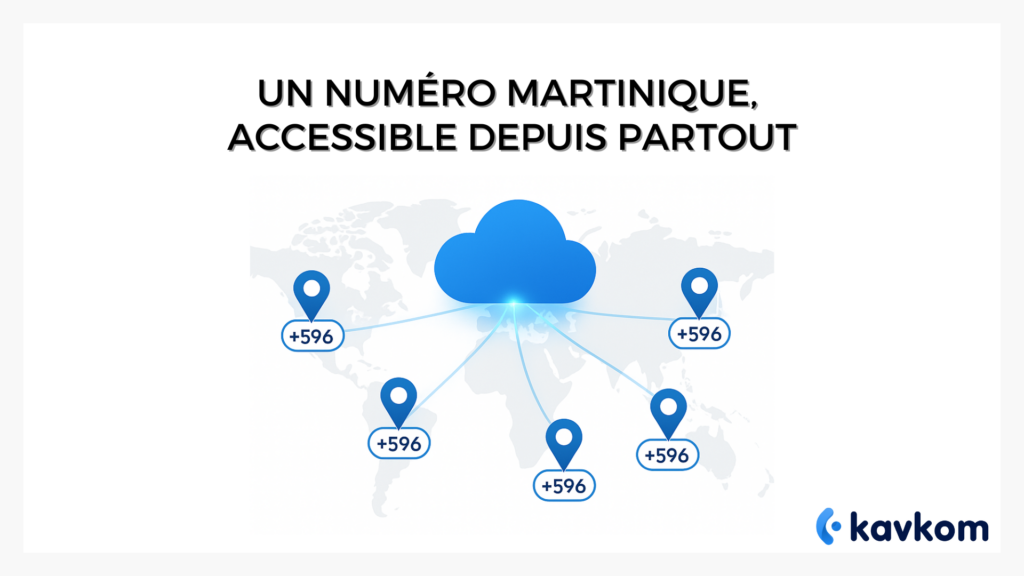
Martinique is an integral part of the French territory, but its telephone system retains its own identity: the +596 area code.
In 2001,Arcep reorganized numbering in the French overseas departments to bring itinto line with metropolitan France.
The aim? To adopt a ten-digit system and bring the French overseas departments into line with European standards.
However, for technical and geographical reasons, it was not possible to assign the +33 country code to the overseas territories.
The region’s telephone networks were already closely interconnected with their neighbors (the Caribbean for Martinique, for example), and a complete overhaul of international routing would have been too complex to implement.
Arcep has therefore opted for a hybrid approach: the same numbering logic as in mainland France, but with separate country codes for each département.
Since the reform :
- Martinique landline numbers begin with 05 96;
- mobiles use the 06 96 series;
- and from abroad, dial +596 596 XX XX XX for landlines, or +596 696 XX XX XX for mobiles.
From mainland France, a call to Martinique is simply dialed with +596.
From the island, to reach a mainland number, simply dial the usual ten digits; no international dialing code is required.
This is what makes cloud telephony so practical: it relies on a structure that is already compatible with French and international standards.
In brief
| Call type | Local format | International format |
|---|---|---|
| Landline | 05 96 XX XX XX | +596 596 XX XX XX |
| Mobile | 06 96 XX XX XX | +596 696 XX XX XX |
| From Martinique to mainland France | 0X XX XX XX XX | — |
Why use a Martinique number for your business calls?
Customers have a simple reflex: they’re more likely to answer a local number than a string of foreign digits.
A familiar prefix inspires confidence. It evokes proximity, service and mutual understanding.
A company based in Lyon or Lille that displays a Martinique number doesn’t change its infrastructure: it just changes the perception of its interlocutors.
For a customer located in the West Indies, seeing +596 appear on his screen is the assurance of speaking to someone who knows his context and his schedule.
A strategic tool
This flexibility goes beyond customer service customer service
A company can choose several numbers according to its strategy: one number per geographical area, per product range or even per language spoken.
It’s a simple way of making communication more fluid and accessible, without multiplying structures.
With cloud telephony, everything can be managed from a single dashboard: incoming calls, redirections, messaging, statistics.
Technical constraints disappear, leaving only the essential: the quality of the conversation.
Obtain and deploy a Martinique number in 3 steps
Step 1: Choose a system capable of bringing it to life
Before thinking about the number itself, you need a system that brings it to life.
Old analog lines don’t allow you to activate a number remotely or manage it across multiple devices.
With cloud telephony, everything is done online: a number can be created, configured and used from anywhere.
This is what Kavkom offers, a 100% cloud platform designed for businesses.
No installation, no hardware: all you need is a simple Internet connection.
You activate your Martinique number in +596, decide where it rings, and control it from a single interface: computer, mobile or IP phone.
Incoming, outgoing and redirected calls are centralized; teams can work remotely while remaining contactable as if they were sharing the same office.
A single tool, a single logic: conversation becomes fluid and continuous.
Step 2: Select your number (+596 landline or mobile)
Once the solution is in place, the next step is to choose the type of number.
Two formats are possible:
- Fixed (05 96): evokes the stability of a local office and is ideal for a customer service or sales switchboard.
- Mobile (06 96): more flexible, it reinforces the image of proximity and responsiveness – ideal for mobile or hybrid teams.
With Kavkom, there’s no need to be physically present in Martinique: the number is reserved online, and activation is almost instantaneous.
You can even combine the two: a landline for credibility, a mobile for availability.
Step 3: Configure, connect, monitor
This is where cloud technology reveals its full potential.
Everything is controlled from a centralized dash board: routing, redirections, schedules, messaging, statistics.
You can :
- configure time-based routing, so that calls are redirected according to opening times;
- set up an IVR (Interactive Voice Response) to direct each call to the right person;
- activate professional voicemail outside office hours ;
- connect to your CRM (HubSpot, Salesforce, Zoho, Pipedrive…).
Here’s a concrete example:
An SME in Marseille manages its West Indies support from a +596 telephone number.
Incoming calls are routed by the IVR: sales to Bordeaux, maintenance to Paris.
For the customer, the experience is totally local: he dials a Martinique number and immediately receives a suitable response.
In short: the right settings mean fewer lost calls, greater responsiveness, and a stronger image of proximity.
Thanks to real-time supervision Kavkom’s real-time monitoring system, managers can track key indicators: response rate, average call duration, call-backs, quality of exchanges.
Every call becomes usable data to improve customer relations.
And all without hardware: a web browser is all you need to pick up, transfer or analyze your communications, wherever you are.
Summary
| Step | Action | Results |
|---|---|---|
| 1 | Choosing a cloud system (Kavkom) | Remote activation possible |
| 2 | Select a landline or cell phone number | Ready-to-use telephone code 596 |
| 3 | Configure and connect your tools | Centralized routing, CRM and supervision |
The concrete benefits of a virtual number (Martinique and beyond)
With cloud telephony, a company can manage all its calls (whether from Paris, Fort-de-France or Montreal) on a single platform.
This continuity, imperceptible to the customer, guarantees a smooth, seamless experience.
An immediate local presence, everywhere
A virtual number makes it possible to be present in several countries or regions without being physically there.
It’s a lever for proximity: customers see a number they recognize and call without hesitation.
For example, a metropolitan company selling in the West Indies can activate a +596 number for its Martinican customers, and another +590 for Guadeloupe, and manage them all from its head office.
The experience for the customer remains local; for the company, everything is centralized.
In short: a virtual number means an office in Fort-de-France without having to cross the Atlantic.
Unified, borderless communication
Calls, voice messages and recordings are no longer scattered across several lines.
Everything is brought together in a single interface, accessible to every employee.
Teams are more responsive: a sales representative can call back a customer from his laptop, a support agent can answer from his cell phone.
The company can be reached at any time, wherever it is.
Real-time supervision
The value of a virtual number doesn’t stop at receiving calls.
It’s also a management tool.
Managers can use clear dashboards to monitor response rates, average call duration and activity times.
This data can be used to adjust staffing levels, identify peak times and improve service quality.
A missed call is no longer a fatality: it becomes measurable, analyzable and correctable.
Tip: call statistics are often the mirror image of customer satisfaction, and the more transparent they are, the faster you’ll make progress.
Total cost control
Cloud telephony requires no hardware, no maintenance, and no long-term commitment.
At Kavkom, billing is prorated, and lines can be paused at any time.
It’s a flexible model, designed for fast-moving businesses.
For example, a seasonal call center can activate ten lines for the summer, then suspend them in September, paying only for what it uses.
A direct impact on image and confidence
Customers no longer perceive your company as “remote”, but as accessible and available.
A local number inspires confidence; smooth service builds loyalty.
In the West Indies as elsewhere, calls are the first impression: that of a close, professional brand.
A company that invests in cloud telephony shows that it is banking on the quality of the relationship, not just the technology.
FAQ : everything you need to know about the Martinique number
Which country corresponds to +596?
Phone numbers starting with +596 refer to Martinique, a French overseas department and region.
Although it has a separate country code, it is fully part of France.
How do I make a call from Martinique to mainland France?
Calls between Martinique and mainland France are charged at the national rate.
Simply dial your correspondent’s ten-digit number, with no international code or surcharge.
Do I have to be based in Martinique to get a local number?
No. Thanks to cloud telephony, you can activate a number in Martinique remotely, wherever you are.
Everything is done online, with no on-site hardware or installation required.
Can I manage several numbers from the same account?
Yes. Cloud platforms like Kavkom allow you to manage multiple numbers simultaneously (metropolitan France, DOM or international) from a centralized interface.
You can track your calls, statistics and recordings for each line, in real time.
Conclusion
For businesses, cloud telephony changes everything.
They can work with their customers in Martinique as if they were on site.
A simple local number is all it takes to build trust.
Thanks to cloud telephony, everything becomes more fluid: rapid activation, remote management, CRM integration, real-time statistics.
A company based in Paris can manage its Martinique customer service in just a few clicks, without any complex infrastructure.
Kavkom is fully in line with this dynamic: a platform that centralizes all your numbers(France, DOM or international) in a single workspace.
You gain flexibility, visibility and consistency, while offering your customers the proximity they expect.