
But while some came to the cloud out of necessity, the majority stayed out of conviction. The simplicity and flexibility of a model without heavy infrastructure (no maintenance, lower costs, just an Internet connection) quickly won them over.
This guide will show you how CCaaS helps companies reduce costs, increase agility and deliver a seamless seamless customer experiencewhatever the context. Because you don’t need a crisis to move towards greater efficiency and flexibility.
Points to remember :
- CCaaS(Contact Center as a Service) moves contact centers into the cloud, simplifying call, channel and team management, while reducing technical costs.
- This flexible, scalable model means you can adjust team size or functionality on demand, without tying up budgets or relying on complex maintenance.
- The cloud promotes a seamless customer experience: voice, e-mail, chat and social networks converge on a single interface, accessible from anywhere.
- By integrating with CRM and business tools, CCaaS provides a 360° view of the customer and facilitates collaboration between sales, support and marketing departments.
- Beyond technology, CCaaS embodies a new customer relations culture: more agile, more human and fully adapted to today’s digital pace.

CCaaS: what is a cloud-based contact center?
Definition and operation
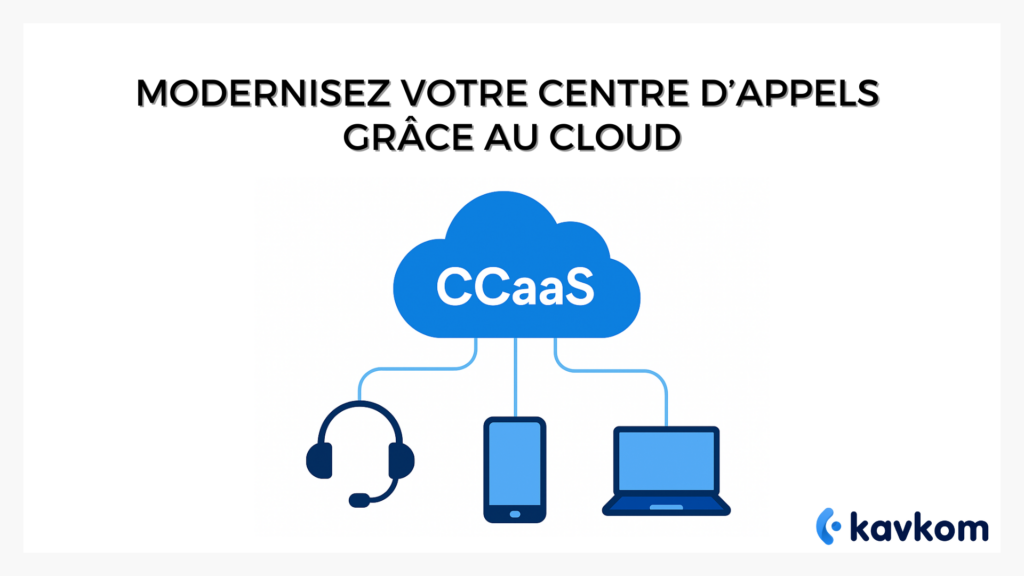
CCaaS, or Contact Center as a Service, is a contact center solution hosted in the cloud.
In concrete terms, all the functions of a traditional call center (reception, routing, supervision, statistics) are accessible online, without local installation.
Instead of expensive hardware and servers to maintain, everything goes through a secure web interface. Agents connect from their PC, IP phone or mobile, wherever they are. Companies benefit from complete telephony without physical infrastructure, with automatic updates and vendor-managed hosting.
Why companies are moving to the cloud
Migration to the contact center cloud is a response to new needs: mobility, cost reduction and better business continuity.
Companies want to be able to add or remove agents with just a few clicks, monitor performance in real time, and integrate their business tools such as CRM or messaging.
The cloud offers this agility without tying up budget or relying on an in-house technical team. Above all, it opens the door to smoother customer relationship management: less rigidity, more availability.
According to Gartner, by 2028, over 50% of companies will be using industry-specific cloud platforms to accelerate their business initiatives. Proof that the cloud is now at the heart of corporate strategies. This includes contact centers, which are looking for greater flexibility and responsiveness.
The benefits of a CCaaS solution for your contact center
Controlled costs and total flexibility
Adopting a CCaaS solution means rethinking the economic structure of your contact center.
Subscription replaces purchase. Upgrades are included. And you only pay for what you use. This pay-as-you-go model frees companies from the maintenance and technical investments that used to tie up their budgets.
But flexibility goes even further. You can resize your teams in real time, open a new queue for a campaign, or close a few jobs during quiet periods. The cloud adapts to your pace, not the other way around.
In a nutshell:
| Expense item | Classic call center | CCaaS solution |
|---|---|---|
| Maintenance | Annual contract | Included |
| Updates | What to expect | Automatic |
| Number of agents | Complex | Just a few clicks away |
| Remote access | Limited | Everywhere, via the cloud |
Better service quality
Customers, especially Millennials and Generation Z, want immediate, personalized and secure answers. For them, good service is no longer a luxury, but a fundamental requirement.
In this context, companies need to keep pace. CCaaS gives them the means to do so. By bringing together voice, e-mail, chat, social networking and SMS in a single space, it creates a seamless experience.
Every interaction becomes actionable data: a satisfied customer, a better prepared agent, an enriched conversation. And thanks to real-time supervisiona manager can adjust the workload, spot a queue that’s too long, or support an agent in difficulty.
Quick tip:
Monitor three key indicators to measure the fluidity of your exchanges:
- response rate (speed),
- average waiting time (comfort),
- first contact resolution rate (efficiency).
CCaaS enables you to monitor them continuously. And make them progress day after day.
Integration with business tools
A contact center doesn’t live in isolation. It is integrated into an ecosystem of tools: CRM, messaging, ERP, marketing automation.
This is where CCaaS makes the difference.
Thanks to its open APIs, it connects easily to your existing stack. Every call, every message, every interaction is automatically recorded in the CRM customer file. The result: a 360° view of the customer journey, with no re-keying or loss of information.
For sales teams, it saves time. For managers, it’s a source of reliable data. And for the customer, the impression of being understood, without having to repeat everything.
In a nutshell:
A well-integrated CCaaS solution becomes the backbone of your communications: every channel, every tool, every customer connected to the same place.
Deploy and customize your CCaaS solution
Needs analysis: laying the right foundations
Before choosing your CCaaS solution, it’s important to understand what you want from it.
Every contact center has its own priorities: reducing waiting times, improving customer satisfaction, or simply enabling teams to work remotely.
Start by mapping your real needs.
How many calls do you handle per day? Which communication channels are essential (telephone, chat, e-mail, social networks)?
Do your agents need a connected CRM or advanced supervision tools?
This analysis phase enables us to determine the essential functionalities: intelligent routing, real-time statistics, CRM integration, interactive voice response (IVR), or outbound call automation.
Quick tip:
Involve your agents in this process. They can often spot the concrete adjustments that will make all the difference.
By accurately identifying your needs, you can avoid overly complex deployments and focus your budget on what really supports your objectives.
Choosing the right cloud provider
Once you’ve defined your needs, the question arises as to which provider you should choose.
And here, simplicity must come first. Your ideal partner is one who offers a cloud-based infrastructure that is reliable, intuitive and free of technical constraints.
Check three key points:
- Is the solution accessible from any device (computer, softphone, mobile)?
- Are updates and maintenance automatic?
- Is technical support responsive and available in French?
This is often where the difference between platforms becomes apparent.
Some impose lengthy contracts or hidden fees. Others take a more open, no-obligation approach, with human support readily available.
By choosing a CCaaS solution like Kavkom, you benefit from a state-of-the-art infrastructure, without the investment costs and maintenance associated with on-premise systems.
The SaaS(Software as a Service) model simplifies deployment andoperation: everything is managed online, with no installation or technical constraints.
This means you can concentrate on your core business, while providing high-quality customer service.
Technical settings and configuration
Once the supplier has been chosen, it’s time to get started.
This is where the CCaaS solution takes shape: configuration of numbers, creation of the Interactive Voice Server (IVS), definition of routing rules and queues.
Every step counts. Start by structuring your call tree: a main greeting, clear menus, then automatic routing to the right service.
A customer who reaches the right person the first time is already a successful experience.
Next, set up your channels: telephone, e-mail, instant messaging. They all need to converge on the same interface.
This is what enables your agents to keep track of customer interactions, regardless of the point of entry.
The final technical step is to connect the solution to your CRM. This integration is often simple, but it changes everything.
It centralizes exchanges, facilitates follow-up and feeds your dashboards with up-to-date data.
In a nutshell:
A good set-up means a fluid organization: every call arrives at the right place, every piece of data is updated automatically, and your teams can finally concentrate on customer relations, not technical matters.
Training and continuous improvement
Implementing a solution is all very well. Bringing it to life is better.
The success of a CCaaS deployment depends as much on the technology as on team training.
Start simple. Introduce agents to the interface, browser calls, transfers, messaging.
Then move on to more interactive sessions: listening to calls together, observing statistics, understanding key indicators.
Supervisory functions are invaluable for this. Thanks to double listening and whispering, supervisors can accompany an agent live, correct an answer or emphasize a good reflex.
The other pillar is data tracking.
Real-time dashboards allow you to monitor three key KPIs:
- the dropout rate,
- average treatment time,
- customer satisfaction.
These indicators become your compass for steering performance and adapting training courses.
Practical tip:
Schedule a regular debriefing with your agents.
Analyze the most complex calls together and let them suggest solutions. You’ll turn performance measurement into a collective learning experience.
8 steps to smooth deployment
- Analyze needs and existing channels.
- Choose the right cloud provider for your business.
- Configure routing numbers and rules.
- Create a clear, functional IVR.
- Connect the solution to CRM and business tools.
- Train agents in daily use.
- Monitor KPIs with real-time supervision.
- Adjust regularly according to results and customer feedback.
With this method, CCaaS becomes more than a tool: it becomes an evolving working environment.
Every adjustment, every update, every new idea contributes to a smoother, more human customer relationship.
FAQ – Everything you need to know about CCaaS
What is CCaaS and how does it work?
CCaaS(Contact Center as a Service) is a contact center solution hosted in the cloud. It brings together all communication tools – calls, e-mails, chat, social networks – on a single online platform.
Businesses access these services via a simple browser, with no hardware to install. Updates are automatic, and maintenance is managed by the provider.
What’s the difference between call centers and contact centers?
A call center only handles telephone calls.
A contact center, on the other hand, encompasses all communication channels: voice, e-mail, chat, social networks.
CCaaS evolves this model by centralizing these interactions in the cloud, for a more consistent, remotely accessible experience.
CCaaS vs UCaaS: complementarities?
CCaaS focuses on external customer relations – your exchanges with your customers.
UCaaS(Unified Communications as a Service) addresses internal communications – between your teams, your offices, your partners.
Together, they form a complete cloud communications ecosystem for the entire enterprise.
What technical prerequisites are required?
A CCaaS works with a stable Internet connection, a VoIP-enabled computer or phone, and a good-quality headset.
Everything else – hosting, updates, security – is taken care of by the provider.
What is the average cost according to company size?
Costs vary depending on the provider and the features chosen.
In general, a CCaaS solution operates on a per-user monthly subscription model, with no significant set-up costs.
This makes it an affordable option for SMEs and large organizations alike, with flexible and predictable billing.
Conclusion
CCaaS is not just a technology: it’s a new way of thinking about customer relations.
By centralizing tools in the cloud, it offers flexibility, real-time supervision and continuity of service, even remotely.
But the transformation goes beyond tools.
It marks the transition from a call management logic to a culture of customer experience, more fluid, more human and more connected to today’s expectations.
With Kavkom, this transition becomes simple: no technical constraints, no commitments, and human support every step of the way.
A natural step towards a modern, agile and future-ready customer service.