Two companies compare business telephony offers. One chooses on the basis of price. The other based on actual usage. Six months later, the first pays for options it doesn’t use, or finds itself blocked by what’s missing.
The problem with most comparisons is that they treat all businesses in the same way. A medical practice handling 80 appointment calls a day doesn’t have the same needs as a multi-site real estate agency or a telemarketing team. Yet they are often offered the same catalog, with the same features and the same vague promise.
This guide takes the problem in reverse: your industry, your call volume and your need for contractual flexibility first, then the choice of solution.
I recommend without hesitation
With Kavkom, I was able to easily resolve the issue of communication costs to my regular customers. My agents, too, were no longer restricted in their mobility, because even when on the move, communications are managed.

How about you?
Request a demo nowWhy choose business telephony according to your sector of activity?
A medical practice that handles 80 appointment calls a day has nothing in common with a real estate agency whose sales staff spend their days on the road. Yet both are often faced with the same catalog of offers, with the same packages, the same options, and the same promise: “everything is included”.
The problem is that “all-inclusive” doesn’t mean “tailored to your reality”.
A small service business that mainly receives inbound calls doesn’t need a predictive dialer. On the other hand, a telemarketing team making 200 outgoing calls a day will quickly suffocate with a basic switchboard. Choosing an enterprise telephony solution that doesn’t take business needs into account means either paying for features that will never be used, or getting stuck after three months because it lacks an interactive voice server or configurable call forwarding.
What changes everything is the reading grid. Before comparing rates or operator names, ask yourself four concrete questions:
- What is your daily volume of incoming and outgoing calls?
- Are your teams sedentary, mobile, or both?
- Do you need a structured telephone answering service with queuing and routing?
- Is your business seasonal (and therefore sensitive to pro rata billing)?
These answers provide a much more reliable usage profile than a generic comparison. A multi-site business that centralizes its calls on a single business number does not have the same constraints as a training center that has to integrate its cloud telephony with its educational CRM.
That’s exactly what this guide proposes: start from your sector, your constraints in the field, and work your way up to the right professional telephony, rather than the other way round.
Pro number, softphone, IP extension: understand the equipment before you choose
Before comparing offers or rates, there’s a prerequisite that many companies skip: understanding what they’re actually buying. The terms “fixed number”, “softphone”, “IP extension” cross paths in all the comparisons, but few take the time to distinguish them clearly. And that’s where the bad choices start.
First point of clarification: a VoIP business number is not a physical line. It’s a number (geographic or national) that transits the Internet via the SIP protocol. You can receive and make calls from this number without telephone wiring, without a conventional operator connection, and without dedicated hardware. It’s a distinction that many people still confuse: having a business landline number doesn’t mean having a landline phone sitting on a desk.
In practical terms, this number can be used on three types of equipment:
- Softphone: software installed on your computer or smartphone. It turns any device into a professional telephone, with call transfer, history and access to your phonebook.
- Webphone: same principle, but directly in your browser. No installation required, just pick up the phone from a Chrome tab. Handy for telecommuting teams or shared workstations.
- The physical IP phone: a classic office handset, but connected via VoIP. For those who prefer a real handset (and this is the case for many secretaries, receptionists or sedentary positions), it’s perfectly compatible with professional cloud telephony.
And here’s the point that few guides mention: with cloud telephony for business, none of this equipment is mandatory. You choose according to your needs. A field sales rep will use the mobile app, an assistant will prefer her IP extension, and a manager on the move will use the webphone. Kavkom supports all three modes at no extra cost, including the physical IP phone (an option often charged extra by other providers).
Operation is 100% cloud-based: no exchange to install on your premises, no technician to wait. Your virtual business number is active within minutes, whatever device you use to pick up the phone.
In short, the key to choosing the right phone system for your business is to know how your teams will actually make and receive calls on a day-to-day basis. The rest follows from this.

Comparison: which enterprise telephony solution is right for your business?
Each sector has its own call rhythms, urgencies and business tools. An e-retailer managing a spike in returns after the sales is not looking for the same thing as a consultancy firm whose telephone exchanges last 45 minutes and demand total confidentiality. Yet most comparisons treat business telephony by profession, as if all offices were alike.
What follows is broken down by sector, each time following the same thread: what call scenarios you experience on a daily basis, what features really count, and what equipment corresponds to your reality in the field.
E-commerce and Retail: managing call peaks
Your after-sales service is taking waves. Black Friday, sales, late delivery of an entire batch: incoming calls can triple in 48 hours. And when a customer calls about a lost parcel, they want an immediate response (67% of consumers prefer the phone for emergencies, according to industry data 2026).
What makes all the difference for an e-tailer is the ability to absorb these peaks without recruiting. A well-configured IVR directs callers to the right service (order tracking, returns, billing) even before an agent picks up. Intelligently managed queuing prevents customers from hanging up after 90 seconds of elevator music. And CRM integration enables the agent to display the order form from the very first ring.
In terms of equipment, a softphone with headset is all that’s needed for support agents. No need for a physical handset when your team works on screen all day. Kavkom natively integrates IVR, queuing and contact form feedback, with no additional modules to activate.
Health and Clinics: automate reception and reminders
In a doctor’s surgery or clinic, the telephone rings non-stop. Appointments, test results, administrative emergencies: the secretariat manages a constant flow, often with just one or two people. 72% of patients want immediate service, and in healthcare, a missed call can mean a lost appointment or a worried patient left unanswered.
The game-changing features here are intelligent routing (directing calls by specialty or practitioner), Robot Dialer for automatic appointment reminders, and RGPD compliance for patient data confidentiality. A well-configured clinical switchboard automatically switches to an out-of-hours message in the evening, without manual intervention.
For equipment: a physical IP phone at the reception desk (secretaries often prefer a real handset), and a webphone for teleworking administrative staff. Kavkom provides both at no extra cost.
Real estate and multi-site agencies: centralize while remaining mobile
A real estate agent misses a call during a visit, and a mandate goes to the competitor across the street. In real estate, telephone responsiveness is directly linked to sales. Prospects expect a call back almost immediately, even in the evenings and at weekends.
For multi-site corporate telephony, the priority is to centralize calls while leaving each agency reachable on its local virtual number. A prospect calling a Parisian number is connected to the Paris agency, even if the switchboard is managed from Lyon. Click-to-call from the real estate CRM eliminates the need for manual number entry, and saves considerable time for field sales staff.
The natural equipment here is the mobile application and the softphone. Agents are rarely behind a desk. With Kavkom, they call from their smartphone with the agency’s business number, not their personal number.
Call centers and prospecting: maximizing productivity
When the telephone is your business, every minute counts. A prospecting agent who spends 60% of his or her time listening to ring tones and answering machines is 60% less productive. For a team of 15 people, that means dozens of lost contacts every day.
This is precisely where Kavkom stands out. The native predictive dialer automatically dials several numbers simultaneously and only connects the agent when a prospect picks up. This is no mere power dialer: the system detects answering machines, manages time rules, and tracks agent-by-agent performance in real time. Withcall recording natively included, managers can replay exchanges for targeted coaching.
Equipment: webphone with professional headset. This is the most common VoIP call center setup, and means you can start a campaign in minutes, with no hardware to install.

Boost the productivity of your sales teams with Kavkom, the 100% cloud-based business telephony software.
Schedule a demo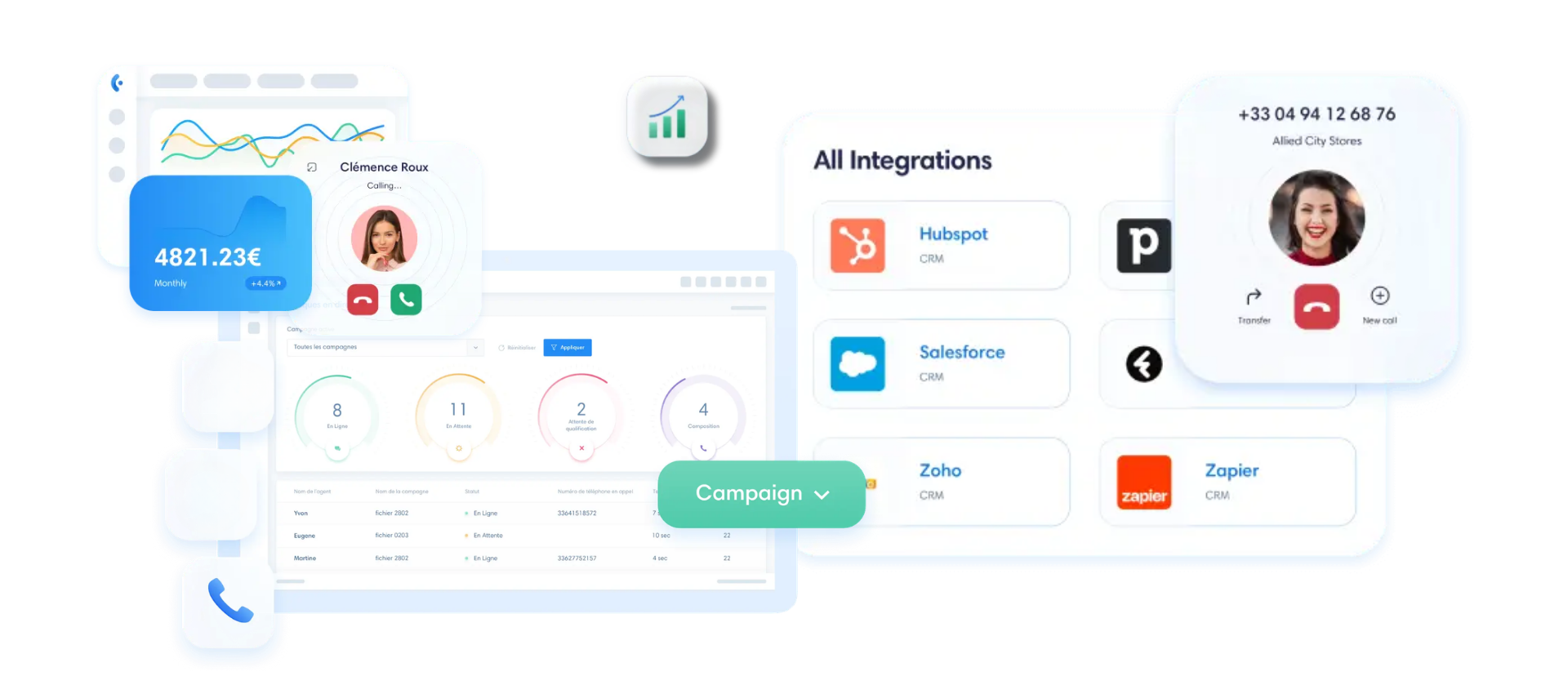
B2B Consulting and Services: professionalizing customer relations
A consulting firm, a lawyer, a chartered accountant: calls are fewer in number, but longer, more sensitive, and often decisive for the business relationship. 63% of B2B customers expect their contact to know their business before they even pick up the phone. If you don’t get the right answer on the phone, your firm’s credibility suffers.
The key features here are HD audio quality (essential for calls lasting 30 to 60 minutes), a professional IVR that guides callers without making them go round in circles, and above allnative CRM integration so that the customer record automatically goes up with every incoming call. Kavkom connects natively to Salesforce, HubSpot, Pipedrive and Zoho, without complex configuration.
For equipment, the ideal mix is a physical IP phone at the office (the comfort of a real handset for long calls) and a softphone for teleworking days. Kavkom manages both on the same number, at no extra cost, so you can maintain a consistent professional image whether you’re at the office or at home.
Usage profiles and budget: how much does a virtual switchboard really cost?
You’ve identified your sector, your key features, your ideal equipment. Then there’s the question everyone asks last but thinks of first: how much will it cost?
The problem with business telephony price lists is that they often display a call price that does not reflect the actual bill. Starting at €8″ may conceal an offer limited to incoming calls. Unlimited” may be accompanied by a “fair use” clause that limits your consumption to 2 hours a day. And an attractive €19 rate can explode as soon as you add call recording or advanced statistics, billed as separate modules.
What follows is a breakdown of the budget according to three real-life profiles, each time following the same thread: what you really consume, what you have to pay, and the pitfalls to avoid.
The classic SME: moderate but complete use
Your company employs between 5 and 30 people. Your teams make and receive calls every day, but nobody spends all day on the phone. The salesperson calls his or her customers, the administrative department handles incoming requests, and management takes a few strategic calls. The volume is around 30 to 90 minutes per day per shift.
For this profile, the real need is for an unlimited VoIP subscription that covers inbound and outbound calls to landlines and mobiles in France, with no hidden cap. Not an €8 “incoming only” package that forces you to switch as soon as you make your first outgoing call.
The price of a virtual switchboard for SMEs is around €30/month per user. At Kavkom, this price includes truly unlimited calls (no disguised fair use), IVR, call recording, statistics and native CRM integration. No modules to unlock, no surprises on the bill. This is a point to be systematically checked: with other providers, advanced features are reserved for premium plans, driving up the real cost well beyond the advertised rate.
Seasonal or multi-site activity: the need for flexibility
Your business fluctuates. You may be a travel agency that triples its staff in the summer, a franchise network that opens new outlets, or simply a company that closes for three weeks in August. In all these cases, paying 12 full months for a virtual switchboard that you only use for 9 months is a waste of money.
The classic trap would be to sign up for a 12 or 24-month contract with an operator that applies a 25% “summer discount”. You’re still paying 75% for a service you don’t use at all.
Kavkom operates on a no-obligation, pro rata temporis basis. In other words, you can suspend a line in August and only pay for the days you actually use it. Opening a new branch in September? You can activate additional lines in just a few minutes, with no minimum number of extensions and no installation costs. Closing a site temporarily? Cut the corresponding lines and stop billing. Over a full year, this flexibility can represent savings of 15 to 25% compared with a rigid contract, depending on the seasonality of your business.
The call center: intensive daily volume
Here, we’re talking about agents who spend up to 500 minutes a day on the phone. Prospecting, lead qualification, follow-ups, technical support: each position consumes a volume that most “unlimited” packages can’t really handle.
For this profile, the budget is around €50/month per agent. This is higher than the SME package, but the difference is justified by technical capacity: the network has to handle the load without degrading audio quality, and productivity tools have to keep pace.
The game-changer at this volume level is the predictive dialer natively included in Kavkom. An agent who dials manually wastes around 60% of his time on rings and answering machines. The predictive dialer dials several numbers simultaneously and only transfers the call when a prospect picks up. At €50/month per agent, you get back hours of productivity every day, without paying for the dialer as an option (which is often the case with other suppliers, where you have to upgrade to a €70 or €80 plan).
Add to this real-time supervision, whisper mode coaching and call recording, all included at no extra cost. For a call center looking for the right price in telephony, the calculation is quickly made: a slightly higher price that includes everything, versus a low entry-level price that explodes as soon as you add the functions you really need.
Boost the productivity of your sales teams with Kavkom, the 100% cloud-based business telephony software.
Schedule a demo
The 4 decisive (and often hidden) criteria for making the right choice
You’ve identified your sector, your volumes, your budget. But when it’s time to sign, there’s still a blind spot that most sales brochures fail to highlight: the actual terms and conditions of the contract. This is often where the bill gets out of hand, the flexibility disappears, or the support turns into an obstacle course.
Here are the four points to check before committing yourself to a VoIP telephony offer for your company, because it’s in the contractual details that the difference is made between a transparent service provider and one that relies on your inertia.
1. Total lack of commitment
Many providers advertise “no commitment” in the main body of the contract, then include a minimum 12-month term in the general terms and conditions. Or impose a minimum number of lines. Or charge termination fees disguised as “account closure fees”.
At Kavkom, no commitment means exactly that: no minimum term, no minimum number of lines, no cancellation fees. You can activate 10 extensions on Monday and cut 5 on Friday if your needs change. This is a point to check in black and white before choosing your VoIP operator.
2. Pro-rata billing
We’ve talked about this for seasonal businesses, but this criterion applies to everyone. Does your company close between Christmas and New Year? An employee goes on maternity leave for three months? With prorata temporis billing, you only pay for the days actually used. Kavkom applies this principle to all its offers, reducing the real cost of your telephony without negotiation or justification.
3. Human support, quickly available
You call support at 4pm on a Friday because your IVR is no longer routing calls correctly. You come across a chatbot offering three help articles. Then a form. Then a ticket with a 48-hour response time.
Has it happened to you?
Kavkom support works differently: you speak to a competent human being, reachable by phone, email or WhatsApp. In the event of a technical block, the team can intervene remotely via AnyDesk within the hour. No chatbot, no mandatory self-service. When it comes to choosing a business telephony solution, the quality of support never appears in price comparisons, but it’s what makes the difference when things go wrong.
4. Features and equipment actually included
Last but not least: what your subscription actually includes. With some providers, call recording is reserved for the €45 plan. Advanced statistics require a €10/month module. And using a physical IP phone costs an additional monthly fee per extension.
Kavkom natively includes IVR, recording, statistics, CRM connection and physical IP phone compatibility in all its offers, at no extra cost. This is the kind of detail that, multiplied by 15 extensions over 12 months, turns a “competitive” rate into a hefty bill for a competitor.
Between you and me, the real criterion for choosing your VoIP operator isn’t the price you pay. It’s the price you pay at the end of the month, all features included.
Boost the productivity of your sales teams with Kavkom, the 100% cloud-based business telephony software.
Schedule a demo
The essentials for making the right choice
- Adapt the tool to your business: IVR for customer reception, predictive dialer for sales, or robot dialer for appointment reminders.
- Favour contractual flexibility: look for the absence of commitment and pro rata invoicing to adjust your costs to your actual activity.
- Demand transparency: make sure that recording, stats and the use of physical IP phones are natively included.
- Rely on responsive, human support, capable of intervening remotely without leaving you facing a chatbot.
The right phone system is the one that takes a back seat to your productivity. For further technical advice, see our complete guide to choosing your business VoIP solution.