
This is where theACD comes into its own.
This functionality is sometimes misunderstood, even though it forms the core of call handling in professional environments. This guide offers a comprehensive, accessible and practical overview of the ACD’s role in modern contact centers.
You’ll see that by structuring your calls with more precise routing, the dynamics of your teams become more fluid. And when a cloud platform automatically manages rules, virtual numbers and waiting times, day-to-day organization becomes simpler. This is the logic behind Kavkom, with telephony designed for real call center management.
Points to remember :
– Automatic Call Distribution (ACD) helps to streamline call center exchanges and speed up processing.
– Data analysis, routing rules and queue management form a coherent whole, directing each caller to the right person.
– Different routing logics, from linear to dynamic, meet the needs of different organizations and business volumes.
– Integration with cloud telephony and CRM enhances the continuity of the customer experience, by making useful information immediately available to agents.
– By monitoring indicators such as the number of calls picked up or the distribution of calls, the system can be adjusted regularly to maintain a stable service.

Definition of telephone ACD
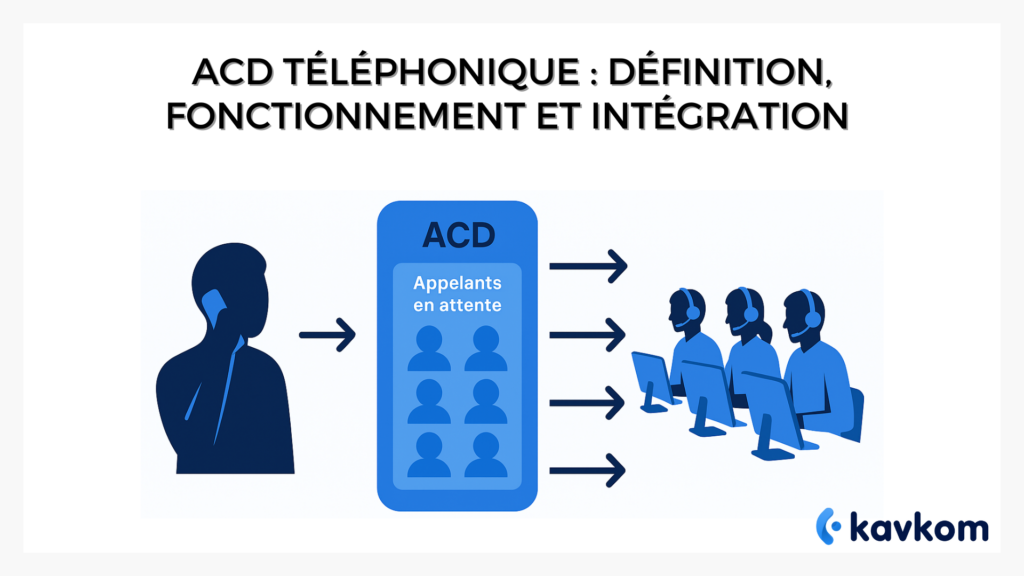
ACD, for Automatic Call Distribution, is a system that automatically organizes incoming calls. Its role is to route each caller to the agent or group best suited to his or her request, taking into account predefined rules, actual availability and the context of the call.
This mechanism forms the backbone of contact centers. It provides fluidity, reduces waiting time and structures the work of teams. In practice, an ACD can be based on several types of information: caller identity, choices made in a voice server, schedules, priorities defined by the company or current workload.
In brief
An ACD identifies the caller, applies the appropriate rule, assesses availability and directs the call to the appropriate agent.
How an ACD works in practice
ACD is based on a series of logical steps that are triggered automatically.
Analysis of available data
When a call arrives, the system collects the relevant information. Depending on the configuration, this may be the originating number, the time of day, a history of previous calls, or selections made in a voice server. This information is used to determine the direction in which the call should be directed.
Application of predefined rules
Each call center sets its own rules. They may be based on agent skills, languages spoken, customer priorities or simply the desire to distribute calls evenly.
Queue management
When all agents are busy, the call is placed in a dedicated queue. The ACD continuously monitors the evolution of the queue, enabling it to make the best decision as soon as an agent becomes available.
The benefits of an ACD in a call center
A well-configured ACD transforms incoming call management and improves service quality.
Reduced waiting time
ACD enables faster orientation, reducing the time spent waiting.
Balanced distribution of work
Thanks to automated distribution, no agent is repeatedly overwhelmed. The system distributes calls according to defined rules to avoid workload discrepancies.
Enhanced customer experience
The caller is directed to the right person from the very first contact. Unnecessary transfers are reduced, as is the risk of frustration. The caller benefits from consistent treatment and fewer unnecessary transfers.
Real-time control
ACD provides precise information on queue status, off-hook rates and availability. Supervisors can thus adjust the organization during the day.
ACD routing types and their uses
Each routing method meets a specific need.
Linear routing
Calls are always allocated in the same order. This system is ideal for small structures looking for simple logic.
Cyclic routing
The call passes from one agent to another in a loop. This distributes calls evenly.
Skill-based routing
The system identifies agents with the skills needed to respond to a particular request. This model is preferred in technical or multilingual environments, as it guarantees an appropriate response from the very first contact.
Dynamic routing
The ACD assesses the workloadThe ACD evaluates the workload, the age of calls in the queue and the average processing speed to automatically make the best decision.
Comparison table
| Method | Advantage | Usage |
|---|---|---|
| Linéraire | Very simple | Small teams |
| Cyclic | Even distribution | Evolving centers |
| Skills | Targeted expertise | Technical support |
| Dynamics | Continuous adaptation | High call volume |
Choose a cloud platform capable of supporting intelligent routing
To take full advantage of an intelligent intelligent routingTo take full advantage of an intelligent routing system, you need to be able to rely on a telephony system that applies rules in real time and adapts easily to variations in activity. A modern cloud solution can create scenarios, adjust queues and connect calls to business tools without interrupting the organization.
With this in mind, Kavkom offers a 100% cloud environment designed for sales teams and call centers. The platform combines virtual numbers, continuous supervision, advanced routing and predictive dialerwith CRM integration integration that adds context to every conversation.
Everything works without commitment, with pro rata billing, and can be used on computer, mobile or physical IP phone at no extra cost, with no hardware imposed.
Human support remains readily available to help teams with their day-to-day adjustments.
ACD and the role of the interactive voice server
The interactive voice response, or IVR, functions as the first stage in the sorting process. It asks the caller to choose an option. The ACD then uses this choice to select the most appropriate queue.
A concrete example
An IVR offers three choices: information, technical, billing.
The caller selects the option corresponding to his request.
The ACD identifies the queue linked to this option and routes it without further intervention.
Integrating an ACD into a modern call center
ACD integration is usually carried out via a cloud telephony solution. Modern systems require no hardware installation, and can be adapted to existing structures.
1) Definition of rules
Teams define each rule according to their actual needs. Some choose rules linked to skills, others base orientation on activity peaks.
2) Connection to professional tools
An ACD can be linked to a CRM or ticketing tool. This connection automatically brings up the caller’s file on the agent’s screen. The call becomes faster and more consistent.
3) Continuous supervision
Supervisors can visualize queues, off-hook rates, conversation times and availability. They can reorganize teams according to the situation.
In brief
The ACD integrates into the telephone system, applies your rules and communicates with your tools to set the pace of your teams’ work.
Concrete ACD use cases
Technical centers
A technical center receiving a high volume of calls can direct each person to a specialized agent. This improves resolution times and reduces transfers.
Multilingual services
Multi-language centers frequently use routing by language skills. Callers benefit from direct contact from the very first second.
Administrative services
In an administrative department, files are often varied. The ACD can direct you to specialized groups: general information, sensitive files, urgent requests.
ACD and queue management
Queues play an important role in busy environments.
Separate files
Centers generally create several queues. Each one meets a specific need. This facilitates dispatching and reduces the risk of bottlenecks.
Automatic recall
Some configurations offer the caller the option of being called back. The system retrieves the caller’s number and inserts it into the queue as soon as an agent is free.
Dynamic priority
When a caller has been waiting too long, the system can move his or her file up the queue. This function prevents long delays.
How to set up an ACD for good results
Identify real needs
An effective ACD starts with an observation of how the center actually operates. This involves understanding volumes, peaks in activity, customer expectations and in-house skills.
Define logical rules
The rules have to be simple. Too many conditions slow down orientation. The idea is to reduce complicated routes and always offer a clear path for the caller.
Adjust regularly
Needs evolve. It’s essential to review rules, queues and schedules to keep up with the changes. Centers that regularly adjust their parameters often achieve the best results.
Operational tip
By testing several scenarios, you can identify the one that best suits your team’s dynamics.
Indicators for measuring CDA effectiveness
Drop-out rate
A high rate indicates good organization of incoming calls. If it falls, it may indicate a one-off overload or a poorly calibrated rule.
Average time to response
This indicator shows how much time the caller spends in the queue. A prolonged increase should raise a red flag.
Breakdown of calls
The aim is to achieve homogeneous distribution, except in special cases. A strong disparity reveals a problem in the rules.
Internal transfer rate
The lower it is, the better the initial orientation.
| Indicator | Fast playback |
|---|---|
| Openers | Efficient organization |
| Waiting | Must remain stable |
| Distribution | Homogenous |
| Transfers | Low ideally |
ACD in the context of cloud telephony
Multi-equipment access
Cloud-based systems allow you to use a computer, a cell phone via an app, or an IP phone, depending on your internal practices.
Flexibility
The configuration can be changed in a matter of minutes. This adaptability is ideal for seasonal centers or variable-sized teams.
Security
Most solutions are based on encrypted protocols, fine-tuned role management and secure hosting. CNIL publications are a regular reminder of the importance of data control in professional environments.
Frequently asked questions
What does ACD stand for?
An ACD is anautomatic distribution system for incoming calls. It identifies the caller, analyzes the available information and applies pre-established rules to route the call to the most appropriate agent or group. Its central function is to structure call handling in a professional environment, where call flows can be large and variable.
Why use an ACD in a call center?
Its main objective is to quickly direct each caller to the right person. This reduces waiting times, limits internal transfers and supports service quality. A well-configured ACD also helps stabilize workloads and smooth outpeaks in activity, boosting both customer and team satisfaction.
Does an ACD replace a voice server?
No. The voice server provides an initial orientation, often in the form of choices offered to the caller. The ACD then takes over, sorting and routing the call according to defined rules. The two tools are complementary and form a coherent duo for structuring telephone reception.
Can an ACD work without CRM
Yes. An ACD can handle incoming calls without depending on a CRM. However, the connection between the two tools brings an important advantage: the agent sees the caller’s record appear as soon as he or she picks up the phone. This synchronization speeds up the exchange, reduces errors and contributes to smoother processing.
Is an ACD right for small structures?
An ACD can adapt very well to a small team, provided the rules and queues are properly calibrated. A smaller structure can gain in organization, even with a modest call volume. It also facilitates work distribution and gives a clearer picture of daily activity.
Conclusion
A well-configured ACD radically transforms the organization of incoming calls. It helps to reduce waiting times, present a more structured welcome and balance the workload between teams.
Between data analysis, intelligent routing and connection to business tools, ACD today occupies a central position in contact centers. Its value is based on fluid organization, precise orientation and continuous management of the pace of conversations.
And if you want to set up efficient routing without technical complexity, implementing a modern cloud solution really simplifies the exercise.