Modernizing a telephone infrastructure without interrupting call center operations is never trivial. Between mobility constraints, audio quality requirements and pressure on supervisory teams, the choice of a wireless IP phone becomes a marker of technological maturity. The challenge is not simply to replace an aging device, but to provide agents with a reliable, adaptable tool for everyday use.
This article offers a complete overview of the best 2025 models, with an analysis grid applied to demanding environments: call centers, sales teams, customer support, multi-site contexts, telecommuting.
Points to remember :
– A wireless IP phone enhances agents’ mobility and directly supports the fluidity of exchanges in a call center.
– Essential criteria such as range, HD audio, autonomy and SIP compatibility enable you to quickly identify the right models for your environment.
– DECT and Wi-Fi phones offer different answers depending on the size of the set, the quality of the network and the desired mobility.
– A cloud platform compatible with these devices enhances their usefulness, by centralizing calls, supervision and routing…


Boostez la productivité de vos équipe commerciales grâce à Kavkom, le logiciel de téléphonie d’entreprise 100% cloud.
Planifier une démo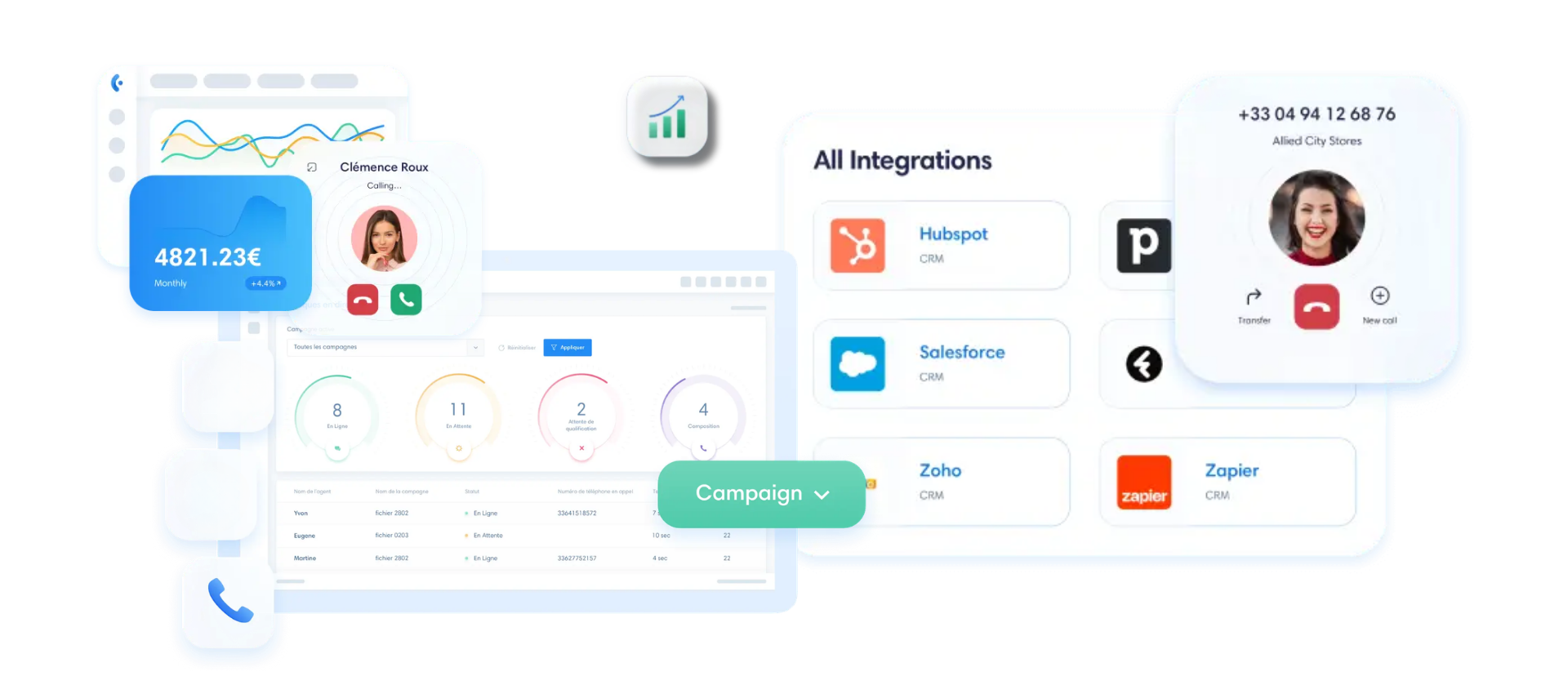
Why switch to a wireless IP phone in 2025?
Business telephony is evolving rapidly. The move towardsVoIP and cloud solutions that began ten years ago is now reaching maturity, transforming the place of the telephone in organizations. For a long time, telephones were synonymous with cables, constraints and immobility. In 2025, the question is reformulated. The true measure of progress is the continuity of exchanges, wherever an agent may be.
Concrete benefits for a call center
A wireless IP phone is more than just a convenience. It offers three key advantages:
- Total mobility on the set and at home.
- Stable HD audio quality thanks to the latest VoIP protocols.
- Better load distribution, as agents are no longer glued to a fixed workstation.
Most of the models identified here support SIP, dual-band Wi-Fi or next-generation DECT, and integrate effortlessly into an existing VoIP infrastructure.
How to choose a wireless IP phone for a call center
Before examining the models, it’s useful to have a quick evaluation grid. The diversity of devices on the market can be confusing, but needs remain surprisingly constant.
The criteria that really count
Three dimensions stand out when we look at organizations renewing their equipment:
- Mobility and range
The difference between Wi-Fi and DECT remains crucial. Wi-Fi is flexible and easy to deploy, but depends heavily on the quality of the internal network. DECT retains a more stable range, often invaluable on large platforms. - Audio quality and noise reduction
Noisy environments such as call centers demand clean capture and HD reproduction. The best 2025 models feature specialized algorithms designed to reduce background noise without altering the voice. - Simple configuration
IT managers see it every day: the problem is never the device, but the time spent integrating and maintaining it. - Autonomy
A phone that lasts all day without recharging enables supervisors to avoid micro-interruptions which, cumulatively, degrade performance. - Software compatibility
The most modern models work with all major cloud PBXs and VoIP platforms on the market.
Key criteria
| Criteria | Importance | Why |
|---|---|---|
| Mobility | High | Hybrid working and internal travel |
| HD Audio | High | Clean conversations, less effort for agents |
| Autonomy | High | Keeping up the pace over long sessions |
| SIP compatibility | Essential | Simple integration into existing systems |
| Noise reduction | High | Noisy platform, enhanced vocal comfort |
The right environment for making the most of wireless IP phones
Wireless IP phones are at their best when operating in a stable environment: a reliable network, simple SIP management and a platform capable of absorbing the flow of calls effortlessly. Without these, devices lose audio quality or service continuity.
Kavkom provides exactly that. It natively accommodates DECT or Wi-Fi handsets, assigns them SIP identifiers, and immediately integrates them into the cloud standard. This means that agents can use a physical telephone, while benefiting from supervision, routing and recording, without complex configuration.
It’s this combination that enables wireless IP phones to become true workstations, perfectly integrated into the running of a call center.
Boostez la productivité de vos équipe commerciales grâce à Kavkom, le logiciel de téléphonie d’entreprise 100% cloud.
Planifier une démoThe phone itself only does half the job. Behind the scenes, you need a no-contract business phone solution capable of handling call routing, call forwarding, and call monitoring.
Top 5 best wireless IP phones in 2025
The models below have been selected on the basis of their reputation, feedback from use in professional environments, endurance, SIP compatibility and ability to meet demanding conditions. They are aimed at decision-makers who wish to invest in durable, reliable equipment adapted to modern VoIP.
Yealink W78P : The premium choice for dynamic call centers
Yealink remains one of the strongest manufacturers in the VoIP market. In 2025, the W78P will establish itself as one of the most versatile devices for high-density call centers.
Why it stands out
The combination of a compact handset, a modern color display and an extremely stable DECT system provides a particularly comfortable environment for teams. Advanced noise reduction facilitates exchanges in busy environments.
Operation is intuitive, and supervisors appreciate the centralized management of parameters, which considerably reduces the need for intervention.
Highlights
- Extended DECT range
- Excellent noise reduction
- HD Audio
- Good autonomy
- Native SIP support
Ideal for
– Call centers with heavy traffic
– Noisy environments
– Hybrid Wi-Fi + DECT teams
Grandstream DP865: The best performance/cost ratio
Grandstream has always targeted companies looking to rapidly equip large teams. The DP865 confirms this focus in 2025 with a robust configuration and competitive pricing.
Why it’s interesting
Long-range DECT makes this a reliable model for multi-site businesses or large spaces. Integrated audio functions provide a clear experience, even without headphones.
The DP865 also appeals for its simplicity: pairing, configuration and commissioning are quick, reducing the workload for IT managers.
Highlights
- Solid autonomy
- Above-average DECT range
- Excellent value for money
- SIP-enabled Grandstream ecosystem
Yealink W73P: The proven, stable option for mixed environments
The W73P remains a standard in many call centers. It is often the preferred choice for teams looking for a reliable device with no surprises.
Why companies love it
Superior battery life means you can go all day without recharging. Integrated noise reduction enhances understanding, and the standard DECT range ensures stable use.
The W73P’s strength lies in its consistency: an uncomplicated, high-performance device that’s well-suited to massive use.
Highlights
- Excellent autonomy
- Effective noise reduction
- Simple configuration
- Stable audio quality
Recommended for
– Call centers that value stability
– Customer support teams
– Intensive use contexts
Gigaset S700H PRO : Top-of-the-range comfort
Gigaset is renowned for the ergonomic quality of its handsets. The S700H PRO stands out for its high-end finish and ergonomics, ideal for long sessions.
Why he deserves his place
The device combines a comfortable screen, generous battery life and excellent handling. HD audio quality brings out the best in even the most delicate interactions, making it ideal for customer relations teams.
It’s a natural choice for organizations wishing to reduce vocal fatigue and improve day-to-day comfort.
Highlights
- Premium ergonomics
- Long autonomy
- Excellent audio capture
- Robust and durable
Cisco 8821 Wi-Fi: Top of the range for Wi-Fi environments
Unlike previous DECT models, the Cisco 8821 relies entirely on Wi-Fi. It has been designed for environments already using an optimized Wi-Fi network.
Why this model is unique
The Cisco 8821 supports advanced security protocols and adapts to professional infrastructures. It is designed to handle high call volumes, with high mobility requirements.
It is often the preferred choice for multi-site organizations that have already invested in a high-performance network.
Highlights
- Professional Wi-Fi quality
- Complete mobility
- Robust construction
- Optimized HD audio
Quick comparison of the 5 best wireless IP phones in 2025
| Model | Technology | Highlights | For whom |
|---|---|---|---|
| Yealink W78P | DECT | Noise reduction, stability | Intensive call centers |
| Grandstream DP865 | DECT | Price, autonomy | Large teams |
| Yealink W73P | DECT | Reliability, endurance | Customer support |
| Gigaset S700H PRO | DECT | Comfort and ergonomics | High-level customer relations |
| Cisco 8821 | Wi-Fi | Total mobility | Multisites with a solid network |
Honorable mention: Alcatel-Lucent 8262 EX
While previous models cover most of the classic needs of a call center, some organizations operate in more demanding environments where robustness is as important as audio quality. This is where a phone like the Alcatel-Lucent 8262 EX comes into its own.
From a historic European manufacturer, this handset is designed to withstand the toughest conditions: industrial buildings, very large platforms, teams in constant motion. It combines a reinforced chassis, anti-shock certification and a solid autonomy that makes intense days safe.
Why this model deserves a special place
The Alcatel-Lucent 8262 EX isn’t just robust. It offers HD audio quality perfectly suited to professional exchanges, surprisingly comfortable ergonomics despite its reinforced size, and stable SIP integration. Its extended DECT range allows agents to move around freely without signal loss.
Multi-activity centers also appreciate its durability. Where other handsets require regular replacement, this one lasts the test of time, even under sustained use.
Highlights
- Advanced robustness for complex environments
- Superior DECT range
- Generous autonomy
- Reliable HD audio
- Proven SIP compatibility
Frequently asked questions
Does a wireless IP phone work when teleworking?
Yes. As long as there is a stable Internet connection, the device can connect to your VoIP infrastructure and operate normally.
Can I use a wireless IP phone without a VoIP system?
No. It must be combined with a SIP-compatible system or VoIP platform.
What’s the difference between Wi-Fi and DECT?
Wi-Fi offers great flexibility, but depends on the quality of the internal network. DECT provides a more stable range, dedicated exclusively to telephony.
Should I opt for recognized brands?
For call centers, the answer is generally yes. Yealink, Grandstream, Gigaset and Cisco guarantee excellent compatibility with most VoIP systems.
Conclusion
In 2025, choosing a wireless IP phone means optimizing your teams’ day-to-day performance. The real question is not which device is the most modern, but which best suits the nature of your organization, your call flow and your VoIP infrastructure.
The models presented here cover most of the needs of call centers, sales teams and multi-site environments. Whether you prefer the stability of DECT, the flexibility of Wi-Fi or ergonomic comfort, you now have a complete overview of how to equip your call center with suitable, long-lasting equipment.
And if you’d like to take your team’s performance even further and test these handsets in a cloud environment designed for intensive call rhythms, you can do so immediately, with no obligation.