Top 9 alternatives to Five9 for enterprise telephony and real-world use by sales teams and call centers

If you’re looking for the Top 9 alternatives to Five9 for business telephony that’s truly adapted to your day-to-day business, this comparison has been designed for you. It’s aimed at sales teams and in-house call centers who want to compare solutions based on actual use, not just on technical data sheets. The aim is simple: to help you make a B2B choice that’s consistent with your operating context.

No credit card

No obligation

Custom demo

Quick comparison of the best Five9 alternatives

The solutions below were compared on the basis of their suitability for real business telephony uses, team productivity and flexible cost models.

Solution Best for Key features Price positioning Score out of 10
Kavkom Performance-oriented sales teams and in-house call centers Predictive dialer, real-time supervision, CRM integration, operational reporting Flexible, no-commitment subscription, clear logic by usage 8,6
RingCentral SMBs and large teams looking for a unified platform Advanced routing, multi-team supervision, analytics, extensive integrations Subscription per user, progressive upgrade 7,9
Mitel Complex organizations with IT and hybrid constraints Cloud and hybrid telephony, multi-site supervision, advanced reporting Modular model, customized options and deployment 7,6
Twilio Technical teams and customized projects Voice API, call automation, scalability, customized integrations Pay-per-use, variable costs according to volume 7,2
Plivo Technical SMEs focused on programmatic calls Telephony API, number management, basic automation Pay-per-use, developer logic 6,9
Vonage Companies looking for UCaaS and API flexibility Cloud telephony, call center, CRM integrations, analytics Subscription + options, mixed pricing structure 7,4
Dialpad

Talkdesk

Collaborative teams and conversational AI

Structured center

AI transcription, intelligent routing, supervision, CRM integrations

Advanced routing, QA, automation

Subscription per user, advanced options in upper levels,

Subscription premium

7,7

7,8

Testing a more operational alternative to Five9

Kavkom is the right choice if you’re looking for business telephony oriented real-world usedesigned for sales teams and in-house call centerswith a flexible that allows you to quickly assess the suitability for your context, without unnecessary rigidity.

Top 9 alternatives to Five9: detailed analysis

Kavkom

For whom it’s relevant

Kavkom is ideal for sales teams and in-house call centers who want enterprise telephony that’s easy to manage, without heavy IT dependency. Typically, a sales team that needs to launch call campaigns, monitor day-to-day activity and keep a clear view of performance, without unnecessary complexity.

Features and real-life use

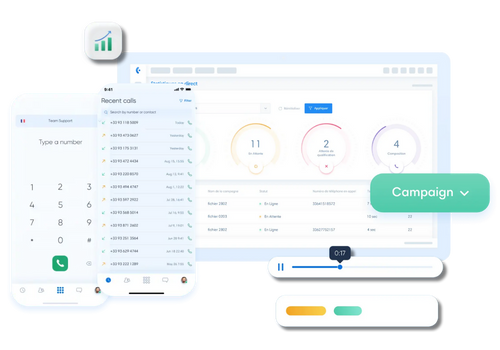
Features designed for field use with no essential modules to add to get started.

  • Predictive and progressive dialog to speed up outbound campaigns.
  • Real-time supervision to monitor activity and support teams.
  • Native CRM integration (Salesforce, HubSpot, Zoho, Pipedrive…), to contextualize calls and synchronize activity, without replacing an existing CRM.
  • Operational reporting focused on daily performance.

Pricing positioning and flexibility

The model is non-bindingwith a clear, scalable billing logic. Costs are based on actual usage and team size, making it easy to test, scale up and adjust quickly.

Limits to be aware of

Kavkom makes a choice of specialization on performance-oriented enterprise telephony. For very specific projects requiring heavy application development or advanced omnichannel orchestration, other more technical platforms platforms.

Note

8,6 / 10


Why Kavkom stands out in this comparison

Kavkom stands out for its direct relevance to operational operational needs needs of sales teams and in-house call centers, combining ease of deployment, real-time control and contractual flexibilitywithout unnecessary technical detours.

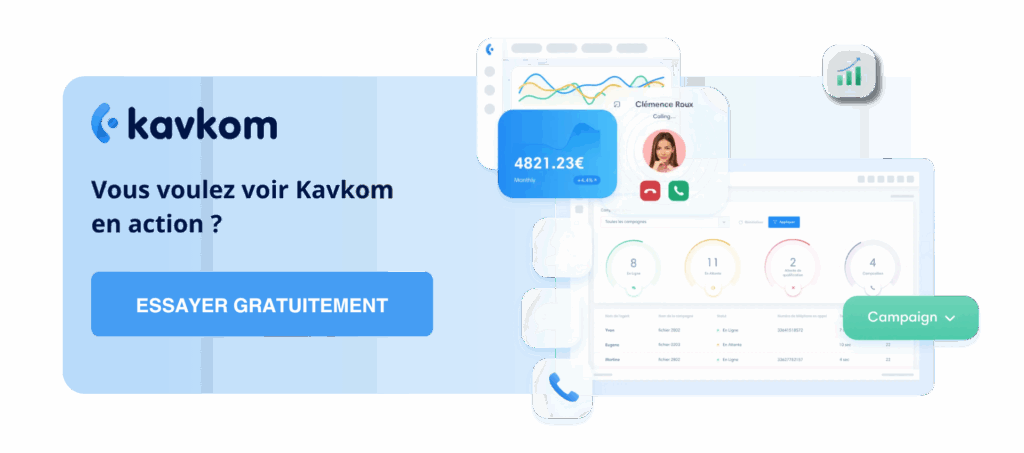
See Kavkom in action


Talkdesk

For whom it’s relevant

Talkdesk is aimed primarily at ETI and large organizations with structured call centers, with teams dedicated to customer service or large-scale customer relations. It is often chosen when operational complexity is already high.

Features and real-life use

The platform covers advanced uses, particularly in large-scale environments.

  • Intelligent routing and advanced queuing.
  • Supervision and quality control tools for managers.
  • Automation and complex scenarios for extended call centers.
  • Deep CRM integration for structured customer paths.

Pricing positioning and flexibility

The model is based on per-user subscriptions, with a gradual move upmarket according to the functionalities activated. Flexibility is available, but budgetary clarity is highly dependent on the options chosen.

Limits to be aware of

For smaller sales teams or structures in the testing phase, the functional richness can become a hindrance, making it harder than it needs to be to get to grips with and manage the system.

Note

7,8 / 10


Vocalcom

For whom it’s relevant

Vocalcom is ideal for in-house call centers often in structured or regulated organizations. It is frequently used in contexts where multi-channel management is already well established.

Features and real-life use

The approach focuses on advanced interaction management.

  • Automatic call and dialer adapted to framed campaigns.
  • Supervision and quality control of agents.
  • Detailed reporting for management control.
  • CRM integrations for complex environments.

Pricing positioning and flexibility

Pricing is generally modular and adapted on quotation, which allows fine-tuning, but requires precise framing upstream to maintain good cost visibility.

Limits to be aware of

The solution may seem oversized for sales teams focused on speed and flexibility, with a heavier implementation than necessary for simple uses.

Note

7,6 / 10


RingCentral

For whom it’s relevant

RingCentral is particularly relevant for and large companies who want to centralize their communications and teams around a single platform. It is often chosen by IT or operations departments with teams spread over several sites.

Features and real-life use

The approach is broad and unified-platform oriented.

  • Cloud telephony coupled with collaboration tools.
  • Supervision and reporting for multi-team managers.
  • Numerous integrations with business tools.
  • Advanced routing for structured call flows.

Pricing positioning and flexibility

Pricing is based on a subscription per userwith features that evolve with plans. The model is predictable, but can become more engaging as needs grow.

Limits to be aware of

For sales teams focused on rapid action and flexibilitythe wealth of functions can make it difficult to get to grips with the system, and dilute the benefits of pure telephony.

Note

7,9 / 10


Mitel

For whom it’s relevant

Mitel is aimed at organizations with a solid solid IT structureThey are often multi-site or subject to specific constraints. We find it in environments where limited supervision, continuity and personalization.

Features and real-life use

The solution covers a wide range of uses, some of them hybrid.

  • Cloud telephony and more complex scenarios.
  • Multi-site supervision and centralized management.
  • Reporting tools for structured structured environments.
  • Can be integrated with existing systems.

Pricing positioning and flexibility

The model is modularwith options adjusted according to scope and complexity. Flexibility does exist, but the clarity of costs depends heavily on the initial framework.

Limits to be aware of

For sales teams who want to test, adjust or evolve quickly, the complexity of implementation can hamper day-to-day agility.

Note

7,6 / 10


Ooma

For whom it’s relevant

Ooma is suitable for small structures and SMEsThese teams are often in the process of professionalizing their telephony. It is well suited to small teams with simple, immediate needs.

Features and real-life use

Functionality is geared towards simplicity.

  • Easy-to-configure cloud telephony.
  • Basic routing and incoming call management.
  • Supervisory functions limited but accessible.
  • Useful CRM integrations for simple uses.

Pricing positioning and flexibility

Pricing is clear and accessiblewith a clear subscription logic. It allows you to get started quickly without excessive contractual complexity.

Limits to be aware of

As soon as the volume of calls or the need for advanced control the solution shows its limitations for intensive sales teams or structured in-house call centers.

Note

7,1 / 10


Vonage

For whom it’s relevant

Vonage is relevant for companies seeking a balance between balance between cloud telephony and customizationespecially when specific integrations are required.

Features and real-life use

The approach combines telephony and technical openness.

  • Cloud telephony with call center options.
  • Supervision and analytics for activity monitoring.
  • CRM integration and various business tools.
  • Can be automated as required.

Pricing positioning and flexibility

The model combines subscription and optionsThis offers flexibility, but requires careful attention to keep a clear view of costs over time.

Limits to be aware of

For sales teams looking for a highly focused, immediately operational solution, the sheer number of multiplicity of options can complicate the decision-making process.

Note

7,4 / 10


Aircall

For whom it’s relevant

Aircall mainly targets SMEs and ETIs with growing sales or support teams, who want a solution that’s quick to deploy and well integrated with their existing tools.

Features and real-life use

Use is fluid and collaborative.

  • Team-oriented cloud telephony.
  • Real-time supervision and managerial listening.
  • Advanced CRM and helpdesk integration.
  • Reporting adapted to daily management.

Pricing positioning and flexibility

Pricing is based on a subscription per useroften on an annual basis, with good clarity but less flexibility for short-term testing.

Limits to be aware of

For teams with high outbound call volumes or intensive campaigns, some advanced features may be missing or require fine-tuning.

Note

7,5 / 10


Dialpad

For whom it’s relevant

Dialpad is relevant for teams that value collaboration collaboration and intelligent assistanceparticularly in hybrid sales and support environments.

Features and real-life use

The solution focuses on automation and analysis.

  • Cloud telephony integrated with collaborative tools.
  • Supervision and transcription for call follow-up.
  • CRM integrations to contextualize exchanges.
  • Quality-oriented reporting and conversational analysis.

Pricing positioning and flexibility

The model is based on scalable subscriptionswith advanced functionalities accessible via higher-level plans, which means we need to anticipate changing needs.

Limits to be aware of

For sales teams focused on pure pure operational performancethe emphasis on collaboration and analysis may be less of a priority.

Note

7,7 / 10

How to choose the best alternative to Five9

1. Type of team

A prospecting-oriented sales team does not have the same expectations as an in-house call center or customer service department, and some solutions are clearly better suited to one use than another.

  • Sales and prospecting. Priority to speed and efficiency in outbound calls.
  • Internal call centers. Need for structuring, monitoring and day-to-day management.
  • Support or customer service. Focus on inbound call management and continuity.

2. Call volume

The volume of calls determines the relevance of the solution. Low, medium or high, it has a direct influence on productivity, the expected level of automation and the way costs evolve over time.

  • Majority entrants or intensive leavers.
  • Punctual variations or constant volumes.
  • Ability to absorb peaks without additional complexity.

3. Need for supervision

The need for supervision changes the nature of the choice. Some teams just need basic monitoring, others need fine-tuned managerial guidance.

  • Listening and punctual follow-up of calls.
  • Real-time supervision to support teams.
  • Useful reporting tools for day-to-day decision-making.

4. Budget constraints

A solution may seem suitable at the outset, but become difficult to manage if costs evolve badly with growth or depend too much on options.

  • Model clarity.
  • Easy to anticipate expenses.
  • Development consistent with team size.

5. Expected flexibility

The expected flexibility is often decisive. Testing, adjusting and evolving the organization without friction is a key criterion in many B2B contexts.

  • Long-term commitment or not.
  • Easy adjustment of the number of users.
  • Activation or deactivation without operational burden.

Mini checklist for decision-makers

  • Is my team more sales-oriented, internal call center or support-oriented?
  • Is my call volume stable or does it vary from period to period?
  • Do I need daily management or just occasional monitoring?
  • Am I comfortable with a cost model that evolves over time?
  • Is contractual flexibility a key criterion for my organization?

Kavkom or Five9: which is best for you?

These two solutions respond to different logics, and the right choice depends above all on how telephony fits into your day-to-day organization.

Is your telephony a simple communication tool or a daily operational lever?
If calls are at the heart of your sales activity or your in-house call center, you’ll need a tool designed for action in the field. Conversely, a more global and structured approach may be appropriate when telephony is part of a wider ecosystem.

Do you need to manage calls and teams in real time?
When day-to-day monitoring, team support and immediate visibility are key, some solutions are more suitable than others, especially for performance-oriented environments.

Are you looking for a turnkey solution or are you comfortable with a more IT-oriented environment?
If you’re looking for rapid implementation and ease of use, a solution that’s straight out of the box will make sense. Conversely, a more technical environment may be appropriate if you have dedicated resources.

Is contractual flexibility an important criterion for your business?
Testing, adjusting or evolving your organization without heavy constraints can weigh heavily in the decision, especially in contexts of growth or changes in activity.

Do your teams work under pressure with volume or performance targets?
In this case, a solution aligned with the actual use of sales teams and internal call centers becomes a real operational support.

In short, the choice between Kavkom and Five9 depends less on features than on your actual use, your level of operational requirements and the flexibility you expect. This makes Kavkom a coherent option for teams who want corporate telephony directly aligned with their day-to-day business.

98% of our customers value the efficiency and simplicity of our services

Find out why over 8,000 companies work with Kavkom for their corporate telephony.

4.7 on Capterra

Frequently asked questions

Any other questions?
Consult our Online Help or Contact us

Which Five9 alternative is best suited to B2B companies?

There is no universal answer. The right choice depends on team typeSome solutions are better suited to highly structured environments. Some solutions are better suited to highly structured environments, others to more operational, field-oriented uses. The key is to align the tool with your organization, not the other way around.

Sales teams need telephony designed for outgoing calls. outgoing callsactivity monitoring and responsiveness. Supervision and readability of performance then become central. Solutions such as Kavkom can be coherent when telephony is used as a “tool of the trade”. daily performance leverrather than just a channel.

Yes, but with important nuances. An in-house call center focused on volume and management does not have the same needs as a more ad hoc support service. We need to distinguish between tools designed to structure and supervise ongoing activity, and those adapted to simpler uses.

Some solutions offer greater contractual flexibilityThis flexibility is often sought by growing companies or those with variable activity. This flexibility is often sought after by growing companies or those with variable activity levels. It enables the tool to be adapted to the real pace of the organization.

Beyond the model displayed, you need to look at how costs evolve with use. Necessary options, ramping up of teams and dependence on certain modules can all have an impact over time. A pertinent comparison is therefore based on durationand the overall legibility of the business model.