Top 8 alternatives to Aircall for business telephony and real-world use by sales teams and call centers

If you’re looking for alternatives to Aircall for your business telephony If you’re looking for a solution that’s really suited to your sales teams or in-house call centers, this comparison is for you. This Top 8 alternatives to Aircall focuses on real day-to-day use, not on a simple list of features. The aim is to help you make an informed B2B choice, according to your operational context.

No credit card

No obligation

Custom demo

Quick comparison of the best alternatives to Aircall

The solutions below were compared on the basis of their suitability for real business telephony uses, team productivity and flexible cost models.

Solution Best for Key features Price positioning Score out of 10
Kavkom Sales teams and in-house call centers Call supervision, dialer, CRM integration, real-time control Flexible model, no commitment, clear costs 8,6
RingCentral Structured companies with broad collaboration needs Cloud telephony, unified collaboration, advanced routing, analytics Modular offerings, progressive upgrading 7,8
Mitel Organizations with IT or hybrid constraints Enterprise telephony, multi-site management, supervision, reliability Project-oriented model, variable costs 7,2
Twilio Technical teams and customized projects Voice API, SMS, automation, advanced personalization Pay-per-use, volume-dependent 6,9
Plivo Startups and technical teams focused on programmatic calls Voice and SMS APIs, application integration, scalability Pay-per-use 6,7
Vonage SMEs with unified communications needs Cloud telephony, call center, CRM integrations Subscriptions with additional options 7,3
Dialpad Data-driven teams and conversational AI AI transcription, supervision, real-time analytics Subscriptions per user, advanced options 7,6

Discover a more flexible alternative to Aircall

Kavkom stands out for enterprise telephony designed for real-life use by sales teams and in-house call centers, with simple implementation, clear contractual flexibility and easy-to-understand costs.


Top 8 alternatives to Aircall: detailed analysis

Kavkom

For whom it’s relevant

Kavkom is ideal for sales teams and in-house call centers who want business telephony that’s easy to use, without heavy IT dependency. For example, a sales team that needs to manage calls, track activity and keep a clear view of performance.

Features and real-life use

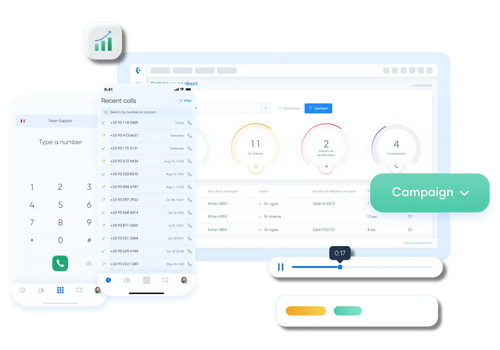
  • VoIP cloud telephony designed for day-to-day operations
  • Supervision and real-time activity monitoring
  • Dialer to structure call campaigns
  • CRM integration to link calls and customer data

Each function serves a clear field application, without unnecessary piling up.

Pricing positioning and flexibility

Logic without commitmentwith clear clear billing and scalable. Invoicing is non-binding and adjustable on a pro rata basis, making it easy to adapt the number of users and options as teams grow, without the need for API consumption-based invoicing.

Limits to be aware of

Kavkom has made a conscious choice to specialize in cloud telephony and CRM integration. Companies looking for a complete omnichannel platform (chat, SMS, social networks) will have to turn to solutions with a different positioning.

Note

8,6 / 10


Why Kavkom stands out in this comparison

Kavkom aligns corporate telephony, real-life use and flexibility around the specific needs of sales teams and internal call centers, without complicating implementation.

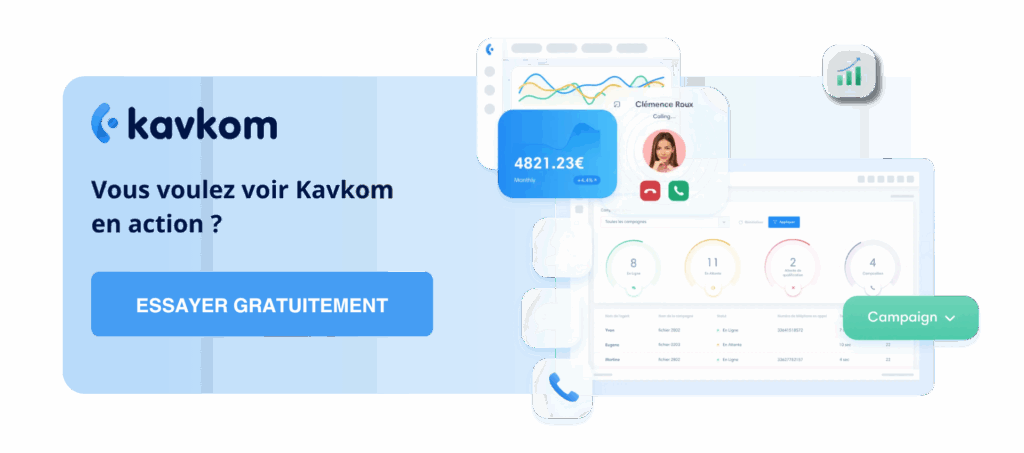
See Kavkom in action


Ringover

For whom it’s relevant

Ringover is aimed at sales and support teams who want to centralize several communication channels in a single tool, often in structured SMEs.

Features and real-life use

  • Cloud telephony with supervision
  • Coaching coaching and call analysis
  • Extended CRM integrations

The approach is productivity-oriented, with a broad functional scope.

Pricing positioning and flexibility

User-defined model, with functional levels. Upgrading may become necessary depending on advanced needs.

Limits to be aware of

Functional richness can add complexity complexity for teams looking for simple, focused telephony.

Note

7,7 / 10


Dialpad

For whom it’s relevant

Dialpad is ideal for data-driven teams data and analysisoften in international or technophile environments.

Features and real-life use

  • Cloud telephony with AI transcription
  • Supervision and analytics in real time
  • CRM integration and collaborative tools

AI adds value to the monitoring and analysis of exchanges.

Pricing positioning and flexibility

Subscriptions per user, with advanced options reserved for higher plans. Readability depends on the level of need.

Limits to be aware of

For teams focused on outbound calls and simplicity, the very IA approach can be over-dimensioned.

Note

7,6 / 10


CloudTalk

For whom it’s relevant

CloudTalk is aimed at SMEs and support or sales teams with structured call activity, often in an international context.

Features and real-life use

  • VoIP telephony with intelligent routing
  • Power dialer and supervision
  • CRM reporting and integration

The functions are designed for in-house call center use.

Pricing positioning and flexibility

User-defined model with options for different levels of analysis and automation.

Limits to be aware of

Advanced features may involve additional additional costs as needs increase.

Note

7,4 / 10


JustCall

For whom it’s relevant

JustCall is ideal for growing sales and support teams who want to centralize calls and messages quickly.

Features and real-life use

  • Cloud telephony and dialer
  • Activity supervision and monitoring
  • CRM and helpdesk integration

The tool is designed for quick learning.

Pricing positioning and flexibility

Scalable subscriptions, adapted to small and medium-sized teams, with an upmarket logic.

Limits to be aware of

For more complex environments, some advanced functions may lack depth. depth.

Note

7,3 / 10


RingCentral

For whom it’s relevant

RingCentral is designed for structured companies that want unified unified communication communication.

Features and real-life use

  • Cloud telephony and collaboration
  • Supervision and call center
  • Multiple integrations

The solution covers a broad spectrum of uses.

Pricing positioning and flexibility

Modular packages for each user, with a gradual increase in complexity.

Limits to be aware of

Functional width can make the tool less readable for strictly commercial telephony purposes.

Note

7,8 / 10


CallHippo

For whom it’s relevant

CallHippo is ideal for small businesses and small teams setting up corporate telephony for the first time.

Features and real-life use

  • VoIP cloud telephony
  • Simple routing and power dialer
  • Basic CRM integrations

The emphasis is on rapid deployment.

Pricing positioning and flexibility

Accessible model, with a progressive payment logic based on usage.

Limits to be aware of

For more structured in-house call centers, advanced advanced supervision remain limited.

Note

7,0 / 10


Talkdesk

For whom it’s relevant

Talkdesk is designed for medium to large in-house call centers with high control requirements.

Features and real-life use

  • Cloud telephony and call centers
  • Advanced supervision and analytics
  • CRM automation and integration

The platform aims for large-scale performance.

Pricing positioning and flexibility

Rather high-end high-endwith offerings adapted to complex environments.

Limits to be aware of

Functionality and cost can be excessive excessive for smaller sales teams.

Note

7,5 / 10

How to choose the best alternative to Aircall

1. Type of team

Start by clarifying who uses the solution on a daily basis.

  • Sales teams focused on outbound calls and performance monitoring.
  • In-house call centers with multiple agents and structured workflows.
  • Support / customer service more focused on inbound calls.
    Not all solutions cover these uses with the same level of relevance.

2. Call volume

Volume determines productivity and the relevance of automation.

  • Low volume, simple requirements and light control.
  • Medium volume, balance between efficiency and supervision.
  • High volume, need for more advanced management and routing tools.

3. Need for supervision

Ask yourself the question of piloting.

  • Basic monitoring for autonomous teams.
  • Real-time supervision to manage activity.
  • Listening and support for structuring skills development.

4. Budget constraints

Beyond the cost, look at the readability.

  • Clear understanding of what is included.
  • Expenses keep pace with team growth.
  • Possible dependence on options or usage.

5. Expected flexibility

Flexibility has a direct impact on risk.

  • Whether or not or not.
  • Easy adjustment of the number of users.
  • Frictionless activation and deactivation.

Mini checklist for decision-makers

  • Is my team sales-oriented, support-oriented or mixed?
  • Is call volume stable or variable?
  • Do I need to manage day-to-day business?
  • Am I comfortable with a rigid model or do I need flexibility?
  • Is it a turnkey solution or a tool to be integrated into my existing system?

Kavkom or Aircall: which is best for you?

Kavkom and Aircall have different rationales. The right choice depends above all on your actual usageand the way you manage your telephony on a day-to-day basis.

Is your telephony a simple tool or an operational lever?
If you use telephony as a production tool for your sales teams or in-house call centers, a solution designed for day-to-day operations makes sense. Conversely, if telephony remains just one channel among many, a more general-purpose platform may suffice.

Do you need to manage your business in real time?
When call monitoring, supervision and team support are part of day-to-day management, adapting to field use becomes central. Without this need, a more standard approach may be appropriate.

Are you looking for a turnkey solution or a more IT-oriented environment?
Some teams prefer rapid implementation and simple operation. Others are comfortable with more technical and configurable environments, at the cost of greater complexity.

Is contractual flexibility important to your business?
If your workforce and volumes change frequently, the ability to adjust the tool without constraint becomes a decisive criterion. In more stable contexts, this point weighs less in the balance.

Do your teams work under volume or performance pressure?
When objectives are linked to the number of calls and results, the tool must keep pace with the pace and reality of the field, without unnecessary friction.

In short, the choice between Kavkom and Aircall is based less on functionality than onyour way of working. For performance-oriented, operational teams, Kavkom is often a coherent, rational option.

98% of our customers value the efficiency and simplicity of our services

Find out why over 8,000 companies work with Kavkom for their corporate telephony.

4.7 on Capterra

Frequently asked questions

Any other questions?
Consult our Online Help or Contact us

Which alternative to Aircall is best for B2B companies?

There is no universal answer. The right choice depends above all on the actual use Sales, support or in-house call centers. Some solutions are designed for sales performance-oriented teams, others for more generalist or technical environments. The key is to align the tool with the way telephony is used on a day-to-day basis.

Sales teams need a tool that focuses on outgoing callsactivity monitoring and control. Solutions that focus on supervision and productivity in the field are often more appropriate. In this context, tools like Kavkom can be coherent when telephony is a central operational lever.

Yes, but only if we’re talking about in-house call centers to the company. Needs differ depending on whether they involve customer support or high-volume sales teams. The key criterion remains the ability to supervise, organize and manage the agents’ day-to-day activities.

Some solutions offer contractual flexibility than others. This can be decisive for companies whose workforce or call volumes change frequently. Conversely, more stable organizations may accept more rigid frameworks.

We need to look beyond the advertised model and analyze the economic logic over time. The options required for actual use, evolution with growth and dependence on use have a direct impact. A relevant comparison is always made over time and according to the operating context, not just at the point of entry.