Your phone system works. So does your CRM. But the two don’t talk to each other, and every call turns into a juggling act between two screens.
This is exactly the problem that integrating phone and IT systems solves: connecting your call system to your business tools so that customer records are automatically populated, every conversation is logged without manual entry, and your teams can spend their time handling calls rather than copying information from one software application to another.
But there’s a gap between understanding the concept and choosing an integration that actually works with your tools. This guide shows you how to assess practical use cases for your business, which CTI features should be included at no extra cost, and how to deploy a CRM phone integration without disrupting your organization.
I recommend without hesitation
With Kavkom, I was able to easily resolve the issue of communication costs to my regular customers. My agents, too, were no longer restricted in their mobility, because even when on the move, communications are managed.

How about you?
Request a demo nowWhat exactly is Computer Telephony Integration (CTI)?
Your sales rep answers a call, and by the time they’ve found the customer’s file in the CRM, the first ten seconds of the conversation are already gone. The customer has to repeat their name, case number, and issue. Sound familiar?
Computer-Telephony Integration (CTI) is designed to eliminate this kind of friction. In a nutshell: it acts as a bridge between your phone system and your business software (CRM, helpdesk, ERP). When a call comes in, the contact record automatically pops up on the screen. When an agent hangs up, the call is logged without manual entry. When a sales rep wants to call a prospect back, they click on the number directly from their CRM.
But be careful not to confuse them. There are three layers, and each has a distinct role:
- VoIP telephony transmits voice over the Internet. It is the pipeline, the raw connection between two callers.
- The cloud-based phone system (cloud PBX) manages call routing: who receives the call, in what order, with what greeting, and during what hours.
- CTI integrates this phone system with your business tools. It displays the customer record, initiates click-to-call, and synchronizes call history between your phone and your CRM.
Without CTI integration, you have a phone system that works and a CRM that works, but the two operate in separate silos. Your agents switch back and forth between screens, copy notes, and lose context. With a well-implemented CTI integration, every call becomes a tracked, contextualized, and actionable interaction.
The goal isn’t to add another layer of complexity. It’s actually the opposite: to streamline call handling so your teams can spend their time interacting with customers rather than juggling different software applications.
The 6 Key Features of a Successful Phone and CRM Integration
Now you know what CTI connects. The question remains: what does it actually do for your teams on a day-to-day basis? Here are the six features that turn a CRM-telephony integration into a real productivity booster, with measurable benefits.
| Functionality | What it changes | Estimated impact |
|---|---|---|
| Automatic data retrieval | Customer profile displayed before even picking up the phone | AHT reduced by 20 to 30% |
| Click-to-call | Make a call with a single click from the CRM | Daily contact volume on the rise |
| Automatic logging | Calls, durations, and notes recorded without manual entry | Post-call work reduced by 40% |
| Intelligent Routing and IVR | Every caller is directed to the right person | Fewer waiting times and unnecessary transfers |
| Call recording | Archived conversations, playback, and coaching | GDPR Compliance and Skill Development |
| Dashboards and statistics | KPIs available in real time | Business management based on reliable data |
The customer profile pop-up is the most visible feature. When a customer calls, even before the agent picks up, the entire history of interactions appears on screen: name, last order, and current ticket. No more spending thirty seconds asking, “What can I help you with?” According to feedback from contact centers, this feature alone reduces average handling time (AHT) by 20 to 30%. At Kavkom, this feature works natively with Salesforce, HubSpot, Pipedrive, and Zoho, without any additional configuration.
Click-to-call may seem like a minor feature. However, eliminating the need to manually enter numbers can significantly boost a sales team’s productivity. A sales representative prospecting from their CRM can make calls with a single click, move quickly from one contact to the next, and stay focused on the conversation rather than on typing in numbers.
When it comes to call logging, it’s the after-call work (ACW) that’s eliminated. Each call is automatically time-stamped, linked to the correct contact, and associated with its duration and recording. Your agents no longer spend ten minutes an hour filling out fields in the CRM: data synchronization happens automatically. It is estimated that automatic logging reduces post-call administrative work by about 40%.
Intelligent routing, combined with an interactive voice response (IVR) system, directs each caller to the most qualified agent based on language, expertise, or availability. Fewer unnecessary transfers, less frustration for customers.
Call recording is used for both team coaching and GDPR compliance (traceability, consent management, deletion upon request). At Kavkom, this feature is included as standard in all plans; it is not reserved for a premium plan.
Finally, the dashboards provide managers with a clear overview: drop-off rates, call volume per agent, and average wait time. This real-time monitoring of operations allows campaigns to be adjusted without waiting for a weekly report. And once again, at Kavkom, all statistics are included at no extra cost, regardless of the plan.
What sets a true computer-to-phone integration apart isn’t just having these six features listed on a product page. It’s that they’re all enabled from day one, with no modules to unlock or options to add to your cart.
Use Cases: How CTI Transforms Your Teams’ Daily Work
CTI software does not have the same impact depending on whether it is used by a support agent, a sales representative making cold calls, or a receptionist. And that makes sense: these three roles have different constraints, different work rhythms, and different success metrics.
What matters isn’t the list of available features. It’s knowing which ones truly make a difference in each team’s day-to-day work. Here’s how computer-telephony integration plays out in practice, department by department.
The CTI for Customer Service and Support
When a customer calls back for the third time about the same issue, the last thing they want to hear is, “Can you give me your case number?” First-call resolution (FCR) is the holy grail of support, and CTI directly influences the three key factors that determine it.
First key feature: instant identification. As soon as a call comes in, the customer’s file appears on the screen, showingtheir communication history, open helpdesk tickets, and recent interactions. The agent knows who is calling, why, and the status of the case before even saying hello. This instant context eliminates unnecessary back-and-forth and shortens handling time.
Second lever: intelligent routing. Instead of being connected to the first available agent (who may not have any expertise on the subject), the caller is directed to the right person based on language, the type of request, or the age of the ticket. Fewer transfers, shorter wait times, less frustration.
Third lever: personalized customer service. A VIP customer identified by the system can be directed to a priority queue. A repeat caller regarding a known issue can receive a targeted voice message. This level of customer service is not a luxury: it’s what determines whether a customer stays or leaves for a competitor.
With Kavkom, these three features work together right from the start, with no additional modules to unlock. Skill-based routing, a customizable IVR, and customer profile integration are included as standard in all plans.
CTI for Sales Teams
A sales rep who makes 200 calls a day can’t afford to waste 15 seconds jotting down a number and then 2 minutes filling out a report in the CRM. Multiply that by 200, and that’s nearly an hour of downtime. Every day.
CTI eliminates these minor losses in two specific areas. First, click-to-call from the CRM: the sales rep scrolls through their list of prospects in HubSpot or Pipedrive, clicks on a number, and the call is initiated via Kavkom. No copy-pasting, no manual dialing, no risk of error. Next, automatic logging: at the end of the call, the duration, timestamp, and recording are automatically attached to the contact without any manual entry.Automating post-callworkflows frees up time for what really matters: closing the deal.
And that’s where Kavkom’s predictive dialer changes the game. Unlike a basic power dialer that dials one number at a time, the predictive dialer places multiple calls simultaneously and only connects the agent when a prospect picks up. Sales performance skyrockets: less time wasted on ringing tones and voicemail, more actual conversations per hour. It’s a native feature at Kavkom, included at no extra cost, whereas other providers charge for it as an add-on or offer only a limited version.
For a sales prospecting team integrated with a CRM system, call qualification becomes more reliable: every interaction is tracked, every follow-up is scheduled, and every conversion is measurable.
The CTI system for reception and the switchboard
The way your company handles incoming calls is the first impression it makes. A caller who has to go through three transfers before reaching the right person doesn’t think, “Their switchboard is complicated.” They think, “They’re not organized.”
The interactive voice response (IVR) system addresses this issue at the source. The caller selects their reason for calling (“press 1 for sales, 2 for support”), and the system directs them to the appropriate group of agents. No human intervention is required for filtering. At Kavkom, the IVR is fully configurable: welcome messages, hours of operation, voice menus—everything can be set up from the administration interface in just a few clicks.
When it comes to call transfer, being able to see employees’ availability makes all the difference. The receptionist can see in real time who is available, who is online, and who is away. Calls are transferred with full knowledge of the situation, not blindly. Customers are no longer directed to an empty voicemail box.
In terms of hardware, CTI via Kavkom adapts to the specific needs of each workstation. A receptionist who prefers a softphone on their computer can use it. Those who want a physical IP phone on their desk can configure their Kavkom line on it at no extra cost (an option often billed as an extra by other providers). This flexibility allows you to maintain a consistent professional image without imposing a single method of use on the entire team.
Ultimately, a well-configured business CTI system goes unnoticed. And that’s exactly the point: callers are assisted, guided, and served without realizing the mechanics behind it. It’s your teams who notice the difference in their daily workload.

Boost the productivity of your sales teams with Kavkom, the 100% cloud-based business telephony software.
Schedule a demo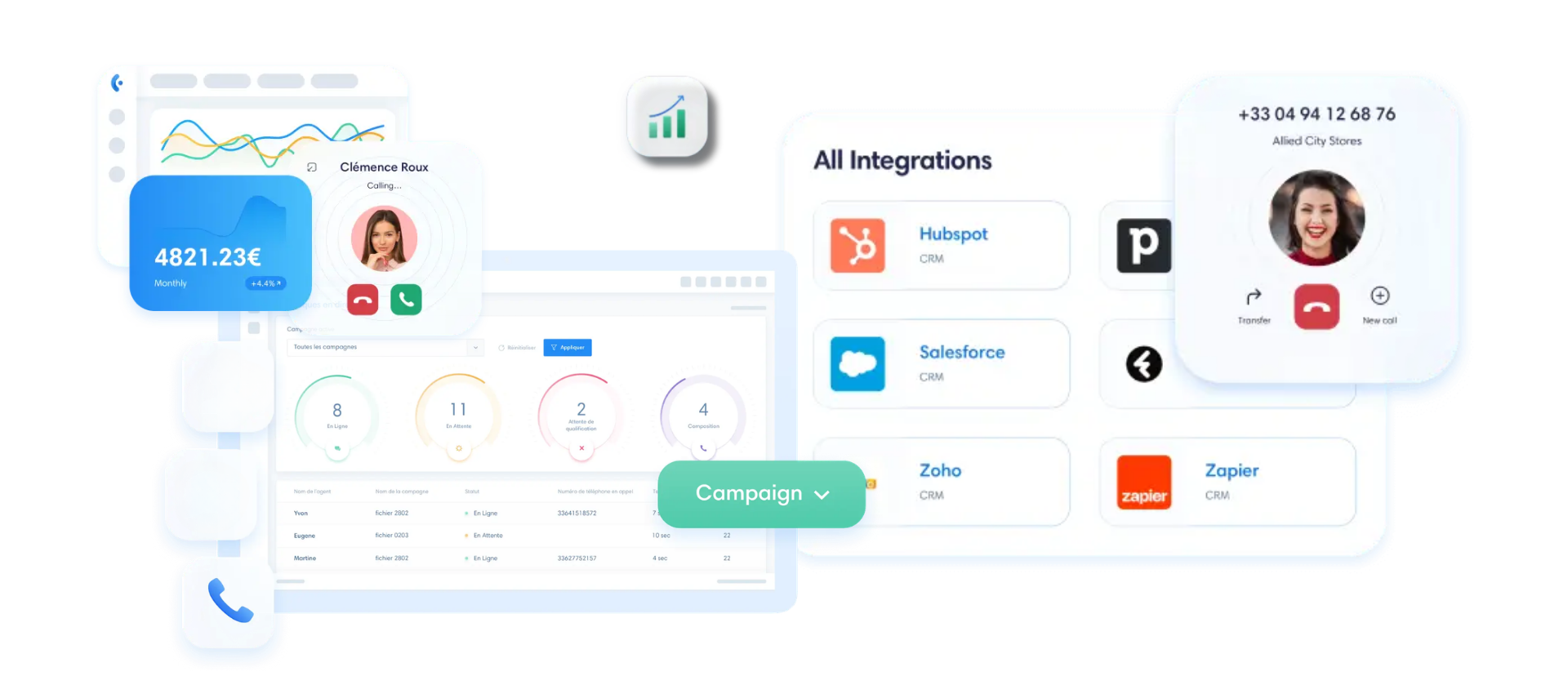
SMEs or Call Centers: How Can You Scale Your CTI System to Match Your Call Volume?
You’re convinced that CTI adds value. But there’s one question that many overlook: what level of integration actually suits your needs? A small business with 12 employees handling 40 calls a day doesn’t have the same needs as a call center with 30 agents handling 2,000 calls. And yet, some solutions on the market sell them exactly the same thing.
Here’s how to configure your computer-phone integration to suit your specific needs.
| Criteria | SMEs / Small and Medium-Sized Enterprises | Call center |
|---|---|---|
| Daily volume per agent | 10 to 50 calls | 100 to 300+ calls |
| Communication time per day | Moderate use (< 120 min) | Heavy use (up to 500 minutes) |
| Key Performance Indicator (KPI) | Dropout rates, customer satisfaction | AHT, ACW, conversion rate |
| Key CTI feature | Record retrieval + click-to-call | Predictive dialer + real-time monitoring |
| CRM integration | Easy synchronization (HubSpot, Pipedrive) | Advanced synchronization + API + workflows |
| Sample Budget at Kavkom | €30/month per user, no commitment | €50/month per user, no commitment required |
For an SME, a CTI call center with advanced supervision and a predictive dialer would be overkill. What you need is seamless integration between your phone system and business tools: the customer file that pops up when the phone rings, click-to-call from your CRM, and automatic logging so you don’t miss a thing. At Kavkom, the €30/month plan covers exactly that, with unlimited incoming and outgoing calls, prorated billing, and no hidden fees.
For a call center, the opposite is the problem: under-equipping a team that spends its day on the phone. When your agents are handling 200 outbound calls in a row, every second of a ringing call goes to waste—and that costs money. Kavkom’s native predictive dialer, whisper coaching, and real-time dashboards: these features aren’t just extras—they’re essential for daily performance tracking. The €50/month plan is designed for this intensive use (up to 500 minutes per day), with all features included at no extra cost.
And that’s where choosing the right provider makes all the difference. With other providers, advanced analytics and monitoring are reserved for premium plans. You start at €25, then discover that the true cost of a call center solution far exceeds the initial price. Kavkom includes everything from the start: no modules to unlock, no extra options to check.
What should you do before making a choice? List your actual call volumes over a typical week, identify the three KPIs that matter most to your business, and verify that the phone system natively supports them. This is the only way to avoid paying for unnecessary features or, worse, discovering too late that you’re missing some.
Implementation: Successfully integrating your phone system without disrupting business operations
You’ve identified the features you need and tailored the solution to your call volume. Now it’s time to get everything up and running. And this is often where projects fall behind schedule—not because of the technology, but because of what wasn’t prepared in advance.
Good news: with a cloud solution like Kavkom, CTI deployment is nothing like installing a physical PBX from the 2000s. No on-site technicians, no wiring, no weeks-long wait. But “easy to activate” doesn’t mean “nothing to prepare.” Here’s what makes the difference between an integration that works from day one and one that generates support tickets for three weeks.
How it works technically (in plain language)
There are three ways for your phone system to communicate with your business software:
- Native connectors: ready-to-use gateways between your phone system and your CRM. Kavkom offers connectors for Salesforce, HubSpot, Pipedrive, Zoho, and Zendesk. Simply activate the connector, grant access, and data synchronization begins. No coding required.
- The REST API: a documented programming interface that allows your technical team (or an integrator) to create custom connections to an ERP system, an internal tool, or any software that lacks a native connector. Every call, every contact, and every statistic is accessible via standardized endpoints.
- Webhooks: automatic notifications sent by Kavkom to your tools when an event occurs (incoming call, call ended, new contact created). This allows you to trigger real-time actions, such as creating a ticket in your helpdesk for every missed call.
For 80% of small and medium-sized businesses, native connectors are sufficient.APIs and webhooks come into play when you have specific workflows or a custom information system.
The three steps that really matter
1. Audit your CRM data. This is the point that everyone underestimates, yet it is the cause of half of all failed record updates. If your phone numbers are formatted incorrectly (spaces, missing area codes, duplicates), the system cannot match the incoming call to the correct contact record. Before activating anything, clean up your data: use the international format (+33), remove duplicates, and verify required fields.
2. Map the fields between the telephony system and the CRM. Which CRM field stores the call duration? Where is the agent’s note saved? Doesthe CRM integration create a new record for each call or update the existing contact? This mapping takes 30 minutes using a native Kavkom connector, but it determines the reliability of the entire process.
3. Check your network. IP telephony relies on your Internet connection. If your bandwidth is shared among 15 workstations, large downloads, and video conferencing, audio quality will suffer. Set up voice traffic prioritization (QoS) on your router, or use a dedicated connection if your call volume warrants it.
The GDPR trap that no one sees coming
You’ve enabled call recording, the customer profile integration is working, and everything is running smoothly. Except that no one thought about consent. In Europe, recording a conversation without informing the caller exposes your company to penalties. Kavkom’s IVR system allows you to include an informational message at the start of the call (“This call may be recorded”), but it’s up to you to enable it and document your data processing policy.
Honestly, this isn’t the most exciting part of the project. But it’s the one that could end up costing you the most if you overlook it.

Integrating your phone system with your IT infrastructure isn’t a six-month project. With clean CRM data and a cloud solution like Kavkom (activation in minutes, out-of-the-box native connectors, and live support available by phone or WhatsApp to resolve configuration issues), going live takes hours, not weeks.
Selection criteria and pricing pitfalls: how to choose the right CTI software
You understand the benefits of CTI, you know how to implement it, and you’ve even tailored the solution to your call volume. Now comes the trickiest part: choosing a provider. And that’s when the unpleasant surprises start piling up—often long after the contract has been signed.
The CTI software market is full of offerings that advertise attractive prices on their homepages but then charge extra for every useful feature. Here’s what to look for before committing, and the red flags that should make you run the other way.
The three most common pricing pitfalls
Unlimited counterfeits. Some providers advertise “unlimited calls” in broad terms, then slip a “fair use” clause into the terms and conditions. In practical terms, once you exceed a certain limit, you’ll be charged for the excess or your line will be throttled. You won’t find out until you receive your bill for the second month.
A disguised commitment. The monthly rate shown is actually based on an annual commitment. If you cancel after three months, you’ll have to pay the difference. Others impose a minimum number of lines or cancellation fees that turn the “no-contract” option into a contractual trap.
Paid options for basic features. Call recording is available as an optional feature. Advanced statistics are available only with the premium plan. Use of a physical IP phone is billed as an optional add-on. The total cost of ownership skyrockets when every useful component is sold separately.
The key factors to consider when choosing your solution
Instead of comparing price lists, focus on what drives day-to-day success:
- Native CRM compatibility: Does your provider offer ready-to-use connectors for your current CRM (Salesforce, HubSpot, Pipedrive, Zoho)? If the integration requires custom development, the cost and timeline will change significantly.
- Quick access to live support: When your ticket system stops working at 4 p.m. on a Friday, you need to talk to someone who understands the problem—not a chatbot that just sends you to the FAQ.
- True contractual flexibility: prorated billing, cancellation without penalty, and the option to suspend service during vacations. That’s what sets a truly flexible plan apart from one that merely claims to be flexible.
- All features included: monitoring, recording, dashboards, predictive dialer. If you have to check boxes to access the features that make CTI useful, the listed price is meaningless.
Kavkom meets every one of these criteria. The platform is 100% cloud-based, can be activated in just a few minutes, and offers transparent pricing: €30/month for small and medium-sized businesses (unlimited incoming and outgoing calls—truly unlimited, with no fair use policy), and €50/month for high-volume call centers. There is also an €8/month plan, but be aware: it is billed annually and covers only incoming calls. The predictive dialer is built-in and included, physical IP phones are compatible at no extra cost, and support is 100% human, available by phone, email, or WhatsApp.
Between us, the real question isn’t “Which provider is the cheapest?” It’s “Which provider won’t charge me extra for what I need to make my phone-to-computer integration actually work?” “.
Boost the productivity of your sales teams with Kavkom, the 100% cloud-based business telephony software.
Schedule a demo
Key Points to Remember About Computer-Telephony Integration
- Productivity gains: Customer file retrieval and click-to-call reduce the average call handling time by 30%.
- Automation: Automatic synchronization reduces the post-call administrative workload (ACW) by 40%.
- Reliability: The success of the integration depends on a preliminary audit of your CRM data (international format, removal of duplicates).
- Transparency: Avoid hidden options and opt for no-commitment solutions that natively include all monitoring features.
CTI isn’t a complex technical project—it’s a direct tool for enhancing your customer relationships. To take it a step further, learn how to maximize the synergy between CRM and outbound calling to boost your sales performance. You now have everything you need to modernize your switchboard.