You’ve been comparing call center solutions for a few weeks now, and you get the impression that they all look the same. Routing, IVR, recording, CRM integration… the sales pages display the same features. Same prime rate. Same promise.
The problem is what you don’t see yet: supervision billed as an option, recordings limited to paid storage, advanced reporting reserved for the top third. Hidden costs that push up the real bill by 30 to 40% in the first quarter.
This guide gives you a concrete decision-making framework: the features that are really essential for your specific use case, the costs to track before signing up, and a demo checklist to test what really counts, including CRM integration and inbound and outbound call management.

Boost the productivity of your sales teams with Kavkom, the 100% cloud-based business telephony software.
Schedule a demo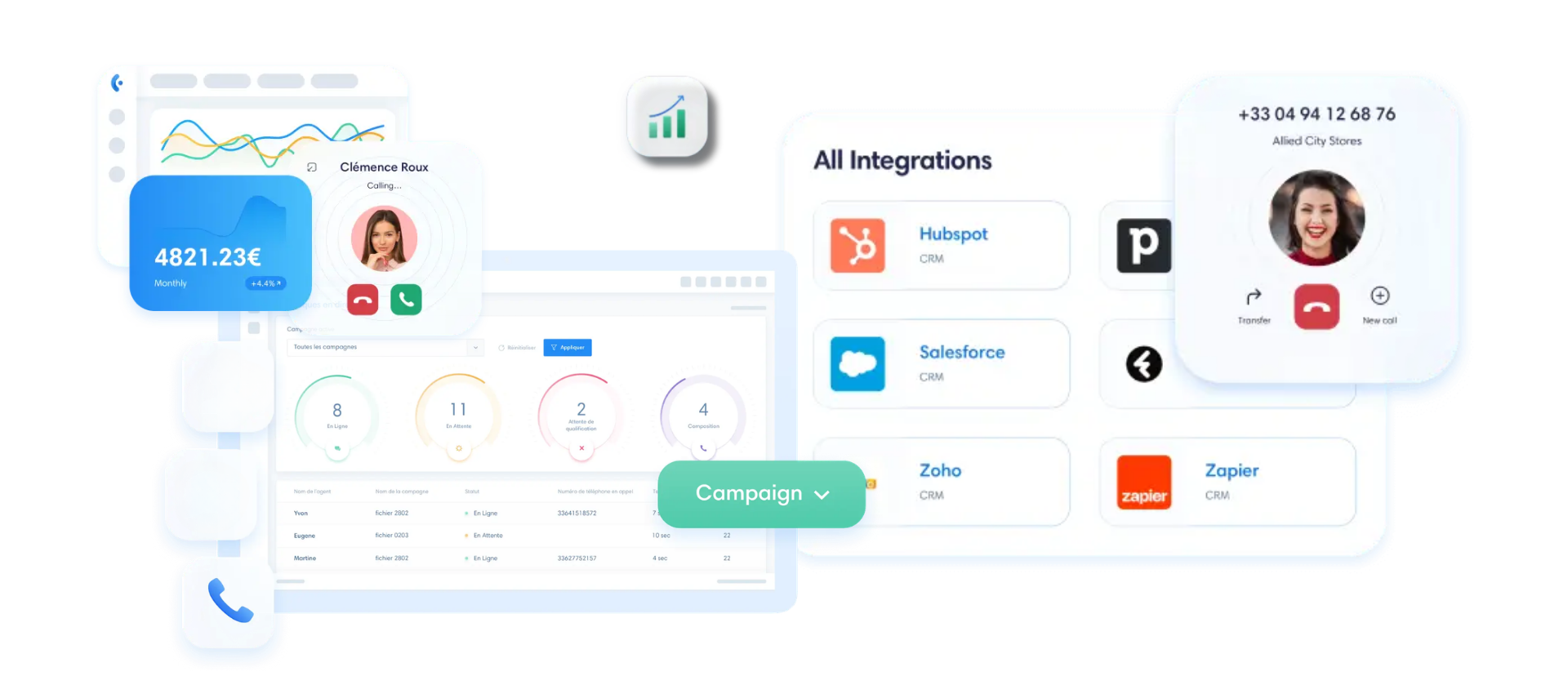
What is a true cloud call center solution vs. simple phone call center software?
Many managers make this mistake. And understandably so.
Some solutions are limited to VoIP telephony (making and receiving calls).
A more comprehensive cloud telephony platform adds supervision, call automation and CRM integration functions to drive the business.
A true call center solution is something else. It’s a cloud telephony platform that combines call management, campaign automation, supervision and CRM integration to drive the business.
Here’s what it means in concrete terms:
- Intelligent call routing: each incoming call is routed to the right agent according to skills, availability or customer language, not just to the first one off the hook.
- Real-time supervision: you can see live how many calls are queued, which agents are available, and what the average waiting time is.
- Outbound campaign management: with a predictive dialer, your agents no longer dial manually – the system calls several numbers simultaneously and connects the agent only when someone picks up.
- Call recording and analysis: for coaching, RGPD compliance, and continuous quality improvement.
The cloud model (CCaaS) has become essential for SMEs. Why ? Because it eliminates physical constraints.
For example, a company opening a new site can deploy the solution immediately, without any technical installation.
This is also the real advantage of the cloud: telecommuting becomes transparent. An agent at home has exactly the same capabilities as in an open-plan office.
The Kavkom platform centralizes incoming and outgoing calls, supervision, statistics and CRM integration in a single interface. Activation is immediate and without obligation.
Essential features for managing incoming and outgoing telephone calls
A ringing telephone line is the minimum. What makes the difference between a struggling team and a successful one is what happens around that call.
Here are the four functional blocks you need to evaluate before choosing your call center solution.
Intelligent routing and IVR (Interactive Voice Response)
A misdirected incoming call means a frustrated customer. And a time-consuming agent transfer.
Intelligent call routing solves this at the root. In concrete terms: a customer calls your sales department. The system identifies their language, the time of the call, and the skills profile available. The call goes straight to the right agent, without having to go through a switchboard operator.
The IVR (Interactive Voice Response) plays a key role upstream. Even before an agent picks up, the customer indicates his or her request via a voice menu. “Press 1 for support, 2 for billing. Simple. But the impact is real:
- Abandonment rate drops, because customers wait less time
- Average processing time is reduced, because the agent already receives a qualified context
- Queues are smoother, because calls are distributed according to actual skills.
With Kavkom, time scenarios and routing rules can be configured directly in the interface, without any technical intervention. Closing on Friday at 6pm? The system automatically switches to a personalized message and reminder option.
Productivity tools: Predictive Dialer and Click-to-call
When it comes to outbound calls, the time wasted on manual dialing is a real abyss. A sales rep who spends 8 hours prospecting actually spends 2 to 3 hours in actual conversation. The rest? Dialing, answering machines and empty ringing.
The predictive dialer radically changes this equation. The system dials several numbers simultaneously, detects answering machines automatically, and only connects the agent when a prospect actually picks up. The result: your sales rep spends his time talking, not waiting.
It’s a rare feature at this level of price and simplicity. Kavkom integrates it natively, with no additional modules to pay for.
Click-to-call completes this feature for everyday use. Via a Chrome extension, your agents click on any number displayed in their browser or CRM to launch the call instantly. No more copying and pasting, no more dialing errors.
Real-time supervision and call recording
You can’t improve what you can’t see. This is where supervision makes all the difference between a manager who steers and a manager who undergoes.
A good supervision tool gives you real-time :
- Number of calls in queue and average waiting time
- Status of each agent (available, on call, in post-processing)
- The ability to listen in on a live call to supervise the quality of exchanges and support agents in training.
- Whisper mode: you guide your agent in real time, the customer hears nothing
When training a new agent, whisper mode allows the supervisor to intervene discreetly to guide the conversation. With whisper mode, you whisper the right answer without interrupting the conversation. It’s real-life coaching, immediate and frictionless.
Call recording extends this work over time. Each archived call becomes a training resource. You can identify recurring objections, build more effective scripts, and train new recruits on real-life cases.
The platform also incorporates advanced security mechanisms: communications encryption, access rights management and RGPD compliance. These elements guarantee the confidentiality of exchanges and the protection of customer data. With Kavkom, these features are included at no extra cost. No “premium supervision” module to add as an option.
Computer telephony integration (CTI) and CRM integration
An agent who receives a call and has to manually search for the customer file in his CRM loses an average of 30 to 45 seconds per call. On 80 calls a day, that’s one hour of lost productivity. Every single day.
Computer telephony integration (CTI) eliminates this problem. As soon as an incoming call is received, the contact’s file is automatically transferred to the CRM. The agent immediately sees the customer’s name, history and most recent interactions. They can concentrate on the conversation, not on research.
Here’s what CRM integration can do for you:
- Automatic file update for each identified incoming call
- Automatic logging of calls, durations and notes in CRM
- Direct access to recordings from the contact form
- Zero double entry, zero loss of information between tools
Kavkom connects natively with the leading CRMs on the market, including Zoho CRM, Salesforce, HubSpot, Pipedrive and Zendesk.
Synchronization is bidirectional: what happens in Kavkom is reflected in your CRM, and vice versa. Your teams keep their usual tools, while Kavkom integrates seamlessly with them.
This is exactly what turns a simple telephone line into a real driver of sales performance and customer service.
Hidden costs: pitfalls to avoid when choosing your Call Center solution
The price displayed on the pricing page of a call center solution is rarely the price you actually pay. And it’s often at this point that the real costs become apparent.
Here’s how it works. You sign up for €65 per agent per month. Then you discover that real-time supervision is a premium module. That advanced statistics are reserved for the top tier. That call recording is billed by the minute of storage. That connecting a physical IP phone costs an extra monthly fee.
At the end of the quarter, your actual bill exceeds your initial budget by 30 to 40%.
Here are the options most often billed as extras by competitors:
- Supervision and advanced dashboards: often reserved for premium plans, with an additional cost per agent
- Statistics and detailed reporting: basic KPIs are included, but customized reports are available as an optional extra.
- Call recording: billed by the minute or storage volume by most providers
- Use of a physical IP phone: Ringover and others charge for this option, while many teams prefer a fixed telephone to a softphone.
- CRM integrations: sometimes included as standard, sometimes invoiced per connector or per volume of synchronized calls
- Responsive human support: priority support (telephone, rapid response) is often an add-on to entry-level offers.
With Kavkom, key functions (supervision, statistics, call recording, predictive dialer) are integrated directly into the platform, without additional modules.
The solution remains entirely cloud-based. Teams can use a web or mobile softphone, and compatible IP phones if they wish, with no hardware requirements. You pay what you see on the pricing page, not what you find on the invoice.
And pro rata billing is a concrete advantage that many people underestimate. Is your team less active in August? You suspend unused lines and pay only for days actually used. You don’t have to pay a fixed rate that runs dry during your vacations.
To avoid unpleasant surprises, here are three things to remember before signing up with any call center solution:
- Ask for the complete list of features included in the basic plan, not in the “enterprise” plan.
- Check whether supervision, recording and reporting are included or billed as an option
- Calculate the real cost with your estimated call volumes, not just the price per seat.
To take your comparison a step further, our comparative guide to the best call center software details the pricing models of the main solutions on the market.
Monitoring and KPIs: measuring the performance of your PC-based call software
Without visibility on indicators, it becomes difficult to adjust resources in real time.
This is exactly the problem that good cloud call center software solves: giving you an instant readout of what’s going on in your call center, without waiting for the end-of-day report.
Here’s what this means for your day-to-day management.
The 80/20 rule is a benchmark for call centers. The objective: 80% of incoming calls answered in less than 20 seconds. If your dashboard shows you that this threshold is exceeded at 2pm on a Tuesday, you can reassign an agent from an outbound campaign to the queue. Immediately. Not the next morning.
Without real-time visibility, this decision comes too late or not at all.
Three KPIs should be monitored in priority:
- Pick-up rate: the percentage of incoming calls answered by an agent. Below 80%, your customer service suffers.
- Average handling time (AHT ): total duration of a call, including post-processing. A rising MTD often indicates a scripting or skills problem.
- Abandonment rate: customers who hang up before being taken care of. Over 5% is a strong warning signal about your sizing.
These three indicators should be readable at a glance, from your screen, without having to export anything.
Here’s what a good dashboard should let you do in less than 30 seconds:
- Identify which agent is available, on call, or in post-processing (ACW)
- See how many calls are waiting in queue and for how long
- Spot if the abandonment rate starts to rise
- Decide on corrective action: reassignment, suspended break, reinforcement
Kavkom integrates these dashboards natively, in real time, without any additional modules. Your supervisors can access all metrics from their browser, whether they’re in an open-plan office or working from home.
And as we saw in the previous section, these features are included in the subscription, not reserved for a premium tier.
To take you a step further in structuring your customer relations center around these indicators, you’ll find concrete methods adapted to different team sizes.
Steering by KPIs is also what enables you to coach your agents objectively. Not “I think you’re spending too much time in post-processing”, but “your average DMT is 6 minutes, the team target is 4 minutes – here’s what we’re going to work on together.”
It’s the difference between a manager who reacts and one who anticipates.
Demo checklist: testing a cloud call center solution
A demo is your only chance to see the reality behind the sales slides. And most managers waste it by letting the salesperson drive the sales.
Take control. Here’s exactly what you need to test for yourself.
1. Audio quality in real-life conditions
Don’t test from a meeting room with dedicated fiber. Test from your office wifi, or from a 4G network. That’s where the problems come in: latency, outages, echoes.
Make an outgoing call to a cell phone. Ask someone to call you back. If audio quality falters under these conditions, it will falter every day.
2. Getting to grips with the interface in 5 minutes
Ask us to create a simple IVR (Interactive Voice Response) live, in front of you. Two menu options, a greeting message, a time rule for weekends.
If the salesperson hesitates, opens the documentation, or says “we’ll train you on this”, it’s a signal. A truly intuitive tool can be set up in a few clicks, without any prior training.
3. Call routing and queuing
Simulate a real-life scenario: three available agents, one incoming call, two busy agents. Where does the call go? How long before it’s redirected? Can the supervisor see the queue in real time?
If you can’t test this during the demo, ask to do it yourself during the free trial.
4. Live CRM integration
Connect your CRM during the demo HubSpot, Salesforce, Pipedrive, whatever. Make a call from an existing contact. Check that the record comes up automatically, that the call is logged and that the duration is recorded.
If integration requires a developer or several hours of configuration, it’s a hidden cost you hadn’t anticipated.
5. Customer support – the most revealing test
Send a message to support during the demo. Not a ticket. An email or WhatsApp message with a real technical question.
How long does it take to get a human response? Not a bot, not an automated FAQ article. A real answer from a real person.
At Kavkom, support is available by email, phone and WhatsApp with no mandatory chatbot, no forced self-service. It’s a criterion that seems secondary until you have a problem at 9am on a Monday morning with 15 agents waiting.
6. Included vs. optional features
Ask directly: are supervision, dual monitoring and advanced statistics included in the basic plan? Ask for a screenshot of the pricing page with detailed options.
And check whether the use of a physical IP phone is included or charged extra – this is often where the nasty surprises lurk, as we saw in the previous section.
To take your assessment a step further, our guide to the enterprise cloud telephony solution will give you additional technical criteria to check before you sign.
Things to remember
Forget the price per seat. The real cost of your call center solution is hidden in the options: supervision, recording, advanced statistics…
This is often where the bill rises by 30 to 40%.
A high-performance platform must integrate these tools natively. Teams need to be able to track their KPIs and connect their CRM without complex configuration.
Don’t put up with demos. Insist on testing the audio quality in real-life conditions and the responsiveness of human support. This is a useful indicator of support reliability and supplier quality.
For a broader view of the technology, see our guide to VoIP solutions for businesses.