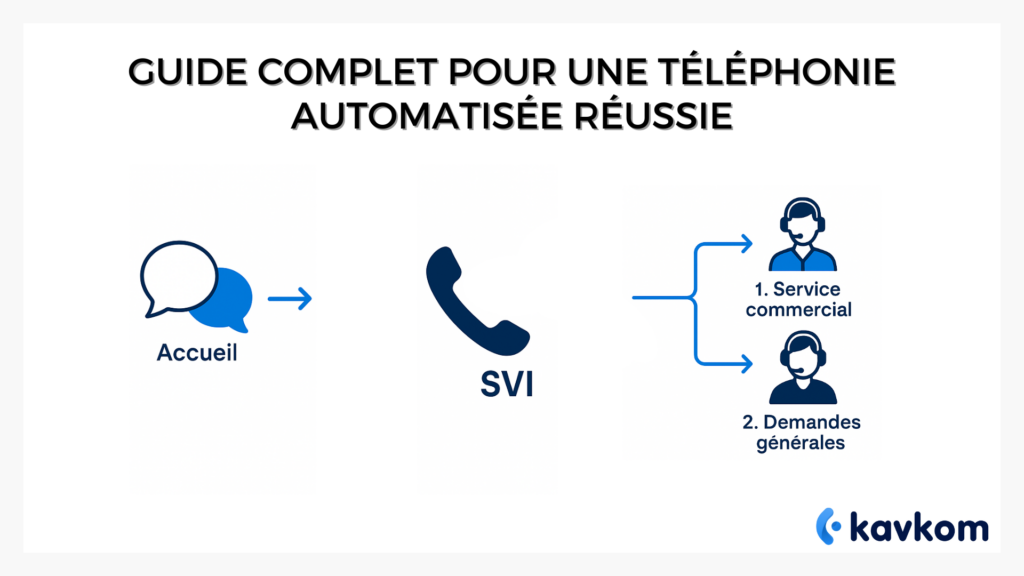
Here’s what a well-designed IVR can do.
The IVR is an everyday tool that transforms the way a company handles calls, organizes its teams and smoothes the customer experience. Yet its potential remains largely under-exploited, often because it’s limited to a simple “Press 1”.
This guide is for you if you want to restructure your telephony, improve call management, reduce waiting times and offer callers a stable experience. It’s also for you if you’re a manager, CTO, call center manager or head of a service company looking to professionalize its reception without complexity.
Points to remember :
- The IVR transforms a raw call flow into an organized process, where each request quickly finds the right contact.
- A simple tree structure built around actual call patterns immediately enhances the caller experience.
- IVR reduces the mental load on teams by eliminating misdirections and unnecessary interruptions.
- Automated reception can absorb peaks in activity without compromising service quality.
- IVR data provides a precise view of volumes, friction points and adjustment needs.
- A scalable IVR, regularly tested and adjusted according to business cycles, becomes a lasting asset for operational performance.


Boostez la productivité de vos équipe commerciales grâce à Kavkom, le logiciel de téléphonie d’entreprise 100% cloud.
Planifier une démo
Why IVR has become indispensable for call management
Imagine an ordinary morning in a customer service department. Agents arrive, settle in, launch their tools. Your switchboard opens. The first calls come in immediately. Three trivial requests, an urgent technical problem, a new customer lost between two options, then a call that should have gone to the sales department. In less than ten minutes, your team is juggling priorities, frustrations and improvisation.
Then replace this scene with an IVR.
From the moment the system opens, each call is listened to, directed and distributed according to a pre-designed path. Your team no longer has to sort through calls. Agents gain cognitive availability and can concentrate fully on resolving requests.
The role of IVR is not mechanical. It’s organizational.
The true function of the Interactive Voice Server
The IVR has a simple mission: to transform a volume of calls into an organized flow.
This means that :
- distributes requests according to their nature
- reduces orientation errors
- harmonizes reception
- manages the entry of all calls as a virtual agent
This makes it a must-have for any company with a significant telephone volume.
How an IVR improves service quality
A company receives around a hundred calls a day, divided between three departments. Without an IVR, the switchboard becomes a constant race. Redirection errors pile up. Waiting times increase. The experience deteriorates.
With an IVR, things change. The caller immediately identifies his or her need. The system applies a referral rule. The right agent receives the right request. The workload is back under control.
A significant reduction in waiting times
The first impact is seen in the queues.
By directing calls, IVR prevents a single entry point from becoming saturated. The caller is placed in the right queue, as soon as the first choice is made.
More equitable flow distribution
Teams are no longer subject to random distribution.
The IVR distributes calls according to your rules: availability, time slots, skills. This ensures that each agent receives a consistent share of the flow.
A better reception experience
Callers no longer need to explain their problem three times. The process becomes linear. The overall impression is improved, and your teams gain in serenity.
| Criteria | Before IVR | After IVR |
|---|---|---|
| Hospitality experience | Unequal | Structured and stable |
| Shift load | Random | Divided according to rules |
| Waiting time | Variable | Reduced |
| Error rate | High | Greatly reduced |
Behind the scenes of successful automated management
The strength of an IVR rests on three pillars: reception, routing and distribution.
This trio forms the backbone of your telephony.
Voice greeting, the first step in your career
Voice greeting defines the perceived quality of your telephone service from the very first seconds.
A well-designed greeting is brief, helpful, and immediately puts the caller on track. It’s not a formality. It’s the first strategic decision.
The message must follow a simple logic: present the choices, guide the user, and make each option immediately understandable.
Routing, the heart of the system
Once the caller has been selected, routing comes into play.
Its role is to apply the rules: agent availability, schedules, priorities, languages, skills. Routing becomes a professional sorting tool, demonstrating its value with every call.
Sometimes it only takes half a second to know whether the call should go to sales, support or billing.
Distribution, the final link in the chain
Once the call is in the right queue, the distribution chooses the appropriate agent.
It can follow different logics:
- first free agent
- balanced distribution
- distribution by skills
- sequential order
Efficient distribution allows your teams to work in a more relaxed environment, where each agent knows what he or she is getting.
Designing an intuitive tree structure
A tree structure should be kept simple: three to five options are enough to guarantee a clear path.
Structuring options according to reality
Your tree structure must reflect the real reasons for calling.
To do this, rely on statistics, your experience in the field, peak hours and repeat requests.
Start with the most popular services.
Put them at the top of the options.
Keeping things simple
An effective tree structure is short.
Ideally, three to five options are sufficient.
Each additional level makes the path more complex and increases the risk of abandonment.
Careful formulation
Choose simple words.
A caller needs to understand instantly what each option means. This is not the time to use industry jargon.
Integrating IVR into your organization
A high-performance IVR doesn’t live alone. It needs to be integrated into an internal ecosystem, with each department contributing its own vision and needs.
Kavkom offers a 100% cloud solution for call centers and sales teams, with virtual numbers, routing, CRM integration and responsive support.
No commitment and pro rata billing mean that the number of lines can be adjusted according to activity, while virtual numbers offer immediate telephone presence, in France and abroad. Teams benefit from a predictive dialerCRM integration and reactive human support to work in comfort.
Boostez la productivité de vos équipe commerciales grâce à Kavkom, le logiciel de téléphonie d’entreprise 100% cloud.
Planifier une démoAligning with your service identity
The greeting carries your voice.
It should reflect your quality of service, your tone, your posture. A cold or impersonal IVR gives the wrong impression and degrades the experience.
Team involvement
The IVR concerns :
- the support
- customer service
- the salesman
- management
- marketing
Each team needs to validate the consistency of the route, to avoid unnecessary options or messages out of sync with your processes.
Adjustment to operating cycles
An IVR must keep pace with the life of the company.
Busy periods, campaigns, organizational changes, schedule updates.
The tool must evolve at the same pace.
Make the most of your IVR data
An IVR doesn’t just direct calls. It generates valuable data on your telephone activity.
Analyze the actual flow
Statistics reveal peaks, troughs, priority requests, saturations.
You identify when teams are overworked and when they are under-utilized.
Understanding friction points
The indicators show :
- which services saturate quickly
- where dropouts are piling up
- which too often remains full
This information becomes the basis for your organizational decisions.
Continuous improvement
Your IVR is not set in stone.
Modify a message, reorganize an option, adjust a distribution rule.
Small improvements often produce significant gains.
Common mistakes when setting up an IVR
An IVR can considerably improve reception… but poor design leads to complexity, errors and frustration.
Too many options
An overloaded tree tires out the caller.
Keep the message brief.
Messages too long
An interminable welcome message is discouraging.
Aim for conciseness.
Untested courses
The best IVRs are fine-tuned after real-life tests.
This helps identify referral errors.
No backup solution
A caller must always be able to talk to a human when necessary.
The easy way to deploy an IVR
Here’s a six-step guide to creating a robust, useful and scalable system, even if you’ve never set up a voice server before.
1. Analyze your calls
The first step is to understand what’s really happening on your line. Before imagining complex menus or elegant options, it’s essential to look at your calls as they really are:
Who calls, why, when, and with what level of urgency.
You can observe the recurring reasons, pinpoint the moments when the line is saturated, identify situations where your teams are being called upon unnecessarily, and identify irritants. The more precise your diagnosis, the more your future IVR will simplify life for everyone, callers and staff alike.
2. Building your tree structure
Based on your analysis, you can draw up a first version of your tree structure. The aim is to transform the most frequent patterns into quick and easy paths. An effective tree structure often boils down to three elements: prioritize what comes up often, eliminate what’s unnecessary, and organize what’s left in a logical way.
A good method is to place the most popular options first, then group secondary requests into a wider choice. The idea is not to be exhaustive, but to be relevant. The tree structure should help the caller, not test his patience.
3. Write your voice messages
Once the tree structure is in place, it’s time to give your IVR a voice. Your greeting and orientation phrases should be simple, direct and immediately understandable. The caller doesn’t have to make an effort to follow your logic.
Eliminate length, unnecessary details or overly technical formulas. Present only what you need to choose. If an option requires too long an explanation, it’s often a sign that it doesn’t belong in a voice menu. Your aim is to create useful messages that can be listened to in one go, without hesitation.
4. Configure routing
Your IVR now has a structure and a voice. It must now apply your business rules. Routing configuration determines how each call is routed after caller selection.
You can define rules based on schedules, skills, available queues, priorities, or even location if your company has several sites. These settings play an essential role in ensuring a smooth call flow. With the right settings, the call goes straight to the right team, without any detours.
5. In-house testing
This is the step that many people neglect, even though it determines a large part of the quality of the result. Once the IVR has been configured, have your teams test it. Call your own number at different times of day, use different scenarios, try to “get it wrong”, look for dead ends, listen to the rhythm of the message.
This test work allows you to spot inconsistencies, menus that are too long, or a poorly configured routing rule. It’s better to discover these points internally than after production.
6. Adjust and optimize
An IVR should never remain static. An organization evolves, and your IVR must keep pace. After a few days or weeks of use, you already have concrete data: reasons for abandonment, saturated queues, waiting times, selection errors.
FAQs
What is an IVR?
An IVR is an Interactive Voice Server, i.e. a system capable of guiding a caller through an automated voice menu. It does more than simply broadcast a greeting. It organizes requests, directs each person to the right service and structures the entrance to your telephony system. In practice, it acts as a virtual assistant, responding immediately and distributing calls according to your rules. This capability makes it a central tool for any company receiving a significant volume of calls.
How many options do you offer?
A good IVR should be simple. Offering between three and five options is more than enough. Beyond that, the caller hesitates, listens again, loses track and the experience deteriorates. Your aim is to help them find their way in a few seconds, not to present them with your entire organization chart. A short, logical tree structure is almost always more effective than an overly detailed menu.
Does an IVR reduce waiting times?
Yes. The main operational advantage of an IVR is its ability to immediately direct the call to the right queue. This avoids all calls entering through a single entry point, which often causes bottlenecks. By directing each caller to the right team, you shorten waiting times and stabilize your flows.
Does an IVR improve satisfaction?
A well-designed IVR improves the greeting experience. Callers immediately understand where to go, reach the right team faster and avoid unnecessary redirections. This fluidity gives an impression of professionalism and naturally boosts satisfaction.
Conclusion
A well-designed IVR does more than just direct callers. It gives rhythm to your reception, lightens the load on your teams and establishes a more serene telephone relationship. When you track your flows, adjust your distribution rules and evolve your tree structure over time, you build an environment where every call finds its place effortlessly.
In this context, a flexible, commitment-free 100% cloud solution like Kavkom provides natural continuity. It combines all the essential features of modern call management, including IVR, with a framework that’s easy to deploy and pleasant to use on a day-to-day basis.