Choosing call center software is no longer just a question of telephony. Today’s team leaders want one thing above all: visibility. Who’s calling. For how long. What pick-up rate. What results. Without this data, it’s hard to manage a sales team or an in-house call center.
For a long time, companies used physical standards, cumbersome installations that were sometimes complex to upgrade. But the market has changed. Telecommuting has taken hold. Teams are distributed. Call volumes vary by season. Call center cloud solutions have become the norm, because they enable lines to be activated in minutes, with no hardware requirements, and calls to be managed from anywhere via the Internet.
But not all solutions are created equal. Some platforms target large international companies with highly advanced tools… which can be very cumbersome to set up. Others are aimed at SMEs and sales teams who want to save time, track their KPIs and retain contractual flexibility.
So how do you choose the right call center solution?
Which features are really useful?
And above all, which platform is right for your type of team and your call volume?
In this guide, we’ll compare the main solutions on the market, analyze their strengths and limitations, and help you understand what you really need to look at before making your choice.
Points to remember
- Call center software does more than just make calls: it structures activity, measures performance and enables teams to be managed via real-time KPIs.
- Call center cloud solutions have become the norm: 100% cloud, no on-site installation, rapid activation and remote agent management.
- Not all platforms are created equal: some target large, omnichannel companies, others SMEs and voice-oriented sales teams.
- The decisive criteria are predictive dialer, supervision, CRM integration, RGPD security and contractual flexibility.
- The pricing model is as strategic as the functionalities: annual commitments are common for many players, with additional paid options, and “unlimited” is sometimes restricted.
- A solution like Kavkom stands out for its business performance-oriented VoIP telephony positioning, 100% cloud, no commitment, pro rata billing and real-time supervision.


Boostez la productivité de vos équipe commerciales grâce à Kavkom, le logiciel de téléphonie d’entreprise 100% cloud.
Planifier une démo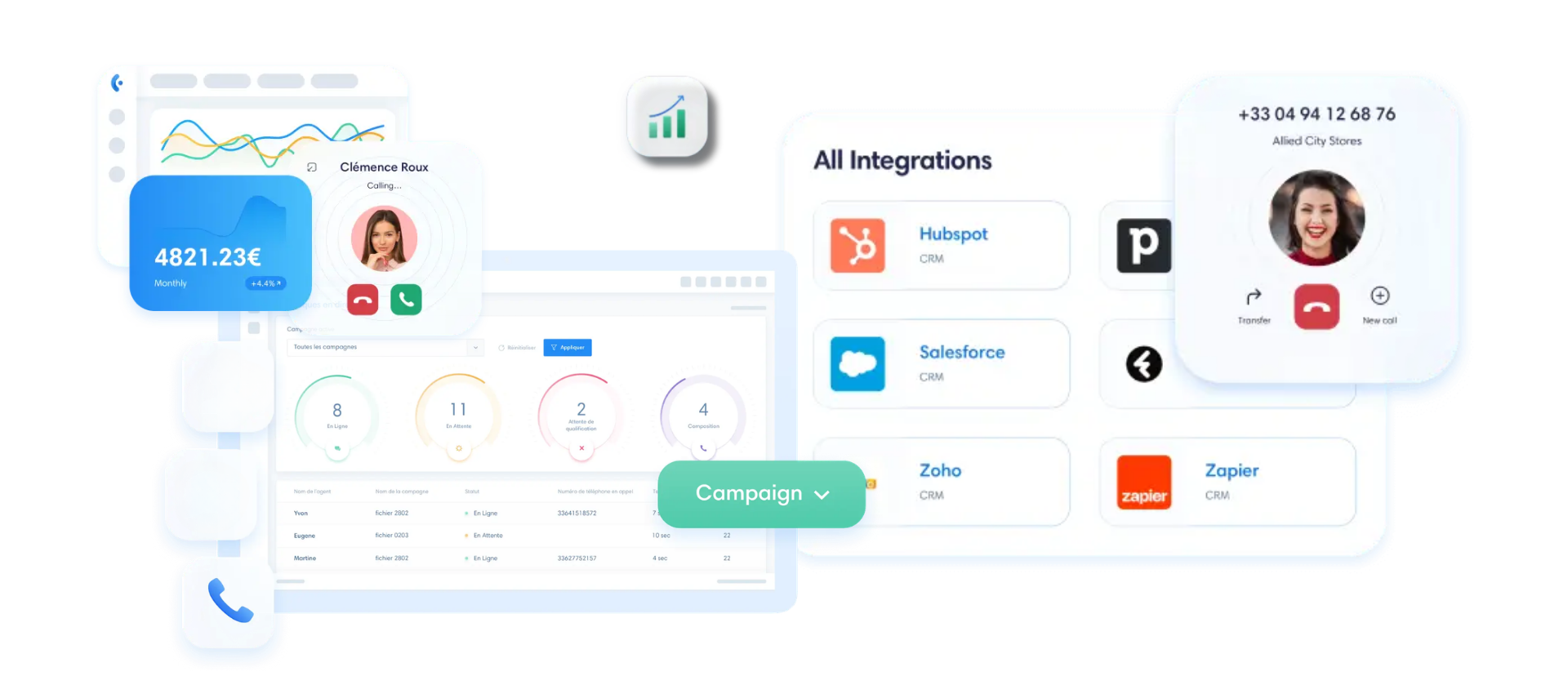
What is call center software?
Call center software is a platform for managing a team’s inbound and outbound calls from a single interface, usually accessible via the Internet.
In concrete terms, this is a cloud switchboard, also known as a cloud PBX (online hosted telephone exchange), to which productivity and supervision tools are added.
This type of solution enables :
- Assign geographic or international fixed numbers
- Manage the routing of calls to the right agents
- Create an IVR (interactive voice server)
- Track calls in real time
- Analyze performance via dashboards
- Record coaching calls
- Integrate data into a CRM
Important information.
Call center software is not an outsourced call center.
It doesn’t replace your teams.
It gives them the tools to work more efficiently.
Most modern solutions use VoIP (Voice over IP), meaning that calls are routed via the Internet rather than a traditional telephone line. This means rapid deployment, with no on-site installation, and more flexible user management.
Another key point:
High-performance call center software does more than just “make calls”. It must also enable you to manage your business.
A manager must be able to answer simple questions:
- How many calls were made this morning?
- What is the dropout rate?
- Which agent performs best?
- Where do we waste time?
Without these indicators, it’s hard to improve sales productivity.
This is precisely why call center cloud solutions have evolved in recent years: they are no longer just telephony tools, but genuine platforms for supervising and steering in-house teams.
Why call center cloud solutions have become the norm
Until a few years ago, setting up a call center often meant :
- Caterial on site
- Wiring
- Heavy technical configuration
- Installation times
Today, this model has become rare:
- Companies want to move fast.
- Open 5 shifts in one morning.
- Add 10 agents for a campaign.
- Reduce activity in August without paying for unused lines.
This is where call center cloud solutions come into their own. A 100% cloud platform operates directly via the Internet. No physical PBX to install. No servers to maintain. Agents can connect using a webphone, a mobile app, or a compatible IP phone.
Result:
- Immediate activation
- Remote deployment
- Hybrid teams or unrestricted teleworking
- Fast scalability
But the cloud doesn’t just change technology.
It changes management.
With a modern solution, a manager can see in real time :
- Available agents
- Call waiting
- Outgoing call volume
- Team performances
We’re moving from a simple telephony tool to a genuine management tool.
And for companies that want to retain flexibility, the cloud model brings another important advantage: the absence of heavy infrastructure also enables models without long-term commitment, with invoicing adjusted to usage.
This has become a decisive criterion for many sales teams and in-house call centers. The cloud is no longer an option. It’s the norm.
Key features of a high-performance call center solution
All call center cloud solutions offer telephony.
But the real question is: what features really make a difference to the day-to-day running of a sales team or in-house call center?
Here are the essential bricks.
Intelligent management of incoming calls
Good call center software needs to organize flows.
This involves :
- IVR (interactive voice response) to guide callers
- Call routing based on availability or skills
- Structured queues
- Hourly rules
The objective is simple: send the right call to the right agent at the right time.
Without it, teams waste time and customers wait unnecessarily.
Predictive dialer and call campaigns
For prospecting teams, the predictive dialer changes everything.
A predictive dialer automatically dials several numbers and connects the agent only when a caller goes off-hook.
Result:
- Less time wasted on ringtones
- More successful calls
- Better sales productivity
- On high-volume campaigns, the impact is immediate.
Real-time supervision and coaching
A manager cannot pilot “blindly”.
A high-performance solution must offer :
- Real-time dashboard
- Detailed statistics
- Listening to calls
- Live coaching if required
- Registration for training
This is what helps improve performance week after week.
Native CRM integration
Making a call without context is a waste of time.
A good call center solution must integrate with the CRM solutions on the market to :
- Display contact details automatically
- Synchronize calls and notes
- Avoid double entries
CRM integration is not a “plus”. It has become standard for structured sales teams.
Safety and compliance
Finally, a cloud solution must guarantee :
- Communication encryption
- Fine-tuned management of access rights
- RGPD compliance
- Secure data archiving
This is particularly important for regulated sectors or multi-site companies. In short, efficient call center software is not just about making calls.
- It must structure the activity.
- Measuring performance.
- And give managers the levers to act.
Among the solutions reviewed here, Kavkom call center software stands out for its per-active-user pricing and the lack of a minimum contract term.
Comparison of the best call center solutions
The market is vast. Some platforms target large international companies. Others are aimed at SMEs or in-house sales teams. Some are highly technical. Others focus on ease of use.
Here’s an overview of the main call center solutions on the market.
Comparative table of call center cloud solutions
| Solution | Solution type | Target audience | Highlights | Limits | Starting price | Commitment | CRM integration | Omnichannel |
| Kavkom | VoIP cloud telephony for business performance | SMEs, in-house call centers, sales teams | Native predictive dialer, real-time supervision, 100% cloud, no commitment, pro rata billing | Not a complete omnichannel platform | 30 €/user/month (unlimited FR) | No obligation | Yes (major CRM + API) | No (focus votes) |
| Talkdesk | Omnichannel cloud contact center | ETI / large companies | Native AI, advanced routing, advanced analytics | Costly, parameter-intensive | ~25 €/user/month | Frequent annual | Yes | Yes |
| Five9 | IA Cloud Contact Center | Large multi-site companies | Advanced WEM, AI, intelligent routing | High price, key account oriented | ~100 €/user/month | Frequent annual | Yes | Yes |
| Vocalcom | Omnichannel cloud contact center | ETI / regulated sectors | Media blending, predictive dialer, numerous KPIs | Complex parameterization | ~99 €/agent/month | On request | Yes | Yes |
| Aircall | Cloud telephony for SMEs | SME / scale-up | Simple interface, native CRM integrations | Advanced options in pay-as-you-go modules | ~30 €/user/month | Annual often required | Yes | Partial |
| Ringover | Enterprise cloud telephony | SMEs / sales teams | Intuitive interface, broad functionality | Frequent annual commitments, invoiced options | ~21 €/user/month | 12 months | Yes | Partial |
| Twilio | CPaaS API-first (cloud infrastructure) | SaaS publishers, technical teams | Highly flexible API, global scalability | Requires in-house development | In use | No obligation | Via API | Yes |
| OVH Telecom | VoIP/SIP cloud | SMEs / IT managers | Modular tariffs, French sovereignty | Less call center productivity | From €0.99/month | No obligation | Via API | No |
| Flexip | SME Cloud Telephony | VSEs, franchises | Rapid activation, human support | Frequent long-term commitment | ~24.90 €/user/month | 24 months | Yes | No |
| LinkedPhone | Cloud mobile-first telephony | Solopreneurs, small teams | Affordable, no-obligation price | Limited advanced functions | ~$14.99/month | No obligation | Limited API | No |
This chart shows one simple thing: there is no such thing as “one best solution fits all”.
It all depends:
- The size of your team
- Your call volume
- Your supervision needs
- Your need for contractual flexibility
- Whether or not you need to be omnichannel
Some platforms are powerful, but aimed at large accounts. Others are accessible but limited in terms of piloting. Some require a technical team. Others are ready to use.
In the following section, we take a closer look at the main solutions, to understand who they are really aimed at and in which contexts they are suitable.
Detailed analysis of solutions
Kavkom
Kavkom is a 100% cloud VoIP telephony solution, specialized in sales performance and internal call center management.
The platform is designed for teams that call a lot: prospecting, structured customer service, multi-agent support. It’s not an infrastructure for developers. Nor is it an omnichannel marketing platform.
The core positioning is clear: cloud telephony, real-time supervision, native predictive dialer, CRM integration, all with no commitment and prorated billing.
Kavkom favors simplicity of activation and contractual flexibility over an accumulation of complex modules.
For whom?
- Structured SMEs
- In-house call centers
- Sales teams
- Growing startups
- Managers who want visibility on their performance
Suitable for teams of 3 to 50+ agents who need :
- Predictive Dialer
- Real-time supervision
- CRM integration
- Quick activation
- Flexibility without commitment
Highlights
- Built-in predictive dialer
- Real-time supervision and coaching
- Native CRM integration (Salesforce, HubSpot, Zoho, Pipedrive…)
- All the functions required for standard commercial use are included in the offers
- IP phone compatible at no extra cost
- No obligation
- Pro-rata billing
- Human support via email, telephone and WhatsApp
Limits
- Not a complete omnichannel platform
- Less chat, SMS or social networking oriented
- Less suitable for very large international groups looking for advanced omnichannel AI tools
To remember
Kavkom is particularly suitable if your priority is :
- Sales productivity
- Team management
- Contractual flexibility
- An easy-to-deploy operational tool
It’s not a generalist platform. It’s a conscious choice to specialize in telephony.
Talkdesk
Talkdesk is an omnichannel cloud contact center platform for large enterprises. The tool integrates advanced artificial intelligence, automation and analytics modules.
Our positioning is clearly geared towards large-scale digital transformation, with a structured approach for international organizations or complex multi-departmental environments.
For whom?
Talkdesk is primarily aimed at :
- ETI and large companies
- International organizations
- Omnichannel contact centers
- Structures with dedicated IT teams
Particularly suited to complex environments with advanced AI requirements. It’s the right solution when you need to manage high multi-channel volumes and highly formalized processes.
Highlights
- Complete omnichannel (voice, chat, email, etc.)
- Native AI features
- Advanced routing
- Detailed analysis tools
- Broad CRM integrations
Limits
- Dense parameterization
- Longer learning curve
- Cost can become high depending on the modules
- May be oversized for an SME
- Frequent contractual commitments
To remember
Talkdesk is a robust solution for large organizations that need a structured omnichannel environment and advanced AI tools.
For a more agile sales team, the complexity can sometimes exceed the real need.
Five9
Five9 is a cloud contact center platform aimed at large enterprises, with a strong focus on AI and advanced workforce management.
The positioning is clearly “enterprise”. It’s a solution designed for multi-site, multi-department environments, with high call volumes.
For whom?
- Large companies
- Multi-site organizations
- Large-scale contact centers
- Environments requiring advanced WEM (Workforce Engagement Management)
Highlights
- Integrated AI
- Intelligent routing
- Advanced team management
- Advanced reporting
- Complete omnichannel
Limits
- High rate
- Often annual contracts
- Longer implementation times
- Less suited to agile structures seeking speed and flexibility
To remember
Five9 is relevant for structured organizations with large teams and complex processes.
For an SME or in-house call center looking for rapid activation and contractual flexibility, the solution may seem cumbersome.
Vocalcom
Vocalcom is an omnichannel cloud contact center platform, historically well established in structured environments and regulated sectors.
Its positioning is based on advanced multi-channel interaction management and detailed performance management.
The platform showcases :
- Media blending (simultaneous management of multiple channels)
- Predictive Dialer
- Numerous, detailed indicators
- Fine tuning
It’s a complete solution, designed for organizations that want to have complete control over their operations.
For whom?
- ETI
- Multi-channel contact centers
- Regulated sectors
- Organizations with advanced KPI needs
Suitable for teams who want a complete solution with numerous parameterization options.
Highlights
- Complete omnichannel
- Predictive Dialer
- Wide range of KPIs
- Advanced settings
- CRM integrations
Limits
- Dense parameterization
- Longer learning curve
- Prices are often quoted on request
- Can be complex for a small team
To remember
Vocalcom is relevant for structures that need a robust omnichannel environment with a high level of parameterization.
For an SME or a sales team looking for rapid deployment and operational simplicity, complexity can become an obstacle.
Aircall
Aircall is a cloud telephony solution for SMEs and scale-ups.
Its positioning is based on its simple interface and native CRM integrations. Aircall is often perceived as a modern, accessible solution, particularly suited to growing sales teams.
For whom?
- SMES
- Startups
- Medium-sized sales teams
- Structured customer services
Suitable for teams who want a simple solution with native CRM integrations.
Highlights
- Intuitive interface
- Rapid deployment
- Native CRM integrations
- Suitable for hybrid teams
Limits
- Some advanced features available as pay-as-you-go modules
- Frequent annual commitments
- Dialer predictive less central to offers
- Total cost may increase with options
To remember
Aircall is the ideal solution for SMEs looking for a simple cloud solution that integrates seamlessly with their CRM.
For teams with an intensive need for outbound campaigns or heavy supervision, you need to carefully analyze the modules included and the additional options.
Ringover
Ringover is a cloud telephony solution for companies and sales teams. It offers a wide range of features, with a light omnichannel approach (voice, messaging, etc.).
The positioning is intermediate: more structured than a very simple tool, less complex than a complete enterprise platform.
For whom?
- SMES
- Sales teams
- Customer services
- Medium-sized multi-site structures
Suitable for organizations that want to centralize their cloud telephony with a wide range of functions.
Highlights
- Intuitive interface
- Wide-ranging functionalities
- CRM integrations
- Structured solutions for SMEs
Limits
- Frequent annual commitments
- Certain options billed as extras
- Physical IP phone, often available at extra cost
- Less flexible contractual model than non-binding solutions
To remember
Ringover is ideal for sales teams looking for a complete cloud solution with a broad ecosystem.
Contractual flexibility and pricing structure may however be a criterion to be analyzed according to your need for agility.
Twilio
Strictly speaking, Twilio is not ready-to-use call center software. It’s a CPaaS platform, for Communications Platform as a Service. In short, a cloud infrastructure that enables developers to integrate voice, SMS or video into their own applications via API.
Twilio provides the technical building blocks. Not the turnkey tool.
If you’re looking for a ready-to-use interface for your agents tomorrow morning, Twilio isn’t designed for that. On the other hand, if you have a technical team capable of developing a tailor-made solution, Twilio becomes an extremely flexible base.
For whom?
- SaaS publishers
- Tech startups with in-house developers
- Companies that want to build their own call center solution
- Organizations with very specific needs not covered by standard solutions
It’s not for sales managers who want to activate a platform in a matter of hours.
Highlights
- Highly flexible API
- Global scalability
- Pay-as-you-go
- Total customization
- Robust infrastructure
Twilio lets you create a customized environment, adapted to very specific workflows.
Limits
Requires in-house development
- No ready-to-use interface for agents
- No ready-to-use native supervision
- Longer set-up times
- Variable cost depending on actual use
In other words: Twilio is powerful, but technical.
OVH Telecom
OVH Télécom positions itself as a VoIP operator and SIP cloud provider. The logic is different from productivity-oriented call center software. OVH supplies SIP lines (VoIP connection identifiers) and modular telecom services.
That means you get connectivity. But not necessarily the advanced supervision tool or the integrated predictive dialer.
OVH is more focused on telecom infrastructure than business performance.
For whom?
- IT managers
- SMEs looking for a simple VoIP solution
- Companies that already have a call center tool and only want connectivity
- Stand-alone technical structures
Less suited to sales teams looking for an integrated management tool.
Highlights
- Accessible entrance fees
- Flexible VoIP services
- French sovereign hosting
- No obligation
OVH may be relevant if the aim is simply to manage VoIP lines at lower cost.
Limits
- Less call center supervision
- No native predictive dialer
- Fewer integrated management tools
- Often requires a combination of tools
In other words, you manage the infrastructure, but the “business performance” layer has to be added elsewhere.
To remember
OVH Télécom is a solid VoIP solution for connectivity.
If your priority is supervision, team coaching, KPI monitoring and call campaign management, a specialized call center solution will be more appropriate.
Flexip
Flexip is a cloud telephony solution for small and medium-sized businesses.
Its positioning is based on ease of implementation and human support. The platform features rapid activation and an accessible approach, particularly for structures new to cloud telephony.
Flexip is positioned more as a modernized cloud switchboard than as call center software for intensive sales performance.
So we’re more concerned with business telephony than advanced call campaign management.
For whom?
- TPE
- SMES
- Franchises
- Simple multi-site structures
- Companies looking to modernize their switchboard
Suitable for teams with moderate call volumes and basic structuring needs.
Highlights
- Quick activation
- Human support
- Accessible interface
- Clear SME positioning
Flexip is ideal for companies who want to move away from a traditional switchboard without having to invest in a complex solution.
Limits
- Long-term contractual commitments (up to 24 months depending on the offer)
- Less call center intensive
- Fewer advanced supervision features
- Limited omnichannel
For sales teams with high outbound activity, the solution may lack advanced productivity levers.
To remember
Flexip is the perfect solution for SMEs looking for simple, structured cloud telephony.
If your priority is call campaign management, fine-tuned KPIs and contractual flexibility, other more specialized solutions may be more appropriate.
LinkedPhone
LinkedPhone is a mobile-first cloud telephony solution. Its positioning is clear: simplicity, accessibility, no commitment and low cost.
This is a solution designed for freelancers, solopreneurs and small teams who want a professional number and basic call management.
It’s not a call center platform in the structured sense of the term.
For whom?
- Solopreneurs
- Small teams
- Consultants
- Independent
- Micro-structures
Suitable for environments where call management is simple and low-volume.
Highlights
- Affordable price
- No obligation
- Easy to install
- Mobile orientation
LinkedPhone is ideal for use by individuals or small teams.
Limits
- Limited advanced features
- No call center supervision
- No predictive dialer
- Limited CRM integration
- Not suitable for structured sales teams
For an in-house call center or prospecting team, management tools will be insufficient.
To remember
LinkedPhone is ideal for small structures that want a business number that’s easy to manage.
It is not a solution designed to manage a sales team or a call center with structured performance objectives.
Why Kavkom is the right call center solution for sales teams
If we take a step back from the previous comparison, we see two major trends.
On the one hand, very comprehensive, often omnichannel platforms, designed for large organizations with complex IT teams and processes. On the other, lighter solutions, adapted to smaller structures but with limited advanced management capabilities.
Kavkom is positioned differently. A positioning focused on sales performance, supervision and flexibility.
A 100% cloud solution, with no hardware requirements
Kavkom operates entirely in the VoIP cloud. No physical standards to install. No on-site infrastructure to maintain.
Agents connect via :
- A webphone
- A mobile application
- Or a compatible IP phone
And one important point: the use of a physical IP phone is possible at no extra cost, unlike some solutions that charge for this option.
Rapid deployment. Activation is immediate. For a sales team that has to launch a campaign within a week, this is a real advantage.
A tool designed for sales productivity
Kavkom natively integrates a predictive dialer.
In concrete terms, this means :
- Less time wasted on ringtones
- More successful calls
- Better use of agent time
In addition :
- Real-time supervision
- Listening to calls
- Direct coaching
- Detailed dashboards
We’re not just talking about telephony. We’re talking about activity management.
For a team manager, it provides a quick answer to key questions:
- Where do we waste time?
- What is the dropout rate?
- Who needs support?
Operational CRM integration
Kavkom integrates with the market’s leading CRM systems. When a customer calls, his or her file is automatically retrieved. Calls and notes are synchronized.
Important to specify:
Kavkom is not a generalist CRM competing with Salesforce or HubSpot. Its value lies in native integration and data synchronization. The aim is simple: to avoid duplication of data entry and make teams’ work more fluid.
Contractual flexibility rare in the market
Many solutions impose :
- Annual commitments
- Long-term contracts
- Options at extra cost
Kavkom works differently.
- No obligation
- Pro-rata billing
- No hidden costs
- Possibility of adjusting lines according to seasonality
Let’s take a simple example.
A company reduces its activity in August. With a traditional model, it continues to pay for its licenses. With pro rata billing, it adjusts its costs to actual usage. For an SME or a sales team, this flexibility can make all the difference.
Assertive specialization
Kavkom is not a complete omnichannel platform with chat, native SMS and advanced social network management.
The choice is voluntary. The speciality remains VoIP telephony for sales performance and internal call centers.
This allows us to concentrate our functionalities on :
- The voice
- Supervision
- The dialer
- Managing KPIs
Rather than spreading the tool over too many channels.
In a nutshell
Kavkom is particularly suitable if your priority is :
- Launch or structure an in-house call center
- Managing sales teams
- Increase productivity on outgoing calls
- A 100% cloud-based, turnkey tool
- Total contractual flexibility
If you’re looking for an extensive omnichannel platform for an international group, other solutions will be more coherent.
But if your objective is measurable sales performance, with rapid activation and no long-term commitment, the positioning becomes clear.
The following section will help you understand another decisive criterion: the real cost of call center software.
How much does call center software cost?
When it comes to call center solutions, the question of price quickly comes up. But the real issue isn’t just the price. It’s the business model behind it.
1. The user model
Most platforms operate on a monthly fee per user.
On average :
- 20 to €40 per user for SME solutions
- 80 to 120 € for key account platforms
But this prime rate doesn’t tell the whole story.
Some advanced features are available as paid modules:
- call logging
- advanced supervision
- detailed analytics
- omnichannel
- IP phone
So it’s important to look at what’s included by default and what’s charged extra.
2. Contractual commitment
Many solutions require an annual commitment.
This means:
- 12 months minimum
- Sometimes 24 months
- Penalties for early termination
For a growing or test company, this can represent a risk.
Conversely, some platforms offer a no-commitment model, with the option of adjusting the number of users according to activity.
3. Real unlimited vs. hidden limitations
Some offers advertise unlimited calls but apply :
- Implicit ceilings
- Restrictions on use
- Fair use” conditions
It’s essential to understand whether unlimited is really included from the outset, or whether there are hidden limits.
4. Kavkom’s price positioning
Kavkom’s structure is simple:
- 8/month (billed annually) for incoming calls only
- 30/month with no commitment for unlimited incoming and outgoing calls in France
- 50/month for intensive call center use
Key points:
- No obligation
- Pro-rata billing
- No installation costs
- No cancellation fees
- No minimum number of lines
This means that a company can :
- Increase the number of users in a campaign
- Reduce lines in off-peak periods
- Adjust costs to actual activity
5. Actual cost to be analyzed
The price of call center software should not be analyzed in isolation.
Take a look:
- Total annual cost
- Contractual flexibility
- Included features
- The ability to generate more successful calls
- Productivity gains
A less expensive but limited solution may cost more in lost time and performance. Conversely, a more comprehensive but oversized solution can unnecessarily burden the budget.
So the question is not “which is the cheapest?”
But rather: Which solution is consistent with your call volume, team structure and management needs?
How do you choose the right solution for your call center?
At this point, you’ve seen the main platforms on the market.
But in practical terms, how do you decide? Rather than just looking at the brand or the price, ask yourself these questions. One by one.
1. What is your actual call volume?
Start with the numbers.
- How many incoming calls per day?
- How many outgoing calls per agent?
- One-off campaigns or continuous activity?
A team of 4 sales reps making 80 calls a day doesn’t have the same needs as a center with 40 agents on permanent rotation.
If volume is high, a predictive dialer and real-time supervision quickly become indispensable.
2. Do you need a control tool or just a telephony tool?
Some companies are simply looking to modernize their standard.
Others want :
- Monitor KPIs in real time
- Coaching agents
- Analyze conversion rates
- Structuring campaigns
If your priority is measurable sales performance, you need to look beyond simple call management.
3. How important is contractual flexibility to you?
Is your business stable all year round?
Or did you :
- Seasonal peaks
- Temporary campaigns
- Changes in headcount
An annual commitment may make sense for a large, stable structure.
For an SME or a growing team, a no-commitment model with pro rata billing may offer more security.
4. Is your CRM at the heart of your business?
If your teams are already working on a CRM, integration is a key criterion.
Check :
- Automatic call synchronization
- Contact form feedback
- No double entry
A call center tool isolated from CRM creates friction and wastes time.
5. Do you have an in-house technical team?
Some solutions require advanced configuration or development.
If you don’t have a dedicated IT team, a turnkey, 100% cloud platform with immediate activation will be more suitable.
6. Do you need full omnichannel?
Chat, email, social networks… If your strategy relies heavily on these channels, an advanced omnichannel platform can be coherent.
If your business relies mainly on voice and telephone prospecting, a specialized telephony solution may be more appropriate and easier to manage.
In a nutshell
Choosing call center software isn’t a matter of choosing “the most complete” or “the cheapest”.
The aim is to find the right solution for :
- Your team size
- Your call volume
- Your need for supervision
- Your need for flexibility
- Your level of technical maturity
Boostez la productivité de vos équipe commerciales grâce à Kavkom, le logiciel de téléphonie d’entreprise 100% cloud.
Planifier une démoFAQ – Call center software
Here are the questions most frequently asked before choosing a call center solution.
What’s the difference between a cloud switchboard and call center software?
A cloud switchboard is mainly used to manage incoming calls: IVR, routing, transfer, queuing.
Call center software goes a step further. It adds supervision, reporting, predictive dialer and CRM integration tools.
In other words, the switchboard structures the calls, while the call center software structures the business.
Do I need to install any equipment?
No, for a 100% cloud solution. Agents can use a webphone or mobile application via the Internet.
It is also possible to use a compatible IP phone, if desired. But no hardware is required, and no on-site installation is necessary.
Is it suitable for teleworking?
Yes. Cloud solutions work from anywhere with a stable Internet connection.
An agent can work from the office, home or another site, while retaining the same business number and supervisory environment.
Does a call center solution replace a CRM?
No. Call center software can offer contact and call history functions.
But its main role is call management and control. Integration with industry-standard CRM systems enables data synchronization and avoids double data entry, without replacing your existing CRM tool.
What’s the difference between an omnichannel solution and a specialized voice solution?
An omnichannel platform manages several channels: voice, chat, email, sometimes social networks.
A specialized voice solution focuses on telephony, supervision and call performance.
The choice depends on your strategy. If voice is your main conversion or support channel, a specialized solution may be easier to manage and better adapted to your sales objectives.
Conclusion
Choosing call center software isn’t just about comparing features on a chart. It’s about deciding how you’re going to run your business on a day-to-day basis.
Some platforms are designed for international organizations with extensive omnichannel needs. Others are adapted to lighter structures with moderate call volumes. The key is to align the solution with your reality: team size, call volume, supervision requirements, CRM integration and contractual flexibility.
If your priority is sales performance, real-time control and the ability to adjust your costs according to your activity, a 100% cloud-based, no-obligation, productivity-oriented solution may be a coherent choice.
The goal is not to have the most complex tool. It’s to have the tool best suited to your team.
Before you decide, take the time to analyze your real needs, your seasonality and your level of supervision requirements. A personalized demonstration often gives you a concrete idea of how the solution fits into your organization.