This is often referred to as a SIP server. Configuration. Hosting. Infrastructure. But in reality… What companies are really looking for is usable, simple, operational SIP software. A tool that enables teams to make and receive calls without having to manage a complex technical architecture.
And that’s where the confusion begins. A SIP server (the system that technically manages call routing) is not the same thing as SIP software (the application your teams use every day to make calls). Yet the two are often confused in research.
The result?
Sales or IT managers find themselves reading highly technical articles… when all they really want to know is which solution to choose for their team. In this article, we’re going to clear things up.
You’ll understand :
- What SIP software really is
- How it works
- How it differs from a SIP server
- And above all, how to choose the right solution for professional use
Because in business, the question isn’t “how do I configure a server”, but rather: which SIP software will really help my teams to be more efficient?
Points to remember
- SIP software is the application used to make and receive calls over the Internet, while a SIP server manages the technical infrastructure in the background.
- Free softphones may suffice for occasional use, but they often lack supervision, CRM integration and advanced security.
- For a company, the key criteria are: ease of deployment, KPI monitoring, CRM integration, security and contractual flexibility.
- Installing your own SIP server involves maintenance, IT skills and indirect costs that are often underestimated.
- A 100% cloud-based, hardware-free solution enables rapid activation, centralized management and simpler scalability for in-house sales teams and call centers.
- Platforms like Kavkom offer business-performance-oriented VoIP cloud telephony, with no commitment and prorated billing, tailored to B2B needs.


Boostez la productivité de vos équipe commerciales grâce à Kavkom, le logiciel de téléphonie d’entreprise 100% cloud.
Planifier une démo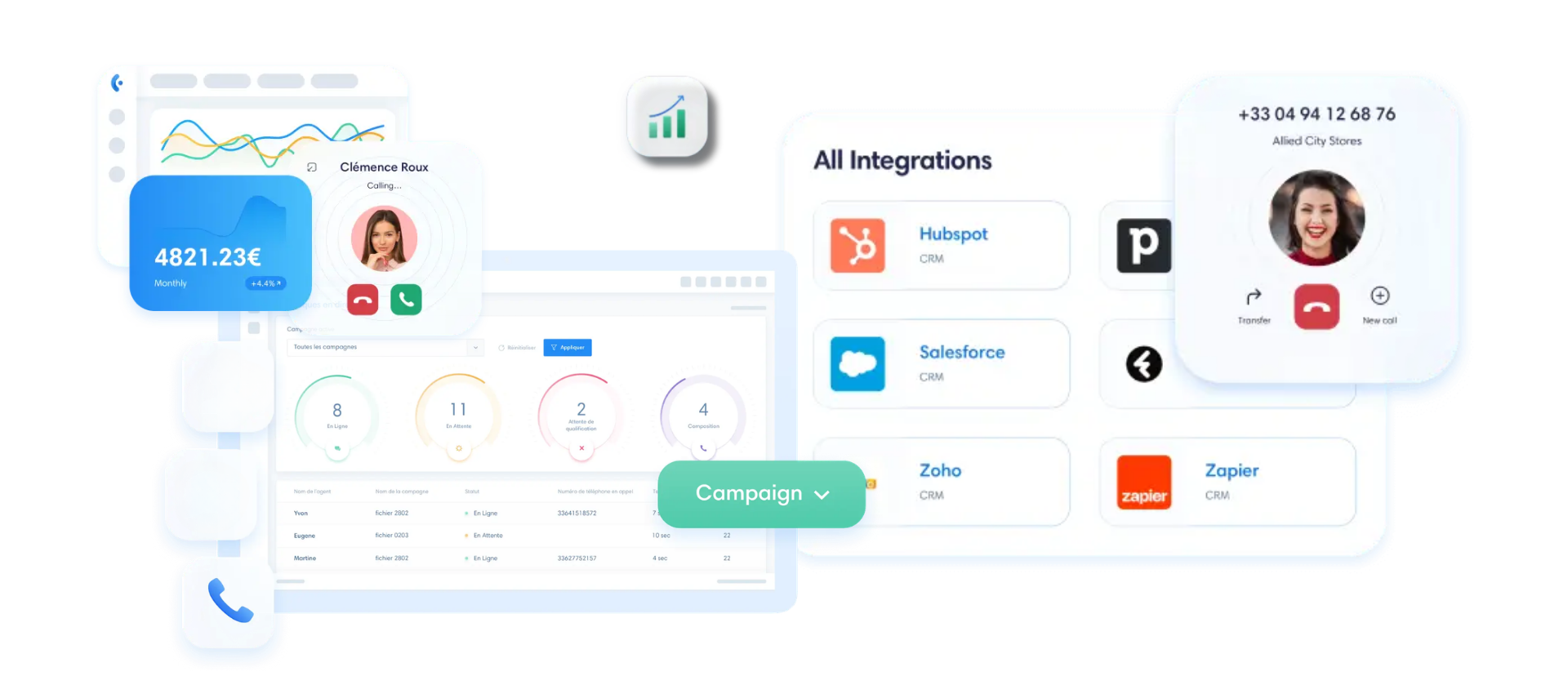
What is SIP software?
SIP software is an application that lets you make and receive calls over the Internet.
SIP stands for Session Initiation Protocol. It’s a session initiation protocol, in other words, a technical rule for establishing, maintaining and terminating a VoIP (Internet Protocol) call.
But be careful.
The SIP protocol is not software. It’s like the road. It keeps cars moving. But it’s not the car. SIP software is the car. It’s the actual tool your teams use to make calls.
Protocol vs. software: what’s the difference?
- The SIP protocol defines how calls are technically established.
- SIP software uses this protocol to enable a user to call from a computer, browser or cell phone.
No protocol, no call. Without software, no user interface. The two are linked. But they don’t have the same role.
What does SIP software actually look like?
In a professional context, this can take several forms:
- Softphone: application installed on a computer
- Webphone: interface accessible directly from a browser
- SIP mobile application: dedicated app for making calls from a smartphone via the Internet
For a salesperson, this means :
- Click on a number in CRM
- Initiate call
- Automatic conversation recording
- Retrieve customer history
- No equipment required.
- No physical phone line.
All you need is an Internet connection and SIP credentials supplied by your telephony solution.
And this is where the “enterprise” dimension becomes interesting. Because SIP software can be a simple, basic tool, or a true cloud telephony platform structured to manage a team. Let’s see the difference.
How does SIP software work?
How it works is simpler than it looks.
SIP software is based on three elements:
- SIP identifiers
- A SIP server
- Internet connection
Let’s take a closer look.
1. Connection via SIP identifiers
Each user has a SIP identifier.
It’s a bit like a login and password. They enable the software to register on the VoIP telephone network.
Once connected, the software knows :
- Which number to use
- Which user to assign calls to
- How to route communications
Without these identifiers, the software cannot make calls.
2. Interaction with a SIP server
The software does not work on its own.
It communicates continuously with a SIP server, which technically manages :
- Call routing
- Connecting people
- Signage
The server is the infrastructure. The software is the user interface.
When a salesperson clicks on “Call”, the software sends a request to the server. The server establishes the connection. And the call begins.
3. Incoming and outgoing call management
Once logged in :
- Outgoing calls go via the Internet
- Incoming calls come directly into the software
All without a traditional telephone line.
The user can :
- Pick up
- Transfer
- Register
- View history
Everything from the screen.
4. Cloud version vs. local installation
There are two approaches.
Local version
The software is connected to an in-house SIP server. This requires maintenance, configuration and technical skills.
Cloud version
The server is hosted in the cloud.
- No on-site infrastructure.
- Quick activation.
- Automatic updates.
Today, the majority of companies prefer the cloud.
- Less complexity.
- Less maintenance.
- More flexibility.
And above all, much faster implementation for teams.
Difference between SIP software and SIP server
This is where many people go wrong. We use both terms as if they meant the same thing. But they don’t.
- A SIP server is a technical infrastructure.
- SIP software is the tool used by the end user.
One is behind the scenes. The other is on screen.
In a nutshell
- SIP server = manages call routing and signalling
- SIP software = to make and receive calls
Without a server, the software cannot establish a connection. Without software, the user has no way of interacting with the system. The two are complementary, but they don’t have the same role.
Quick comparison chart
| Element | SIP server | SIP software |
| Role | Technical infrastructure | User interface |
| Function | Call routing | Making/receiving calls |
| Visible to the user | No | Yes |
| Possible installation | Local or cloud | Computer, browser, mobile |
| Technical level | High | Accessible to teams |
If you’d like to get a more detailed understanding of how SIP servers work and the types of server available, you can consult our complete guide to SIP servers.
Here, we focus on the most operational question:
Which SIP software should you choose for business use?
Top 6 SIP software products for businesses in 2026
Not all SIP software is created equal. Some are highly technical. Designed for IT teams.
Others are geared towards internal collaboration. And some are clearly designed for sales performance and team management.
So before you choose, you need to understand one simple thing:
- The right SIP software depends above all on what you need it for.
- A call center manager doesn’t have the same expectations as a CIO.
- A sales manager is not looking for the same thing as a multi-site company.
To help you make sense of it all, we analyze solutions according to specific criteria:
- Real-world business use: SMEs, sales teams, in-house call centers
- CRM integration: call and customer file synchronization
- Supervision and management: statistics, monitoring, KPIs
- Complexity of implementation: simple configuration or heavy infrastructure
- Contractual flexibility: commitment, scalability, hidden costs
The aim is not to draw up a technical list. But to understand which solution fits your operational reality. Let’s take a look at the 6 most relevant SIP software solutions in 2026.
Kavkom
Positioning
Kavkom is a 100% cloud VoIP telephony solution. Turnkey. No hardware to install.
- Quick activation.
- No obligation.
- With pro rata billing.
The platform is clearly geared towards sales teams and internal call centers. It’s a tool designed to drive performance, not just to “have a line”.
Forces
- Native predictive dialer to speed up call campaigns
- Real-time supervision with dashboards and KPIs
- Native CRM integration (Salesforce, HubSpot, Zoho, etc.)
- Responsive human support, reachable without mandatory chatbot
- Possibility of using a physical IP phone at no extra cost
An important point.
Kavkom is not :
- A traditional telecom operator
- A general CRM
- A SIM or eSIM solution
It’s a specialized cloud telephony solution, focused on business use and productivity.
Microsoft Teams (VoIP + SIP Trunk)
Angle
Microsoft Teams is first and foremost a collaborative platform for messaging, videoconferencing and file sharing.
Telephony is possible via a SIP trunk (connection between Teams and a VoIP operator). The environment is consistent if you are already equipped with Microsoft 365.
Limits
- Complex configuration
- Dependence on the Microsoft ecosystem
- Not natively designed for advanced call center management
- Limited supervision without add-on modules
Teams is solid for internal collaboration. Less specialized for intensive telephone performance.
Cisco Unified Communications Manager (CUCM)
Angle
CUCM is an enterprise communications infrastructure.
Very robust. Highly technical.
Our approach is based on network logic and IT architecture.
Limits
- Heavy deployment
- Ongoing maintenance
- High costs
- High complexity
CUCM is aimed primarily at large companies with dedicated IT teams.
Mitel MiCloud Connect
Angle
Mitel MiCloud Connect is a cloud telephony solution for SMEs. Switchboard, call management, collaborative features.
Limits
- Prices may vary according to options
- Additional advanced modules
- Less specialized in intensive prospecting
Suitable for structures looking for structured cloud telephony, but less focused on pure commercial performance.
3CX
Angle
3CX is an IP PBX (IP switchboard) solution. Can be installed locally or in the cloud.
Flexible. Modular.
Limits
- Technical configuration
- Server management for on-premise deployment
- Requires IT skills
3CX may be suitable for companies wishing to maintain a high level of technical control.
But this is not always the easiest thing to do for sales teams.
Vonage Business Communications
Angle:
Vonage offers a general-purpose cloud telephony solution. Calls, collaboration, various integrations.
Rather broad orientation: SMEs, multi-site companies.
Limits
- Additional modules as required
- Commitment varies according to offer
- Additional advanced features
Versatile solution. Less specialized than call center-oriented platforms.
These six solutions cover very different approaches:
- Heavy infrastructure
- Collaboration
- General cloud telephony
- Specialized sales performance
The real question now is no longer “which is the best known”.
But: Which one is right for your everyday use?
Free SIP software vs. professional solutions
On paper, free SIP software may seem sufficient. You download a softphone. Enter your SIP credentials. And you call.
It works.
But the real question isn’t “Does it work?”.
It’s: Does it structure my business?
The limits of free softphones
A free softphone lets you make calls.
But in a professional context, several limitations quickly become apparent:
- No team supervision
- No dashboards or KPIs
- No performance monitoring
- No structured call recording
- Little or no CRM integration
- Community support
- Variable safety depending on configuration
For a freelancer, this may be enough.
For a sales team of 8?
- Much less.
- You don’t measure anything.
- You’re not flying anything.
The benefits of a professional SIP solution
A professional cloud solution goes further. It doesn’t just enable the call. It structures usage.
We’re talking about :
- Real-time supervision
- Detailed statistics
- Automatic CRM integration
- Intelligent routing
- Security and RGPD compliance
- Responsive human support
And above all:
- Simple deployment
- Without equipment
- Immediate scalability
The difference is clear. A free softphone is a tool. A professional solution is a system. If your aim is simply to make a few calls, free may suffice.
But if you need to manage a team, track performance, improve a conversion rate… Then the decision clearly becomes B2B. And that’s where choosing the right SIP software comes into its own.
How do you choose the right SIP software for your business?
Choosing SIP software isn’t just a matter of comparing prices.
The real question is simple: will this tool really help my teams to work better? Here are the criteria to look for. Concrete. Operational.
1. Simple deployment
How long does it take to get up and running?
- Heavy technical installation?
- Server configuration ?
- Or immediate activation in the cloud?
If your IT team has to spend two weeks setting up the system…you’re already wasting time.
A 100% cloud solution generally enables :
- rapid activation
- no equipment required
- remote commissioning
For an SME or a sales team, simplicity is a real performance factor.
2. CRM integration
Today, callers don’t live alone.
They must be linked to :
- a contact sheet
- customer history
- sales notes
Without CRM integration, your teams have to copy and paste information. That’s a waste of time.
A good SIP software package must enable :
- automatic update of card on call
- recording synchronization
- interaction tracking in CRM
This is what turns a simple call into usable data.
3. Supervision and KPIs
If you manage several users, you need to measure.
- Call volume.
- Pick-up rate.
- Communication time.
- Performance by agent.
Without a dashboard, you’re flying blind.
Enterprise SIP software must integrate :
- real-time statistics
- detailed history
- monitoring tools
Because what can’t be measured can’t be improved.
4. Safety and compliance
Calls contain sensitive data.
- Customers.
- Prospects.
- Contractual information.
Check :
- communication encryption
- access rights management
- RGPD compliance
- secure hosting
Safety should not be an option.
5. Human support
When a problem arises, you need someone to talk to.
- Not a forum.
- Not a generic chatbot.
Responsive, human support that understands your business makes all the difference. Especially if your business depends on the telephone.
6. Contractual flexibility
This point is often underestimated.
- Is there a long-term commitment?
- Is it easy to adjust the number of licenses?
- Is billing flexible?
If your business is seasonal, flexibility becomes strategic. Being able to adjust or suspend lines without penalty can represent real savings.
7. Actual cost
The advertised price is not always the final price.
Take a look:
- fee-based modules
- installation costs
- optional extras
- hidden costs
SIP software that’s inexpensive at the outset can become expensive once all the necessary features have been added.
Install your own SIP server or choose a turnkey cloud solution?
It’s a real question.
Some companies consider installing their own SIP server in-house. Others prefer an out-of-the-box cloud solution.n Both approaches exist. But they don’t imply the same level of commitment.
Let’s be clear.
1. Maintenance
Internal SIP server
- Regular updates
- Safety patches
- Continuous monitoring
- Incident management
Someone has to take care of it. All the time.
Turnkey cloud solution
- Supplier-managed maintenance
- Automatic updates
- 24-hour supervised infrastructure
Your teams use the tool. They don’t manage the infrastructure.
2. IT team
Installing an internal SIP server involves :
- technical skills
- of time
- ability to diagnose network incidents
If you have a dedicated IT team, it’s possible.
But for an SME or an independent sales team? It can quickly become a burden.
A cloud solution greatly reduces this technical dependency.
3. Scalability
Your team grows from 5 to 20 salespeople.
With an internal server, this may involve :
- reconfiguration
- increasing capacity
- infrastructure adjustment
With a cloud solution :
- add licenses in minutes
- immediate activation
- no hardware to install
Growth is more fluid.
4. Hidden costs
An internal server is more than just software.
We need to integrate :
- IT time
- accommodation
- safety
- maintenance
- any interruptions
These costs are rarely visible at the outset.
In contrast, a cloud solution generally offers :
- a clear subscription
- included features
- budget visibility
No heavy initial investment.
So which to choose?
Installing your own SIP server can make sense for highly technical structures, with a robust IT team and specific needs.
But for most companies…
A turnkey cloud solution is simpler, faster to deploy, more flexible and more predictable in terms of costs. It’s not just a technical issue.
It’s strategic: do you want to manage an infrastructure… or focus your efforts on the performance of your teams?
For many organizations, the choice becomes quite obvious.
Boostez la productivité de vos équipe commerciales grâce à Kavkom, le logiciel de téléphonie d’entreprise 100% cloud.
Planifier une démoFAQ : SIP software
Does SIP software work without a server?
No.
- SIP software always needs a SIP server to establish calls.
- The software is the user interface.
- The server manages the technical connection in the background.
In a cloud solution, this server is simply hosted by the provider. You don’t have to install anything.
Do I need an IP phone?
No, it’s not mandatory. SIP software can work :
- on a computer via a softphone
- in a browser via a webphone
- on mobile via a dedicated application
A physical IP phone can be used if you wish, but it’s never a requirement in a modern cloud solution.
Can I use a SIM card?
No.
SIP software works via the Internet, in VoIP. It does not rely on a SIM card or a traditional cell phone plan.
Calls are made via an Internet connection, not the traditional mobile network.
Is it compatible with CRM?
Yes, if the solution so provides.
Enterprise SIP software generally offers CRM integration:
- automatic transmission of the contact form
- call logging
- note synchronization
This allows all customer interactions to be centralized in one place.
Is it secure?
Yes, as long as you choose a professional solution.
Serious platforms include :
- communication encryption
- access rights management
- secure hosting
- RGPD compliance
As with any business tool, security depends on the level of solution chosen. A simple free softphone does not offer the same level of protection as a structured cloud platform.
Conclusion
SIP software is a usage tool. It’s what your teams use to make calls.
A SIP server is an infrastructure. It’s what manages the mechanics in the background. The two are linked. For the majority of SMEs, sales teams and in-house call centers, the question is not :
“How do I install a SIP server?
But rather:
“Which solution will get me up and running quickly, without technical complexity?”
And in most cases, a 100% cloud solution, ready to use, with no hardware to install, remains the simplest and most effective option.
Add to that :
- no long-term commitment
- pro rata billing
- included features
- CRM supervision and integration
And you get a truly performance-oriented tool. If you’d like to see how a SIP cloud solution can structure your calls and improve team management, book a personalized demonstration.
This is often referred to as a SIP server. Configuration. Hosting. Infrastructure. But in reality… What companies are really looking for is usable, simple, operational SIP software. A tool that enables teams to make and receive calls without having to manage a complex technical architecture.