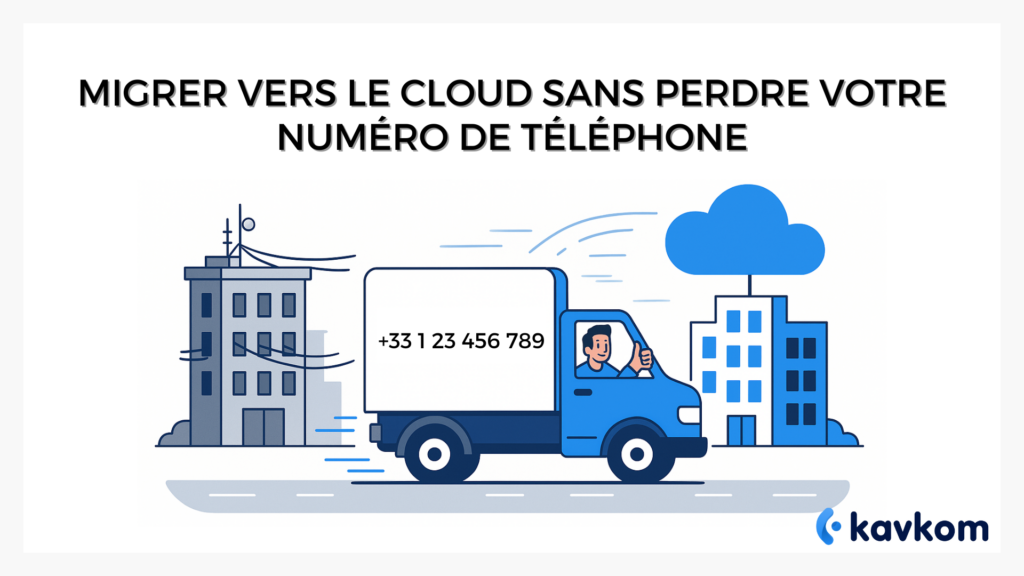
This is where the administrative but essential term comes into play: number portability. This discreet mechanism enables you to transfer your existing lines to a new telephony solution, while keeping exactly the same numbers. In other words, your customers dial the same number as yesterday, but a more modern system picks up the phone.
In this guide, we’ll show you how to make this migration a success, without losing numbers or interrupting calls.
First, we’ll look at how portability works, then why it plays a key role in the transition to the cloud, before moving on to the concrete steps you need to take to migrate your telephony with confidence.
Points to remember :
- Number portability lets you switch to cloud telephony without changing your number, ensuring continuity of exchanges with customers and partners.
- The process is based on a simple, regulated procedure: obtain the RIO code, sign a portability mandate and let the new service provider manage the switchover.
- Portability acts as a link between the stability of your old system and the flexibility of cloud telephony.


Boostez la productivité de vos équipe commerciales grâce à Kavkom, le logiciel de téléphonie d’entreprise 100% cloud.
Planifier une démo
Number portability: definition and basic principles
Changing your phone system doesn’t mean starting from scratch.
Number portability is there to bridge the gap between old and new. It’s the official process that lets you keep your current numbers while transferring your lines to a cloud telephony solution.
In practice, the procedure is the same as if you were changing your traditional mobile or fixed-line operator. The regulations, laid down byARCEP, make no distinction between a traditional operator and a cloud service. What changes is the technical support: instead of a SIM card or a physical box, your calls now go through the Internet.
To identify each line, you have a unique code, the RIO (Relevé d’Identité Opérateur). This is the key to your portability. It links your old contract to the new service provider, enabling a seamless transfer. You can obtain it by dialing a short number (3179 for mobiles) or by asking your current provider for a fixed line.
Once this code has been transmitted to your new cloud platform, the portability request is launched. On porting day, the line switches automatically: your customers continue to call the same number, but your new cloud solution takes over.
In practice
Portability applies :
- to landline numbers (01 to 05 in France) ;
- to mobile numbers;
- special or international numbers, subject to compatibility with the service provider.
Transfer times vary :
- 1 working day for a mobile number ;
- 3 to 10 days for business numbers (depending on volume and geographical area).
The benefits are twofold: you avoid lost calls, and you retain the credibility associated with your historical numbers.
Number portability therefore acts as a regulated bridge between two environments: that of your old system and the more agile one of cloud telephony. If you’ve already changed mobile operator, the process will seem familiar: it’s exactly the same logic, applied to your business lines.
Why portability is essential when migrating to the cloud
Migrating to cloud telephony means modernizing your infrastructure without changing your habits or your customer contact point. You rebuild the infrastructure, but the address remains the same. The phone number, on the other hand, is the digital address your customers know.
Without portability, you’d be forced to announce new numbers, change your signatures, your Google listings, your business cards… all opportunities to create confusion. With portability, your contacts continue to call the same number, and the transition remains invisible to them.
It’s also a question of image: a company that keeps its historical numbers projects stability and continuity. For call centers, this is vital: a single day’s interruption can degrade service quality and customer satisfaction.
By migrating your numbers to the cloud, you gain much more than a technical solution. You open the door to :
- total mobility (your teams can pick up the phone from anywhere) ;
- centralized management (all your lines on a single interface);
- a real-time view of activity (call monitoring, supervision, recordings).
In brief
The 3 major benefits of cloud portability
- Absolute continuity: no lost calls, your numbers remain active during migration.
- Simplified administration: just one procedure, and your new service provider takes care of everything.
- Immediate flexibility: your numbers are accessible from any connected device.
Let’s take a concrete example: a call center based in Lyon decides to switch to cloud telephony. Thanks to portability, it keeps its regional numbers, while adding international lines for customers in Spain and Canada in just a few minutes. No downtime, no hardware to install: just a new freedom of action.
In a market where every call counts, portability is a guarantee of assurance of continuity. It transforms a technical transition into a fluid evolution, imperceptible to your customers but invaluable to your teams.
Practical guide: how to transfer your numbers to cloud telephony
Migrating your lines to a cloud telephony solution is not a risky operation.
The process is based on the same regulations as classic portability: an RIO code, a transfer mandate, a switchover date.
This step-by-step guide explains how to wear your numbers with ease.
Step 1: Obtain your RIO code
The Relevé d’Identité Opérateur (RIO ) acts as a passport for each number. It contains all the information needed to transfer the number to a cloud platform. Without this code, no portability is possible.
How do I get it?
- For a mobile line, dial 3179 from the phone concerned: an SMS containing the RIO and the end of contract date is sent immediately.
- For a fixed line, the RIO can be obtained from the current provider, via the customer area or helpdesk.
- For a fleet of lines, a complete statement can be requested in order to centralize all the RIOs.
The code remains valid for 40 days after issue.
For more details on the administrative steps involved in portability in France, see the complete information sheet published by Service Public.
Step 2: Launch the portability request with the new cloud platform
Once the RIO codes have been retrieved, portability runs directly on the new telephony infrastructure.
Choosing a cloud platform like Kavkom makes the process particularly simple.
When subscribing, simply select the Portability of existing number option.
After activation, a summary e-mail is sent with the list of information and documents to be provided:
- portability mandate (to be signed electronically),
- proof of identity or company document,
- and, if necessary, the latest invoice from your current supplier.
Once these elements have been transmitted, the request is validated and the exact porting date is communicated.
On D-day, numbers are automatically switched over to cloud telephony, with no downtime and no additional configuration.
A smooth transition, with no surprises
Throughout the procedure, the lines remain active. Incoming calls continue to arrive on the existing system until the final switchover.
The transition is instantaneous and imperceptible: callers notice no change.
In a nutshell:
- Free portability ;
- No line breaks;
- Processes fully supported by the platform;
- Transparent monitoring from the Kavkom dashboard.
Human support
Each company is assigned a dedicated French-speaking expert to monitor the portability request, from the initial mandate to final validation.
Support is available by telephone, e-mail or WhatsApp for any questions.
With Kavkom, transfer your existing numbers to 100% cloud telephony, with no disconnection, no commitment and human support available every step of the way.
Boostez la productivité de vos équipe commerciales grâce à Kavkom, le logiciel de téléphonie d’entreprise 100% cloud.
Planifier une démoStep 3: Terminate old contract without service interruption
After porting, the previous contract is automatically terminated; the porting request is sufficient to terminate the original service, except for non-transferred lines.
1. Possible charges
If a commitment is still in effect, charges may apply for the remaining months.
Non-committal offers – such as those for cloud telephony – avoid this constraint: the subscription can be suspended or stopped at any time.
2. Overlapping services
We recommend keeping both systems temporarily: the old service remains active until the confirmed porting date, ensuring total continuity.
3. Final checks
Once the switchover is complete :
- making an incoming call from a cell phone ;
- make an outgoing call ;
- test the interactive voice server or queue if the company uses one.
Quick tip: note the porting date.
If an invoice from the previous supplier is received after this date, provide proof of porting to cancel the invoice.
Portability acts as a key to passage: well prepared and monitored, it transforms an administrative process into a smooth, controlled transition.
Once the number has been ported, it needs to be connected to something. At Kavkom, it goes directly into the business phone system and is routed to the extensions or queues of your choice.
Common mistakes to avoid when requesting portability
Portability is a simple process, but certain oversights can slow it down. An oversight, the wrong data, and the whole timetable shifts. Here are the most common mistakes made when transferring numbers to cloud telephony.
The wrong RIO
Each line has its own code; confusing one is enough to block porting. Always check that the RIO transmitted corresponds to the number in question.
Ill-anticipated deadlines
Porting from one day to the next doesn’t exist for companies: depending on the volume of lines, the procedure can take up to ten days. Planning ahead avoids the stress of a hasty switchover.
Double cancellation
Manually terminating the contract before the end of the porting period interrupts the line. The transfer automatically triggers the termination: no action is required.
Incomplete documents
An unsigned portability mandate or a missing invoice will push back the due date. It’s better to send a complete file from the outset.
What to watch for:
- Check all RIOs before sending.
- Note confirmed porting date.
- Leave the old service active until the switchover.
- Centralize exchanges in a single channel (dashboard or e-mail).
All it takes is a little rigor: well-prepared, portability becomes a smooth, seamless transition.
FAQ: everything you need to know about business number portability
What is number portability?
Portability allows you to keep an existing phone number while changing provider or technology. It links the previous contract to the new provider, thanks to the RIO code, and takes place without interrupting calls.
Does portability also apply to cloud telephony?
Yes. The same ARCEP rules apply whether you use a traditional operator or a cloud solution.
The only difference is the form: everything is done online, without any physical intervention.
How long does the procedure take?
For a mobile line, the transfer is often completed in less than 24 hours.
For several fixed or international numbers, allow between 3 and 10 working days.
The service remains active throughout the entire period: no interruption is to be feared.
Do I have to pay for portability?
No. With most cloud providers, including Kavkom, portability is free of charge.
The only possible charges relate to an old contract that is still in force.
What to do if portability fails?
Failures are rare. They are most often due to an error in the RIO or a missing document.
Simply return the corrected elements to restart the process. Human follow-up ensures that there are no interruptions.
Conclusion: Portability, the gateway to telephone freedom
Number portability acts as a bridge between two worlds: that of yesterday’s rigid infrastructures and the agile world of cloud telephony.
It offers the continuity essential for modernizing your communications system without losing what makes a company who it is: its number, its accessibility, its voice.
Migrating to a cloud solution means regaining freedom: no more imposed commitments, no more dreaded interruptions.
Teams remain reachable, customers remain connected.
By adopting a modern telephony solution like Kavkom, businesses can keep their bearings while gaining in mobility, visibility and simplicity.
Portability then becomes more than a procedure: it’s a key step towards fluid, stable, forward-looking communication.