The real challenge: many teams still build their strategies on assumptions rather than actual customer feedback.
This is where the Voice of Customer (VoC) changes everything.
VoC is not a passing trend or a miracle technology. It’s a return to something fundamental: listening before acting.
Done right, VoC becomes the antidote to guesswork: it replaces guesswork with understanding, and chance with relevance.
In this article, you’ll learn how to set up a VoC strategy in five simple, concrete steps, centered on three pillars: collect, analyze and act.
Points to remember :
- Voice of Customer is not a marketing concept, but a concrete method for understanding customers’ real needs, emotions and expectations in their own words.
- An effective VoC strategy is based on three simple steps: collect, analyze and act. Consistently repeated to transform customer feedback into continuous learning.
- Centralizing and sharing feedback across the company enables all teams to align on a common vision of the customer, and to act faster and more accurately.
- Companies that integrate VoC into their culture become more relevant and responsive, because their decisions are based on the reality experienced by their customers, not on assumptions.


Boostez la productivité de vos équipe commerciales grâce à Kavkom, le logiciel de téléphonie d’entreprise 100% cloud.
Planifier une démo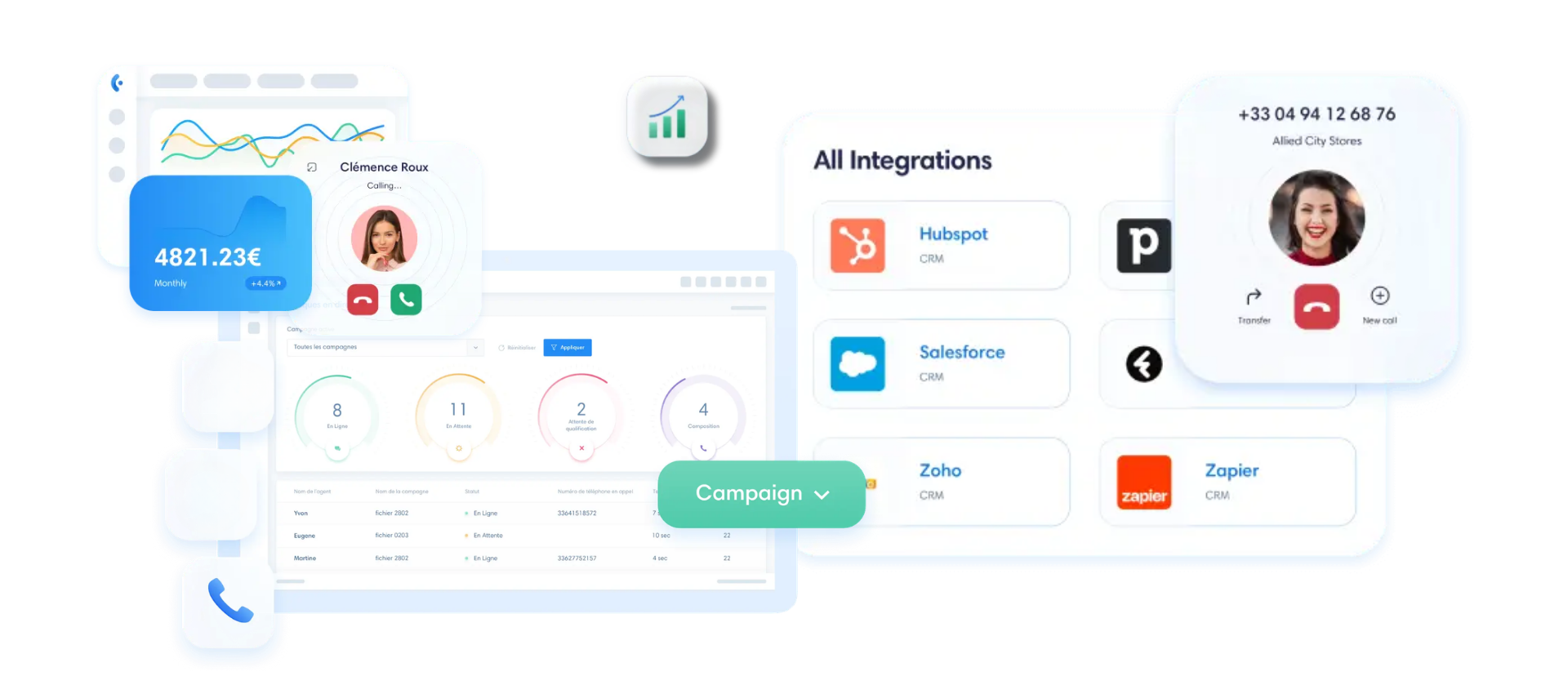
What is Voice of Customer?
Voice of Customer ( VOC) is a simple yet powerful method for collecting, analyzing and applying customer feedback.
VoC is about what your customers say, of course, but also about what they don’t say. Silences, hesitations, little phrases like “it doesn’t matter” often hide the most precious signals.
This approach is based on a common-sense principle: listen before you act. It involves turning scattered feedback into raw material for understanding the expectations, frustrations and emotions behind each interaction.
The many voices of your customers
The voice of the customer is not expressed through a single channel. It lives on in support calls, e-mail exchanges, conversations on social networks, satisfaction surveys, reviews left on a website.
Every message, every word, is data that can be used to better understand the customer journey.
| Voice of the Customer channels | Feedback type | A concrete example |
|---|---|---|
| Phone calls | Spontaneous and emotional | An impatient customer with a long waiting time |
| E-mails and chats | Structured but rich in nuance | “Your solution is good, but I had trouble…” |
| Opinions online | Public and impactful | Google or Trustpilot comment |
| Satisfaction surveys | Guided | NPS score with verbatim report |
| Social networking | Reactive and instantaneous | Mention on LinkedIn or X (Twitter) |
The strength of a VoC strategy lies in continuity: listening shouldn’t be a one-off project, but a habit.
An annual survey gives a trend, but only continuous listening can really track the evolution of needs.
VoC then becomes a permanent learning system. It brings out the truth: understanding your customers is a daily discipline.
Why the voice of the customer has become essential to customer loyalty
The most successful companies are not those that communicate the most, but those that listen the best.
Customers no longer want to be sold products: they want to recognize themselves in the brands they choose. They’re looking for relevance, not reach.
Voice of Customer is the answer. By analyzing feedback, it reveals what really triggers a purchasing decision or disappointment.
Customers don’t leave a company because of a technical detail: they leave because they don’t feel understood or heard.
VoC, a mirror of the customer journey
Each VoC data illuminates a moment in the customer journey.
A negative review after the purchase reveals friction in the service.
A repeated comment on the complexity of a product highlights a need for simplification.
An enthusiastic comment on telephone reception becomes proof of differentiation.
Traditional indicators (satisfaction rate, NPS, CSAT) provide a statistical vision.
But VoC gives the emotional substance of these figures.
It helps to understand why NPS is falling or why the re-purchase rate is stagnating.
Towards “customer-led” companies
Teams who adopt VoC don’t just improve a product.
They transform the way they think.
This is what’s known as a customer-led approach: the customer is no longer an input, but becomes the center of decision-making.
Circulating the voice of the customer throughout the company guarantees a shared vision and more coherent decisions.
A company that continuously listens creates a virtuous loop: listen, understand, act, measure, repeat.
“When product, marketing and sales teams all hear the same voice of the customer, decisions become sharper and faster.”
DC Analytics, a firm specializing in data-driven B2B marketing.
5 steps to a VoC strategy
Let’s take a look at how to structure listening to the voice of the customer in five steps, from initial feedback to customer-centric corporate culture.
Step 1: Collect customer feedback at every point of contact
The best Voice of Customer strategies capture what customers say… and what they don’t.
Silences, hesitations or awkward turns of phrase often tell as much as the words themselves.
Two types of data to combine
The reactive data comes from spontaneous interactions: support complaints, online reviews, product returns.
It reflects the customer’s immediate and often emotional feelings.
The proactive data is collected on your initiative: interviews, user tests, NPS surveys, focus groups.
It reveals latent expectations that customers don’t always express on their own.
A sound VoC strategy combines these two approaches to obtain a complete picture: hot reactions and cold reflections.
Identify the right listening points
Each stage of the customer journey offers an opportunity to listen:
- Customer service: analyze recurring complaints.
- Incoming calls: identify common objections.
- Social networks: follow up on recurring questions.
- Website: observe cart abandonment or unsubmitted forms.
Taken together, these signals paint an accurate picture of real expectations.
Telephony, a unique listening channel
Voice remains the most sincere medium.
Every conversation contains a fragment of the customer experience that numbers don’t.
This is where Kavkom makes the difference: every call can be recorded, listened to, transcribed and analyzed over time, transforming telephony into a continuous source of insights for sales and support teams.
Boostez la productivité de vos équipe commerciales grâce à Kavkom, le logiciel de téléphonie d’entreprise 100% cloud.
Planifier une démoStep 2: Centralize and organize customer data
Listening without structuring means losing half the value of feedback.
Centralization brings coherence to VoC and enables all teams to speak the same language.
Giving every return a place
Every piece of feedback deserves to be categorized and shared.
A simple tagging system helps to highlight recurring themes:
- Frustrations: slowness, lack of clarity
- Expectations: simplicity, reliability, time savings
- Barriers: price, service, understanding
Ordered in this way, verbatims become legible and usable.
Create a common base
Centralizing feedback in a CRM gives each department the same view of the customer.
Sales understands a prospect’s hesitations, product identifies irritants, support anticipates problems before they escalate.
A simple observation (a form that’s too slow, for example) can mobilize marketing, product and IT around the same diagnosis.
- Kavkom integrates naturally with your CRM tools such as HubSpot, Salesforce or Zoho, to automatically synchronize calls, recordings and comments.
Data becomes alive, accessible to all and exploitable in real time.
This interconnection makes collaboration more fluid: feedback collected on the phone is instantly reflected in shared dashboards.
Step 3: Analyze feedback to identify trends
Listening is good. Understanding is decisive.
VoC data only makes sense if it becomes collective learning.
Finding the red thread in the noise
Group feedback by theme (technical, service, product, communication), then measure their frequency and tone.
What comes back often (and with emotion) deserves your attention.
Semantic analysis tools can help, but a clear, rigorous table is enough to spot the constants: what your customers like, reject or don’t understand.
The right indicators to track
Three simple indicators structure this analysis:
- Percentage of positive / negative feedback
- Dominant themes (product, service, support)
- Average response or resolution time
These figures create a common language for discussing customer satisfaction between departments.
An insight that is not applied remains an observation. It’s action that gives listening its full meaning.
Step 4: Turning insights into action
Analysis is just one step. It’s what you do with it that makes the difference.
Linking listening to decision-making
A customer-centric company transforms each lesson into a concrete choice: improve a product, reformulate a message, simplify a process.
This is the VoC action loop: listen, understand, act, measure.
Each cycle brings the brand closer to reality on the ground.
Concrete examples
- Repeated complaints about the slowness of a service? The technical team corrects the cause.
- Confusion about an offer? Marketing simplifies the message.
- Feedback on reception? Support adjusts its scripts and trains its agents.
The impact accumulates as one adjustment follows another.
Step 5: Share and embed the VoC culture within the company
A VoC strategy can only have an impact if it becomes a collective reflex.
For it to live, it has to circulate.
Voice of the customer
Isolated feedback in a spreadsheet is useless.
Shared in an internal channel, newsletter or team briefing, it becomes a common signal.
Organizing monthly “Voice of Customer meetings” helps to highlight trends and recognize successes.
The role of managers
Managers set the tone.
When a manager cites customer feedback in a meeting, it lends credibility to the approach.
When a team sees its suggestions from the field taken into account, the culture of listening takes root naturally.
An inspiring example
Some companies apply VoC in exemplary fashion.
Slack, for example, has built part of its success on methodically listening to its users:
- Live user tests,
- Feedback channels integrated into the platform,
- Surveys via e-mail and social networks.
This feedback has given rise to some emblematic features:
- Shared channels, facilitating collaboration between companies ;
- Accessibility improvements, based on feedback from disabled users;
- Customizable notifications, to reduce alert overload.
The result: enhanced inter-company collaboration and increased user satisfaction.
Slack shows that continuous listening can shape a product as much as a corporate culture.
When the entire company speaks the language of its customers, it no longer guesses their needs: it anticipates them.
Voice of Customer FAQs
What’s the difference between a VoC and a satisfaction survey?
A satisfaction survey measures an instant: a purchase, an interaction, a score.
The Voice of Customer, on the other hand, follows a movement. It picks up signals all along the customer journey, in calls, messages, reviews, network exchanges.
A survey tells you how the customer feels now.
The VoC tells you why they feel that way, and how their opinion evolves over time.
How do you get started on your VoC strategy without complex tools?
Start small, but start right away.
Centralize your feedbacks in a spreadsheet, group customer verbatims together and classify them by theme.
Gradually add a listening or analysis tool if the volume increases.
The important thing is not the technology, but the regularity of the listening.
What indicators should you track to measure the success of your VoC strategy?
Three simple indicators are all you need to measure customer satisfaction:
- NPS (Net Promoter Score): propensity to recommend.
- CSAT (Customer Satisfaction Score): level of satisfaction with a given interaction.
- CES (Customer Effort Score): perceived effort to obtain an answer or solve a problem.
Combined with customer reviews and qualitative feedback, these indicators become powerful compasses for steering quality of experience.
Conclusion
Voice of Customer is not an abstract concept. It’s a daily practice of listening, analyzing and acting.
The five key steps(listen, centralize, analyze, act, share) transform the customer relationship into a continuous learning process.
Companies that adopt it become more lucid. They speak less loudly, but much more accurately.
VoC is not just another tool to be ticked off in a software stack.
It’s a way of thinking, a shared culture where every decision is based on reality in the field.
What if listening to your customers also meant listening to their voices, literally?
At the end of the day, listening to your customers is not an option. It’s the only strategy that’s sustainable over time.