

IP telephony has established itself as the new standard for business communications. By replacing traditional telephony infrastructures with cloud platforms, companies can manage their calls more easily, connect telephony to their business tools and monitor their teams’ activity in real time.
But with so many different solutions on the market, it can be hard to know which platform to choose. Some solutions are designed for SMEs, others for call centers or intensive sales teams. This comparison presents several IP telephony platforms used by businesses, to help teams identify the solution best suited to their needs.
In this comparative guide, we analyze the main IP telephony solutions for businesses, their features and benefits, and the criteria to consider when choosing the right platform for your organization.
Points to remember
- IP telephony allows companies to manage their calls via the Internet, without the need for a heavy telephone infrastructure.
- Cloud solutions offer greater flexibility, especially for sales teams, customer service departments and multi-site organizations.
- Not all platforms offer the same features: supervision, CRM integration, call campaigns or reporting.
- The choice of a solution depends above all on its actual use: call volume, team organization, management needs, etc.
- A comparison of solutions makes it easier to identify the right platform for your business
- Kavkom stands out for its sales performance-oriented approach, with a 100% cloud solution that is free of commitment and billed on a pro rata basis.

What is a business IP telephony solution?
An IP telephony solution for businesses is a telephone system that enables calls to be made and received via the Internet, rather than the traditional telephone network. Voice is converted into digital data and transmitted over the IP (Internet Protocol) network, enabling communications to be managed from an online software platform.
In practice, this replaces the physical switchboard formerly found in offices. Calls are now managed by a cloud switchboard (an online hosted system that distributes and organizes calls). Users can make or receive calls from a computer, smartphone or IP phone, simply with an Internet connection.
This type of solution isn’t just for making calls. A professional IP telephony platform generally integrates a number of useful day-to-day tools: queue management, call routing, conversation recording, activity dashboards and CRM integration. The aim is to transform telephony into a genuine communications and customer relations management tool.
Comparison of IP telephony solutions for businesses
| Solution | Type | Target audience | Highlights |
|---|---|---|---|
| Kavkom | cloud telephony | sales teams / call centers | advanced supervision, dialer, CRM |
| Ringover | cloud telephony | SMEs / sales teams | easy to deploy |
| Aircall | cloud telephony | customer support | numerous integrations |
| 3CX | IP PBX | technical companies | custom installation |
| Dialpad | cloud telephony | international teams | AI and transcription |
The main IP telephony solutions for businesses
Kavkom
Kavkom is a VoIP cloud telephony solution designed for sales teams and in-house call centers. The platform enables inbound and outbound calls to be managed from a single interface, and telephony to be integrated directly with CRM tools.
The solution includes :
- real-time call supervision
- conversation recording
- automatic dialing for call campaigns
- activity dashboards
The platform operates 100% in the cloud, with no hardware to install. It’s also commitment-free, with prorated billing, so you can easily adapt the number of users to your business activity.
Ringover
Ringover is a cloud telephony solution designed for SMEs, sales teams and customer services departments who want to centralize their communications in a simple-to-deploy platform. The system operates entirely via the Internet, enabling employees to make and receive calls from a computer or smartphone using a softphone.
The platform offers a cloud switchboard for managing incoming and outgoing calls, creating user groups, queues and call transfers. Ringover also includes dashboards and call statistics to monitor team activity.
The solution offers unlimited calls to certain zones, as well as several CRM integrations such as HubSpot, Salesforce or Pipedrive, enabling contact information to be retrieved during calls and a history of exchanges to be kept.
Aircall
Aircall is a cloud telephony solution used primarily by sales teams and customer support departments. The platform operates entirely via the Internet, enabling employees to make and receive calls from a computer or smartphone using a dedicated application.
Aircall offers a cloud switchboard with features such as inbound call management, queue creation, call transfers and activity dashboards. The solution is also known for its numerous integrations with SaaS tools, including CRM and customer support software, making it easier to synchronize calls with customer data and track interactions.
3CX
3CX is a more technical IP telephony solution that lets you deploy an IP switchboard (IPBX) either on site or in the cloud. Unlike some fully managed platforms, 3CX offers greater control over the telephony infrastructure and system parameters.
The solution is often used by companies with an in-house IT team, or by organizations wishing to customize and administer their telephone system themselves. Call rules, users, queues and internal extensions can all be configured according to the company’s needs.
Dialpad
Dialpad is a cloud telephony solution that combines business communications and analytics tools based on artificial intelligence. The platform enables teams to make and receive calls via the Internet from a computer, smartphone or IP phone, with no telephone infrastructure to install.
Dialpad offers a cloud switchboard, inbound and outbound call management, and dashboards to monitor team activity. The solution also features automatic conversation analysis functions, and integrations with several CRM tools and business applications, making it easy to monitor customer exchanges.
How does corporate IP telephony work?
An IP telephony solution is based on a simple principle: calls no longer go through the traditional telephone network, but over the Internet. Voice is converted into digital data, then transported via IP (Internet Protocol), just like any other data stream.
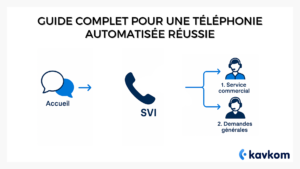
In the majority of companies, this infrastructure is managed by a cloud switchboard, also known as a cloud PBX (Private Branch Exchange hosted online)cloud switchboard, also known as a cloud PBX (Private Branch Exchange hosted online). This system centralizes incoming and outgoing calls, distributes communications to the right users and lets you configure different call scenarios: queues, transfers, opening hours or redirections.
On the user side, access is very simple. Employees can make and receive calls from a softphone (telephony application on computer or smartphone) or from an IP phone connected to the company’s Internet network. Everything is controlled from an online interface, enabling users to be added, numbers assigned or telephone activity monitored in real time.
A major advantage of this cloud architecture is that it eliminates the need for a heavy telephone infrastructure. The company doesn’t need to install or maintain a physical switchboard. A stable Internet connection is all that’s needed to operate the entire system.
Key features of a professional IP telephony solution
An IP telephony solution isn’t just about making calls over the Internet. Modern platforms incorporate a range of features designed to organize communications and facilitate teamwork.
Here are the main features found in an IP telephony solution used in business.
Cloud switchboard
The cloud switchboard (online hosted PBX) centralizes all your company’s incoming and outgoing calls.
It automatically manages the distribution of calls to the right employees or departments, without the need for physical equipment on the premises.
Companies can easily configure various parameters:
- call transfer
- user groups
- queues
- schedule-based redirection rules
Intelligent call routing
Call routing automatically directs a call to the right person or department.
For example, a call may be directed to an available sales representative, to technical support or to a dedicated queue.
This system improves inbound call management and reduces dropped calls, which is particularly useful for sales and customer service teams.
Call supervision and statistics
IP telephony solutions generally offer dashboards for monitoring telephone activity.
Team managers can view several indicators:
- number of incoming and outgoing calls
- call duration
- missed calls
- activity by employee or team
These data enable us to better understand telephone activity and adjust the organization of our teams.
Call recording
Call recording keeps a record of telephone conversations.
This feature is often used for quality monitoring, team training or customer dispute management. Recordings can be consulted directly from the platform interface.
CRM integration
An IP telephony solution can connect directly to a company’s business tools, such as CRM.
When a call comes in, the contact record can be opened automatically in the CRM. Calls are also recorded in the customer history, facilitating sales follow-up and customer relationship management.
Call campaign automation
Some platforms offer dedicated tools for sales teams, such as outbound call campaigns or diallers.
These features enable you to link calls more quickly, avoid manual dialing and track campaign performance directly within the platform.
Why companies are adopting IP telephony
In recent years, IP telephony has become widely adopted by businesses. This change is not simply the result of technological evolution. Above all, it responds to concrete needs linked to work organization and communications management.
Greater flexibility for teams
With an IP telephony solution, employees can make and receive calls from a variety of devices. A computer, smartphone or IP phone connected to the company network.
This flexibility is particularly useful in organizations where teams work remotely, travel regularly or alternate between the office and telecommuting. Communications remain accessible from the same tool, without depending on a fixed workstation in an office.
Centralized communications management
IP telephony solutions bring all communications together on a single platform.
Managers can manage users, assign numbers, configure call rules or create groups directly from an administration interface. This centralized approach makes it easier to organize calls, and eliminates the need for multiple tools and technical configurations.
Better visibility of telephone activity
IP telephony platforms generally integrate dashboards to monitor call activity in real time.
These data provide better visibility of call volumes, response times and team activity. For sales or customer service managers, these indicators make it easier to adjust organization and identify areas for improvement.
An infrastructure that’s easier to upgrade
Unlike traditional telephone systems, an IP solution can be easily upgraded.
Adding a new user, assigning an additional number or modifying call organization requires no complex technical intervention. Most parameters can be adjusted directly from the platform.
This flexibility enables companies to adapt their telephone system to changes in their teams or business.
Real-life use cases for IP telephony in the enterprise
An IP telephony solution really comes into its own when it’s used at the heart of a team’s activity. Depending on how the company is organized, it can meet very different needs: sales call management, customer support or coordination between several sites.
Here are just a few of the most common corporate use cases.
Sales teams
For sales teams, telephony remains a central tool. Calls are used to prospect, qualify contacts or follow up on current opportunities.
With an IP telephony solution connected to CRM, sales reps can quickly access information on their contacts. Calls are automatically recorded in the customer history, and managers can monitor overall team activity via dashboards.
Some platforms also offer automatic dialing tools to facilitate outbound calling campaigns and structure prospecting work.
Customer service
In a customer service department, incoming call management must be organized to avoid long waiting times or lost calls.
An IP telephony solution can be used to set up queues, distribute calls between several agents and monitor activity load in real time. Managers can quickly identify busy periods and adjust the distribution of teams if necessary.
Call recording can also be used to support training or continuous service improvement.
In-house call centers
Some companies have teams dedicated to call management, whether for sales prospecting or customer support.
In this context, IP telephony enables more precise business management: call volume monitoring, performance analysis per agent, real-time supervision or listening in on conversations to support teams.
These features help managers to structure the work of their teams and improve the quality of customer interactions.
Multi-site companies
Organizations spread over several offices or agencies often need to centralize their communications.
With an IP telephony solution, all employees can be connected to the same system, even if they work from different sites. Calls can be transferred from one office to another, and teams use the same communications management tools.
This approach makes it possible to unify corporate telephony without having to deploy a specific infrastructure at each site.
How to choose an IP telephony solution for your business
Not all IP telephony solutions meet the same needs. Before choosing a platform, it’s a good idea to evaluate a number of criteria linked to your company’s organization and the actual day-to-day use of telephony.
Easy to install
An IP telephony solution needs to be able to be deployed quickly, without complex infrastructure.
Most cloud platforms allow users to be activated, numbers assigned and call rules configured from an online interface.
The aim is to be able to use the system without heavy technical installation or dependence on specific equipment.
Team-friendly features
Needs can vary from team to team.
A sales department will need tools to manage outbound calls and track performance, while a customer service department will need to organize inbound calls with efficient queues and transfers.
Before choosing a solution, it’s a good idea to check for features such as :
- call supervision
- activity dashboards
- conversation recording
- outgoing call campaigns
These tools help structure telephone activity and monitor team activity.
Integration with business tools
In many companies, telephony is used in direct conjunction with CRM or customer relationship management software.
An IP telephony solution capable of integrating with these tools makes it possible to retrieve contact information during calls, and keep a history of exchanges. This facilitates sales follow-up and team coordination.
Contractual flexibility
A company’s needs can change rapidly.
It can be useful to choose a solution that makes it easy to add or remove users, without any long-term commitment.
Some platforms offer more flexible billing models, with monthly subscriptions or billing based on the number of active users.
Technical support quality
Finally, technical support remains an important point.
In the event of a problem or question about system configuration, reactive assistance helps maintain communications continuity and avoid business interruptions.
Why Kavkom is the right IP telephony solution for businesses
Not all IP telephony platforms are designed for the same uses. Some are designed for highly technical needs, others for simpler communications. Kavkom is positioned as a VoIP cloud telephony solution dedicated to sales teams and internal call centers. The platform is 100% cloud-based, which means it operates without the need to install any telephony infrastructure on the company premises.
In practical terms, implementation is a snap. Users can access the system from any computer or telephony application, with no special hardware required. Teams can thus make and receive calls from any connected workstation, while remaining integrated into the same communications management system.
Kavkom also boasts a number of useful features for managing telephone activity:
- real-time call supervision to monitor team activity
- recording of conversations for quality monitoring or training purposes
- automatic dialing (dialer) to structure outbound call campaigns
- dashboards and activity statistics to analyze performance
The platform also offers native CRM integrations with tools such as HubSpot, Salesforce and Zoho. This enables calls to be automatically synchronized with contact records, and customer interaction history to be centralized.
Contractually, Kavkom operates on a flexible model. The solution is non-binding and invoiced on a pro rata basis, enabling companies to easily adjust the number of users according to their activity. This flexibility can be useful for sales teams or call centers whose needs evolve over time.
For companies, the challenge is no longer limited to having a business number. It’s all about effective communications management: managing incoming calls, tracking team activity, connecting telephony to CRM and enabling employees to work from any connected workstation.
FAQs
What’s the difference between IP telephony and VoIP?
The two terms are often used together, but they don’t mean exactly the same thing.
VoIP (Voice over IP) is the technology used to transmit voice over the Internet.
IP telephony refers to the entire communications system that uses this technology: telephone platform, call management, business numbers, integration with business tools.
In practice, when a company adopts an IP telephony solution, it uses VoIP to transport calls.
What equipment do I need to use an IP telephony solution?
In most cases, no special telephone equipment is required.
A cloud IP telephony solution works with :
- computer or smartphone
- a stable Internet connection
- a telephony application called softphone
Some companies also use IP telephones (desk phones connected to the Internet), but this is not mandatory.
How much does an IP telephony solution cost for a company?
The price depends mainly on the number of users and the features included in the platform.
For SMEs, IP telephony offers generally range from €20 to €50 (excl. VAT) per user per month for complete solutions with call management, supervision and CRM integration.
Some platforms also offer more flexible models, with no-commitment monthly subscriptions or billing based on the number of active users.
Can I keep my phone number with an IP telephony solution?
Yes. You can keep your business number thanks to number portability.
When changing telephony solutions, companies can transfer their existing numbers to the new platform. This procedure generally takes a few days, and enables customers and partners to continue using the same contact details.
Is IP telephony right for SMEs?
Yes, and it’s one of the main audiences concerned.
Cloud IP telephony solutions enable SMEs to have a complete telephone system without having to install a physical switchboard on their premises. The platform can be quickly configured and easily upgraded as the team grows.
This flexibility explains why many SMEs are now adopting this type of solution to manage their business communications.
Is call quality good with IP telephony?
Call quality depends mainly on the Internet connection used.
With a stable broadband connection (fiber or very good ADSL), audio quality is generally comparable to that of a conventional telephone line. Professional IP telephony solutions also incorporate stream compression and stabilization technologies to maintain clear communication.
In a properly equipped business environment, IP telephony offers call quality that is perfectly suited to everyday business use.
Conclusion
IP telephony has become the standard for business communications. By using a cloud platform rather than a traditional telephony infrastructure, companies can manage their calls more easily, centralize their communications and connect telephony to their business tools. This evolution responds to the needs of today’s organizations: hybrid teams, remote collaboration and more precise monitoring of customer relations.
For this transition to be truly useful on a day-to-day basis, the solution chosen must remain simple to deploy and adapted to team uses. Today’s companies are looking for 100% cloud-based platforms, capable of managing inbound and outbound calls, offering visibility over telephone activity, and integrating directly with the CRMs used by sales and customer service teams.
Against this backdrop, Kavkom is positioned as a VoIP cloud telephony solution designed for companies wishing to structure their communications without a complex technical infrastructure. The platform enables rapid deployment of a complete telephone system, with supervision, CRM integration and advanced call management functionalities. All with a no-commitment model and prorated billing, enabling companies to adapt their telephony to the evolution of their teams and business.