
So the real question is simple: how do you enable your teams to keep an overview of all these exchanges without getting lost in them?
The answer can be summed up in four words: customer relations center.
This guide will show you how to create a customer relationship center, capable of bringing together all channels, data and teams in a single space.
A model that makes the difference between a brand you contact… and a reactive brand, capable of responding on all channels without interruption.
Points to remember :
– The customer relations center is the meeting point between all the channels of exchange between a brand and its audience.
– The cloud telephony and a centralized CRM provide a solid foundation for responsive, consistent service that can be accessed from anywhere.
– A structured customer relations center improves satisfaction and strengthens loyalty.

What is a customer relations center?
The customer relationship center (CRC) is much more than a call center.
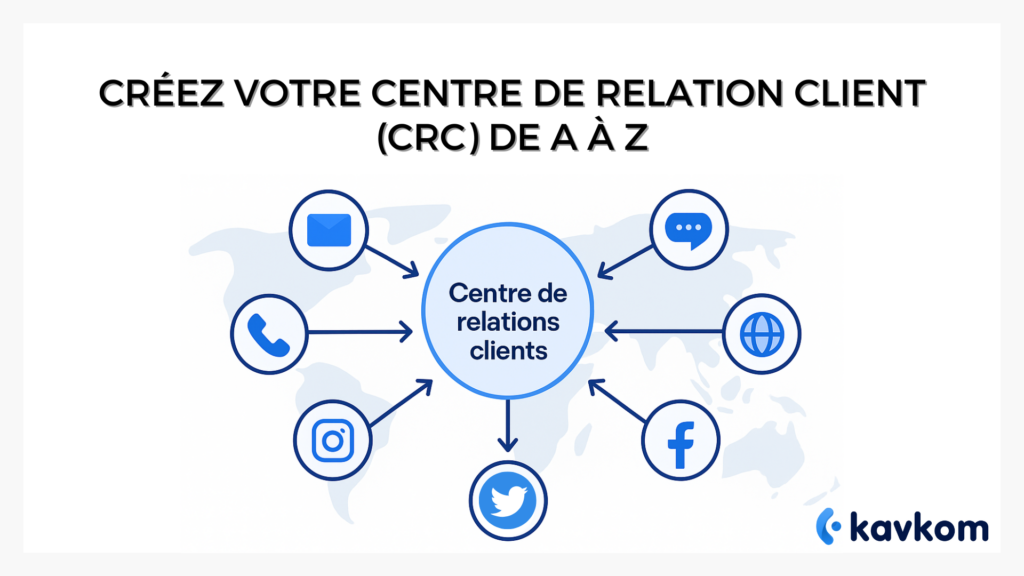
It’s the crossroads of all your communications, where telephone, e-mail, chat and social networks converge.
Every contact becomes a moment of dialogue, an opportunity to understand your customer a little better.
An evolution of the classic call center
For a long time, companies relied on call centers designed to respond.
A customer asked a question, an agent answered. End of story.
This model is no longer sufficient.
Today, a contact center is designed to support.
It’s no longer just a matter of picking up the phone, but of following the customer’s journey through all communication channels: a conversation started in a chat room can continue seamlessly by e-mail or telephone.
It is this continuity that transforms simple assistance into a lasting relationship.
The three missions of a modern CRC
A good CRC rests on three simple pillars:
- Listen and understand: pick up on signals, both verbal and non-verbal, to identify the real need.
- Resolve quickly: provide efficient, consistent responses, whatever the channel.
- Build loyalty: turn every contact into a positive, memorable experience.
In short: the customer relationship center is not a help desk.
The customer relationship center becomes a central element of your relationship strategy.
Pre-creation requirements
Before building your customer relationship center (CRC), you need to define what it will really be used for.
A center isn’t created “because we have to have one”, but to solve a specific problem and serve a broader strategy.
Identify your objectives and priority channels
Start with the simple question: why do you want to set up a customer relations center?
To streamline support? Manage after-sales service? Relaunch leads? Retain existing customers?
Each goal requires a different organization.
Next, take a look at your communication channels.
Do your customers prefer to call, write or chat?
A good CRC doesn’t try to be everywhere: it chooses the channels that count and commits to them wholeheartedly.
Tip: go back over the last ten conversations with your customers. The media they used are already your best roadmap.
Choosing an organizational model
Three possible paths:
- Internal, when you want to control everything, from the tone to the rhythm of your answers.
- Hybrid, if you keep the core in-house and delegate certain niches.
- Outsourced, for companies handling large volumes.
The cloud model brings new freedom: your agents can work from anywhere, monitoring calls and messages from the same space, without imposing hardware or physical centers to maintain.
Define success indicators
Without reference points, even the best team ends up sailing blind.
Choose a few simple, meaningful indicators:
response time, first contact resolution rate (FCR), customer satisfaction (CSAT ) or NPS.
These figures are not checklists, but dialogue points.
They show where the conversation with your customers is enriched, and where it’s lost.
Guide: Creating your customer relations center step by step
We start with the foundations, then progressively structure each component of the customer relationship center.
Here’s how to lay each brick of your customer relationship center without getting lost in the technicalities.
Step 1: Choose the right technical infrastructure
Before talking performance, let’s talk terrain.
The best service in the world won’t stand on a shaky foundation.
Telephony is no longer a matter of cables or handsets screwed to desks.
With cloud telephony, everything goes through the Internet: your teams can pick up the phone from their computer, their mobile, or an IP phone.
The real change is this freedom: no more fixed location, no more time constraints, just the conversation that flows.
Less equipment, less waiting, less costs.
The cloud adapts to the rhythm of your business: an extra line when the season starts, a paused line when it ends.
And above all, everything is controlled from a single space: calls, messages, statistics, recordings.
This is exactly what Kavkom offers: a professional telephony platform designed for teams who want to focus on communication, not technology.
It combines calls, CRM and supervision on a single interface, accessible from anywhere and with no hardware to install.
Step 2: Build your team
A customer relations center isn’t a room full of headsets and screens.
It’s first and foremost a team that understands why they pick up the phone.
Recruiting the right profiles
Look for people who like to solve, not recite.
People who can maintain a consistent, professional tone, even in complex situations.
Minds who ask questions before giving answers.
A good agent is not one who talks the most, but one who listens just enough to understand.
Training and support
Training is more than just a one-week induction period.
It’s a continuous thread: observing, correcting, encouraging.
Modern tools make it possible to listen in on a live call, whisper a discreet word of advice, review key conversations together.
The aim is not to monitor, but to help people grow.
Define key roles
Each voice has its own role.
The supervisor keeps the big picture in view and helps to spread the load.
The trainer keeps the flame burning, passing on the right reflexes.
The analyst reads between the numbers to understand what the data is saying about the customer.
When everyone knows why they’re there, quality almost comes by itself.
In short: technology connects, but it’s people who keep the conversation alive.
Step 3: Structuring customer service
Having tools and a team is good.
Knowing how everything fits together is better.
Designing the call path
Each call follows a clear path: greeting, orientation, resolution.
Skill-based routing avoids unnecessary detours: the customer goes straight to the right person.
A well-designed IVR (interactive voice response) sets the tone: simple, welcoming, efficient.
The idea is not to make the customer jump from one queue to another, but to give them the feeling that they are expected.
Integrating digital channels
Customers don’t always call you. Sometimes they write, comment, or send a message at midnight.
Your center must know how to welcome these voices too.
E-mail, chat, social networks… everything counts, as long as you keep the same tone, the same listening skills, the same speed of response.
Each channel is a mirror of your brand; consistency is what makes the customer feel recognized, whatever the point of entry.
Centralize data in CRM
The CRM is your memory.
It keeps track of everything: requests, purchases, preferences, even silences.
A good CRM enables your agents to have the customer’s story in front of them, even before they pick up the phone.
Kavkom connects to it naturally: Zoho, Salesforce, HubSpot, Pipedrive, Zendesk… everything comes together effortlessly, so that the data circulates and the conversation remains personal.
Tip: take the time to listen to your agents before mapping out your customer journey. They already know where things go wrong, where the machine forgets the human.
Step 4: Implement supervision and analysis
Once your customer relations center is up and running, it’s not enough to “take calls” and “answer messages”.
You need to understand what’s happening in real time.
That’s where supervision comes in.
Follow what’s happening live
Supervision consists of seeing service activity as it happens: who’s on the line, who’s waiting, where it’s jamming.
The idea is not to spy on teams, but to protect thebalance.
If a queue explodes, you reinforce it.
If an agent goes on without a break, you reassign it.
This is real-time management, designed to maintain the balance of the service.
Read the indicators that count
Some indicators speak to you immediately.
Average response time.
Abandonment rate (calls that hang up before getting through).
First contact resolution (FCR).
CSAT or NPS after exchange.
These figures tell a simple story:
Do your customers wait too long?
Do they have to call back for the same thing?
Do they leave satisfied or annoyed?
Sharing the vision with the team
A center works best when the numbers don’t stay in a spreadsheet, but circulate.
Show trends to agents.
Highlight successes (“no callbacks on this file, bravo”), and treat irritants as common issues, not individual reproaches.
This creates a culture where problems are solved together.
Step 5: Modernize and upgrade your CRC
Once launched, a customer relations center is never static.
It’s a living organism: it learns, it adapts, it also ages if it stops moving.
Today’s essential tools
Cloud telephony is the backbone, but other tools enhance it.
An integrated CRM for memory, dynamic reporting for vision, a well-thought-out IVR for fluidity of paths, virtual numbers to open up new markets.
It’s not the quantity of tools that counts, but the way they talk to each other.
A good hub is a simple ecosystem: everyone sees the same information, at the same time.
And anything that doesn’t serve the conversation should disappear.
The future of customer relations is connected, not robotized
Modernity only makes sense if it strengthens the bond.
A good customer relations center doesn’t try to go faster than the customer, but to walk at their pace.
There’s nothing cold about this future: it’s made up of agile teams, personalized exchanges, conversations that still breathe a little human touch.
Tip: every quarter, set aside a day “in the customer’s shoes”. Listen to ten calls at random, test the IVR like a stranger. There’s no substitute for this immersion.
The measurable benefits of a structured customer relations center
We often talk about “results”, but behind this rather dry word, there are faces.
A team that breathes easier. Customers who call back to say thank you. A brand that inspires confidence.
Productivity and service quality
When routing works, and everyone knows what they have to do, calls go smoothly.
Agents spend less time looking for information and more time understanding the person in front of them.
This is where productivity really comes into its own: not more calls, but exchanges that count.
Satisfaction and loyalty
A well-received customer remembers your tone, not your script.
Every positive interaction weaves an invisible thread that retains loyalty.
Companies that cultivate this attention naturally see their sales follow.
ROI and cost reduction
Less equipment, fewer intermediaries, less wasted time.
A well-designed customer relations center becomes a long-term investment: it streamlines internal exchanges, avoids duplication and preserves reputation.
FAQ – Everything you need to know before setting up your customer relations center
What’s the difference between a call center and a customer relations center?
A call center manages volumes, a customer relations center manages relationships.
The former responds, the latter understands.
It handles not only calls, but also messages, e-mails and conversations on networks.
Its role is to maintain the link over time, not just to resolve a ticket.
How much does it cost to set up a customer relations center?
Less than you might think.
Cloud solutions like Kavkom eliminate the need to purchase hardware and installation costs.
You only pay for actual usage: from around ten euros a month for incoming calls, or around thirty euros for unlimited calls in France.
The main investment remains human: recruiting, training, listening.
What are the key steps for getting started?
Start small.
Define your objectives. Choose an easy-to-deploy cloud solution. Train your agents in active listening. Connect your CRM to centralize information. Track results and continuously adjust.
Success is rarely the result of a grand plan, but of a series of small, well-made adjustments.
What size team do you need?
It all depends on your call volume.
An SME can start with three or four agents, provided it has the right tools and good management.
The most important thing is not size, but the ability to respond quickly and effectively, on the right channels.
Conclusion
A customer relations center is like the heart of a company.
Every call, every message, every silence speaks volumes about how a brand lives with its customers.
Building this center means learning to listen again.
Technology provides structure.
Dashboards light the way.
But it’s the people who make sense, the ones who pick up the phone with curiosity, who explain with patience, who remind with a concern for doing things right.
Kavkom is in line with this philosophy: 100% cloud telephony, with no hardware or commitment, leaving more room for listening and responsiveness.