Top 7 alternatives to Twilio for enterprise telephony and real-world use by sales teams and call centers

If you’re looking for the Top 7 alternatives to Twilio for enterprise telephony that’s truly adapted to your sales teams or call centers, this comparison has been designed with you in mind. It analyzes solutions based on real-world use, going beyond purely technical approaches to help you understand what really works on a day-to-day basis. The objective is clear: to give you the keys to making a B2B choice that’s consistent with your context, constraints and operational priorities.

No credit card

No obligation

Custom demo

Quick comparison of the best Twilio alternatives

The solutions below have been compared in terms of their suitability for real-world use in corporate telephony, for performance-oriented sales teams and in-house call centers.

Solution Best for Key features Price positioning Score out of 10
Kavkom Sales teams and in-house call centers Cloud telephony, predictive dialer, real-time supervision, CRM integration Flexible, no-commitment, pay-as-you-go and prorated billing model 8,6
RingCentral Structured companies and multi-site teams VoIP cloud, unified collaboration, contact center, advanced analytics Subscriptions per user, progressive upgrading 8,0
Mitel Organizations with extensive telephony needs Enterprise telephony, call routing, supervision, advanced options Contractual model, costs linked to deployment complexity 7,5
Twilio Technical teams and customized projects Voice and messaging APIs, automation, custom integrations Pay-per-use, developer logic, variable costs 7,4
Plivo SaaS products and API-oriented platforms Voice/SMS APIs, virtual numbers, scalability, reporting Volume-optimized, pay-as-you-go pricing 7,3
Vonage Companies looking for omnichannel and API Unified communications, contact center, CRM integrations Subscriptions and API usage combined 7,2
Dialpad AI-focused sales and support teams Cloud telephony, conversational AI, analytics, integrated CRM Subscriptions per user, advanced pay-as-you-go options 7,1

Testing a more operational alternative to Twilio

Kavkom stands out for its business telephony approach, designed for real-life use, with simple implementation, clear contractual flexibility and direct relevance to in-house sales teams and call centers, without unnecessary complexity.

Top 7 Twilio alternatives: detailed analysis

Kavkom

For whom it’s relevant

Kavkom is relevant for sales teams and in-house call centers who need enterprise telephony that can be used directly, without having to depend on a heavy technical project. This is typically the case for a sales team that needs to call every day, monitor activity in real time and remain agile in its organization.

Features and real-life use

Kavkom focuses on the key features key functionalities required for standard commercial usewith a very field-oriented logic.

  • Cloud telephony for immediate use, without hardware or infrastructure.
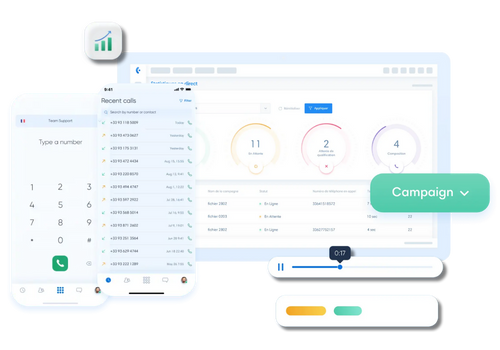
  • Supervisory supervision to monitor team activity on a daily basis.
  • Dialer and automation designed to support sales productivity.
  • CRM integration to link calls to sales actions, without being a CRM.

Pricing positioning and flexibility

The positioning is based on a 100% no-commitment logic, with instant activation and termination, billing based on actual usage, and no minimum duration or number of lines, guaranteeing total transparency of costs even in the event of variations in activity.

Limits to be aware of

Kavkom is not designed for projects requiring highly specific telecom development or complex technical orchestration on the product side. Purely technical teams looking for low-level control via API will find less latitude.

Note

8,6 / 10


Why Kavkom stands out in this comparison

Kavkom stands out for its direct alignment with the actual use of sales teams and in-house call centers, combining turnkey corporate telephony, operational supervision and contractual flexibility, with no unnecessary technical detours.

Test Kavkom in your real-life business context


RingCentral

For whom it’s relevant

RingCentral is aimed at structured structured companiesoften with multiple sites, looking to centralize communications for sales, support and cross-functional teams, with a strong focus on internal collaboration.

Features and real-life use

The platform offers a broad approach to corporate communications.

  • Cloud telephony integrated with collaboration tools.
  • Advanced contact center to handle high volumes.
  • Reporting and analytics for managerial steering.
    These functionalities are relevant in organizations that are already mature in terms of processes.

Pricing positioning and flexibility

The model is based on per-user subscriptionswith functional levels. Flexibility exists, but access to the most advanced uses often involves a gradual move upmarket.

Limits to be aware of

For smaller sales teams or those with a strong focus on field action, the whole process can seem complex. complex and sometimes oversized. The global platform approach also takes time to get used to.

Note

8,0 / 10


Mitel

For whom it’s relevant

Mitel is suitable for established organizations that already have a structured telephony environment and want to move it to the cloud, while retaining logic close to historical corporate standards.

Features and real-life use

The solution covers classic business telephony needs.

  • Advanced call and routing management.
  • Supervision and control options.
  • Extended capabilities for complex environments.
    These elements respond well to stable organizational contexts.

Pricing positioning and flexibility

The positioning is more contractualThese costs are linked to the functional scope and level of customization. Flexibility is reduced for teams who need to adjust their system quickly.

Limits to be aware of

Mitel can become less suitable when you’re looking for operational simplicity. operational simplicity or very rapid implementation. For fast-moving sales teams, the perceived cumbersomeness can slow down adoption.

Note

7,5 / 10


Twilio

For whom it’s relevant

Twilio is designed primarily for technical teams or product teams who want to integrate voice and messaging directly into their business applications, with fine-grained control over flows.

Features and real-life use

Twilio’s strength lies in its API approach.

  • Programmable tools for voice and messaging.
  • Customized automation.
  • Strong ability to integrate into existing environments.
    In a product context, this offers great freedom.

Pricing positioning and flexibility

The model is based on pay-per-useThis provides flexibility at start-up. On the other hand, budget visibility can become more complex as volumes increase.

Limits to be aware of

For sales sales teams or in-house call centersTwilio often requires development work or tool assembly before it is truly operational. Field use is not immediate.

Note

7,4 / 10


Plivo

For whom it’s relevant

Plivo is relevant for SaaS, digital platforms or product teams that need that need large-scale voice and messaging capabilities, without relying on an out-of-the-box solution for agents.

Features and real-life use

The solution is clearly API-oriented.

  • Programmable voice and SMS.
  • Number and scalability management.
  • Reporting tools for technical monitoring.
    These uses are best suited to automated scenarios.

Pricing positioning and flexibility

Pricing is based on consumption logicThis is an attractive proposition for controlled volumes and product-oriented projects. Flexibility is real, but requires careful management.

Limits to be aware of

Plivo is less suitable when you’re looking for business telephony corporate telephony that can be used directly by sales or support teams, with no intermediate technical layer.

Note

7,3 / 10


Vonage

For whom it’s relevant

Vonage is ideal for growing businesses who want to combine unified communications omnichannel scenarioswith sales and support teams working across multiple channels.

Features and real-life use

The platform offers a broad functional scope.

  • Cloud telephony and contact centers.
  • CRM and business tool integrations.
  • API to personalize certain courses.
    The whole is coherent for cross-functional use.

Pricing positioning and flexibility

The model combines subscriptions and usageThis allows for a gradual evolution. However, reading the costs requires a good understanding of the scope of activation.

Limits to be aware of

For teams with a strong pure sales performancethe wealth of functions can dilute the clarity of the main use and make management more complex.

Note

7,2 / 10


Dialpad

For whom it’s relevant

Dialpad is designed for sales and support teams sensitive to the benefits of AI, particularly for exchange analysis and coaching, in already well-structured environments.

Features and real-life use

The tool showcases AI-assisted uses.

  • Cloud telephony with conversational analysis.
  • Coaching and quality monitoring tools.
  • CRM and helpdesk integration.
    These functions are useful for continuous improvement-oriented teams.

Pricing positioning and flexibility

Pricing is based on subscriptions per userwith advanced options that can be activated as required. Flexibility exists, but depends on the level of functionality chosen.

Limits to be aware of

For teams looking for operational simplicity operational simplicity and fine-tuned cost control, the AI-oriented approach may seem secondary, or even over-dimensioned.

Note

7,1 / 10

How to choose the best alternative to Twilio

1. Type of team

Not all solutions respond to the same operational realities.

  • The sales teams are looking for outbound callsactivity tracking and field efficiency.
  • Visit in-house call centers need supervision, control and stability at scale.
  • Visit support or customer service often focuses on managing incoming calls and ensuring continuity of service.

2. Call volume

Call volume determines the right tool for the job.
Low volume does not imply the same constraints as sustained activity.

  • Mostly inbound incoming or outgoing.
  • Stable or highly variable volumes depending on the period.
  • Direct impact on productivityand cost control over time.

3. Need for supervision

Some teams are content with simple use, while others need fine-tuned control.

  • Listening to and following up calls on a daily basis.
  • Real-time view of activity.
  • Managerial support versus a simple call tool.

4. Budget constraints

Beyond the initial cost, it’s the overall logic that counts.

  • Ability to easily understand what you’re paying for.
  • Evolution of costs as the team or usage grows.
  • Possible dependence on options or intensity of use.

5. Expected flexibility

It is the key to organizational agility.

  • Presence or absence of long-term commitment.
  • Easy to add or remove users.
  • Easy to activate, adjust or stop the solution.

Mini checklist for decision-makers

  • Does my team focus on sales, support or mixed use?
  • Is call volume low, regular or highly variable?
  • Do I need real-time or ad hoc call tracking?
  • Am I looking for a turnkey solution or a tool to integrate into my existing environment?
  • Is contractual flexibility essential for my organization in the short and medium term?

Kavkom or Twilio: which is best for you?

These two solutions don’t address the same realities on the ground, and the right choice depends above all on how your telephony is used on a daily basis.

Is your telephony a simple communication channel or a central operational lever?
If calls are at the heart of a company’s sales activity or internal call center operations, a solution designed for day-to-day use and operational management often makes all the difference. Conversely, a more modular approach is appropriate when telephony is integrated into an existing product or ecosystem.

Do you need to manage calls and teams in real time?
Activity monitoring, supervision and managerial visibility are essential as soon as volumes increase or performance is closely monitored. Some solutions are designed for this direct use, while others leave this kind of management to be built in.

Are you looking for a turnkey solution or are you comfortable working in a highly IT-intensive environment?
A telephony solution that can be used immediately is better suited to operational teams, while an integration-oriented platform is better suited to technical profiles capable of designing their own workflows.

Is contractual flexibility important to your business?
When staff numbers or volumes vary, the ability to easily adjust the tool becomes a structuring criterion over time.

Do your teams work to volume or performance targets?
In this case, the alignment between the tool, real-life uses and the pace of daily work is often more decisive than raw technical wealth.

In practice, the most coherent choice is the one that corresponds to your actual use, the maturity of your teams and your management needs. For sales teams or in-house call centers looking for directly operational and flexible telephony, Kavkom is a logical and rational option.

98% of our customers value the efficiency and simplicity of our services

Find out why over 8,000 companies work with Kavkom for their corporate telephony.

4.7 on Capterra

Frequently asked questions

Any other questions?
Consult our Online Help or Contact us

Which alternative to Twilio is best for B2B companies?

There is no universal answer, because it all depends on the actual use. A B2B company focused on sales or internal customer relations will have different expectations from a SaaS product driven by a technical team. The right choice depends on the type of team, the role of telephony in the business and the level of day-to-day management expected.

Sales teams need telephony designed for outgoing calls, activity monitoring and field productivity. The most relevant solutions are those offering rapid implementation, clear supervision and integration with existing sales tools. In this context, operationally-oriented platforms such as Kavkom are often better suited than highly technical environments.

Yes, but with important differences depending on the use. An in-house call center requires control, supervision and visibility of team activity. Some solutions are designed for this direct use, while others require more configuration or are aimed more at automated scenarios.

Some solutions offer a more flexible approach, with no long-term commitment, which can be decisive for growing teams or those with variable volumes. This flexibility makes it easier to adjust users and usage according to actual activity. Other platforms rely on more structured contractual or technical frameworks.

The comparison must not be limited to the model displayed, but must take into account changes over time. We need to analyze billing logic, dependency on usage or options, and the ability to anticipate costs when activity increases. Enterprise telephony solutions often seek to offer greater clarity, while API platforms require more detailed budget tracking.