If you’re looking for Top 10 alternatives to Talkdesk for business telephony that’s truly adapted to your sales teams or call centers, this comparison is designed for your situation. It analyzes solutions according to real-world usage, to help you make a B2B choice that’s consistent with your operational needs.
No credit card
No obligation
Custom demo
The solutions below have been compared in terms of their suitability for real business telephony applications, sales team productivity and in-house call center operations.
| Solution | Best for | Key features | Price positioning | Score out of 10 |
| Kavkom | Performance-oriented sales teams and in-house call centers | Predictive Dialerreal-time supervision, CRM integration, multi-team management | Flexible model with no commitment, prorated billing | 8,8 |
| RingCentral | Structured enterprises with unified communication needs | Advanced routing, omnichannel contact center, analytics, integrated collaboration | Subscription per user with functional tiers | 8,2 |
| Mitel | SMEs and key accounts with IT or hybrid constraints | Cloud and hybrid telephony, multi-site supervision, advanced reporting | Modular model with complex options and deployments | 7,9 |
| Twilio | Technical teams and customized API projects | Voice and messaging APIs, automation, custom integrations | Pay-per-use, developer logic | 7,6 |
| Plivo | Startups and product teams focused on programmable communications | Voice and SMS APIs, programmable routing, scalability | Pay-per-use, variable costs according to volume | 7,4 |
| Vonage | Businesses looking for a combined UCaaS and API platform | Cloud telephony, contact center, CRM integrations, APIs | SaaS subscription with options and add-ons | 7,8 |
| Dialpad | Teams looking for a unified cloud platform with AI | Real-time transcription, supervision, CRM integrations | Subscription per user with AI options | 7,7 |
Kavkom is aimed at teams who want corporate telephony designed for real-life use, with simple implementation, flexible logic and essential features for sales teams and internal call centers.
Kavkom is relevant for companies that operate with sales teams or in-house in-house call centers and who want directly usable enterprise telephony. Typically, a sales team that needs to launch call campaigns, track activity in real time and rely on its CRM without going through a heavy technical project.
Kavkom focuses on the features functionality required for commercial use standardwith no essential modules to add to get you started.
The whole system is designed for everyday use, by agents and managers alike.
The model is based on a logic commitment-freewith pro rata billing. Costs remain transparent and evolve simply with team size, facilitating adjustments during growth or testing phases.
Kavkom’s choice choice of specialization sales performance. Organizations looking primarily for an extensive omnichannel platform or advanced collaboration features may find the approach more focused.
8,8 / 10
Kavkom stands out for its ability to meet real-life business telephony needswith rapid implementation, operational supervision and contractual flexibility for in-house sales teams and call centers. It also stands out for its human, French-speaking and responsive support, with direct assistance during implementation and on a day-to-day basis, without chatbots or impersonal support.
Five9 is especially aimed at large contact centers and companies with high volumes of interactions. It is often chosen by customer service departments managing large, sometimes multi-site teams, with high management requirements.
The platform is designed forlarge-scale omnichannel.
These features are powerful, but require an already structured organization.
Our positioning is clearly corporate and major accountswith modular offers. Flexibility does exist, but it often involves more binding contracts and a gradual move upmarket.
Functional richness means complexity complexity of implementation and a higher overall cost. For medium-sized sales teams, the solution may seem over-dimensioned.
8,3 / 10
Vocalcom is suitable for and large companies operating in-house call centers focused on customer service and sales performance, often in regulated environments.
The solution covers a broad spectrum of uses.
It is well suited to structures that want to centralize all channels.
The model is modularwith several possible logics depending on usage. This flexibility makes it possible to adapt, but also makes costs less easy to read.
The platform requires time to get to grips with and a certain organizational maturity. For smaller teams, the configuration effort can be disproportionate.
8,1 / 10
RingCentral is designed for companies looking for a unified communications platformcombining telephony and collaboration, often in multi-departmental environments.
The tool is versatile.
It has a wide range of uses, beyond just commercial ones.
Pricing is based on subscriptions per userstructured in tiers. Upgrading is straightforward, but certain key functions require higher packages.
For teams focused solely on sales performance, a very general approach can dilute the value of field applications.
8,0 / 10
Mitel is relevant for complex organizationsoften multi-site, with strong IT constraints and sometimes hybrid environments.
The solution covers telephony and large-scale contact centers.
It is designed for already structured environments.
The model is modularwith different options depending on the architecture chosen. This flexibility comes with heavier contract management.
The complexity of deployment can hold back agile or fast-moving sales teams.
7,9 / 10
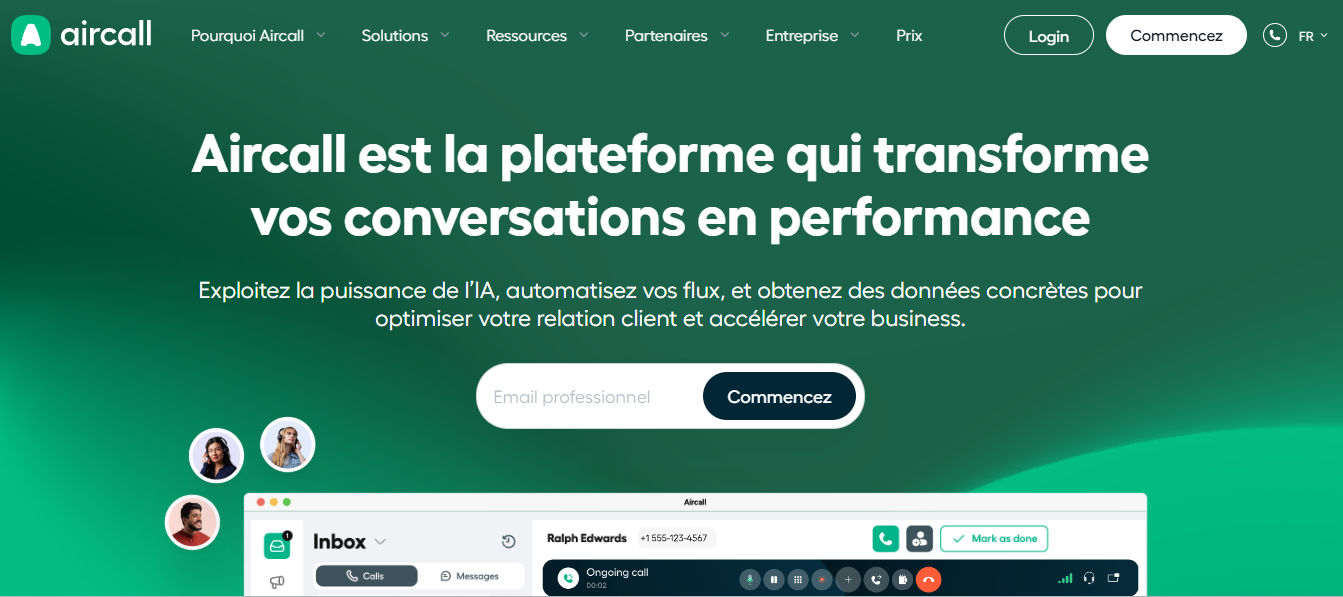
Aircall is often chosen by growing SMEswith sales or support teams who want a solution that’s easy to deploy and well integrated with SaaS tools.
The platform is productivity-oriented.
It is well suited to teams in an acceleration phase.
The model is based on a subscription per userwith structured plans. Scalability is easy, but certain options quickly become necessary.
For more advanced call centers or very high volumes, capacities can reach their limits.
7,8 / 10
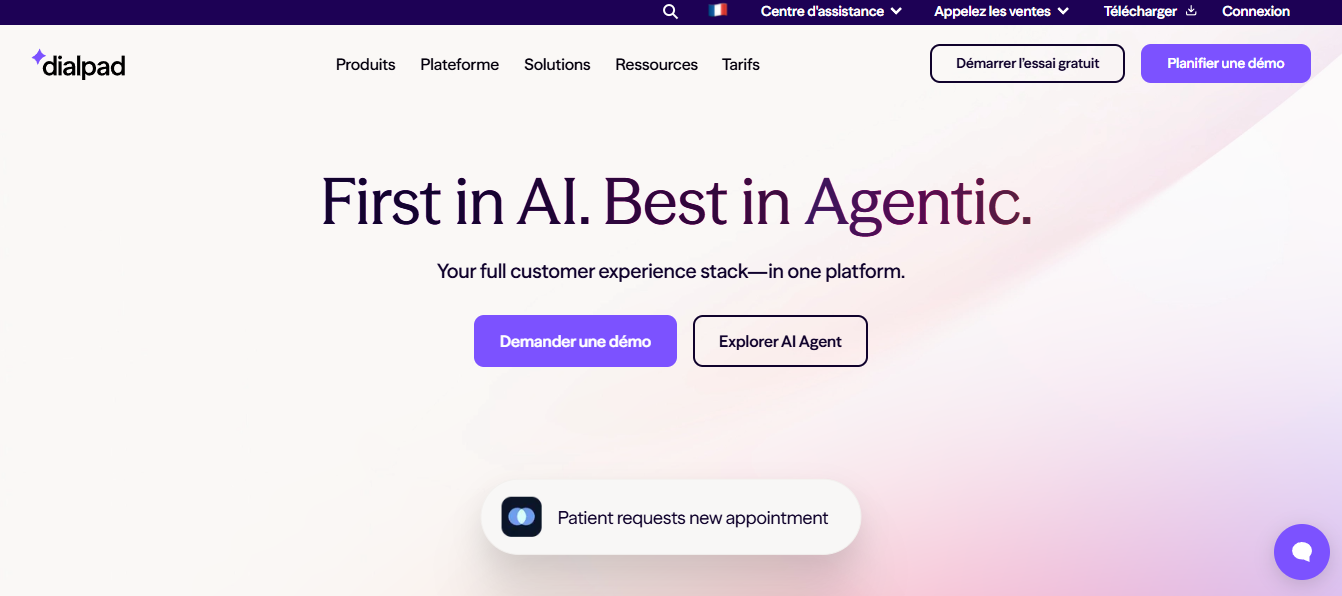
Dialpad targets teams who want a unified unified cloud platformwith a strong focus on intelligent assistance and conversation analysis.
The tool relies on automation.
These functions are useful for improving the quality of exchanges.
Pricing is per userwith advanced options as required. The structure is clear, but some key functionalities are conditional on higher-level plans.
The highly automated approach may not be suitable for teams whose primary concern is simple sales management.
7,7 / 10
CloudTalk is ideal for SMEs and support or sales teams who operate internationally and want a cloud telephony solution that’s quick to learn.
The solution covers essential needs.
It is designed for everyday use without heaviness.
The model is based on scalable subscriptionswith gradual upgrades as needs change.
For highly structured call centers, advanced advanced supervision may be limited.
7,6 / 10
Ooma targets and small teams who want to professionalize their telephony without complexity.
Functionality is geared towards simplicity.
This meets standard needs.
The logic is simple and accessiblewith clear subscriptions and few technical dependencies.
As soon as volumes increase or supervision becomes strategic, the solution shows its limits.
7,4 / 10
Vonage is relevant for companies that want to combine cloud telephony and programmable communicationsoften with a strong need for integration.
The platform is wide.
Technical teams appreciate it.
The model combines subscriptions and pay-per-usewhich offers flexibility but makes cost estimation more complex.
Without in-house expertise, this wealth of functionality can be difficult to exploit to the full.
7,8 / 10

Start by identifying who actually uses the solution on a daily basis.
Volume directly influences the relevance of a tool.
Ask yourself what level of steering you expect.
Beyond the initial budget, look at the overall logic.
Flexibility is often decisive in a B2B context.
These two solutions have different rationales, and the right choice depends above all on how your telephony is used on a day-to-day basis.
Is your telephony a simple communication tool or a daily operational lever?
If calls are at the heart of the business, with volume, follow-up and performance objectives, a solution designed for use in the field makes perfect sense. Conversely, a more generalist approach may suffice when telephony remains secondary.
Do you need to manage calls and teams in real time?
When management is based on immediate visibility, listening and continuous monitoring, certain platforms are designed to support this operational management. Others take a broader approach to customer relations.
Are you looking for a turnkey solution or are you comfortable with a more IT-oriented environment?
Some companies want to get started quickly, without complex configuration. Others have the technical resources to integrate and further customize their telephony tools.
Is contractual flexibility an important criterion for your business?
In contexts where teams evolve rapidly, the ability to adjust usage without heavy constraints becomes a decisive factor in the final choice.
Do your teams work under pressure with volume or performance targets?
When telephony directly supports sales performance or the efficiency of an in-house call center, alignment between the tool and the real pace of the teams is essential.
In practice, the right choice is always based on actual usage and operational priorities. This makes Kavkom a coherent option for organizations seeking corporate telephony aligned with performance-oriented sales teams and internal call centers.
Find out why over 8,000 companies work with Kavkom for their corporate telephony.
4.7 on Capterra
With Kavkom, I was able to easily resolve the issue of communication costs to my regular customers. My agents, too, were no longer restricted in their mobility, because even when on the move, communications are managed.
Ben Cauchois
VP Sales & Operations @ SEIZA
We’ve increased our targets by 10% thanks to the information we’ve gained from call identification and analysis provided by Kavkom’s telephony solution.
Dov Dahan
CEO @ Formideo
The transition to enterprise telephony in the cloud with Kavkom enables us to track KPIs to identify our strengths and weaknesses.
Arnold Panou
CEO @ VAD Assistance
We evaluated several service providers, and Kavkom emerged as the only option that allowed us to tailor our customer service requirements to our unique business practices.
Pierre Roche
Managing Partner
at Groupe OREL
The integration of Kavkom’s virtual number service with voicemail has considerably facilitated our process of collecting visitor testimonials. We have been able to gather valuable feedback that helps us to continually improve our services.
Hélène Lafont-Couturier
Visitor Relations Manager
Musée des Confluences
Any other questions?
Consult our Online Help or Contact us
Which Talkdesk alternative is best for B2B companies?
There is no universal answer, because it all depends on the actual use. A sales-oriented B2B company will prefer telephony designed for team performance and follow-up, while a more customer relations-oriented context will be looking for a different approach. The right choice depends on the type of team, the role of calls and the level of management expected.
Which Talkdesk alternatives are best suited to sales teams?
Sales teams need tools adapted to outgoing calls, activity monitoring and daily supervision. Some solutions are designed as genuine operational levers, while others remain more generalist. Kavkom can be a coherent option when telephony directly supports sales objectives.
Are these alternatives suitable for an in-house call center?
Yes, but not in the same way, depending on the solution. An in-house call center generally requires real-time control, supervision and managerial monitoring tools. Some platforms are better suited to these intensive uses than others, depending on the size of the teams and the level of control required.
Are there more flexible alternatives to Talkdesk in terms of commitment?
Flexibility varies greatly from one solution to another. Some rely on more rigid contractual frameworks, while others make it easier to adjust usage according to changes in business activity. This is an important criterion for companies whose teams or volumes change regularly.
How do you compare the real costs of Talkdesk alternatives?
It’s important to look beyond the displayed model and consider the overall logic. Real costs often depend on the options required, the evolution of the teams and the intensity of use. A solution may seem appropriate at the outset, but become less relevant as usage becomes more complex.
Please share your location to continue.
Check our help guide for more info.