Top 7 alternatives to OVH Télécom for business telephony

If you’re looking for a Top 7 alternative to OVH Télécom for business telephony use, this comparison is for you. It’s aimed at sales teams and call centers who want to compare solutions based on actual use in the field, in order to make an informed B2B choice, without getting lost in overly technical or generalist approaches.

No credit card

No obligation

Custom demo

Quick comparison of the best alternatives to OVH Télécom

The solutions below have been compared and evaluated according to concrete criteria of real use in corporate telephony, for sales teams and call centers.

Solution Best for Key features Price positioning Score out of 10
Kavkom Sales teams and in-house call centers Dialer, real-time supervisionCRM integration, call reporting Flexible subscription, no commitmentsimple logic 8,5
RingCentral Structured companies, multi-team collaboration Cloud telephony, advanced routinganalytics, contact center Subscription per user, modular options 7,5
Mitel ETI and large accounts with IT constraints Hybrid telephony, multi-site supervisionqueuing Licensing model and options, complex deployment 7
Twilio Technical teams and digital products Voice API, customized workflowsanalytics Usage-based billing, developer logic 6,5
Plivo Large-scale voice and SMS projects Call API, programmable routingmonitoring Pay-per-use, variable costs 6
Vonage Companies looking for UCaaS + API Cloud telephony, contact centerCRM integrations Subscription + additional modules 7
Dialpad Support and customer relations teams Cloud telephony, conversational AIsupervision Subscription per user, AI options 7,5

Testing a more operational alternative to OVH Télécom

Kavkom is aimed at companies looking for enterprise telephony designed for real-life use by sales teams and call centers, with simple implementation and clear contractual flexibility.

Top 7 alternatives to OVH Télécom: detailed analysis

Kavkom

For whom it’s relevant

Kavkom is designed for sales teams and in-house call centers who use telephony as a daily management tool. Typically, SMEs and ETIs who want to monitor call activity, supervise teams and remain agile without depending on a complex infrastructure.

Features and real-life use

  • Dialer to speed up outbound call campaigns
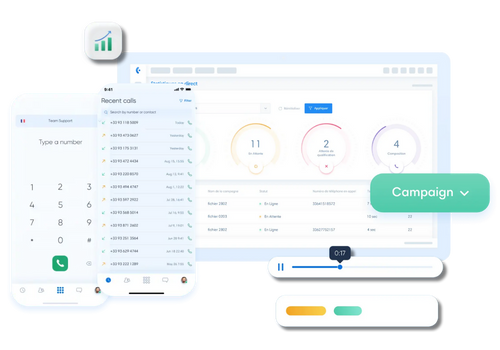
  • Real-time supervision to monitor activity and adjust load
  • CRM integration to maintain continuity between calls and customer follow-up
  • Reporting focused on operational activity

These elements respond to needs in the field, such as managing a remote sales team or monitoring the performance of an in-house call center.

Pricing positioning and flexibility

The model is based on a simple simple, easy-to-understand logicwith commitment-free and pro rata billing. This makes it easy to adjust headcount and usage according to activity, without contractual rigidity.

Limits to be aware of

Kavkom is designed above all for business performance-oriented telephony. Organizations looking for a general-purpose collaboration platform or very specific custom development scenarios will need to take this into account.

Note

8,5 / 10


Why Kavkom stands out in this comparison

Kavkom stands out for its direct alignment with the key criteria of the comparison: actual use, operational supervision, CRM integration and contractual flexibilityin a 100% cloud framework, without unnecessary complexity for sales teams and in-house call centers.

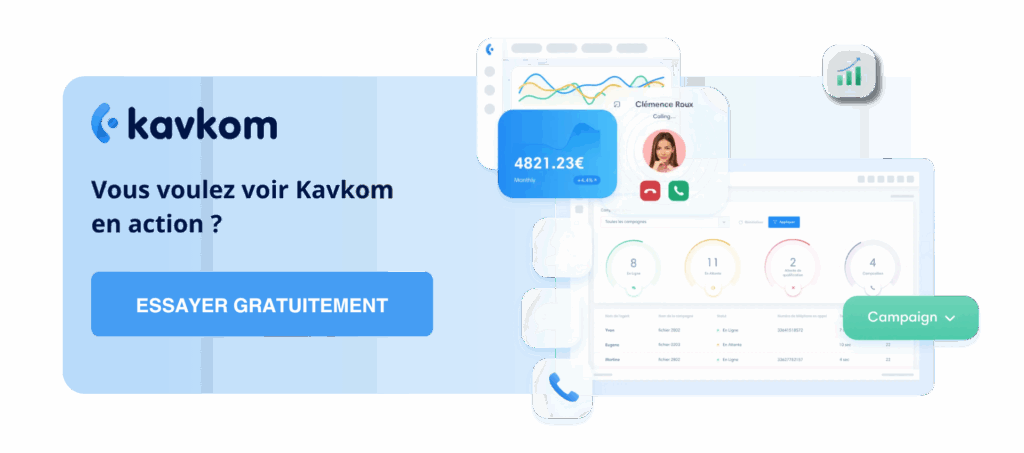
See Kavkom in action

RingCentral

For whom it’s relevant

RingCentral is ideal for structured companies and multi-service teams looking to centralize telephony, collaboration and contact center services in a single single platformThis is often the case in environments with more than 100 employees.

Features and real-life use

  • Cloud telephony with advanced routing
  • Omnichannel contact center with supervision
  • Integrated collaboration tools (messaging, meetings)
  • Analytics for global activity monitoring

It’s the ideal solution for organizations that want to unify internal communication and customer on the same tool.

Pricing positioning and flexibility

RingCentral works on a subscription per userwith modules and options depending on requirements. Legibility depends on the functional scope chosen, which can make cost projections more complex as usage evolves.

Limits to be aware of

Functional richness can become a hindrance for sales teams looking above all for operational simplicity. operational simplicity. Getting started and configuring the system is often more time-consuming, especially for smaller structures.

Note

7,5 / 10


Mitel

For whom it’s relevant

Mitel focuses on ETI and large accounts with structured IT teams, often multi-site or in regulated sectors. The typical case is an organization that needs to cohabit cloud and legacy environments, while retaining a high level of control.

Features and real-life use

  • Unified telephony cloud or hybrid
  • Multi-site supervision and advanced queue management
  • Contact center with analytics and sector-specific options
  • Extensive CRM integrations for complex environments

These features are ideally suited to situations where telephony needs to be integrated into an already dense information system.

Pricing positioning and flexibility

The model is based on licenses per user and add-on add-on moduleswith deployments often contracted over time. Flexibility does exist, but it is more limited in contexts of rapid growth.

Limits to be aware of

The complexity of implementation can be an obstacle for sales teams looking for a tool that is immediately operational, without being heavily dependent on IT.

Note

7 / 10


Twilio

For whom it’s relevant

Twilio is designed for technical teamsThis is the case for digital products or SaaS publishers who want to build their own communication logic. Common usage concerns highly personalized customer paths, integrated into the heart of a business application.

Features and real-life use

  • Voice API for programmable calls
  • Customized workflows and automation
  • Technical monitoring and analytics tools
  • High integration capability via API

This is a powerful tool when telephony is part of a product, rather than a turnkey tool for field teams.

Pricing positioning and flexibility

The logic is based on pay-per-usewhich is very flexible in theory, but requires precise monitoring to remain legible on a large scale.

Limits to be aware of

For sales sales or call center teamsthe absence of a ready-to-use interface and dependence on developments can slow down operational adoption.

Note

6,5 / 10


Plivo

For whom it’s relevant

Plivo is primarily aimed at technical teams and large-scale voice or SMS-oriented projects, particularly in international contexts where volume control is key.

Features and real-life use

  • API calls and programmable routing
  • Real-time monitoring flows
  • Conversation quality control tools
  • Integrations via APIs and third-party connectors

It’s ideal for automating workflows, but less so for directly managing sales teams on a day-to-day basis.

Pricing positioning and flexibility

The model is fully customizablewith a high degree of elasticity according to volumes. This flexibility is interesting, but requires good technical and budgetary control.

Limits to be aware of

Lack of native tools for supervising team supervision limits its suitability for in-house call center use without an additional application layer.

Note

6 / 10


Vonage

For whom it’s relevant

Vonage is suitable for mid-market companies who want to combine cloud telephony and APIs, with a unified approach to customer relations and internal internal communications.

Features and real-life use

  • Cloud telephony and contact center
  • CRM and helpdesk integration
  • API for customization
  • Centralized supervision and reporting

The solution is used in hybrid contexts, between a turnkey tool and an adaptable platform.

Pricing positioning and flexibility

The model combines subscription and additional modulesThe model combines subscription and add-on modules, with good flexibility but readability that depends on the scope activated.

Limits to be aware of

The multiplication of options can make the tool more complex to pilot for sales teams looking for a simple, field performance-oriented framework.

Note

7 / 10


Dialpad

For whom it’s relevant

Dialpad is designed for support and customer relations teamsas well as sales teams sensitive to assistance and conversational analysis tools.

Features and real-life use

  • Cloud telephony with conversational AI
  • Real-time supervision and analytics
  • Transcription and automated coaching
  • Common CRM integrations

AI is a real plus for analyzing exchanges and supporting agents on a daily basis.

Pricing positioning and flexibility

Pricing is based on a subscription per userwith advanced AI-related options. The move upmarket is gradual, but can weigh on the budget on a large scale.

Limits to be aware of

For contexts with a strong pure operational managementsome teams may find AI more relevant for analysis than for fine-tuned call flow management.

Note

7,5 / 10

How to choose the best alternative to OVH Télécom

The choice depends above all on the actual context of usenot a list of functionalities. Not all solutions meet the same operational constraints.

1. Type of team

Start by identifying the teams concerned.

  • Sales teams Sales teams: need effective outbound calls and activity monitoring.
  • In-house call centers Priority to incoming flow management and agent management.
  • Support/customer service Customer service: the importance of continuity in exchanges and the customer context.

2. Call volume

Volume has a direct influence on the preferred solution.

  • Low to medium volume: quick and easy to use.
  • High or variable volume: automation, supervision and capacity to absorb peaks in activity.
  • Net difference between incoming and outgoingwith impacts on team organization.

3. Need for supervision

Not all teams have the same managerial expectations.

  • Easy to use: global visibility of calls and activity.
  • Advanced use : listeningreal-time monitoring and support for teams on a daily basis.
  • The more central the supervision, the more the solution needs to be designed for control.

4. Budget constraints

Cost aside, the key issue is legibility. readability.

  • Understand what evolves with use or growth.
  • Identify the portion linked to options or actual use.
  • Avoid models that are difficult to project over time.

5. Expected flexibility

Flexibility is the key to the solution’s adaptability.

  • Quick adjustment of users.
  • Easy to switch on or off depending on activity.
  • Ability to keep pace with organizational changes without friction.

Minichecklist decision-maker

  • Is my team mainly sales, support or mixed?
  • Is call volume stable or subject to regular variations?
  • Do I need daily or occasional monitoring?
  • Am I looking for a turnkey solution or an integrated tool?
  • Is contractual flexibility crucial for my organization?

Kavkom or OVH Télécom: which alternative to choose, depending on your usage?

Kavkom and OVH Télécom do not respond to the same usage contexts. The choice depends above all on the role telephony plays in your day-to-day business.

Is your telephony a simple communication tool or a daily operational lever?
If telephony is mainly used to stay in touch, a generalist approach may suffice. On the other hand, when it structures team work, activity monitoring and objectives, a solution designed for operational use makes more sense.

Do you need to manage calls and teams in real time?
Day-to-day management, supervision and managerial support require tools that focus on activity monitoring. Not all platforms are designed for this intensive use.

Are you looking for a turnkey solution or are you comfortable with a more IT-oriented environment?
Some organizations prefer modular, technical environments. Others are looking for rapid implementation, with a tool that can be used directly by field teams.

Is contractual flexibility an important criterion for your business?
When staff numbers and volumes change, the ability to quickly adjust usage and users becomes a factor of comfort and control.

Do your teams work under pressure with volume or performance targets?
In these contexts, telephony becomes a management tool rather than a simple channel, which naturally leads to the choice of specialized solutions.

In practice, the right choice depends on actual usage and the expected level of control. For organizations that see telephony as an operational tool serving sales teams and internal call centers, a solution like Kavkom is part of a coherent, rational logic.

98% of our customers value the efficiency and simplicity of our services

Find out why over 8,000 companies work with Kavkom for their corporate telephony.

4.7 on Capterra

Frequently asked questions

Any other questions?
Consult our Online Help or Contact us

Which alternative to OVH Télécom is best suited to B2B companies?

There is no universal answer. The right choice depends on team typeThis depends on the intensity of use and the role telephony plays in the business. Some solutions are suitable for general communication, others for more operational, management-oriented use. The analysis must always be based on the company’s actual context.

Sales teams need effective outbound calls, clear activity tracking activity follow-up and supervision tools. Sales-oriented solutions focus on productivity and day-to-day management. Other, more generalist platforms may be less suited to volume or performance objectives.

Yes, but with important nuances. An in-house call center requires fine-tuned flow controlReal-time supervision and team support. Not all solutions offer the same level of control, especially when it comes to managing several agents simultaneously.

Some solutions focus on flexibilityThis approach is often appreciated in changing business environments. This approach is often appreciated in changing business environments. Others rely on more structured contractual frameworks, adapted to stable organizations.

The comparison should not be limited to the model displayed. You need to analyze the cost transparencyIn the long term, a simple, predictable model is often easier to manage than a highly fragmented pricing model. In the long term, a simple, predictable model is often easier to manage than a highly fragmented pricing structure.