Top 6 alternatives to Evoice for enterprise telephony and real-world use by sales teams and internal call centers

If you’re looking for the Top 6 alternatives to Evoice for enterprise telephony that’s truly adapted to your day-to-day business, this comparison is for you. It’s aimed at sales teams and in-house call centers who want to compare solutions based on real-life usage, not just on promises or data sheets. The aim is simple: to help you make a B2B choice that’s consistent with your context and operational priorities.

No credit card

No obligation

Custom demo

Quick comparison of the best Evoice alternatives

The solutions below were compared on the basis of their suitability for real business telephony applications, and the productivity of sales teams and in-house call centers.

Solution Best for Key features Price positioning Score out of 10
Kavkom Performance-oriented sales teams and in-house call centers Dialer, real-time supervision, CRM integration, cloud telephony No commitment, pro rata billing, simple logic 8.8
Grasshopper Self-employed and mobile VSEs Business number, simple IVR, call routing Monthly fee per user, simple model 6.6
RingCentral Structured companies with advanced IT needs Cloud PBX, contact center, advanced analytics Subscription per user, tiered options 7.9
Ooma VSEs and SMEs looking for a versatile solution Virtual switchboard, call analytics, CRM integrations Per-user subscription, modular options 7.2
Google Voice Small teams already on Google Workspace Unified calls and SMS, voice transcription, mobility Subscription per user, integrated into Workspace 6.8
Line2 Freelancers and microteams Secondary number, SMS, basic routing Subscription per number, entry-level 6.4

Testing a more operational alternative to Evoice

Kavkom is designed for teams who expect enterprise cloud telephonytelephony, designed for real-life use, with simple implementation and flexibility in line with day-to-day business challenges.

Top 6 alternatives to Evoice: detailed analysis

Kavkom

For whom it’s relevant

Kavkom is relevant for sales teams and in-house call centers who use the telephone as a daily work tool. Typically, a sales or lead qualification team that needs to call in volume, monitor activity in real time and keep a clear view of performance, without depending on an IT team.

Features and real-life use

The approach is focused on the operational, not on the accumulation of modules.

  • Enterprise telephony cloud for immediate use, without hardware
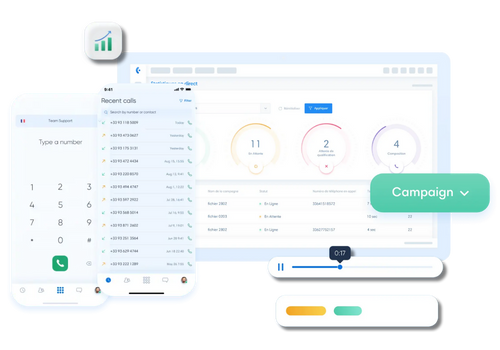
  • Predictive Dialer to increase the number of successful calls and reduce time wasted on answering machines
  • Real-time supervision to control team activity
  • CRM integration to centralize calls in existing sales tools, without being a CRM

These functions correspond to standard commercial use, where the phone is used to produce measurable results.

Pricing positioning and flexibility

The model is easy to read and scalable.
No commitmentwith pro rata billingThis makes it easy to adjust the number of users or usage according to activity, without contractual rigidity. Kavkom also stands out for its human, French-speaking, responsive supportwithout chatbots or automated paths.

Limits to be aware of

Organizations looking for a complete collaboration platform (videoconferencing, chat, extended collaborative tools) will have to look elsewhere: Kavkom specializes in performance-oriented corporate telephony.

Note

8.8 / 10


Why Kavkom stands out in this comparison

Kavkom stands out for its clear alignment with the real needs the real needs of sales teams and in-house call centerswhere simplicity of use, supervision and contractual flexibility take precedence over complex functional layers.

See Kavkom in action


Grasshopper

For whom it’s relevant

Grasshopper is ideal for freelancersThis is the case for freelancers and very small teams who want a business number separate from their personal use. For example, a single consultant or a micro-structure who wants to answer customer calls from their mobile.

Features and real-life use

The tool covers the basics of simple professional telephony.

  • Business number and call routing
  • Basic automated reception
  • Voicemail and mobile management

These functions are sufficient for individual activity, but remain limited for team use.

Pricing positioning and flexibility

The model is based on monthly packages per userThese are easy to understand, but less flexible as the team grows or usage becomes more complex.

Limits to be aware of

Grasshopper shows its limitations when it comes to supervise a teamIt’s not designed for organized sales teams. It’s not designed for organized sales teams.

Note

6.6 / 10


RingCentral

For whom it’s relevant

RingCentral is aimed at structured companiesThese are often IT departments looking for a broad communications platform. A mid-sized group or a large company will find a robust framework.

Features and real-life use

The solution goes far beyond telephony.

  • Cloud PBX and contact center
  • Advancedanalytics
  • Numerous integrations with business tools

This makes sense for multi-service organizations, but less so for a sales team focused on the call.

Pricing positioning and flexibility

Pricing is organized by functional levelswith per-user subscriptions. The move upmarket is gradual, but can become complex to read.

Limits to be aware of

For sales teams in the field, the whole package can seem cumbersome to configure and maintain, especially if not all the bricks are used.

Note

7.9 / 10


Ooma

For whom it’s relevant

Ooma targets VSEs and SMEs who want versatile business telephony without excessive complexity. For example, a small service company with a few sales representatives and thin client support.

Features and real-life use

The solution covers a fairly broad spectrum.

This is enough to structure a small team, without going into very intensive use.

Pricing positioning and flexibility

The per-user model is relatively simplewith options to suit your needs. Legibility remains good as long as the organization remains moderate in size.

Limits to be aware of

As soon as call volumes rise sharply or supervision becomes critical, capacities can appear limited when compared with more specialized solutions.

Note

7.2 / 10


Google Voice

For whom it’s relevant

Google Voice is ideal for small teams already highly dependent on Google Workspace. For example, a start-up in its early stages of growth, or a distributed team that favors mobility.

Features and real-life use

The tool focuses on simplicity.

  • Centralized calls and messages
  • Voicemail transcription
  • Smooth operation on web and mobile

Comfortable to use for simple needs, with no need for advanced piloting.

Pricing positioning and flexibility

Pricing per user is clear and predictableespecially in a Google environment already in place.

Limits to be aware of

For structured sales teams or in-house call centers, the absence of advanced advanced supervision and dedicated productivity tools quickly becomes an obstacle.

Note

6.8 / 10


Line2

For whom it’s relevant

Line2 is suitable for freelancers and micro-teams who want a second business number that can be used on both mobile and PC, without complex configuration.

Features and real-life use

Functionality remains deliberately basic.

  • Business number
  • Calls and messages
  • Simple routing and messaging

This meets an individual need rather than a team logic.

Pricing positioning and flexibility

The model by number is availablewith an entry-level model that’s easy to switch on and off.

Limits to be aware of

Line2 is not designed to structure a collective commercial activity. As soon as you need to monitor performance or coordinate several users, the solution reaches its limits.

Note

6,4/10

How to choose the best alternative to Evoice

1. Type of team

Start by identifying who actually uses the solution on a daily basis.

  • The sales teams need tools that focus on outgoing calls and productivity.
  • Visit in-house call centers are looking for supervision and control.
  • The support or customer service focuses on incoming call management and continuity.

Not all solutions cover these uses with the same level of depth.

2. Call volume

Volume changes everything.

  • Low volume, occasional use.
  • Medium volume, regular activity.
  • High volume, continuous calls.

The higher the volume, the greater the impact on productivityautomation and team organization becomes critical.

3. Need for supervision

Ask yourself the question of piloting.

  • Follow a few calls from time to time.
  • Listening, analyzing and supporting teams on a daily basis.
  • Get a real-time view of your business.

The difference between simple use and managerial use is often decisive.

4. Budget constraints

Look beyond the apparent cost.

  • Are costs clear from the outset?
  • Do they evolve easily with growth?
  • Do they depend heavily on options or actual usage?

A solution may seem simple at first, but become complex to manage over time.

5. Expected flexibility

Finally, assess your need for agility.

  • Long-term commitment or free exit.
  • Quick user adjustment.
  • Frictionless on/off.

Flexibility is often key in changing business contexts.

Mini checklist for decision-makers

  • Is my team sales-oriented, support-oriented or mixed?
  • Is call volume stable or variable?
  • Do I need to supervise the activity on a daily or occasional basis?
  • Is cost transparency a key criterion for me?
  • Do I need a solution that can be easily adjusted over time?

Kavkom or Evoice: which is best for you?

These two solutions do not meet the same expectations. The choice depends above all on the place telephony occupies in your organization and the way your teams use it on a daily basis.

Is your telephony a simple communication tool or an operational lever?
If the telephone is mainly used to be reachable, a simple solution may suffice. As soon as it becomes a central work tool, with objectives and follow-up, the approach needs to be more structured.

Do you need to manage calls and teams in real time?
Some organizations are content with individual use. Others need monitor activitysupport teams and maintain a clear vision of performance, day after day.

Are you looking for a turnkey solution or are you comfortable with a more technical environment?
Depending on your situation, you may prefer a tool that’s ready to use straight away, or one that requires more configuration and management.

Is contractual flexibility important to your business?
When business evolves, the ability to quickly adjust to users and uses becomes a concrete decision criterion.

Do your teams work under pressure with volume or performance targets?
The greater the operational pressure, the greater the difference between the tool and the field on a daily basis.

In practice, the right choice always depends on theactual usenot the name of the solution. For sales teams or in-house call centers that use the telephone as a performance tool, an approach aligned with these constraints naturally becomes more coherent.

98% of our customers value the efficiency and simplicity of our services

Find out why over 8,000 companies work with Kavkom for their corporate telephony.

4.7 on Capterra

Frequently asked questions

Any other questions?
Consult our Online Help or Contact us

Which Evoice alternative is best suited to B2B companies?

There is no universal answer. The right choice depends on team typeSome solutions are suitable for simple use, while others are designed for structured business telephony. Some solutions are suitable for simple use, while others are designed for structured corporate telephony. The important thing is to align the tool with actual usage.

Sales teams need a telephone as an operational lever operational leveragenot just as a means of contact. The right solutions offer activity monitoring, supervision and tools to support outbound calls. Without these, productivity and managerial visibility remain limited.

Yes, but only if we’re talking about in-house call centersno outsourced services. The challenge is to manage flows, listen to and support teams. Some solutions cover these needs, while others remain too basic for intensive use.

Yes, several solutions offer a more flexible logic flexibleThis flexibility is particularly useful for growing companies or those with variable volumes. This flexibility is particularly useful for growing companies or those with variable volumes. The absence of any long-term commitment reduces the risk involved in making the right choice.

We need to look at the overall business modelNot just the initial subscription. The options required, the evolution with call volumes and the growth of teams can strongly influence the cost over time. A solution that’s easy to understand at the outset can become complex as usage evolves.