A telemarketing company helps companies identify new prospects and generate sales appointments over the telephone. In many B2B sectors, telephone prospecting remains an effective lever for making contact with new customers. Despite the development of digital channels, the telephone is still often the most direct way to establish an initial exchange.
But to be effective, telephone prospecting needs to be structured. Without a clear organization, teams spend a lot of time dialing numbers, searching for information or tracking prospects in several tools. This makes it difficult to measure performance.
A teleprospecting company or a dedicated team can organize this activity. In this guide, we’ll take a look at how telemarketing works, how to organize it and what tools are needed to structure effective sales prospecting.
Points to remember
- A telemarketing company contacts prospects by telephone to qualify business opportunities and obtain appointments.
- Companies can outsource prospecting to a specialized agency or structure an in-house team.
- A prospecting campaign is based on several elements: targeting prospects, call scripting, CRM tracking and results analysis.
- Tools such as cloud telephony, dialers and CRM integration boost team productivity.
- Telemarketing is still widely used in B2B when it is organized and complies with data protection regulations.


Boostez la productivité de vos équipe commerciales grâce à Kavkom, le logiciel de téléphonie d’entreprise 100% cloud.
Planifier une démo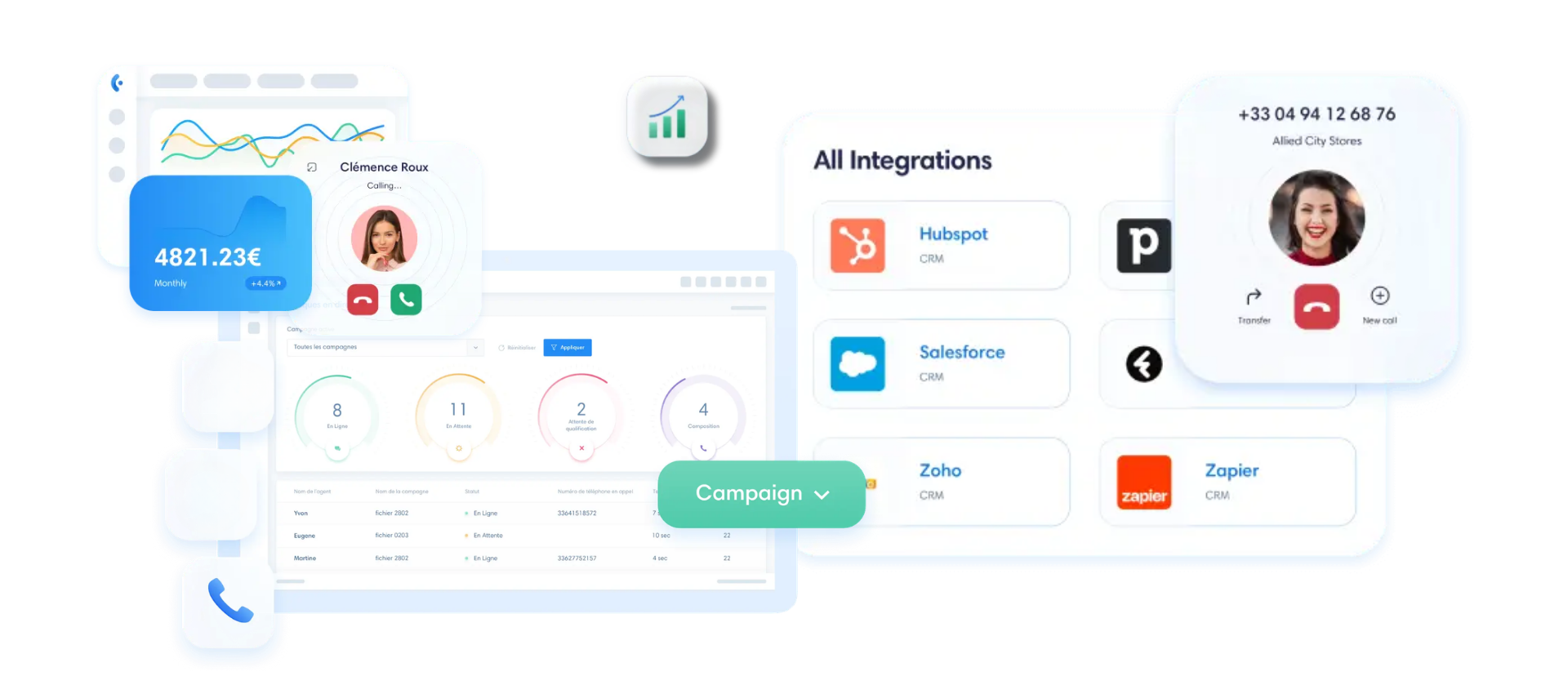
What is a telemarketing company?
A telemarketing company is an organization specialized in commercial prospecting by telephone. Its role is to contact prospects to identify needs, qualify opportunities and obtain appointments for sales teams.
Telemarketers generally call contacts from a prospect database. The aim is not necessarily to make an immediate sale, but to initiate an initial conversation, understand the prospect’s situation and check whether there is any sales potential.
This enables sales staff to focus on the key stages of the sales cycle: demonstration, negotiation and signature.
Teleprospecting is used in a number of situations, particularly in B2B sectors where sales cycles are long and decisions involve several contacts.
- B2B appointment scheduling
- marketing lead qualification
- prospecting for new markets
- follow-up with prospects or former customers
Some companies entrust this task to a specialized agency, while others prefer to organize a dedicated in-house team.
In all cases, telemarketing relies on a structured method, call scripts and tools to monitor campaign performance.
The main missions of a telemarketing company
A telemarketing company is involved in several types of sales missions. Its aim is to transform a base of contacts into qualified business opportunities for sales teams.
The most frequent task is to make appointments for sales representatives. Telemarketers identify interested prospects and schedule a meeting with a sales representative.
Teleprospecting is also used for lead qualification. When a prospect downloads content or requests information, a call is made to verify their project and level of interest.
Some companies also use telemarketing to prospect new markets. Calls are used to identify key contacts and gauge interest in an offer.
Last but not least, it can be used to reactivate sales opportunities with prospects or former customers.
In all cases, telemarketing is used to filter and qualify contacts before the sales force intervenes.
Outsource or manage telemarketing in-house?
When a company wants to develop its telephone prospecting, there are two possible approaches: outsource prospecting to a specialized agency, or set up a dedicated in-house team.
The choice depends on the volume of prospecting, the resources available and the level of control the company wishes to retain over its sales approach.
Outsource telemarketing to an agency
Some companies use a telemarketing agency to delegate some of their sales calls.
In this model, the agency provides telemarketers who contact prospects on behalf of the company and secure appointments for the sales team.
The main advantage is speed of implementation. The company can launch a campaign without having to recruit or train a team. On the other hand, an external agency rarely knows the offer as well as the company itself. This can sometimes limit the precision of the sales pitch during calls.
Structuring an in-house telemarketing team
Other companies prefer to manage prospecting in-house, with sales staff or specialized profiles such as SDRs (Sales Development Representatives).
This organization gives us greater control over the sales pitch and the data collected during calls.
But it requires several elements to be in place:
- recruiting and training telemarketers
- campaign organization
- tools for managing calls and tracking results
With a clear method and the right tools, an in-house team can generate a steady flow of qualified leads for sales reps.
How does a telemarketing campaign work?
A telemarketing campaign isn’t just about calling up a list of contacts.
To achieve results, prospecting must follow a clear method. Teams generally structure their campaigns around several stages: identifying the right prospects, preparing calls, qualifying exchanges and monitoring performance.
This organization avoids impromptu calls and gradually improves campaign efficiency.
1. Identify the right prospects
The first step is to define precisely who to contact.
Telemarketing rarely works with overly large or poorly targeted contact bases. Companies therefore start by defining a clear prospect profile.
Several criteria can be used:
- line of business
- company size
- contact function
- location
- potential needs
For example, a company selling B2B software might target sales managers in SMEs with between 10 and 100 employees.
Precise targeting enables us to focus calls on really relevant prospects.
2. Prepare call script
Before launching a campaign, teams often define a call script.
This script serves as a guide for structuring the conversation. It helps telemarketers keep a logical thread running through the exchange.
A script generally includes :
- an introduction
- a few qualification questions
- a brief presentation of the offer
- an appointment proposal
The aim is to open the discussion and quickly identify whether the prospect might be interested.
3. Make calls and qualify prospects
Once the campaign has been launched, the telemarketers start making calls.
During each conversation, they seek to understand the prospect’s situation: their needs, projects or constraints.
The information gathered is then entered into a tracking tool, often a CRM (Customer Relationship Management) software package. This enables us to keep a record of exchanges and organize follow-ups.
4. Monitor campaign results
A telemarketing campaign must be managed with precise indicators.
Teams generally follow :
- number of calls made
- contact rate (prospects who drop out)
- the number of appointments obtained
- appointment conversion rate
This data is used to identify what works and to adjust targeting, scripting or campaign organization.
The essential tools for a telemarketing company
A telemarketing campaign is as much about the method as the tools used.
When teams work solely with Excel files and manual calls, follow-up quickly becomes difficult. Information gets scattered, some reminders are forgotten, and it becomes complicated to analyze performance.
These tools are often grouped together in corporate telephony and prospecting campaign management solutions. These solutions centralize calls, track prospects and analyze campaign results.
Cloud telephony for call management
The basis of a telemarketing organization remains the company telephone.
Cloud telephony solutions enable incoming and outgoing calls to be managed from a platform accessible via the Internet. Teams can call from a computer or mobile application, without complex technical installation.
These solutions enable you to :
- use business numbers
- organize incoming calls between several agents
- record calls for sales follow-up
- centralize conversation history
In a prospecting team, cloud telephony acts as a centralized switchboard accessible to the whole team.
Automatic dialer to increase the number of calls
When a team needs to call a large number of prospects, dialing each number manually becomes a waste of time.
Dialers automate this step. They dial numbers automatically and connect agents when a prospect picks up.
Several types of dialers are used in prospecting:
- predictive dialer: dial several numbers to reduce waiting time
- progressive dialer: launches calls at the agent’s pace
- dialer preview: allows you to consult the prospect’s file before the call
These tools increase the number of real conversations with prospects.
CRM integration to track prospects
CRM (customer relationship management) software is often at the heart of sales prospecting.
It allows you to centralize prospect information:
- contact details
- trading history
- scheduled appointments
- commercial notes
When a call is connected to the CRM, the agent can immediately consult the prospect’s file and record information after the conversation. This enables the entire sales team to track the progress of opportunities.
Team supervision and coaching
In a telemarketing team, managers need to monitor agent activity.
For example, supervision tools can be used to :
- see the number of calls made in real time
- listen in on certain calls to analyze exchanges
- support new telemarketers
These functions are often used to improve call scripts and train teams.
How to organize a telemarketing team
Setting up a telemarketing team requires clear organization.
Successful companies usually divide roles between several profiles to structure the sales process.
Telemarketers or SDRs
Teleprospectors, often referred to as SDRs (Sales Development Representatives), are responsible for initial contact with prospects.
Their mission is to :
- contact prospects
- qualify their needs
- check for business opportunities
- get an appointment for a salesperson
They are mainly involved in the qualification phase.
The sales team
Once the prospect has been qualified, the sales person takes over.
At a more advanced stage in the sales cycle, he or she presents the offer, gives a demonstration and accompanies the prospect through to signature.
This separation between prospecting and sales often improves team efficiency.
The sales manager
The sales manager supervises the team’s activity. He/she analyzes campaign performance and helps telemarketers improve their calls.
Its missions generally include :
- tracking performance indicators
- call analysis
- campaign organization
- training new team members
With the right tools, he can monitor team activity in real time.
An example of simple organization
In an SME, a telemarketing team can operate with a simple structure:
- 1 sales manager
- 2 to 5 telemarketers
- 1 or 2 sales representatives in charge of appointments
This organization generates a steady flow of qualified prospects for the sales teams.
How much does a telemarketing company cost?
The cost of a telemarketing campaign depends on the model chosen. Some companies outsource prospecting to a specialized agency, while others prefer to set up an in-house team.
The budget generally depends on the volume of calls, the expected level of qualification and the target market.
The cost of a telemarketing agency
Telemarketing agencies offer several billing models.
Some charge per appointment obtained, meaning that the company only pays when a sales appointment is scheduled.
Others operate on a fixed monthly fee, which includes a volume of calls or hours of prospecting.
Depending on the sector and the complexity of the target, the cost per appointment can vary greatly, especially in specialized B2B markets.
The cost of an in-house team
Creating an in-house team involves several costs:
- telemarketers’ salaries
- team training
- campaign management
- telemarketing tools
However, this model allows us to better control the sales pitch and maintain control over the data collected during calls.
For companies that prospect regularly, an in-house team can pay off in the long term.
The cost of telemarketing tools
Companies generally use tools to manage their campaigns.
Cloud telephony solutions often work on a per-user subscription basis. They can be used to centralize calls, automate certain tasks and analyze team performance.
These solutions also offer greater flexibility: companies can easily adjust the number of users as their campaigns evolve.
Structuring modern telephone prospecting with the right tools
Whether a company outsources its prospecting or develops an in-house team, the organization of calls remains essential.
For a long time, sales teams worked with scattered tools: individual telephones, Excel files and notes taken after calls. This organization quickly became unmanageable as call volumes increased.
Cloud telephony solutions now make it possible to centralize calls and connect telephony to the company’s business tools.
Business telephony accessible from anywhere
Cloud telephony platforms enable you to make and receive calls from a computer or mobile application.
Companies can assign business numbers to their teams and manage calls from a centralized interface. Incoming calls can be routed to the right contacts, and conversations recorded for sales follow-up.
This allows teams to work from different locations without the need for complex telephone installations.
Tools for managing prospecting campaigns
Modern telephony platforms often include features dedicated to prospecting.
For example:
- automatic dialers for faster call initiation
- campaign tracking tools
- dashboards to analyze team activity
These features enable you to increase the number of conversations with prospects and track campaign performance.
CRM integration
In many companies, telephone prospecting is connected to CRM.
When a call is made or received, the prospect’s record can be displayed automatically. Notes taken during the exchange are then saved in the contact history.
This integration makes it possible to track sales opportunities without multiplying tools.
The example of a solution like Kavkom
Some platforms have been designed to equip sales teams and in-house call centers.
Such is the case with Kavkom, a 100% cloud-based business telephony solution that lets you manage business calls from a single interface, with no hardware to install and no commitment.
The platform includes :
- business numbers accessible via the Internet
- a cloud switchboard to organize calls
- supervision tools to monitor team activity
- integrations with several CRMs used by companies
Kavkom is not a telemarketing company: the solution provides the infrastructure to manage the calls, while the campaigns remain managed by the company’s own teams.
Legal framework for telemarketing
Telemarketing is governed by a number of rules designed to protect personal data and limit abusive practices.
In particular, companies must comply with regulations on data protection and commercial canvassing.
RGPD and data protection
In Europe, telephone prospecting is governed by the RGPD (General Data Protection Regulation).
Companies need to manage prospect information transparently and securely. Data collected during calls, such as telephone numbers and call history, must be protected and accessible only to authorized persons.
Prospects must also be able to request access, modification or deletion of their data.
Do not contact lists
In some countries, individuals can sign up to telephone anti-spam lists.
In France, for example, the Bloctel service enables consumers to refuse commercial calls.
Companies should therefore check that their contact databases comply with these rules. In a B2B context, calls are generally authorized when they concern the professional activity of the company contacted.
This framework changed on August 11, 2026: contacting a consumer now requires their prior consent, and the opt-out list has been eliminated. We’ve outlined, on a case-by-case basis, what remains permissible following the end of Bloctel.
Boostez la productivité de vos équipe commerciales grâce à Kavkom, le logiciel de téléphonie d’entreprise 100% cloud.
Planifier une démoTelemarketing FAQs
What’s the difference between telemarketing and telemarketing?
Telemarketing involves contacting prospects by telephone to qualify their needs and obtain sales appointments. Telemarketing is broader, and includes promotion and direct sales by telephone.
How many calls does it take to get a sales appointment?
The number of calls depends on the sector and the quality of the prospect base. In many B2B campaigns, teams observe a contact rate of between 10% and 30%, and an appointment rate of between 5% and 20% of conversations.
Does telemarketing still work today?
Yes, telemarketing is still widely used in B2B. The telephone can often be used to establish a rapid initial exchange with a prospect, and to qualify a business need more effectively than certain digital channels.
What tools should you use to organize your telemarketing?
Companies generally use a corporate telephony solution, a CRM to track prospects, a dialer to automate outbound calls and reporting tools to analyze campaign performance.
Conclusion
Telemarketing remains an important lever for developing sales activity, particularly in B2B environments where direct contact plays a key role. If well organized, it can rapidly identify interested prospects and generate sales appointments.
Companies can choose to outsource this activity to a specialized agency, or structure an in-house team dedicated to telephone prospecting. In both cases, performance depends on clear organization and appropriate tools.
Cloud telephony solutions like Kavkom make it possible to centralize calls, connect prospecting to CRM and monitor sales activity from a single interface, with no hardware to install and no commitment.