Internal communication can’t wait. Teams work remotely, on several sites, sometimes across several time zones. Exchanges must be rapid, structured and traceable.
Professional instant messaging has established itself as a central tool. It replaces dispersed e-mail discussions and reduces unnecessary meetings. It also facilitates file sharing, audio or video calls and real-time collaboration.
But the market has become increasingly complex. Between solutions focused on internal collaboration, platforms integrated with office suites and hybrid tools combining chat and project management, the choice is becoming difficult.
Not all messaging systems meet the same needs. Some focus on security and data hosting. Others focus on integrations, external channels or open source. The differences in price and functionality are sometimes considerable.
This comparison presents the main business instant messengers in 2026. For each, we analyze key features, limitations, pricing and use cases. You’ll also find concrete criteria for choosing the right tool for your organization.
Points to remember
- A professional instant messaging system helps to structure internal exchanges, speed up communication and centralize discussions within an organization.
- But not all tools serve the same purpose. Some are designed for internal collaboration, with chat, files and videoconferencing. Others are geared to customer relations, with calls, supervision and CRM integration.
- The choice depends above all on your organization: type of team, volume of exchanges, tools already in place and security constraints.
- The SaaS model offers rapid implementation and simplified management, while open source solutions provide greater control at the cost of higher technical complexity.
- For a company, messaging should not be chosen for its functionality alone. It has to fit in with your existing processes, and meet a specific need, whether for internal collaboration or sales management.


Boostez la productivité de vos équipe commerciales grâce à Kavkom, le logiciel de téléphonie d’entreprise 100% cloud.
Planifier une démo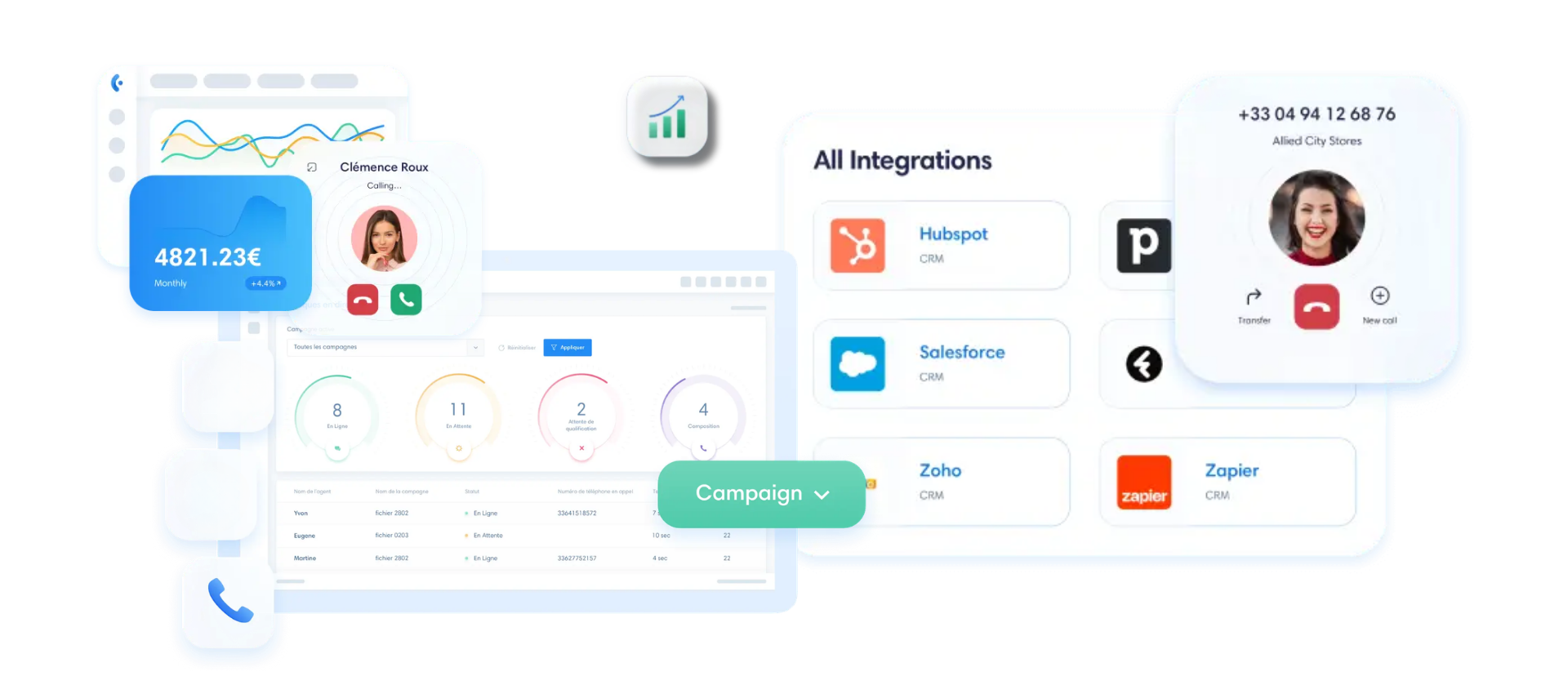
A quick comparison of the main professional messaging services
| Tool | Ideal for | Audio / video calls | Integrations | Data hosting | Admission prices |
| Kavkom | Sales teams and in-house call centers | Yes (VoIP audio calls, no native videoconferencing) | Native CRM integrations (Salesforce, HubSpot, Zoho…) + APIs | 100% cloud, secure hosting | 10/user/month (incoming calls only); €30/month with no commitment for unlimited incoming and outgoing calls |
| Slack | SMEs and multi-tool project teams | Yes (native audio/video, Huddles) | Extensive marketplace (CRM, project management, support) | Proprietary cloud (USA / EU according to plan) | Free for a limited period, then approx. 7-8 € /user/month |
| Microsoft Teams | Companies already on Microsoft 365 | Yes (advanced meetings) | Microsoft suite + numerous third-party apps | Microsoft Cloud (regional data centers) | Includes Microsoft 365 or approx. 4-5 € /user/month |
| Google Chat | Companies on Google Workspace | Yes, via Google Meet | Native integration with Gmail, Drive, Docs + add-ons | Google Cloud (configurable regions) | Includes Workspace (from approx. €6/user/month) |
| Discord (pro use) | Tech startups, in-house communities | Yes (robust audio/video) | Limited integration vs. B2B tools | Proprietary cloud | Free, Nitro optional |
| Rocket.Chat | Companies looking for control and open source | Yes (depending on configuration) | PLC + multiple connectors | Self-hosted or cloud Rocket.Chat | Free open source version, paid cloud |
| Element (Matrix) | Organizations sensitive to data sovereignty | Yes (via Matrix) | Integration via API / bots | Self-hosted or Matrix servers | Free open source, paid cloud |
| Chanty | SMEs looking for simplicity | Yes (audio/video) | Limited integrations, but CRM and popular tools | Proprietary cloud | Free for a limited period, then approx. 3-4 € /user/month |
| Flock | SMEs / support teams | Yes (audio/video) | CRM and productivity integrations | Proprietary cloud | Free for a limited period, then approx. 4-6 € /user/month |
| Zoho Cliq | Companies using Zoho | Yes | Native Zoho integration + external apps | Cloud Zoho | Includes Zoho Workplace or approx. 3 € /user/month |
| Mattermost | Enterprise IT / DevOps | Yes (depending on edition) | DevOps integrations (Git, Jira…) | Self-hosted or cloud | Free open source version, paid cloud |
This table provides an overview.
The differences are then played out in terms of security, depth of integration, call management and suitability for your organization.
Top 10 professional instant messengers
Kavkom
Quick overview
Kavkom is a 100% cloud solution for professional VoIP telephony. It includes messaging features for call management and sales collaboration.
Main features
- VoIP telephony with virtual numbers
- Incoming and outgoing audio calls
- Native CRM integrations (Salesforce, HubSpot, Zoho…)
- Real-time supervision
- API for customized integration
Benefits
- No obligation
- Pro-rata billing
- Immediate activation
- Features included without additional modules
- Responsive, human support
Limits
- No native videoconferencing
- No complete omnichannel solution
- Specializing in telephony, not general chat tools
Rates
From €10 per user per month for incoming calls only.
€30 per month with no commitment for unlimited incoming and outgoing calls.
For what type of company?
Sales teams, in-house call centers, SMEs looking to centralize their cloud telephony with CRM integration.
Slack
Quick overview
Slack is a collaborative messaging system designed for teamwork. It structures exchanges by thematic channels and direct messages.
Main features
- Public and private channels
- Native audio and video calls
- File sharing
- Searchable history and advanced search
- Broad marketplace of integrations
Benefits
- Simple interface
- Wide range of integrations (CRM, support, project management)
- Good adoption by teams
Limits
- Limited history in free version
- Cost increases with number of users
- Data hosted in a proprietary cloud
Rates
Limited free version. Paid plans from around €7 to €8 per user per month.
For what type of company?
SMEs, startups and project teams already using several SaaS tools.
Microsoft Teams
Quick overview
Microsoft Teams combines messaging, video conferencing and document collaboration in the Microsoft 365 ecosystem.
Main features
- Individual and team chat
- Advanced video meetings
- Share and co-edit Office documents
- Microsoft and third-party integrations
Benefits
- Integrated with Word, Excel, Outlook
- Advanced meeting management
- Centralized administration
Limits
- Dense interface
- Less flexible outside the Microsoft ecosystem
Pricing
Included in Microsoft 365 or available from around €4 to €5 per user per month.
For what type of company?
Companies already equipped with Microsoft 365, multi-site structures.
Google Chat
Quick overview
Google Chat is the internal messaging system integrated into Google Workspace.
Main features
- Discussion forums
- Gmail, Drive, Docs integration
- Video calls via Google Meet
Benefits
- Simplicity
- Native integration with Google tools
- Lightweight interface
Limits
- Fewer advanced integrations than Slack
- Limited personalization
Prices
Included in Google Workspace from around €6 per user per month.
For what type of company?
SMEs already using Gmail and Google Drive.
Discord
Quick overview
Originally designed for online communities, Discord is sometimes used in professional environments.
Main features
- Text and voice channels
- Audio and video calls
- Screen sharing
Benefits
- Free for the most part
- Very fluid for fast exchanges
Limits
- Not very business-oriented
- Proprietary cloud hosting
- Less suitable for regulated environments
Pricing
Free version, Nitro paid options.
For what type of company?
Tech startups, informal teams.
Rocket.Chat
Quick overview
Rocket.Chat is an open-source, self-hosted messaging system.
Main features
- Internal chat
- Audio/video calls
- PLCs and connectors
Benefits
- Total data control
- Advanced customization
Limits
- More complex technical set-up
- Internal maintenance required for self-hosting
Rates
Free open source version. Cloud pay-as-you-go.
For what type of company?
Organizations sensitive to data sovereignty.
Element
Quick overview
Element is based on the Matrix protocol, an open communications standard.
Main features
- Secure messaging
- Audio/video calls
- End-to-end encryption
Benefits
- High level of safety
- Flexible hosting
Limits
- More technical adoption
- Less mainstream interface
Rates
Open source free, cloud pay.
For what type of company?
Public organizations, regulated sectors.
Chanty
Quick overview
Chanty is a simple messaging system designed for small teams.
Main features
- Cat
- Audio/video calls
- Basic task management
Benefits
- Intuitive interface
- Accessible pricing
Limits
- Fewer integrations
- Limited advanced features
Rates
Free for a limited period, then around €3 to €4 per user per month.
For what type of company?
Small teams looking for simplicity.
Zoho Cliq
Quick overview
Zoho Cliq is part of the Zoho ecosystem.
Main features
- Cat
- Audio/video calls
- Zoho CRM integrations
Benefits
- Consistency with Zoho suite
- Competitive prices
Limits
- Less relevant outside the Zoho ecosystem
Prices
Including Zoho Workplace or from around €3 per user per month.
For what type of company?
Companies using Zoho CRM.
Mattermost
Quick overview
Mattermost targets IT and DevOps teams.
Main features
- Structured chat
- Git and Jira integrations
- In-house hosting available
Benefits
- Data control
- Adapted to technical environments
Limits
- Less oriented towards non-technical professions
Pricing
Free open source version, cloud editions at extra cost.
For what type of company?
IT teams, technology companies.
How do you choose a professional instant messenger?
Choosing a messaging system is not just a matter of comparing interfaces.
The real question is simple: what problem does it need to solve in your organization?
Here are the criteria to analyze before deciding.
Safety and compliance
First point: data protection.
Where is the data hosted? In the European Union? In the United States? On your own servers?
Some SaaS (software available online) solutions offer regionalized hosting. Open source tools enable in-house hosting, but require technical resources.
Also check :
- exchange encryption (message protection)
- access rights management
- RGPD compliance
- traceability of conversations
For a regulated sector, this criterion can take priority.
Integrations with CRM and business tools
Isolated messaging creates silos.
Connected messaging makes flows more fluid.
Ask yourself:
Does your team already work with a CRM, ticketing tool or specific business software?
Some platforms offer native connectors. Others use APIs (technical interfaces enabling data to be exchanged between systems).
The simpler the integration, the less time you waste on manual re-entry.
Internal collaboration or customer relations?
Not all messaging services cover the same uses.
Some are designed for internal collaboration: team exchanges, project management, video meetings.
Others are more customer-oriented: calls, sales team supervision, CRM integration, interaction tracking.
If your priority is internal coordination, a comprehensive collaborative tool may suffice.
If your teams spend all day on the phone with prospects or customers, a specialized cloud telephony solution may be more appropriate.
SaaS or open source hosting?
Two models dominate.
SaaS: turnkey solution, vendor-managed maintenance, rapid implementation.
Open source: open code, in-house hosting, advanced customization.
SaaS is often suitable for SMEs and fast-moving organizations.
Open source appeals to organizations with an IT team capable of administering and securing the tool.
This choice influences technical complexity and overall cost.
Budget and scalability
The posted price is just a starting point.
Take a look:
- cost per user
- additional paid modules
- history limits
- advanced options billed separately
Think growth too.
Your tool should be able to grow from 10 to 50 users without a complete overhaul.
Finally, check the contractual flexibility. Some solutions require a long-term commitment. Others allow licenses to be adjusted according to activity.
In short, the right choice depends less on the “best tool” than on the match between your uses, your regulatory constraints and your internal organization.
Instant messaging vs. e-mail: should you replace?
Instant messaging and e-mail don’t meet the same needs.
Instant messaging encourages rapid exchanges. It streamlines internal collaboration, reduces response times and cuts down on unnecessary meetings. Conversations are organized by channel or team, with a searchable history.
E-mail remains relevant for formal communications, external exchanges or messages requiring a more structured, official record.
So replacing e-mail altogether is not always appropriate.
In most companies, instant messaging complements rather than replaces e-mail.
Boostez la productivité de vos équipe commerciales grâce à Kavkom, le logiciel de téléphonie d’entreprise 100% cloud.
Planifier une démoFAQs
What’s the best messaging solution for SMEs?
There’s no single best business instant messaging solution for SMBs. The choice depends on your needs.
For simple internal collaboration, tools like Slack or Google Chat are sufficient.
For a sales team with high call activity and CRM integration, a cloud telephony-oriented solution may be more suitable.
Which solution is safer?
The most secure solutions are those offering encryption of exchanges, fine-grained management of access rights and RGPD compliance.
Open source platforms offer total control via in-house hosting.
SaaS solutions often offer certifications and a secure infrastructure managed by the publisher.
Are there any open source solutions?
Yes. Tools such as Rocket.Chat, Element or Mattermost offer open source versions.
They can be self-hosted (installed on your own servers) for complete data control.
On the other hand, they require more technical skills.
Can a messaging system be integrated into a CRM?
Yes, many professional messaging systems offer native integration or integration via API (technical interface enabling data exchange).
This makes it possible to centralize exchanges, calls or histories directly in the CRM.
This integration is particularly useful for sales and customer support teams.
Instant messaging or full-featured collaborative tool?
Instant messaging covers chat and rapid exchanges.
A complete collaborative tool also includes project management, advanced videoconferencing and sometimes telephony.
The choice depends on your organization: simple internal coordination or unified work environment.
Conclusion
The market for professional instant messaging is vast. Some tools are designed for internal collaboration. Others focus on security, open source or integration with an office suite. The right choice always depends on the context of use.
Before deciding, clarify your priorities: data security and hosting, CRM and business tool integrations, audio or video call requirements, budget and ability to grow with your business. A project-oriented SME won’t have the same expectations as a sales team that’s very active on the telephone.
If your main concern is managing calls and coordinating sales teams with CRM integration, a specialized solution like Kavkom may be a good idea. You can request a demo or test the solution without obligation to assess its suitability for your organization.