
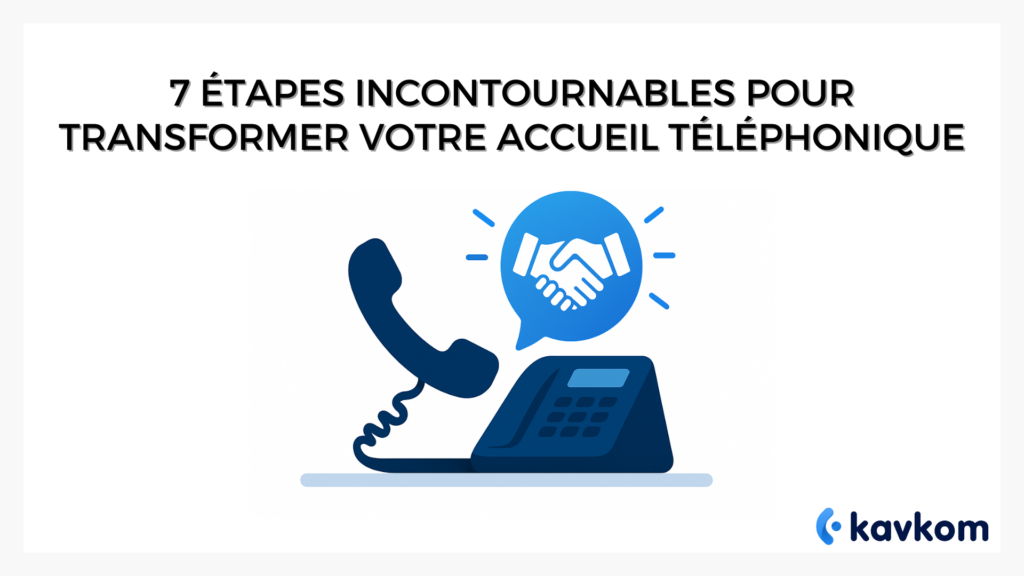
The good news is that setting up a warm, professional and efficient welcome isn’t magic. It can be learned. This guide takes you through 7 practical steps, illustrated with examples and phrases, to turn every call into a positive experience from the very first moment of contact.
Points to remember :
- The telephone greeting is the first reflection of your company: it must be fast, structured and warm to inspire confidence from the very first seconds.
- The quality of listening, personalization and the way in which waiting or transfer is handled directly determine customer satisfaction and loyalty.
- Ongoing training and the monitoring of simple indicators (response time, satisfaction) guarantee the consistency and progress of our teams.
- The modern telephony tools facilitate supervision, integration with CRMs and personalized reception, making the experience more fluid for customers and staff alike.

What is a telephone reception and why is it strategic?
Telephone reception is the first point of contact between a company and its public. It reflects the company’s seriousness, organization and respect for its customers.
A good telephone greeting consists of answering quickly, courteously, clearly identifying yourself and listening to the request. It’s a gateway that can open the door to a lasting relationship or, on the contrary, close it immediately.
According to BVA’sCustomer Services Observatory, 75% of French people contact a customer service department at least once a year. Digital channels such as mobile messaging and chatbots are on the rise, but the telephone remains the preferred channel for 96% of French people.
A well-groomed welcome is a marker of professionalism and a decisive asset in customer relations.
In a nutshell: the 3 benefits of a good telephone greeting
- Professionalism: reflects the company’s serious and organized image.
- Speed: reduces the frustration of waiting or endless ringing.
- Personalization: create a human link from the very first sentence.
The 7 essential steps to successful telephone reception
Step 1: Preparing your welcome and your objectives
Telephone reception is all about preparation. A well-trained team knows how to pick up the phone, what to say and how to say it.
The basis is always the same: clearly announce thecompany, introduce yourself by your first name and, if necessary, specify the department. This formula provides a framework and builds trust.
Examples of professional presentations:
- “Alpha Company, Claire Martin in the accounting department, hello.”
- “Hello, you’ve reached Beta Consulting, Julien speaking, how can I help you?”
An opening script should be short, uniform and familiar to all employees. It’s a benchmark, especially for new recruits or during busy periods.
Common mistakes to avoid
- Respond with a simple “Hello?” or “Yes? It’s too familiar, and gives off an amateurish image.
- Hesitate in your presentation. The caller immediately perceives a lack of professionalism.
- Forgetting to specify the service or company, forcing the customer to ask where they landed.
Preparing your welcome
- Opening script validated and shared.
- Clear identity of the caller.
- Company and service presentation.
- Regular training to standardize practices.
Step 2: Taking care of the first few seconds
The first few seconds determine the rest of the call. A warm tone, a calm voice and an appropriate flow are enough to inspire confidence.
A typical example : “Hello, Nova company, Élodie in customer service customer serviceCan I help you? This formula combines clarity, courtesy and availability.
The impact of a vocal smile is real. Even without an image, a smile can be heard. It gives the impression of someone attentive and motivated to help.
Common mistakes to avoid
- Respond with a monotone or tired voice.
- Use negative expressions: “I can’t” or “It’s not possible”.
- Interrupt the caller before he has finished speaking.
Quick tip – Reassuring words from the start
- “Hello” (systematic).
- “I’m listening” (sign of openness).
- “With pleasure” or “Of course” (reinforces conviviality).
Step 3: Identify the purpose of the call and personalize the exchange
Once the introduction has been made, it’s time to qualify the request. A simple question immediately clarifies the situation: “Can you tell me the purpose of your call?
This step is crucial for two reasons:
- Quickly direct to the right person or the right answer.
- Personalize the relationship by showing interest in the caller’s situation.
Examples of useful formulations
- “How can I help you today?”
- “Can you tell me your name and company, please?”
- “I’ll take note of your request, so that I can direct you in the best possible way.”
Personalization builds trust. Using the caller’s first name during the exchange, or recalling something from their file, makes a difference.
Standardized vs. personalized welcome
| Standardized welcome | Personalized welcome |
|---|---|
| Identical script for all | Adaptation to customer profile |
| Fast but impersonal | Create proximity |
| May seem mechanical | Adds value to each contact |
Step 4: Handle call waiting professionally
Handling call waiting with professionalism
Putting a caller on hold is sometimes essential : to check information, consult a colleague, switch to another department. It’s not putting a caller on hold that’s the problem, but how to manage it.
The golden rule is toexplain and ask for agreement. Example: “I’m going to check this information, can I put you on hold for a few moments? The caller feels respected and understands the reason for the delay.
When you return, remember to say thank you and summarize the progress: “Thank you for waiting. I’ve found your file, here’s the rest…”. This small gesture erases much of the frustration.
Quick tip
A waiting message repeated at fixed intervals can… have the opposite effect. Call center studies show abandonment peaks just after certain scheduled announcements (around 60 seconds). Alternate messages and avoid an identical loop that’s too short.
What to say / What to avoid on hold
- To say
” I propose a brief hold, while you confirm the info. “
” Would you prefer to wait 30 to 45 seconds, or may I call you back?”
” Thank you for holding. Good news / Here’s what I’ve found… ” - To avoid
“Don’t leave” without explanation.
Put the caller on hold without an announced delay.
Take over the line without thanking the caller or giving a progress report.
Useful times and scripts
- Before waiting: “To give you a precise answer, I’ll check with the technical department. Can I put you on hold for less than a minute?”
- During (if overrun): “I’m continuing the check. Would you like me to call you back within 10 minutes? “
- On return: “Thank you for your patience. I have the answer: … If you prefer, I can also send it to you by e-mail. “
Step 5: Transfer a call or take a message efficiently
The call transfer is a sensitive stage. Poorly executed, it gives the impression of telephone ping-pong and irritates customers.
To transfer properly, always announce the person to whom the call is being directed: “I’m transferring you to Mrs Roux, who will be able to answer your call”. This reassures the caller and avoids having to repeat the whole story.
If a transfer is not possible, you need to know how to take a complete and precise message. The minimum to note is: name, company, purpose of call and contact details. Then read the message again to confirm the information.
Common mistakes to avoid
- Transfer without informing the recipient.
- Forgetting to note a key detail in the message.
- Let the caller repeat the same request to three different callers.
Checklist – How to take a message in 4 steps
- First and last name of caller.
- Company or department represented.
- Specific purpose of call.
- Contact details to call back.
Step 6: End the call with a positive impression
Closing is the final step in the welcome process. A good closing makes you want to call again.
Always say thank you. Example: “Thank you for your call, we’ll be happy to help. Offer an alternative means of contact, such ase-mail, to extend the relationship.
Keep your intonation warm and professional to the end. Avoid ending abruptly.
3 sentences that leave a good impression
- “Thank you for getting in touch with us.”
- “Don’t hesitate to come back to us if you need anything.”
- “I hope you have a wonderful day.”
Common mistakes to avoid
- Cut short with a simple “Goodbye”.
- Don’t thank the caller.
- Give the impression of haste or annoyance.
Step 7: Train and supervise your teams on a daily basis
A telephone answering service is only as good as its follow-up over time. Training and supervision help maintain quality.
Organize listening sessions to identify strengths and areas for improvement. Provide personalized feedback and role-playing exercises.
Monitoring is also based on simple indicators: average response time, perceived quality, satisfaction rate. These KPIs highlight progress and encourage teams.
4-stage continuing education cycle
- Observe actual calls.
- Give personalized feedback.
- Practice with role-playing.
- Monitor progress using indicators.
Modernize your telephone reception with the right tools
Efficient reception today relies on simple, accessible technologies. Conventional switchboards quickly reach their limits: lost calls, complex transfers, lack of supervision. Conversely, a cloud switchboard provides advanced functions that transform the experience.
The role of IVR and modern tools
The Interactive Voice Server (IVS) is at the heart of this evolution. It greets callers with a professional message and guides them to the right person or service at the touch of a button. The result: less waiting and immediate assistance.
Other functions complete the package:
- Call recording to keep track of calls and train your teams.
- Real-time supervision to listen, coach and correct live.
- CRM integration so that each call is displayed with the customer’s history, without double entry.
With these tools, every interaction becomes fluid, personalized and measurable.
For rapid deployment, some tools combine all these functions. For example, Kavkom offers a 100% cloud telephony solution that facilitates call management and enhances the customer experience.
Classic standard vs. modern cloud standard
| Criteria | Classic standard | Modern cloud standard |
|---|---|---|
| Installation | Physical equipment, regular maintenance | 100% online, immediate activation |
| Flexibility | Low scalability, limited to fixed lines | Add or remove lines in just a few clicks |
| Call routing | Manual transfer, often slow | Intelligent routing via IVR and queues |
| Supervision | Little or no visibility | Real-time statistics, recordings |
| Integration | Disconnected from business tools | Connected to CRM (Zoho, HubSpot, Pipedrive…) |
| Costs | Investment in equipment + maintenance | No-obligation monthly subscription |
FAQ : Your questions about telephone reception
How is a company’s telephone service organized?
A successful greeting is based on a simple procedure. Pick up the phone at the second or third signal, greet the caller with a hello, identify the company and introduce yourself. Then let the caller express his or her request, qualifying it and directing him or her to the right answer.
What is a professional telephone reception?
It’s a structured service that handles incoming calls with responsiveness and courtesy. A professional welcome is characterized by a consistent presentation, a personalized exchange and an appropriate tone. It’s a direct reflection of the company’s image and professionalism.
What are the standard phrases for greeting a customer over the phone?
Here are some practical examples:
- Opening: “Hello, Company X, [first name] speaking, may I help you?
- Hold: “Please wait a few moments, I’ll get back to you.”
- Closing: “Thank you for your call, I hope you have a wonderful day.”
These simple formulas ensure fluidity and professionalism.
How can you train your teams to provide a quality telephone service?
The training combines practical coaching, regular supervision and role-playing. Listening to calls, analyzing strengths and reworking weaknesses helps toanchor the right reflexes. Modern tools, such as a cloud switchboard with real-time supervision and CRM integration, simplify this work and give managers objective benchmarks.
Conclusion
Thetelephone greeting is more than a formality: it’s the first point of contact that determines how your company is perceived. By following the 7 key steps – preparation, appropriate tone, call identification, controlled holding, smooth transfer, careful closing and ongoing training – every call becomes an opportunity to create a lasting bond.
Taking good care of this reception means building trust, improving customer relations and avoiding invisible losses due to poorly managed calls.
Modern solutions like those offered by Kavkom make it easy to structure this welcome, without technical complexity. Today, testing a cloud switchboard is a simple way to take the plunge andoffer your customers a smooth, professional experience from the very first ring.