


Let’s say you run a sales team or a customer service department that makes calls all day long. You’re looking at Sewan to equip your extensions, but first you want to know what it’s like in the field. We’ve sifted through reviews published on Google, Trustpilot and Capterra. Here’s what’s coming back, and what it means in concrete terms for your team.
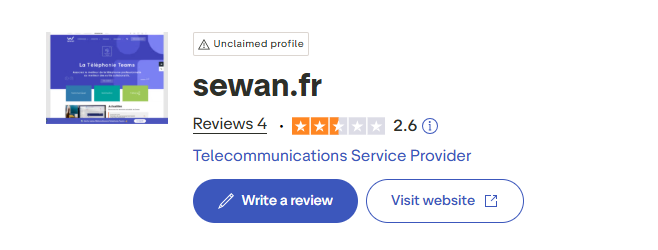
Overall feedback is mixed. Positive feedback cites simple installation, a clear interface and a service that is suitable for basic needs. However, a majority of opinions mention problems of reliability and call quality, hardware malfunctions, and support that is judged to be unpredictable depending on the situation.
Of the 30 reviews analyzed, 8 were positive, 6 mixed and 16 negative. Recurring strengths include ease of use and what some perceive as rapid take-up. As for recurring limitations, customers talk about network instability, lost calls, hardware updates that don’t happen, and uneven technical support. There are also reports of intrusive telephone canvassing.
“For basic IP telephony needs, Sewan responds well with simple installation and a clear interface.” – Google
“Scattered technical support, lack of follow-up, numerous unresolved problems and lack of coordination between teams.” – Trustpilot

In practical terms, for simple uses, it’s a quick start. But if your business depends on constant call availability or a multi-site fleet, the incidents mentioned in the reviews can lead to lost calls, extra waiting time and slower production days. For a growing team, the instability felt in notifications means that you need to have workarounds in place, and a more rigorous ticket tracking process.
The reviews do not go into detail about the pricing structure. Instead, they mention a shared perception. Some customers find the prices attractive, while others feel that the cost is a little high given the perceived quality. None of the reviews mention volume discounts, installation fees, exit fees or specific conditions in the event of a reduction in the number of users along the way.
“Rates are attractive but service stability and reliability are inconsistent.” – Capterra
“The range of features is satisfactory, but the prices are a little high for the perceived quality.” – Google
In concrete terms, for a B2B budget, you need to bear in mind that the price argument may be attractive at the outset, but that the indirect costs associated with incidents (lost time, on-site interventions) can weigh heavily if stability is not forthcoming. Reviews don’t allow you to accurately compare monthly or annual costs with other solutions, nor to know how the bill will evolve if you rapidly increase or decrease the number of employees.
Reviews cite the simplicity of the interface and rapid installation when the need is basic. They do not detail the extent of the telephony modules, nor the existence or otherwise of an advanced dialer, real-time analytics, recording or transcription. On the other hand, several feedbacks emphasize call quality judged to be average to poor, unstable connections and hardware failures.
“The connection is often unstable, causing significant call drops.” – Google
“The hardware supplied does not update properly and often has unresolved faults.” – Trustpilot
For a manager, this means that the basic functions seem accessible. But if your team needs sustained call campaigns, live coaching, or fine-tuned control, reviews don’t provide robust proof of use on these subjects, and warn about stability. In practice, an unstable connection has an impact on appointments and contact rates. Hardware failures that are not quickly resolved can also block workstations for hours on end.
No explicit mention of encryption, MFA or SSO. No mention of security incidents. Instead, they insist on the operational effects of network and hardware dependency. Connection instability, lost calls, failed updates. It’s more a risk to service continuity than a cybersecurity issue in the strict sense, according to the testimonials.
“Unstable connection and lost calls.” – Google
For hybrid or telecommuting teams, this means securing your network redundancy internally and clarifying recovery commitments. If you operate a call center, plan a load test and fallback scenarios in the event of local equipment failure.
No reviews mention dashboards, real time, exports or API. As a result, there is no public user feedback on the quality of reporting, the depth of statistics or the ease of tracking performance.
“The interface is easy to get to grips with and customer support responds quickly to queries.” – Capterra
Ergonomics are appreciated, but the reviews don’t provide information on advanced management tools. For a team manager, this means you’ll need to validate the presence of reports, CSV exports or APIs upstream, if your call KPIs and sales reviews depend on them on a daily basis.
The reviews analyzed do not mention country coverage, types of numbers available, or porting. No feedback on the ease of choosing a specific city or region, or on coverage gaps.
Operationally, if your project involves multi-country local numbers or massive porting, these issues will need to be verified directly, as public testimonials provide no guidance here.
This is one of the most widely shared points. A number of reviews praised responsive, competent support, especially during configuration or for simple needs. Other feedback, on the contrary, described support as “scattered”, difficult to reach, with unresolved incidents and a lack of coordination. Some technical problems would have required face-to-face intervention, with a direct impact on productivity.
“The support is responsive and the teams competent, especially in case of concerns with the configuration.” – Trustpilot
“Scattered technical support, lack of follow-up, numerous unresolved problems and lack of coordination between teams.” – Trustpilot
“Many connection problems often require face-to-face interventions, which slows down work.” – Trustpilot

In concrete terms, your experience may vary according to the complexity of the ticket. For onboarding and standard settings, users report good responsiveness. For network or hardware failures, timescales and coordination seem more uncertain. If your lines are business-critical, provide written SLAs and a dedicated follow-up contact. And anticipate the operational impact if on-site visits are necessary to restore service.
The reviews don’t mention integrations with CRM or business tools. There’s no feedback on the depth of integration possible, the presence of contact sheet pop-ups, auto call logs, or the availability of an API.
“Service tailored to basic needs, simple installation.” – Google
For a sales or support team working from a CRM, you’ll need to check the existence of native integrations, the necessary plan levels, and test the quality of call and recording synchronization. The available reviews do not provide visibility on these key points.
Another common complaint is that the service is not used. A number of users have complained of aggressive telephone canvassing, with frequent calls.
“This company spams my phone up to 3 times a day with different numbers.” – Trustpilot

On a day-to-day basis, this doesn’t affect your team’s use of the client, but it is a signal of the prospecting practices perceived by prospects. Take this into account if you value a more discreet business relationship framework.
In short, its simplicity is attractive for basic uses, but the need for reliability in production and the quality of monitoring still need to be tested in pilot trials before it can be deployed on a large scale.