Your team loses a lead for every missed call. Not because no one called back, but because no one knew they were supposed to call back.
This is the specific problem that a telephony webhook solves, and yet most guides on the subject stop at the technical definition. You end up with a concept, not a practical use case.
Here are eight real-world use cases, organized by call event: incoming call, missed call, end of call, and voicemail. For each one, you’ll see exactly what’s triggered, what data is sent to which tool, and the concrete benefits for your sales or support team.
Let’s start with how it works—in two minutes flat.
I recommend without hesitation
With Kavkom, I was able to easily resolve the issue of communication costs to my regular customers. My agents, too, were no longer restricted in their mobility, because even when on the move, communications are managed.

How about you?
Request a demo nowWhat is a webhook in telephony (and how does it differ from an API)?
You’ve probably seen the word “webhook” in your VoIP solution’s settings. And you’ve wondered: What does it actually do?
Here’s the short version. A telephony webhook works like an automatic alert. As soon as a call event occurs (incoming call, missed call, call ended), your VoIP system instantly sends a data packet to the tool of your choice: CRM, help desk, Slack, spreadsheet. No need to go looking for the information. It comes to you automatically, in real time.
The process is simple:
- A trigger event occurs (a prospect calls your number)
- Your VoIP platform sends an HTTP request to a URL that you have specified
- The target tool receives the data (caller ID, assigned agent, duration, status) and triggers an action: creating a contact record, sending an automatic notification to the team, opening a ticket
This is what’s known as a lightweight event-driven architecture. No complex development. No infrastructure to maintain.
So, how is this different from an API?
The API operates in “pull” mode: your tool queries the server to check for updates. The VoIP webhook, on the other hand, operates in “push” mode: the server notifies you as soon as something happens. In practical terms, with an API, you check for updates every 30 seconds. With a webhook, you receive the response the exact moment it becomes available.
For a sales team or a call center, this difference is fundamental. Every missed call can trigger a follow-up in your CRM without any agent intervention. Kavkom natively integrates this functionality through its hybrid CRM and open REST API: you configure your telephony webhooks, define the destination URL, and your business tools sync automatically.

Well, theory is all well and good. What really makes a difference are real-world use cases.
What call events can trigger an automation?
Now you know how a webhook works. The real question is: What specific events can you trigger your automations with?
The answer depends on your VoIP solution. But in a full-fledged cloud-based phone system, triggers cover much more than just an “incoming call.”
Here are the three types of events that can trigger a call webhook:
Call-Related Events
- Incoming call: A prospect or customer dials your number. The webhook instantly sends the caller’s number, the time, and the destination to your CRM or help desk.
- Call answered: The agent picks up the phone. The call status changes to “in progress,” and your internal systems are updated in real time.
- Missed call: No one answered. This is often the most critical trigger for customer support management, as it can automatically generate a callback or a ticket.
- Call ended: The conversation is over. The webhook sends the duration, the outcome, and the assigned agent to populate your tracking dashboards.
- Call placed in the queue: the customer is waiting. You can trigger a team alert or send a waiting SMS.
Message-Related Events
- New voicemail: A caller leaves a message on your voicemail. The webhook can create a ticket in your help desk with a link to the recording.
- Call recording available: The audio is ready. Your managers will receive a notification for coaching or lead qualification.
Agent-Related Events
- Status change: An agent‘s status changes from “available” to “on break.” Your monitoring dashboard updates.
- Log in or log out: An agent logs in or logs out. Useful for tracking work hours in a call center.
With Kavkom, these events are accessible via the open REST API. You choose the ones that interest you, configure the destination URL, and each trigger event feeds your tools without any manual entry.
What does that mean in practice? It means that every phone interaction—from the first “hello” to the moment the call ends—can serve as the starting point for an automated workflow.
8 Practical Examples of Automation Using Webhooks for Your Calls
You know how it works. You know which events can serve as triggers. Now, let’s move on to what matters in your daily life: the strategies you can put into practice starting this week.
Each example follows the same logic: a call event occurs, a webhook sends the data, and a business tool performs an action without human intervention. In practical terms, this isbusiness workflow orchestration applied to telephony.
Here are eight examples of webhooks for telephony that your sales and support teams can start using right away.
1. Incoming call: CRM record opens automatically
You receive a call. Your agent picks up. Then, they spend 15 seconds looking up the customer’s name in the CRM while the prospect waits on hold.
With an incoming call webhook, this step is eliminated. As soon as the caller’s number is detected, the HTTP request sends the contact’s ID to your CRM. The contact record automatically opens on the agent’s screen before the agent even says “hello.”
Kavkom offers this lead synchronization feature through its cloud-based VoIP telephony service, which includes native connectors for Salesforce, HubSpot, and Pipedrive. This eliminates the need for manual data entry, and your sales rep starts every conversation with the full customer context right in front of them.
2. Missed Call: Creating a Priority Callback Task
A prospect calls at 2:12 p.m. No one answers. Without a webhook, this missed call ends up in a log that no one checks until 6:00 p.m. By then, the prospect has already called a competitor.
The missed call webhook is a game-changer. The event instantly triggers the creation of a follow-up task in your CRM or help desk, assigned to the right sales representative. The caller’s number, the time, and the relevant department are included in the payload.
The result: your team calls back within minutes. When it comes to lead follow-up, that’s the difference between winning a customer and losing one. And all of this happens without a manager having to monitor the queue.
3. End of call: Automatically recorded in the call history
Let’s be honest: How many of your sales reps forget to log their calls in the CRM?
Well, with a webhook triggered every time a call ends, that’s no longer an issue. The call duration, outcome (answered, unanswered, transferred), the number dialed, and the assigned agent are automatically sent to the customer record. No human intervention required.
This is not a minor detail. The traceability of customer interactions depends on the reliability of the data. If your call statistics depend on the goodwill of each agent, they’re worthless. Synchronizing data via webhooks ensures that every call is logged, without exception, and that your KPIs reflect what’s actually happening on the ground.
4. Voicemail: Creating a support ticket with a transcript
It’s 8:00 p.m. A customer leaves a voicemail on your number. Your support team doesn’t start work again until 9:00 a.m. the next day.
Without a webhook, this message sits in a voicemail box until someone remembers to check it. With a customer support webhook, the scenario is completely different: as soon as the message is left, a ticket is created in your help desk. The voice transcription (audio-to-text) is attached, and the ticket is prioritized according to rules you define.
Your team starts the day with a structured ticket, not an answering machine to listen to. Incoming requests are prioritized automatically, and urgent ones move to the top of the pile before the first cup of coffee is even served.
5. New lead: Triggering a marketing sequence
An unknown number calls your sales line for the first time. Your agent qualifies the lead. What happens next?
Next, the webhook detects that this is the first call with a prospect and sends the data to your marketing automation tool. The contact is added to a nurturing sequence: a welcome email, a follow-up on Day 3, and educational content on Day 7.
What’s changing here is the alignment between your sales and marketing teams. Sales reps don’t need to manually pass along leads.Marketing automation kicks in as soon as the first phone call is made. With its Click-to-Call extension and CRM integrations, Kavkom connects every incoming and outgoing call to your lead qualification workflows without any disruption in the process.

Boost the productivity of your sales teams with Kavkom, the 100% cloud-based business telephony software.
Try Kavkom for free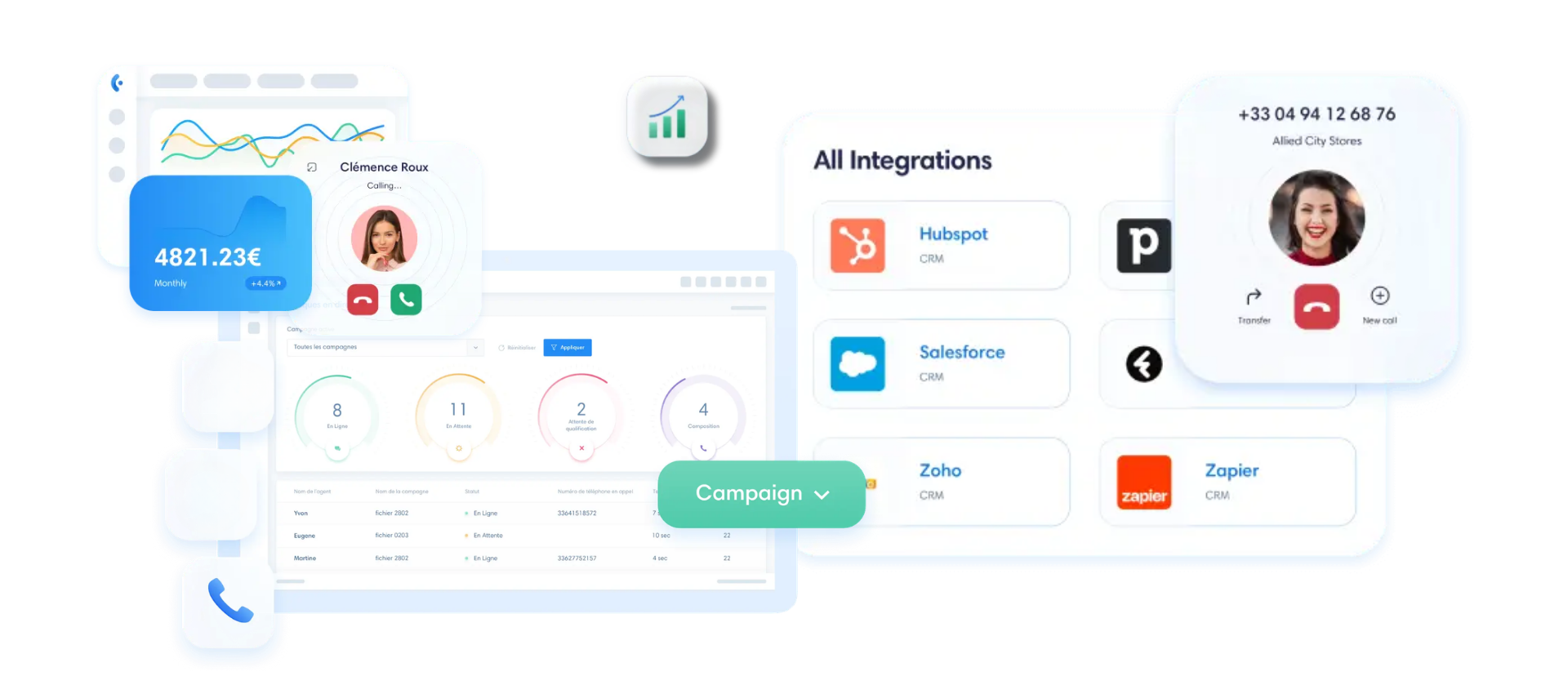
6. Agent Unavailable: Real-Time Routing Adjustment
Your best agent goes on lunch break. Three calls come in right after that. Without any adjustments, they either go unanswered or overload the queue.
A webhook triggered by a change in an agent’s status (available, on break, offline) can dynamically change call routing. The call is redirected to another available team or to a temporary IVR that offers a callback.
For a call center, this is a direct way to reduce wait times. Shorter wait times mean fewer call abandonments and more successful conversations. The entire process is driven by a system event, not by a supervisor watching a screen.
👉 Check out the list of Kavkom integrations to discover the essential tools for your sales team.
7. Call answered: Instant notification on Slack or Teams
A VIP account calls. The agent picks up the phone. But the key account manager has no idea.
With a webhook triggered when a call is answered, an automatic notification is sent to a dedicated Slack or Teams channel. The message includes the customer’s name, the agent who answered the call, and the time of the call. All the context, in a single line.
It’s a simple mechanism that transforms internal collaboration. Whether it’s a technical emergency or a strategic account, real-timeteam alerts allow everyone to respond immediately, without having to wait for the end-of-day report. There’s no need to ask, “Who spoke with that client?”—the information flows on its own.
8. Recording Available: Archiving for Coaching
Are you wondering how to improve your sales team’s performance without spending hours on it?
This is a scenario that managers appreciate. As soon as a call recording is generated, the webhook sends a secure link to your CRM or aquality analysis tool. The manager receives a notification with the recording’s URL, the agent’s name, and the duration of the conversation.
Kavkom natively supportscall recording for every call, accessible to both agents and managers. By combining this feature with a call center webhook, you can create a continuous sales coaching workflow: every conversation becomes a training resource, automatically archived and categorized.
Boost the productivity of your sales teams with Kavkom, the 100% cloud-based business telephony software.
Request a Custom Demo
Measurable benefits for your sales and support teams
You’ve seen the scenarios. You know how it works. But the question your management will ask is: What are the concrete benefits?
The answer lies in three measurable factors.
First factor: time saved per agent. Each call logged manually in a CRM takes between 30 and 90 seconds. For a team of 10 sales reps who make 50 calls a day, that adds up to hours lost each week just on data entry. With a phone webhook that automatically logs every interaction, that data entry time drops to zero. Your agents spend their time selling, not filling out fields.
Second factor: recall speed. The data is clear. According to a study reported by Voiso, a lead contacted within the first minute sees its chances of conversion increase by 391%. After 5 minutes, the probability of qualifying that lead drops by 80%. Every minute counts. A webhook triggered by a missed call that instantly creates a follow-up task in your CRM turns a lost lead into an ongoing conversation. That’s sales team productivity at its finest.
And it’s not just a sales pitch.
Third lever: real-time customer experience. 85% of callers who can’t reach you on the first try will never call back (source: AnsweringAgent). A webhook for missed calls, combined with a team alert or an automatic callback, drastically reduces this risk. Your support team no longer has to wait until the next morning to discover overdue requests. They handle them within minutes.
Kavkom makes these three features accessible without the need for a complex technical project. The open REST API, native connectors with Salesforce, HubSpot, and Pipedrive, andthe customizable IVR included in all plans let you set up your automations in just a few minutes. No commitment required, with prorated billing.
Sales performance tracking no longer relies on manually filled-out Excel spreadsheets. It relies on reliable data, transmitted in real time, that can be acted upon immediately.
Boost the productivity of your sales teams with Kavkom, the 100% cloud-based business telephony software.
Schedule a Custom Demo
Technical and Security Requirements: How to Set Up Your Webhooks Correctly
You’re convinced by the scenarios. But one legitimate question remains: Is it complicated to set up, and is it secure?
The good news is: no, it’s not complicated. But there are a few rules you need to follow to ensure that your telephony webhooks work reliably and securely.
The Basics: Destination URL, JSON Format, and HTTP Request
To set up a webhook, you need three things. A destination URL (the address where your VoIP solution sends the data), a data format (the standard is JSON payload, which is readable by virtually all business tools), and a communication protocol (the HTTP POST request, which transmits information in real time). In practice, you enter the URL in your platform’s interface, select the events you’re interested in, and you’re all set.
With Kavkom, this configuration can be done directly from the administration interface in just a few minutes. The documented REST API guides you through the available endpoints and the format expected for each event.
Security: HTTPS, Authentication, and Signing
A webhook transmits sensitive data (caller ID, contact name, call duration). Securing system-to-system communications is not optional.
Three best practices to follow consistently:
- Always use an HTTPS URL. TLS encryption protects data in transit.
- Enableauthentication for your webhooks. A secret token shared between your VoIP solution and the target tool ensures that only your system can send data to this URL.
- Verify the signature of each request on the receiving end. This prevents a third party from injecting fraudulent data into your CRM or help desk.
Let’s be clear: if your destination URL accepts any request without validation, you’re opening the door to corrupted data.
Error Handling: Response Codes and Retry Mechanisms
Your target service may be temporarily unavailable. It happens. What matters is how your system handlesdelivery errors. A properly configured webhook checks the HTTP response code returned by the destination server. If the code is 200, everything is fine. If it’s a 500 or a timeout, the system must automatically retry the request (this is called “retries,” or new attempts).
Without this mechanism, a missed call at 2:12 p.m. would never generate a ticket if your helpdesk was undergoing maintenance at that time. With retries, the data always ends up getting through.
GDPR Compliance: Be Mindful of the Data You Share
A webhook can transmit personal data: phone number, contact name, conversation content. In Europe, the GDPR applies. You must ensure that the tools receiving this data comply with the same data protection requirements. Kavkom is GDPR-compliant (traceability, consent management, deletion upon request), but your responsibility also extends to the connected IT tools.
Let’s put it another way. Technology isn’t an obstacle. A modern VoIP solution like Kavkom provides the building blocks: a well-documented API, native HTTPS, and all features included at no extra cost. Your role is to ensure that every link in the chain meets the same standards.
I recommend without hesitation
With Kavkom, I was able to easily resolve the issue of communication costs to my regular customers. My agents, too, were no longer restricted in their mobility, because even when on the move, communications are managed.
How about you?
Request a demoKey Takeaways
- Webhooks automate data entry and tracking, making it effortless for your agents.
- A missed call instantly becomes a priority follow-up task in your CRM.
- Real-time synchronization provides complete visibility into your sales performance.
A webhook isn’t an abstract concept. It’s the tool that allows your teams to focus on human interaction while technology handles the behind-the-scenes logistics of data.
Automation via webhooks ensures that no lead is overlooked due to a simple data entry error.
For more information, our guide to phone systems for IT teams goes into detail about the technical aspects. You can also check out our no-obligation offers to see how these features fit into your budget.
Ask yourself this: How many hours of manual data entry could you free up for your employees starting this week?