
This step-by-step guide explains what a verified multipurpose number is, how it came about, how it works and how you can get one. And if you’re already using cloud telephony, or are thinking of doing so, you can use these numbers perfectly in a modern, easy-to-manage solution.
Points to remember :
– Verified Versatile Numbers are part of an evolution of the numbering plan designed to control certain technical and automated uses.
– An NPV belongs to specific ranges defined by ARCEP, and can still be used as a caller ID in a professional context.
– Understanding how NPVs work enables us to better situate their role in the architecture of today’s professional communications.

Overview of verified multipurpose numbers
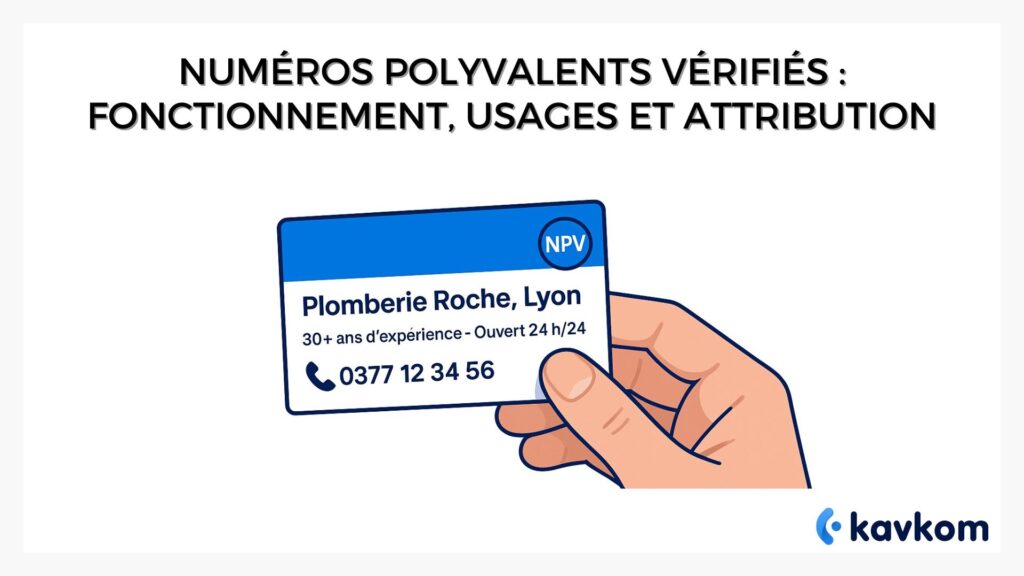
Verified multipurpose numbers are a specific category of numbers that are part of the recent evolution of numbering in France. They were created to regulate certain uses, in particular when technical systems make calls or send messages automatically.
The objective is clear: certain communications are triggered by technical systems rather than by human users. We therefore needed a category of numbers adapted to these uses.
Where NPV comes from
NPVs are part of the modernization of the French numbering plan, a project led by ARCEP in the early 2020s to organize the use of different number ranges more precisely.
- distinguish between interpersonal and technical communications,
- organize number ranges according to usage,
- make caller identification clearer for the various players in the network.
Within this framework, a new family of numbers has been defined to serve ascaller IDs for certain volume calling technologies: verified multipurpose numbers.
What are verified multipurpose numbers for?
An NPV has essentially two functions:
- serve as a caller number for automated or semi-automated call systems,
- remain callable and identifiable, just like any landline or national number.
A “versatile” number is one that can be used for a variety of purposes, as long as they fall within the defined framework: outgoing calls in volume, voice messages, interactions with platforms. We call it a “verified” number because its use must be validated by the operator assigning it.
In a nutshell
– A verified multipurpose number is a number dedicated to certain technical uses.
– It is used as a caller ID by call systems.
– It belongs to well-defined number ranges in the numbering plan.
– It remains callable and must point to an identified contact or service.
Defining a verified multipurpose number
Now that we’ve clarified the context, we can move on to a more precise definition.
A verified multipurpose number is a telephone number:
- from specific geographic or national number ranges,
- assigned to a professional end-user,
- authorized to be used as a caller ID by automated calling or messaging systems,
- whose use is validated by the operator who manages them.
Key elements of the definition
Three elements really structure the notion of NPV.
- Specific numbering range
NPVs are not “just any numbers”. They belong to specific number ranges, for example 0162, 0270, 0377, 0424, 0568 or 0948 and 0949 for metropolitan France. - Intended use
The number is intended to be presented as a caller number by automatic call systems or advanced dialing systems (predictive, progressive, etc.). - Operator verification
The operator assigning this number must verify that the user has given his consent for this number to be used as a caller ID in associated communications.
Difference with a “classic” fixed or mobile number
An NPV may look like a geographic or national number, but its use is regulated differently.
- A “classic” geographic number (01 to 05) is primarily linked to a zone.
- A mobile number (06, 07) is linked to interpersonal communications.
- A verified multipurpose number is linked to a type of technical use, not to a place or an individual.
| Number type | Example of a prefix | Main use | Special features |
|---|---|---|---|
| Geographic number | 01, 02, 03, 04, 05 | Local or regional communications | Linked to a geographical area |
| Mobile number | 06, 07 | Communication between natural persons | Must be presented from a cell phone |
| National number in 09 | 09 | Various pro services and communications | Zone-independent |
| Verified all-purpose number | 0162, 0270, 0377, 0424, 0568, 0948, 0949 | Caller ID for call systems | Use validated by operator |
Multi-purpose numbers verified in the numbering plan
To understand where NPVs are located, we need to place them in the current French numbering plan.
A quick reminder of numbering in France
In France, numbering is organized around major families:
- 01 to 05 for geographic numbers,
- 06 and 07 for mobiles,
- 08 for specific services,
- 09 for a variety of uses, often linked to services.
Verified general-purpose numbers do not create a new number length. They use existing ranges, but with a specific assignment.
Areas reserved for NPV
NPV root figures are precisely defined. For mainland France, these include:
- 0162, 0163
- 0270, 0271
- 0377, 0378
- 0424, 0425
- 0568, 0569
- 0948, 0949
For overseas territories, some series start between 09475 and 09479.
These ranges are therefore “reserved” for a very specific use: that of verified multipurpose numbers.
Why these beaches are special
Reserving series makes it possible:
- easily identify, at network level, that it is an NPV,
- apply the special rules for this type of number,
- control the numbering resources used by call systems.
Quick reference points
– A verified multi-purpose number belongs to a very specific range.
– These ranges are defined in the numbering plan.
– NPVs remain 10-digit numbers, like other French numbers.
– Their specificity comes from their use, not their length.
Conditions of allocation and authorized uses
A verified multi-purpose number is not assigned at random. It is subject to precise conditions concerning both the end-user and the intended use.
Who can get NPV
NPVs are intended for professional users. They may include:
- of companies using automated call systems,
- service providers who manage call campaigns,
- players who need a specific caller ID for large volumes.
The same NPV is assigned to only one customer at a time. The operator must be able to identify this assignee.
Authorized use as caller ID
The special feature of the NPV is its role as acaller identifier in contexts where the call is initiated by a system. For example, in the case of
- predictive dialing platforms,
- voicemail campaigns,
- systems that automatically send calls or notifications.
In these cases, the NPV serves as the platform’s digital “shop window”.
Recall obligation possible
An NPV must remain callable. If someone sees this number and decides to call back, the call must result in a device:
- telephone reception,
- voice server,
- answering machine,
- another destination number.
The NPV is never an inactive number: it must always enable a callback to an identified device.
Rotation and reallocation
When an NPV is no longer in use, it can be reassigned to another customer, but not immediately. There is a minimum delay before it is reassigned, to avoid confusion between its old and new uses.
Conditions checklist
– Assigned to an identified business customer.
– Use declared ascaller ID.
– Callback possible during period of use.
– Reallocation only after minimum delay.
– Use in accordance with numbering plan rules.
Cloud telephony and ARCEP compatibility: a common base with verified multipurpose numbers
When we think of cloud telephony, we often imagine a technology totally detached from the traditional telephone. A web interface, computer calls, total flexibility.
Yet cloud telephony is based on the same national framework as all other communications. The numbers used are allocated and organized in accordance with the numbering plan, and all the rules defined by ARCEP continue to apply.
A cloud solution like Kavkom lets you use business numbers, while remaining within the framework of the numbering plan. The advantage of the cloud is that it’s easy to manage, with no installation and no commitment, while complying with national regulations.
How to get a verified multipurpose number
In practice, obtaining an NPV requires a relationship with an operator or telephony service provider who can assign this type of number.
The general approach
The typical route looks like this:
- The company expresses a need to use a dedicated number for its call systems or platform.
- The operator confirms whether a verified multipurpose number is suitable.
- The customer provides the information required for the assignment (identity, contact, description of use).
- The operator assigns an available NPV in the allocated slots.
- The NPV is configured to be used as a caller ID.
Prefix selection
Depending on the context, the company may prefer to do so:
- a prefix that resembles a geographic number,
- a national 09 prefix,
- a certain coherence with its other numbers.
In all cases, the choice is governed by the available slots and the operator’s policy.
Redirection and day-to-day management
An NPV can be redirected to:
- a landline or mobile number,
- a switchboard,
- a voice server.
Day-to-day management consists mainly of:
- monitor its operation,
- decide whether to keep it or terminate it,
- update the destination in the event of organizational changes.
Simplified steps
- Define the need for a dedicated number for your call systems.
- Contact an operator offering verified multipurpose numbers.
- Provide identification and usage information.
- Receive and activate NPV on your infrastructure.
- Configure redirection of incoming calls to the right contact point.
Technical operation of NPV in call systems
The technical part may seem intimidating, but the role of the NPV is fairly straightforward when you follow the path of a call.
NPV as caller ID
When your system triggers a call:
- It establishes communication with the network via your operator.
- It features a multipurpose number verified as a caller ID.
- The operator checks that this number is authorized for this type of use.
- The call is routed to the recipient.
For the recipient, the call looks like any other call, with a decodable number.
Interaction with operators
Operators have a special responsibility when it comes to NPV:
- check that use of the number is authorized by the customer to whom it is assigned,
- ensure that the number is consistent with the associated traffic type,
- refuse to use an NPV if this consistency is not respected.
This verification layer gives meaning to the word “verified” in verified general-purpose numbers.
Traceability and recall
Since the NPV remains recallable, it plays a role in communications traceability:
- it makes it easier to identify the organization behind the call,
- it can be documented in internal systems,
- it offers a single point of entry for telephone returns.
FAQs on verified multipurpose numbers
Is a verified multipurpose number a new type of 10-digit number?
No. It uses the usual 10-digit format, but belongs to ranges reserved for this specific use.
Can a private individual obtain NPV?
No. Verified multipurpose numbers are intended for professional players who use technical call or message systems.
Can an NPV be used as a classic support number?
Yes, as long as it remains callable and its use is consistent with its nature as a number assigned to call systems.
Is NPV necessarily 09?
But not only. Some ranges are geographical (prefixes such as 0162, 0270, 0377, 0424, 0568) and others are national (0948, 0949).
What happens when an NPV is no longer in use?
The operator can decommission it, then reallocate it to another customer after a minimum period, to avoid confusion between old and new uses.
Conclusion
NPVs are not a marginal type: they structure technical communications within a strict regulatory framework.
An NPV is therefore not an abstract concept, but a number with a clearly defined role: to act as an interface between technical platforms and the world of traditional telephone communications.
If you’d like to see for yourself how these numbers fit into an easy-to-manage cloud telephony solution, it’s often best to try out the platform for yourself.