If you’re looking for the Top 9 alternatives to Vocalcom for business telephony that’s truly adapted to your day-to-day needs, this comparison is for you. It’s aimed at sales teams and in-house call centers who want to compare solutions based on actual usage, not on promises or data sheets. The aim is simple: to help you understand the differences that really matter, so you can make a B2B choice that’s consistent with your context.
No credit card
No obligation
Custom demo
The solutions below have been compared in terms of their suitability for real-world use in corporate telephony, for sales teams and in-house call centers.
| Solution | Best for | Key features | Price positioning | Score out of 10 |
| Kavkom | Performance-oriented sales teams and in-house call centers | Real-time supervision, predictive dialer, call recording, CRM integration | No-commitmentcloud model , prorated billing, simple logic | 8,5 |
| RingCentral | Structured enterprises with UCaaS and contact center needs | Advanced routing, omnichannel contact center, analytics, multiple integrations | Subscription per user, progressive upgrade | 7,5 |
| Mitel | SMEs and large accounts with IT or hybrid constraints | IP telephony, contact center, multi-site supervision, customization | Complex model, à la carte options and modules | 7 |
| Twilio | Technical teams and customized API projects | Voice and messaging APIs, automation, scalability, technical integrations | Pay-per-use, variable costs according to volume | 6,5 |
| Plivo | Developers and product teams focused on programmable communications | Call and SMS APIs, basic routing, technical reporting | Pay-as-you-go, not easy to read outside tech context | 6 |
| Vonage | Businesses looking for a broad communications platform | Cloud telephony, contact center, API, supervision | Subscription and additional options, modular logic | 7 |
| Dialpad | SMEs and SMBs sensitive to conversational AI | AI transcription, supervision, cloud contact center, CRM integrations | Subscription per user, advanced paid options | 7,5 |
Kavkom stands out for enterprise telephony designed for the real-life use of sales teams and in-house call centers, with simple implementation, infrastructure-free cloud logic and contractual flexibility consistent with today’s B2B constraints.
Kavkom is relevant for sales teams and in-house call centers who want directly operational corporate telephony. Typically, a sales team of 10 to 50 people who call every day, need to monitor activity in real time and keep a clear view of performance without depending on a cumbersome IT department.
Kavkom focuses on the key features key functionalities required for standard commercial usewith no essential modules to add to get you started.
These include :
Everything is designed for use in the field, not for a catalog of theoretical functions.
The model is 100% cloud, no hardwarewith a commitment-free and pro rata billing. Costs remain transparent and evolve simply with the size of the team, which is ideal for growing structures or organizations that want to retain flexibility. Kavkom also stands out for its responsive, French-speaking human supportaccessible without chatbot or automated route.
Kavkom offers an open REST API for specific integrations, but is not positioned as a raw, developer-oriented telecom brick, unlike Twilio or Plivo.
8,5 / 10
Kavkom stands out for its direct alignment with real-world use sales teams and in-house call centers. The solution goes straight to the point, with rapid implementation, clear supervision and contractual flexibility in line with B2B constraints.
Five9 is particularly relevant for and large accounts that manage high call volumes, often multi-site, with dedicated customer service teams. For example, a contact center with several hundred agents, with stringent management and reporting requirements.
Five9 offers a comprehensive contact center platform, with :
These functionalities are powerful, but require an already structured organization to take full advantage of them.
The model is based on per-user subscriptions, often associated with commitments and optional modules. Costs can rise rapidly as the system is scaled up, requiring careful budgeting.
Five9 can be oversized for SMEs or medium-sized sales teams. The complexity of parameterization and the overall cost can become an obstacle to simpler or more scalable uses.
7,5 / 10
Talkdesk is primarily aimed at customer service departments and customer experience-oriented organizations, often in mature structures. A good example would be a company with several contact channels and a strong focus on personalizing customer journeys.
Talkdesk highlights:
In the field, these tools are effective for steering quality and customer satisfaction, provided you have the resources to exploit them.
Pricing is tiered, with a gradual move upmarket. Advanced functionalities are often reserved for higher-end offers, which can make the cost structure less clear in the long term.
For sales pure sales-oriented sales teamsTalkdesk may seem too focused on omnichannel customer relations. The functional richness can also make daily use cumbersome if the need is primarily telephone-based.
7,5 / 10
RingCentral is particularly suited to structured companies who want to centralize telephony, collaboration and contact center services on a single platform. For example, a multi-site SME with well-organized sales and support teams.
RingCentral offers a comprehensive unified communications package:
In the field, it’s effective for organizations looking for a global platform, not just one focused on outbound calls.
The logic is based on subscriptions per userwith several offering levels. The move upmarket is gradual, but readability can diminish with the addition of advanced bricks.
For sales teams focused on pure telephone performance, RingCentral may seem too general. Some useful features require higher offers.
7,5 / 10
Mitel is suitable for ETI and large accounts with strong IT constraints, sometimes hybrid or multisite. A typical case is an organization gradually modernizing a complex legacy system.
Mitel covers a wide range of needs:
These capabilities are useful in demanding environments, but require solid IT governance.
The model is modularwith options and bricks to be activated as required. This approach offers flexibility, but makes the whole system more complex to manage.
For medium-sized sales teams looking to get up and running quickly, Mitel can be cumbersome to deploy and over-dimensioned in relation to actual usage.
7 / 10
Ooma is primarily aimed at VSEs and small SMEs who want to professionalize their telephony without complexity. For example, a small sales or support team with simple needs.
Ooma offers essential functions:
Day-to-day use is smooth for moderate volumes and simple scenarios.
Pricing is generally affordable and non-bindingwith a simple logic. This makes adoption easier for smaller structures.
Ooma shows its limits as soon as volumes increase or advanced supervision needs become critical for team management.
6,5 / 10
Vonage is relevant for companies looking for a communications platformsometimes with technical or omnichannel needs. A good example is a tech SME or ETI with an IT system already equipped.
Vonage combines :
In the field, the solution is versatile, but requires a clear definition of uses.
The model is modularwith subscriptions and additional options. The flexibility is there, but the cost structure can become complex.
For sales teams looking for a highly field-oriented solution, Vonage may seem less easy to understand and more technical than necessary.
7 / 10
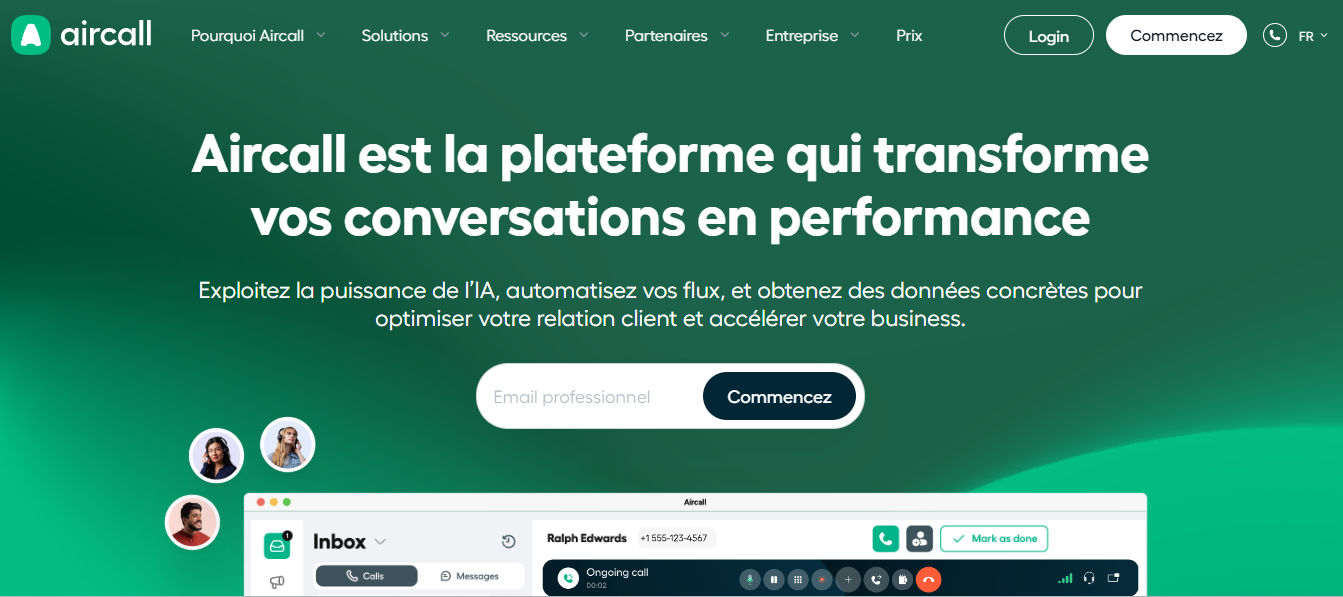
Aircall is designed for SMEs and their sales and support teams who want a solution that’s quick to deploy and easy to learn. For example, a growing sales team that wants to centralize its calls.
Aircall focuses on :
It’s fluid and intuitive to use, which is appreciated by non-technical teams.
Pricing is based on subscription per userwith tiers. Costs remain predictable, but some advanced features require higher bids.
For in-house call centers with very advanced dialer or fine control requirements, Aircall can reach its limits.
7 / 10
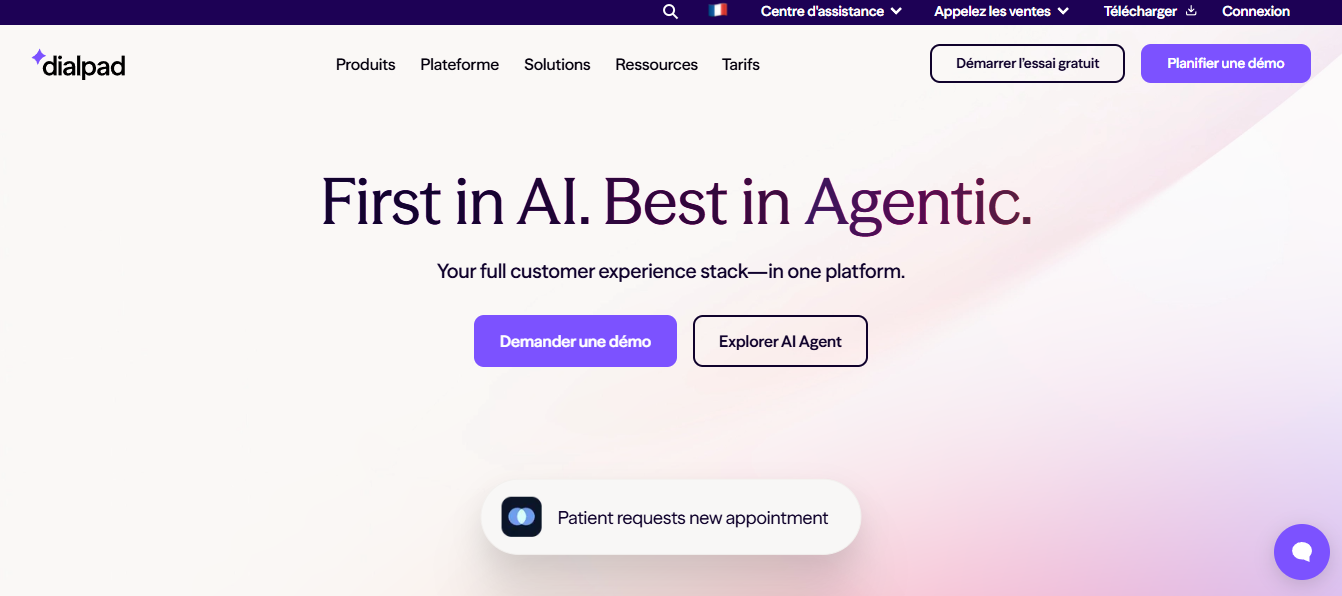
Dialpad is relevant for SMEs and ETIs sensitive to the benefits of AI in telephony and support. For example, a sales team that values automatic conversation analysis.
Dialpad highlights:
These features are a real plus in analysis, provided the team is ready to exploit them.
The model is based on per-user subscriptionswith advanced options available for a fee. Legibility is good, but costs increase with the use of AI bricks.
For teams looking for simple, outbound-oriented telephony, the AI approach may be of secondary importance. secondary to the real need.
7,5 / 10

Team type is the first filter. A solution designed for sales teams do not deliver the same benefits as a tool designed for in-house call centres. in-house call centers or a customer service with different incoming flows and priorities.
Call volume directly influences the choice.
The need for supervision must be clarified from the outset.
Some teams are content with basic monitoring, while others need real-time real-time monitoringOthers need real-time monitoring, call listening and coaching tools to support agents on a day-to-day basis.
Budget constraints are not limited to the initial cost.
We need to look at cost transparencyand how the bill evolves as the team grows or usage changes.
Long or short commitment, ease of adding or removing users, simplicity of activating or deactivating the solution according to the company’s actual activity.
Kavkom and Vocalcom have different rationales. The right choice depends above all on the role telephony plays in your day-to-day business.
Is your telephony a simple tool or an operational lever?
If calls structure the work of sales teams or in-house call centers, a solution designed for use in the field, supervision and fast learning curve makes perfect sense. Conversely, a broader platform may be appropriate if telephony is part of an extended customer relations system.
Do you need to manage calls and teams in real time?
When day-to-day monitoring, listening and support for teams are central, ergonomics and readability take precedence. Other environments are more oriented towards parameterization and global management.
Are you looking for a turnkey solution or a more IT-oriented environment?
Some organizations prefer rapid, infrastructure-free implementation, while others accept a heavier technical layer for very specific uses.
Is contractual flexibility important to you?
If your business changes frequently, the ability to easily adjust users and engagement becomes a decisive criterion.
Do your teams work under pressure with volume targets?
In this case, operational simplicity and business visibility help you to keep up the pace on a daily basis.
In practice, Kavkom fits in well with contexts where telephony is a central work tool, oriented towards performance and field management, while Vocalcom is more suited to larger, more structured customer relations environments.
Find out why over 8,000 companies work with Kavkom for their corporate telephony.
4.7 on Capterra
With Kavkom, I was able to easily resolve the issue of communication costs to my regular customers. My agents, too, were no longer restricted in their mobility, because even when on the move, communications are managed.
Ben Cauchois
VP Sales & Operations @ SEIZA
We’ve increased our targets by 10% thanks to the information we’ve gained from call identification and analysis provided by Kavkom’s telephony solution.
Dov Dahan
CEO @ Formideo
The transition to enterprise telephony in the cloud with Kavkom enables us to track KPIs to identify our strengths and weaknesses.
Arnold Panou
CEO @ VAD Assistance
We evaluated several service providers, and Kavkom emerged as the only option that allowed us to tailor our customer service requirements to our unique business practices.
Pierre Roche
Managing Partner
at Groupe OREL
The integration of Kavkom’s virtual number service with voicemail has considerably facilitated our process of collecting visitor testimonials. We have been able to gather valuable feedback that helps us to continually improve our services.
Hélène Lafont-Couturier
Visitor Relations Manager
Musée des Confluences
Any other questions?
Consult our Online Help or Contact us
Which Vocalcom alternative is best for B2B companies?
There’s no single answer. It all depends on the actual use of telephony in the company, the type of teams involved and the level of management expected. Some solutions are designed for large-scale customer relations environments, others for more operational day-to-day telephone use.
Which alternatives are best suited to sales teams?
Sales teams especially need tools geared to outgoing callsactivity monitoring and simple supervision. Solutions that facilitate the day-to-day rhythm, performance visibility and managerial support are often better suited than very generalist platforms.
Are these alternatives suitable for call centers?
Yes, but not in the same way. A in-house call center The expectations of a volume-oriented and piloted service are not the same as those of a support service. Some platforms focus on supervision and telephone efficiency, others on omnichannel management and complex customer paths.
Are there any alternatives to Vocalcom without commitment?
Yes, some solutions offer contractual contractual flexibility stronger, with the possibility of adjusting users according to activity. This is key for companies with fluctuating volumes, or who want to limit long-term constraints.
How do you compare the real costs of these alternatives?
We need to look at the overall business modelnot just the basic subscription. Necessary options, scalability and changes in usage all have a major influence on the real cost over time. A solution that’s easy to understand at the outset can become more complex as your business evolves.
Please share your location to continue.
Check our help guide for more info.