Top 6 Dialpad alternatives for corporate telephony and real-world use by sales teams and call centers

If you’re looking for the best alternatives to Dialpad for business telephony that’s truly adapted to your sales teams or call centers, this Top 6 Dialpad alternatives is designed with your real-life use in mind. The comparison focuses on how these solutions work on a day-to-day basis, to help you make an informed B2B choice according to your operational context.

No credit card

No obligation

Custom demo

Quick comparison of the best Dialpad alternatives

The solutions below were compared on the basis of their suitability for real-life business telephony applications, team productivity and operational flexibility.

Solution Best for Key features Price positioning Score out of 10
Kavkom Performance-oriented sales teams and in-house call centers Predictive dialer, real-time supervision, CRM integration, operational reporting Flexible, no-commitment model, logic of use and scalability 8,8
RingCentral Structured companies with unified IT and collaboration needs Cloud PBX, advanced routing, analytics, integrated collaboration Tiered packaged offers, gradual move upmarket 7,9
Mitel Existing organizations looking for hybrid continuity Enterprise telephony, call management, supervision, reporting More rigid model, costs linked to deployment complexity 7,2
Twilio Technical teams with advanced customization needs Voice API, workflow orchestration, automation, raw reporting Usage-based billing, developer logic, variable costs 6,9
Plivo SaaS products requiring a programmable voice brick Call API, SMS, routing, basic supervision Usage-based model, volume and technical integration oriented 6,7
Vonage International companies with multi-channel needs Cloud telephony, routing, analytics, business integrations Modular subscriptions, options according to features 7,4

Why Kavkom is the best alternative to Dialpad

Kavkom stands out as a coherent alternative to Dialpad when you’re looking for business telephony designed for real-life use, with a clear operational logic, quick learning curve and flexibility tailored to sales teams and internal call centers.

Top 6 Dialpad alternatives: detailed analysis

Kavkom

For whom it’s relevant

Kavkom is particularly well suited to sales teams and in-house call centers who need business telephony that’s simple to deploy and immediately operational. It is well suited to SMEs and SMBs who want to manage day-to-day call activity without having to rely on a heavy IT team, for example a telesales team that needs to be productive from the very first week.

Features and real-life use

Kavkom focuses on the features needed for standard commercial use, designed for the field.

  • Cloud telephony for use on PCs and mobiles, without hardware.
  • Real-time supervision to monitor agent activity and intervene if necessary.
  • Predictive Dialer to optimize outbound call volume and reduce idle time.
  • CRM integration to centralize calls and customer follow-up without multiplying tools.

Pricing positioning and flexibility

The model is based on a logic commitment-freewith clear, scalable billing. Teams can adjust their usage according to periods of activity, limiting fixed costs and facilitating gradual scalability.

Kavkom natively integrates advanced security mechanisms (call encryption, fine-grained rights management, logs) and fully complies with RGPD requirements for European companies.

Limits to be aware of

Kavkom is deliberately focused on business telephony and sales performance. Companies looking for a very broad collaborative suite or advanced non-telephony functions will need to complement it with other specialized tools.

Note

8,8 / 10


Why Kavkom stands out in this comparison

Kavkom stands out for its consistency between actual use, ease of installation and contractual flexibilityThese are three key criteria for sales teams and in-house call centers who want to remain agile without sacrificing operational control.
Try Kavkom free of charge


Aircall

For whom it’s relevant

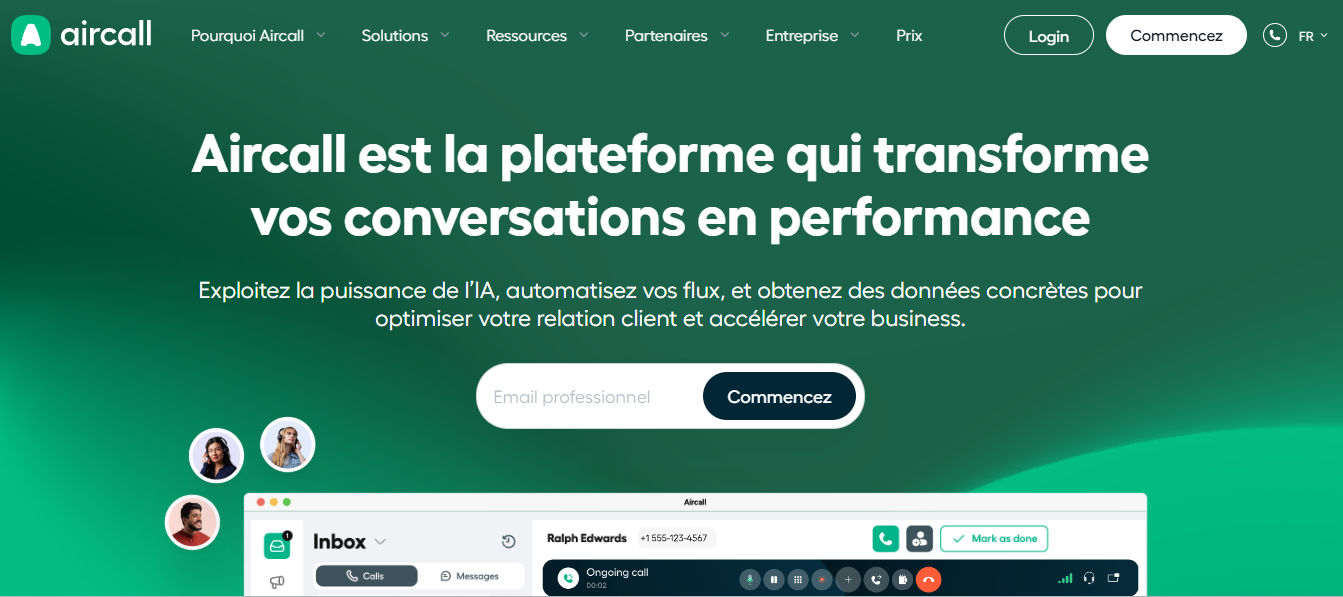
Aircall is aimed above all at the sales and support teams of growing SMEs, who are looking for a collaborative solution that is quick to deploy and well integrated with their existing business tools, such as a CRM or helpdesk.

Features and real-life use

The platform is designed for smooth, everyday use.

  • Cloud telephony with call routing and queuing.
  • Tools for supervision and listening for management.
  • Power dialer and click to call to speed up call campaigns.
  • CRM and support integrations widely used by teams.

Pricing positioning and flexibility

Aircall operates on a per-user model, usually with a commitment. The pricing structure is straightforward, but can become less flexible when teams evolve rapidly or needs vary greatly from month to month.

Limits to be aware of

This solution may have its limits for teams that are highly volume-oriented or require a high degree of contractual flexibility, particularly when the workforce fluctuates frequently.

Note

8,1 / 10


Ringover

For whom it’s relevant

Ringover is ideal for sales or customer relations teams who want to centralize their exchanges on a modern interface, with a strong emphasis on omnichannel and integration with business tools.

Features and real-life use

The approach is focused on productivity and tracking interactions.

  • Cloud telephony and call management.
  • Integrated supervision and integrated.
  • Dialers and scripts to structure sales campaigns.
  • Extensive CRM integration to enhance customer follow-up.

Pricing positioning and flexibility

The model is based on subscriptions per user, with functional tiers. Readability is good, but flexibility depends on the level of formula chosen.

Limits to be aware of

For teams highly focused on intensive outbound calling, or looking for a highly flexible logic with no tiers, Ringover may require some arbitration on which features are really necessary.

Note

8,0 / 10


CloudTalk

For whom it’s relevant

CloudTalk is well suited to the sales and support teams of SMEs and growing companies, especially those operating internationally and requiring consistent call quality.

Features and real-life use

The solution focuses on performance and analysis.

  • Cloud telephony with customizable routing and IVR.
  • Power dialer and productivity tools for agents.
  • Real-time reporting and recordings for steering.
  • CRM integration and support for centralized monitoring.

Pricing positioning and flexibility

CloudTalk offers a per-user model with several levels of functionality. The structure is progressive, but some advanced functions need to be upgraded.

Limits to be aware of

It’s still easy to get to grips with, but teams looking for a very light configuration or maximum contractual flexibility may find the model less flexible.

Note

7,8 / 10


JustCall

For whom it’s relevant

JustCall is aimed at the sales and support teams of start-ups and SMEs who want to centralize calls and messages in an omnichannel logic, without technical complexity.

Features and real-life use

The tool is designed to automate exchanges.

  • Cloud telephony and call management.
  • Dialers and reminder planning for sales teams.
  • Recording and analysis to monitor performance.
  • CRM integrations for a unified customer context.

Pricing positioning and flexibility

The positioning is subscription-oriented by user, with an increase in functionality according to need. Readability is good, but flexibility depends on the plan chosen.

Limits to be aware of

For highly structured teams or in-house call centers with strong advanced supervision requirements, JustCall may seem more limited.

Note

7,6 / 10


RingCentral

For whom it’s relevant

RingCentral is especially suited to medium-sized to large companies with distributed distributed teams and extensive communication and collaboration needs.

Features and real-life use

The platform offers a very broad approach.

  • Cloud telephony and call management.
  • Collaboration and unified communications tools.
  • Supervision and reporting for multi-site teams.
  • Extensive integration with existing IT environments.

Pricing positioning and flexibility

The model is based on packaged offers by level. Functional richness is high, but the pricing structure can become more rigid as needs become clearer.

Limits to be aware of

For sales teams looking for a solution focused solely on operational telephony and flexibility, RingCentral may seem more complex than it needs to be.

Note

7,9 / 10

How to choose the best alternative to Dialpad

1. Type of team

The first criterion is the profile of your teams.
A sales-oriented sales team does not have the same expectations as a customer support or an in-house call center, particularly in terms of productivity, supervision and day-to-day management. Not all solutions cover these uses with the same level of consistency.

2. Call volume

The call volumeboth incoming and outgoing, has a strong influence on the choice.

  • A simple solution may be all that’s needed.
  • In the medium to high range, automation and management tools become essential.
  • Highly variable, the ability to absorb peaks without rigidity has a direct impact on costs and organization.

3. Need for supervision

It is important to evaluate your expected steering level.
Basic use is limited to tracking calls, while managerial use involves listening, real-time supervision and coaching teams to improve performance.

4. Budget constraints

The budget constraints are not limited to the initial cost.
The legibility of expenses, the dependence on options and the way the solution evolves as the team grows are often more decisive in the medium term.

5. Expected flexibility

The contractual flexibility plays a key role in many contexts.
Commitment or not, rapid adjustment of the number of users and ease of activation or deactivation determine the company’s ability to remain agile.

Mini checklist for decision-makers

  • Is my team mainly oriented towards sales, support or mixed ?
  • The call volume stable or subject to wide variations?
  • Do I need daily daily supervision or just occasionally?
  • Does the solution have to be turnkey or integrated into an existing ecosystem?
  • The contractual flexibility a determining factor for my organization?

Kavkom or Dialpad: which is best for you?

Kavkom and Dialpad do not meet exactly the same expectations. The choice depends above all on the place telephony occupies in your organization and the way your teams use it on a daily basis.

Is your telephony a simple communication tool or an operational lever?
If calls are used mainly for occasional exchanges, a collaboration-oriented solution may suffice. On the other hand, when telephony structures the commercial activity or operations of an internal call center, a more operational approach becomes central.

Do you need to manage calls and teams in real time?
Some organizations are content with global statistics. Others need fine-tuned monitoring, listening and supervision to support teams and adjust performance on a day-to-day basis.

Are you looking for a turnkey solution or a more IT-oriented environment?
If you prefer simplicity and rapid implementation, a solution designed for business use is often more appropriate. Conversely, a more technical environment may be more suitable if you already have in-house IT resources.

Is contractual flexibility important to your business?
When staff numbers and call volumes change frequently, the ability to adjust usage without rigidity becomes a decisive criterion in the choice.

Do your teams work to volume or performance targets?
In contexts where sales pressure is high, the tool must support productivity and management, without adding unnecessary complexity.

In the end, the right choice between Kavkom and Dialpad depends on your actual use, your level of operational requirements and the flexibility you expect. This makes Kavkom a coherent option for teams who make telephony a central performance tool, without looking for an overly generalist platform.


98% of our customers value the efficiency and simplicity of our services

Find out why over 8,000 companies work with Kavkom for their corporate telephony.

4.7 on Capterra

Frequently asked questions

Any other questions?
Consult our Online Help or Contact us

Which alternative to Dialpad is best for B2B companies?

There’s no universal answer, because it all depends on theactual use. Some companies use telephony as a simple communication channel, while others use it as a central sales or operational management tool. The right choice depends on the type of team, the volume of calls and the level of supervision required.

Sales teams generally need tools that focus on outgoing callsand productivity. The most appropriate solutions are those that facilitate day-to-day management, supervision and integration with customer management tools, so that telephony directly supports performance.

Yes, but mainly for in-house call centers. Needs differ from simple customer support, with more supervision, real-time monitoring and volume management. Not all solutions cover these needs with the same level of consistency.

Some solutions are based on acontractual commitmentOthers rely on greater flexibility. This flexibility is particularly important for fast-moving organizations, with fluctuating staff numbers or call volumes.

It’s essential to look beyond the advertised model and consider the overall economic logic. The options required on a day-to-day basis, the evolution with team growth and the dependence on certain modules have a strong influence on the actual cost over time. Comparing solutions according to these criteria helps to avoid unforeseen discrepancies.