You ask for a quote for an hourly hot line and receive three offers that are impossible to compare.
That’s normal. Because “on time” doesn’t mean the same thing to all service providers. And without knowing it, you run the risk of paying two or three times more than expected, due to rounding, monthly minimums or surcharges that nobody mentions in the estimate.
You don’t have to put up with this. This guide gives you a concrete method for estimating your real budget, understanding the three possible definitions of time-based billing, and honestly comparing per-call and fixed-price models, before you even contact a service provider.


Boost the productivity of your sales teams with Kavkom, the 100% cloud-based business telephony software.
Schedule a demo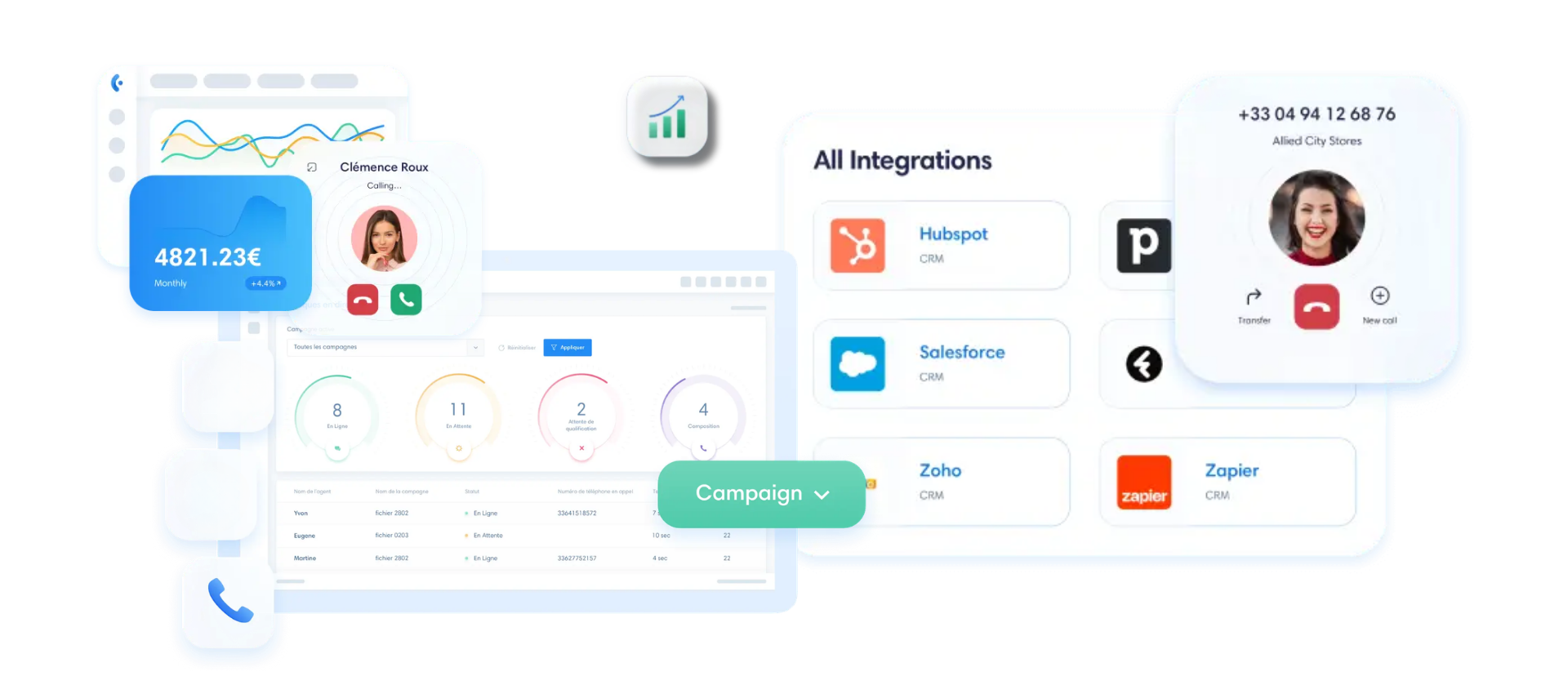
What does hourly invoicing for telephone answering services really mean?
Here are the three realities that this term can hide.
1. Actual communication time
This is the exact length of time the telesecretary is on the line with your caller. If a customer calls for 3 minutes, you pay for 3 minutes. In theory, this is the fairest model. In practice, service providers often round up to the nearest minute, or even to the nearest 6-minute increment.
A concrete example: your practice receives 20 calls averaging 2 minutes each. Rounded up to 6 minutes, you pay 120 minutes instead of 40. The bill triples.
2. Overall processing time
Here, we include communication plus the time it takes to type the message, write up the minutes and send the notification. This is the most common model, generally billed at between €15 and €35 per hour. The problem: you don’t know how much real time has been spent on your call versus the administrative tasks involved.
3. The dedicated presence of a telesecretary
Here, you literally hire a part-time person. She’s only available to you for a set period of time. This is the most transparent model in terms of availability, but also the most expensive. And often the least suitable for SMEs with an irregular flow of calls.
This changes everything: before comparing two quotes, systematically ask the service provider what definition they use. A rate of €20/hour for communication time may be more expensive than €28/hour for dedicated time, depending on your actual volume.
It’s easy to see why the term “hourly billing” can be misleading. The term “by the hour” is a commercial shorthand, not a guarantee of transparency. The next step is to know how to estimate your own call volume so you can choose the right model.
Rate model comparison: by the hour, by the call or by the month?
The right pricing model depends on a single question: is your call flow predictable? Depending on the answer, the calculation changes completely.
Time-based billing (hourly rate)
This model remunerates the telesecretary’s actual work: communication, message capture, diary management. Everything is accounted for.
It’s ideal for complex assignments – medical appointments, legal files, structured data entry. Ranges from €15 to €35 per hour.
The risk: if your calls are unpredictable, the hours add up quickly. A busy month can double your bill without warning.
Pay-per-call (or pay-per-action) pricing
You only pay for what is processed. Between €0.68 and €1.50 per call, depending on the service provider.
Example: 20 calls/day over 22 working days at €0.68 = approx. €299/month. Transparent, flexible.
But pay attention to the contractual definition: is a transfer included or billed extra? Does an unsuccessful call count?
Monthly package with call volume included
Fixed budget, no surprises. Around €150 ex VAT/month for 100 calls with most French service providers.
This is the most reassuring model for an SME with a regular flow of calls. But out-of-package calls are billed at between €1 and €2.50 each, and there’s no refund for empty months.
Hidden costs to anticipate in your outsourcing budget
You have received a quotation. The price seems reasonable. But what you’ll actually pay at the end of the month is another story.
Hourly call center contracts almost always contain lines that nobody reads before signing. Here’s the checklist you should go through before committing yourself.
Set-up costs
Some service providers charge between €50 and €200 to set up an account, including setting up your instructions and integrating your agenda. This fee is not included in the hourly rate. Ask explicitly whether set-up is included or billed separately.
Minimum monthly billing
This is the most common pitfall for SMEs with a low or seasonal call flow. Even if you use 2 hours in a month, some contracts stipulate a minimum billable time of 5 hours. Result: you pay for hours you haven’t used.
Case in point: you run a consulting firm, August is quiet, and you receive a total of 15 calls. Your service provider charges a minimum of 5 hours at €25/hour. You pay €125 for around 45 minutes of actual work.
The rounding rule
This is probably the most underestimated hidden cost. A 1 minute 10 second call billed by the minute = 2 minutes. Multiplied by 300 calls per month, the difference becomes significant.
Some providers round up to 6 minutes. A 2-minute call then costs you 6 minutes. Always check the rounding clause in the general terms and conditions.
Evening, weekend and public holiday surcharges
If you need extended coverage, expect surcharges of between 20% and 50% on the standard hourly rate. Some providers also apply a surcharge for on-call duty at night or on public holidays, sometimes up to double the basic rate.
Here are the four questions to ask each service provider before signing:
- Are there any set-up or configuration costs?
- What is the minimum monthly charge, even for low consumption?
- What rounding rule is applied to each call?
- What surcharges apply outside office hours?
A quotation without a clear answer to these four points is not a complete quotation. It’s a starting point for negotiation.
Calculation method: how to estimate your real monthly budget
Now you know the pricing pitfalls. But how do you get from the concrete to a reliable monthly figure, even before asking for a quote?
Here’s a four-step method. Simple, straightforward and applicable tonight.
Step 1: Count your actual incoming calls
Look at your phone records over the last 30 days. If you don’t have a tracking tool, make a quick estimate: how many times does your phone ring per day? Multiply by 22 business days.
Example: 12 calls per day × 22 days = 264 calls per month.
Step 2: Estimate average treatment time
A simple message-taking call takes about 2 to 3 minutes. A medical appointment or request qualification: 4 to 6 minutes. Be honest about your case.
If you run a medical practice with a complex agenda, allow 5 minutes on average. If it’s a simple message redirection, 2 minutes is enough.
Step 3: Apply rates and rounding
This is where the method comes in handy. Take your average duration, apply the provider’s rounding rule, then multiply.
Here’s a concrete scenario for a medical practice:
| Parameter | Hourly billing | Per-call billing | Monthly package |
|---|---|---|---|
| Monthly volume | 264 calls | 264 calls | 264 calls |
| Average time processed | 5 min → rounded off 6 min | Not applicable | Not applicable |
| Calculation | 264 × 6 min = 26.4h × €25 | 264 × 0,90€ | Package 200 calls + 64 overrun |
| Estimated monthly budget | ~660€ | ~238€ | ~150€ + 64€ à 1,50€ = ~246€ |
See the difference? €660 versus €238 for the same volume of calls. The difference comes solely from the billing model and the 6-minute rounding rule.
For this medical practice, billing by the hour is clearly the wrong choice. Calls are short and numerous, and rounding up to 6 minutes triples the time billed.
Step 4: Add foreseeable extra costs
Repeat the checklist from the previous section. Add to the basic budget :
- Set-up costs (one-off, but to be integrated over 12 months)
- Increases if you need coverage in the evening or on Saturdays
- Guaranteed minimum monthly income, even in lean months
A quiet August with a minimum of 5 hours at €25? Add €125 to your annual estimate.
This method does not replace a quotation. But it does give you a reference figure, so you won’t be surprised by a bill you hadn’t anticipated.
Internalize call management: the software alternative with Kavkom
Outsourcing is one option. But it’s not the only one.
If you already have teams in place, working from home or on call, paying a service provider by the hour to manage your incoming calls can become more expensive than equipping your staff directly with the right tools.
In this case, some companies choose to equip their internal teams with a cloud telephony solution like Kavkom to manage calls directly.
Rather than delegate call management to an external service provider, some companies choose to equip their in-house teams with a cloud telephony solution to handle calls directly. Your agents answer from home, the office or on the move, via a webphone or mobile application, thanks to an entirely cloud-based VoIP telephony infrastructure.
Here’s what this means in concrete terms for a sales team or customer service department handling inbound calls.
- IVR (Interactive Voice Response) to automatically direct callers
- Intelligent routing to available teams
- Supervision and statistics to track call activity
And when it comes to pricing, there are no surprises.
Kavkom operates on a no-commitment basis, with billing based on the number of days actually used. Are your teams on vacation in August? You suspend the lines and pay only for active days. No monthly minimums, no hidden costs.
This approach keeps call management under control, while controlling costs.
For a company that already has a team capable of handling incoming calls, equipping employees with a cloud telephony solution can sometimes be cheaper than full outsourcing.
Boost the productivity of your sales teams with Kavkom, the 100% cloud-based business telephony software.
Schedule a demo
Conclusion
The promise of an “hourly” hotline often conceals a far more complex billing structure. Your final budget doesn’t depend on the hourly rate displayed, but on the conditions surrounding it, such as the method used to calculate the time spent.
The actual cost depends on details that can double your bill: call time rounding (sometimes in 6-minute increments), the monthly minimum imposed even without activity, and activation fees.
You now have the method to estimate your budget and compare offers without being surprised. The alternative is to keep control with an in-house telephony solution, which ensures flexible billing with no hidden costs.
Compare pricing models and check billing conditions to avoid unpleasant surprises. Before choosing a service provider or an in-house solution, take the time to estimate your actual call volume and check the billing rules applied.