Business telephony has come a long way in recent years. On-site switchboards and traditional lines are gradually giving way to more flexible solutions. Today, many companies use cloud telephony, i.e. a telephone system that operates via the Internet.
With this model, call management no longer depends on a physical installation in the office. The switchboard is hosted in the cloud and accessible from an online interface. Teams can make and receive calls from a computer, IP phone or mobile application.
In this guide, we’ll look at what cloud telephony really is, how it works and why more and more companies are adopting it. We’ll also look at the practical uses it covers, and how to choose the right solution for your organization.
Points to remember :
- Cloud telephony enables companies to manage their calls via the Internet, without the need for an on-site switchboard or complex infrastructure.
- It is based on VoIP technology, which transforms voice into digital data for transmission over the Internet.
- Companies are adopting this model for a number of practical reasons: rapid deployment, centralized call management, remote working and monitoring of team telephone activity.
- A cloud telephony solution lets you configure a switchboard, manage business numbers, organize call routing and analyze team performance.
- Today, platforms such as Kavkom make it possible to deploy this type of telephony rapidly, with a solution accessible via the Internet, with no technical installation, no commitment and pro rata billing.


Boostez la productivité de vos équipe commerciales grâce à Kavkom, le logiciel de téléphonie d’entreprise 100% cloud.
Planifier une démo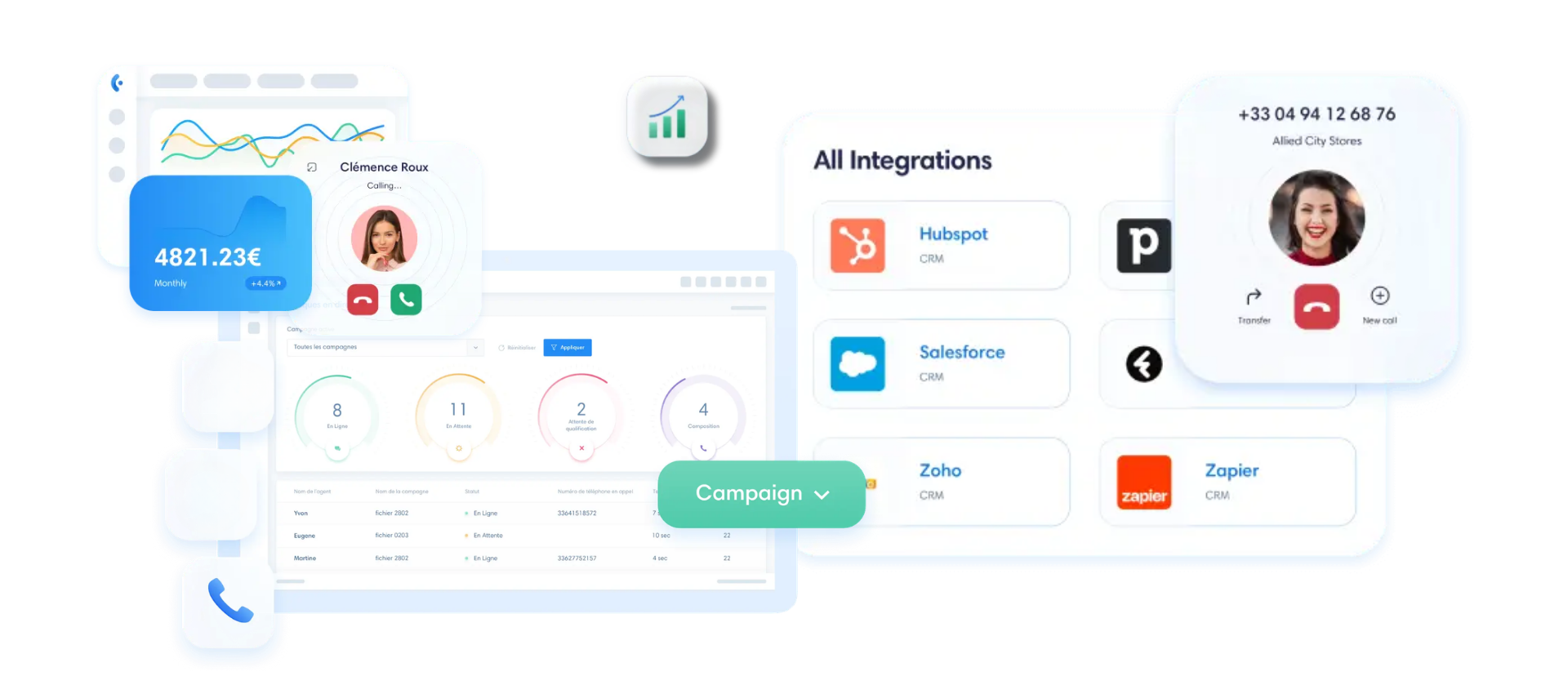
What is cloud telephony?
Cloud telephony refers to a business telephone system whose infrastructure is hosted in the cloud. In concrete terms, the switchboard and associated services are no longer installed on the company’s premises. They are managed on servers accessible via the Internet.
In this model, calls are made via an Internet connection rather than the traditional telephone network. Users can then make and receive calls from a variety of media: a computer, a mobile application or a compatible IP phone.
This changes many things for the company. The telephone system becomes simpler to deploy and easier to administer. Creating new lines, managing numbers or configuring the switchboard can all be done directly from an online interface.
Cloud telephony and VoIP: what’s the difference?
The two concepts are often used together, but they don’t mean exactly the same thing.
VoIP (Voice over Internet Protocol) is the technology used to transmit voice over the Internet. When a call is made, the voice is converted into digital data, which travels over the network.
Cloud telephony refers to the entire telephone system that uses this technology. It includes, for example :
- telephone switchboard hosted in the cloud
- number and user management
- call routing functions
- interfaces enabling teams to make and receive calls
In other words, VoIP is the underlying technology, while cloud telephony is the complete environment that enables businesses to manage their telephone communications via the Internet.
How does cloud telephony work?
The principle is simple.
With a cloud telephony solution, calls no longer pass through an in-house telephone system. They transit via the Internet and are managed by a platform hosted in the cloud.
When a user makes a call, their voice is converted into digital data. This data is then sent to the platform’s servers, which route the call to the right recipient.
For the company, the entire system is managed via an online interface. The administrator can, for example, create users, assign numbers or modify call routing without on-site technical intervention.
Cloud telephony is generally based on three main elements.
A switchboard hosted in the cloud
The heart of the system is the cloud switchboard, also known as the PBX cloud (Private Branch Exchange).
This is where call logic is managed.
In particular, it allows you to :
- organize queues
- direct calls to the right department
- create voice menus (IVR)
- manage user groups
This standard is accessible via a web interface. Parameters can be modified at any time, without any technical intervention on the company’s premises.
Some cloud telephony solutions, such as Kavkom, offer this type of switchboard directly accessible via a web interface. The administrator can then manage users, configure call routing or create groups of agents, without having to install any technical equipment on the company’s premises.
Professional numbers accessible via the Internet
In a cloud telephony solution, users have access to virtual business numbers. These numbers are not linked to a physical installation.
An employee can therefore use his or her number from different devices:
- a computer via calling software
- a mobile application
- a compatible IP phone
This keeps teams in touch, whether they’re working in the office, at home or on the road.
Applications for making and receiving calls
Access to the system is via interfaces called softphones or webphones.
These are simply applications that enable you to make and receive calls from a computer or smartphone.
The user then has all the functions of a conventional business phone:
- incoming and outgoing calls
- STANDBY
- call transfer
- communications history
The difference is that everything runs via the Internet and is controlled from the cloud platform.
Why companies are switching to cloud telephony
Cloud telephony is gradually gaining ground in the corporate world. The reason is simple. It meets very real needs that traditional telephone systems have difficulty handling.
Rapid deployment, teams spread over several sites, call activity management. The cloud brings greater flexibility to business telephony management. Here are the main benefits observed in practice.
Rapid deployment of a telephone system
With a conventional telephone system, it can take a long time to set up. Switchboard installation. Configuration of extensions. Technical intervention.
With cloud telephony, deployment is much faster.
Users and numbers are created directly from an administration interface.
For example, a company can :
- create a new number for an employee
- add an agent to a call group
- modify standard routing
Some platforms, such as Kavkom, allow you to create new lines and equip a sales team in just a few minutes, without any technical intervention or hardware installation.
A system adapted to teleworking and mobile teams
Working patterns have changed. Many teams now work remotely or on several sites.
Cloud telephony makes it easier to manage this organization. Users can access their business line from different Internet-connected devices.
A sales representative can make calls from his laptop.
A support agent can answer from a mobile application.
A manager can supervise call activity from an online interface.
The entire system remains centralized, even if the teams work from different locations.
Centralized call management
The cloud switchboard makes it easier to manage incoming calls.
For example, a company can :
- create a voice menu to orient callers
- automatically route calls to a specific service
- manage queues during busy periods
These rules can be modified at any time from the administration interface.
This means you can quickly adapt the switchboard organization to suit your business.
Better monitoring of telephone activity
Cloud telephony solutions often include call tracking tools.
Team managers can consult various indicators such as :
- incoming and outgoing call volumes
- waiting times
- missed calls
- call duration
Solutions like Kavkom integrate these monitoring tools directly into their interface, enabling team managers to track call activity and agent performance in real time.
Lower infrastructure costs
Cloud telephony also reduces certain costs associated with telephone infrastructure.
There’s no need to install or maintain a physical switchboard on the premises. The infrastructure is managed by the solution provider.
Companies generally pay a subscription fee per user or per line, which makes costs more predictable.
This model is often simpler to manage for organizations wishing to modernize their telephony without investing in on-site technical equipment.
Features of a cloud telephony solution
More than just making calls, a cloud telephony solution lets you manage all your company’s telephone communications from a single platform.
These solutions generally combine a number of functions to facilitate call organization, team work and activity monitoring.
These are the functions most commonly found in cloud telephony systems used in the enterprise.
Virtual business numbers
A cloud telephony solution lets you assign business numbers to company users or departments.
These numbers are not linked to a physical installation. They are accessible via the Internet and can be used from different devices.
For example, a company can :
- assign a number to each employee
- create a customer service number
- have numbers in several cities or countries
These numbers can then be used from a computer, mobile application or compatible IP phone.
Interactive Voice Response (IVR)
The interactive voice server, often called IVR, creates a welcome menu to guide callers.
When a customer calls, he may hear a message like :
- press 1 for commercial service
- press 2 for customer support
This system enables calls to be directed to the right department without human intervention.
IVR is particularly useful for companies with high call volumes.
Intelligent call routing
Call routing automatically directs a call to the right person or team.
Several rules can be implemented:
- distribution of calls among several agents
- transfer to another department if no one answers
- redirection according to opening hours
This avoids lost calls and improves switchboard management.
Call recording
Call recording is often used by sales and customer service teams.
Calls can be recorded and viewed from the platform.
These recordings are used in particular to :
- train new employees
- analyze the quality of customer exchanges
- keep track of certain business conversations
This enables team managers to review calls and identify areas for improvement.
Integration with CRM tools
Many cloud telephony solutions offer integration with the CRM (Customer Relationship Management) systems used by companies.
When a customer calls, his or her details can automatically appear on the employee’s screen. The call history can also be saved in the CRM.
This connection centralizes customer information and facilitates the follow-up of exchanges. In most cases, the telephony solution integrates with the company’s existing CRM, rather than replacing it.
Use cases for enterprise cloud telephony
Cloud telephony is used in many business contexts. Depending on how the company is organized, it can be used to manage incoming calls, organize call campaigns or centralize communication between several teams.
Here are just a few examples of common business uses.
Sales teams
In sales teams, telephony remains a central tool for prospecting and customer follow-up.
A cloud telephony solution lets sales reps make calls directly from their computer or CRM. Numbers can be dialed at the click of a button, eliminating the need to manually enter contacts.
Sales managers can also track their team’s activity using the call data available on the platform.
For example, you can consult :
- number of calls made
- average call duration
- busy periods
Cloud telephony solutions like Kavkom are often used in this context to organize call campaigns, track sales activity and analyze team performance.
This information helps to better organize prospecting campaigns and track team performance.
Customer services and support
In customer services, cloud telephony makes it easier to manage incoming calls.
Companies can implement :
- a voice server to direct callers
- queues to manage call peaks
- automatic call distribution between agents
Teams also have access to call histories and, in some cases, recordings. These tools make it easier to track customer requests and train new agents.
In-house call centers
Some companies have teams dedicated to call management, whether for customer relations, prospecting or support.
Cloud telephony makes it possible to supervise the activity of these teams from a centralized interface.
Managers can track various indicators such as :
- volume of calls in progress
- agent availability
- caller waiting time
This information is useful for adapting the organization of teams to the activity.
It is important to note that these solutions are designed to equip a company’s in-house teams. They do not replace an outsourced call center, nor do they take over customer relations for the company.
Multi-site companies
Organizations with several offices or branches often have to manage telephony spread over several sites.
Cloud telephony makes it possible to centralize this management in a single system.
For example, a company can :
- assign numbers to different offices
- manage a single switchboard for several sites
- transfer calls between teams located in different cities
Employees can access the system from any location with an Internet connection.
This facilitates coordination between teams and simplifies the administration of company telephony.
Cloud telephony vs. traditional telephony
To understand the benefits of cloud telephony, we need to compare it to the more traditional corporate telephony model.
For a long time, companies used an on-site switchboard, often called a PABX. This system was connected to the operator’s telephone network, and required hardware installation on the premises.
With cloud telephony, the infrastructure is hosted on servers accessible via the Internet. The telephone system is no longer installed in the company. It is managed from an online platform.
This difference changes the way telephony is deployed and managed.
Here are the main distinctions between these two approaches.
| Traditional telephony | Cloud telephony |
|---|---|
| Telephone switchboard installed on the premises | Cloud-hosted switchboard |
| On-site technical installation | Remote activation and configuration |
| Equipment maintenance by the company | Vendor-managed infrastructure |
| Adding more complex lines | Quick creation of new users |
| Mainly for office use | Access from a variety of devices |
| Heavier technical administration | Web-based management |
In a traditional system, any modification often requires technical intervention. Adding a line, modifying call routing or adapting the switchboard can take time and specific skills.
With cloud telephony, these operations are generally accessible from an online dashboard. Administrators can modify phone system parameters without physical installation or on-site maintenance.
It’s this model that explains the gradual adoption of cloud telephony in businesses, particularly in organizations that work across multiple sites or with distributed teams.
How to choose a cloud telephony solution for your business
The cloud telephony market has grown considerably in recent years. Today, there are many different platforms, some with very different approaches.
Some solutions are designed for developers, offering mainly technical infrastructures. Others are designed for business teams and offer a ready-to-use telephone system.
Before choosing a solution, several criteria need to be analyzed.
Easy to deploy and learn
A cloud telephony solution must be able to be implemented quickly. In most cases, companies are looking to modernize their telephony systems without launching a complex technical project.
It is therefore preferable to choose a solution that offers :
- fast account activation
- a clear administration interface
- simple switchboard configuration
The aim is for teams to be able to start using the system without heavy installation or advanced technical configuration.
Features tailored to your business activity
Not all companies have the same telephony needs.
Some are mainly looking for a switchboard to handle incoming calls. Others need more advanced tools to organize call campaigns or monitor the activity of their teams.
Before choosing a solution, it’s a good idea to check for features such as :
- queue management
- intelligent call routing
- statistics and dashboards
- call logging
These functions are particularly useful in sales or customer service teams.
Integration with business tools
Telephony is rarely used alone in a company. It is usually integrated into an environment made up of other tools, such as CRM.
A good cloud telephony solution must be able to connect easily to the tools already used by the company.
For example, this integration enables :
- automatically display a contact’s record during a call
- record communications history in CRM
- launch a call directly from a customer file
This avoids double entries and makes it easier to monitor customer relations.
Contractual flexibility
Contractual conditions can vary widely from one supplier to another.
Some solutions, such as Kavkom, offer no-commitment, pro-rata billing, enabling companies to easily adjust their telephony according to activity or team size.
For companies wishing to retain flexibility, it may be worth choosing a no-commitment solution with flexible billing, to adapt the subscription to the evolution of their teams.
Quality of guidance and support
Telephony remains a critical tool for many companies. When a problem arises, it’s important to be able to get help quickly.
Before choosing a solution, it is useful to find out about :
- available support channels
- response times
- the level of support during implementation
Responsive support can make a real difference during deployment and in the day-to-day use of the platform.
Cloud telephony, a logical evolution for business communications
The way companies manage their calls has changed dramatically. On-site switchboards are still present in some organizations, but the trend is clearly towards cloud switchboards.
This model enables calls to be managed from a platform accessible via the Internet, with no telephone infrastructure to maintain on the premises. Teams can use their business line from a computer, mobile application or compatible IP phone.
For many companies, cloud telephony means greater flexibility in work organization. It makes it easier to manage incoming calls, track telephone activity and equip teams spread over several sites.
The choice of solution will then depend on a number of factors: the size of the company, the organization of its teams, the tools already in use and the level of functionality expected.
Companies looking to modernize their telephony systems are generally looking for a solution that is easy to deploy, remotely accessible and capable of integrating with existing business tools.
This is precisely the rationale behind cloud telephony solutions designed for sales teams, customer services or in-house call centers: to offer a professional telephone system, accessible from anywhere, and manageable from a centralized interface.
Example of a cloud telephony solution: Kavkom
There are a number of solutions available today for setting up cloud telephony within a company. Some platforms are aimed primarily at developers, and offer a technical infrastructure. Others are designed for business teams wishing to rapidly deploy an operational telephone system.
This is particularly true of Kavkom, a VoIP cloud telephony solution that enables companies to manage their business calls from an online interface. The platform lets you set up a cloud switchboard, manage business numbers and track team call activity.
The solution operates entirely via the Internet, with no on-site technical installation required. This means companies can quickly equip their sales teams or customer service departments, and manage their telephony from a single interface, with no commitment and pro rata billing.
Boostez la productivité de vos équipe commerciales grâce à Kavkom, le logiciel de téléphonie d’entreprise 100% cloud.
Planifier une démoFAQ – Cloud telephony
What is cloud telephony?
Cloud telephony is a business telephony system that works via the Internet rather than with a physical telephone installation on the premises. The switchboard is hosted on servers in the cloud and accessed via an online interface. Users can make and receive calls from a computer, mobile application or IP phone connected to the Internet.
What’s the difference between cloud telephony and VoIP?
VoIP (Voice over Internet Protocol) is the technology used to transmit voice over the Internet. Cloud telephony is the complete system that uses this technology to manage a company’s telephony. It includes switchboard, user management, call routing and online administration tools.
Can I use a business number with cloud telephony?
Yes. Cloud telephony solutions enable business numbers to be assigned to employees or company departments. These numbers are accessible via the Internet and can be used from different devices, enabling teams to remain contactable in the office, at home or on the move.
Does cloud telephony require special hardware?
No, in most cases no specific hardware is required. Users can make and receive calls from a computer or mobile application, using calling software called a softphone. Some companies also use VoIP-enabled IP phones, but the telephony infrastructure remains hosted in the cloud.
How good is call quality with cloud telephony?
Call quality depends mainly on the Internet connection used. With a stable connection and sufficient bandwidth, cloud telephony solutions today offer audio quality comparable to that of traditional telephone systems. Today’s VoIP technologies make it possible to maintain clear, stable communication in most business environments.
Conclusion
Today, cloud telephony enables companies to manage their calls without the need for an on-site telephone infrastructure. The switchboard is hosted in the cloud and accessible via the Internet, simplifying deployment and system administration.
This model is particularly well suited to companies that need to manage teams spread over several sites, track call activity or connect their telephony to business tools such as CRM.
Solutions like Kavkom make it possible to set up this type of cloud telephony quickly. The platform lets you manage business calls, organize call routing and equip sales teams or customer services departments, with no commitment and pro rata billing.