This is where speech analytics provides a clear operational answer.
This technology transforms voice into actionable data to help managers make better decisions, spot weak signals, understand irritants and boost service quality. The following article offers a complete overview of the subject. You’ll discover exactly what speech analytics covers, how it supports operational performance and how to deploy it step by step in a call center environment.
As your teams move forward with their speech analytics project, you’ll find that telephony quality plays a decisive role. And with a cloud platform like Kavkom, recordings, virtual numbers and call management integrate naturally into your organization, without disrupting day-to-day work.
Points to remember :
- Speech analytics helps you understand what’s really going on in your call center conversations, turning the voice of the customer into actionable data.
- This technology helps to improve the customer experience by identifying irritants, signals of dissatisfaction and moments when a course adjustment is required.
- Managers have a solid basis for coaching their agents, thanks to objective data on silences, tone, words used and adherence to scripts.
- Speech analytics helps to reduce certain operational costs by revealing the most time-consuming interactions, redundancies and processes that need to be simplified.


Boostez la productivité de vos équipe commerciales grâce à Kavkom, le logiciel de téléphonie d’entreprise 100% cloud.
Planifier une démo
What is speech analytics?
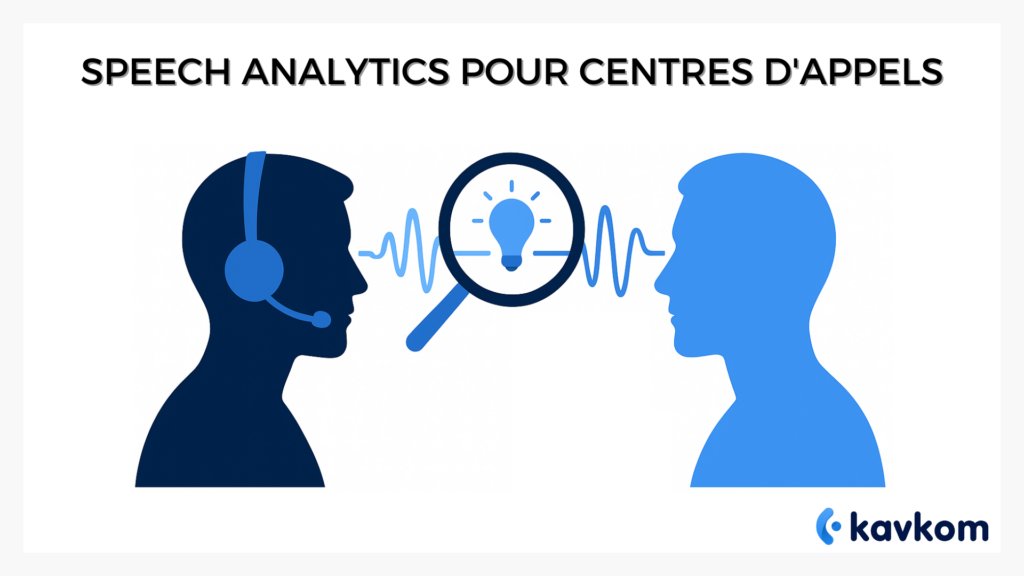
Speech analytics is the automatic analysisof telephone conversations. The system transcribes exchanges, identifies variations in tone or attitude expressed in the voice, detects emotions, pinpoints key expressions and assembles these signals into a comprehension chart. This technology is generally based on language processing and speech recognition algorithms.
The aim is simple: to transform the voice of the customer into useful information.
Why is this technology attracting so much attention from managers?
Because it simplifies what used to be a tedious task: understanding on a large scale what goes on in exchanges on a daily basis. When a call center handles tens of thousands of calls a month, it becomes very difficult to observe the whole thing accurately. Speech analytics serves as a foundation for tracking interactions and supporting teams in a dynamic of continuous improvement.
The benefits of speech analytics for call centers
A call center is based on three priorities: quality, efficiency and processing time. A small improvement on one dimension can have a positive effect on the others. Speech analytics acts precisely on these points.
The benefits
| Profit | Operational impact |
|---|---|
| Rapid call analysis | Time-saving, more efficient supervision |
| Detecting dissatisfaction | Reduced churn, faster corrective action |
| Tracking emotions | Targeted agent coaching, improved customer experience |
| Identifying keywords | Analysis of trends and recurring requests |
| Compliance support | Traceability of exchanges |
| Best training | Identifying weaknesses in scripts |
| Process optimization | Adjustments based on actual data |
1. Improving the customer experience
Understanding what bothers a customer or what makes them feel confident requires careful listening. Speech analytics makes it possible to track these signals on a large scale. It’s easier to identify the moments that provoke annoyance, hesitation or satisfaction.
This enables teams to identify situations requiring rapid adjustment. Managers can revise their scripts or adapt treatment paths according to the most frequent requests.
2. More effective agent coaching
A call center manager spends a great deal of time coaching, encouraging, reframing and helping his or her teams to evolve. Speech analytics provides structured data to spot difficulties: too long silence times, lack of empathy in certain situations, awkward phrases or lack of precise information.
Rather than giving general feedback, the manager can draw on extracts, trends and examples. This makes coaching sessions more useful and focused.
3. Reduced operating costs
According to Siècle Digital, digital transformation represents a direct opportunity for SMEs to reduce costs while increasing efficiency. The use of tools capable of automating tasks, optimizing internal processes and exploiting data makes this dynamic particularly accessible.
Speech analytics is precisely in line with this logic, as it helps to identify the most costly interactions, reduce overly long paths and better direct the efforts of teams.
4. Enhanced compliance
In many sectors, it is essential to keep track of commitments, consents and information communicated to customers. Speech analytics contributes to this rigor by providing precise information on the nature of exchanges. This strengthens compliance and secures interactions.
Preparing your call center for speech analytics
When teams decide to integrate speech analytics into their daily work, they quickly discover that this technology doesn’t work in a vacuum. To deliver good results, it needs a solid foundation: a clean audio signal, accessible recordings and telephony capable of dialoguing easily with the CRM. In other words, the work begins long before the analysis itself.
Kavkom provides the cloud infrastructure needed to ensure reliable recording and seamless integration with CRM. Virtual numbers provide a flexible structure for teams, and the predictive dialer generates a constant volume of calls, ideal for feeding a future speech analytics tool.
CRM integration plays a key role. It ensures that every transcription is immediately contextualized. Responsive human support facilitates technical adjustments, while the absence of hardware requirements simplifies deployment. Teams even retain the option of using a physical IP phone at no extra cost when this is more comfortable.
This preparation provides a methodical basis for welcoming speech analytics under the right conditions and transforming every conversation into usable data.
Boostez la productivité de vos équipe commerciales grâce à Kavkom, le logiciel de téléphonie d’entreprise 100% cloud.
Planifier une démoConcrete use cases in call centers
Speech analytics can be easily integrated into operations, as it meets very concrete needs. Here are the most common scenarios.
Examples
– Detection of complaints before escalation
– Analysis of obstacles in the customer journey
– Identification of sales opportunities
– Improved compliance with scripts
– Identification of key emotional moments
– Monitoring of calls with high strategic value
– Reduction of churn by anticipating weak signals
Complaints and irritants
A word spoken more often than usual can alert teams. The technology detects recurring expressions that signal frustration. This makes it possible to act earlier and adjust processes.
Respect for scripts and quality of responses
When an agent fails to follow recommended steps, or forgets important information, speech analytics can record these discrepancies. Training managers can then revise scripts or help agents become more fluent.
Identifying sales opportunities
By spotting signals of interest, purchase-oriented questions or a customer’s hesitations about a product, teams can better direct follow-ups and boost sales.
Churn analysis
One of the most sought-after uses is to spot the warning signs of a departure. An increase in negative terms, repeated requests or frequent misunderstandings are all indicators of a risk of termination.
How to deploy speech analytics: an implementation guide
Implementing a speech analytics solution is more than just installing a tool. It’s a structured project that requires a methodical approach.
Step 1: Define objectives
Step 2: Choose indicators
Step 3: Prepare data and integration
Step 4: Configure analysis rules
Step 5: Train teams
Step 6: Monitor results
Step 7: Adjust models
1. Define objectives
Would you like to better understand complaints, reduce processing times, identify decisive moments in a sale, reinforce compliance or improve coaching? The answers to these questions will influence the indicators you track.
2. Choose the right indicators
Call centers generally track metrics such as emotions detected, interruptions, key words, quality of handling or silence times. Each indicator offers a different angle on interaction quality.
3. Prepare data
This stage involves ensuring that the recordings are available, of good audio quality and well structured. A well-organized database makes for more efficient analysis.
4. Configure analysis
The tool must be equipped with your business rules. Which keywords should be monitored? Which agent behaviors should be highlighted? What situations require an alert?
5. Train agents
Speech analytics is never intended to spy or punish. It accompanies. It provides signs to understand, improve and guide conversations. Agents need to see technology as a support.
6. Measuring effects
The first results appear quickly, but optimizations are made over time. Indicators need to be monitored regularly to adjust actions.
7. Continuous adjustment
As teams become more skilled, rules evolve. Scripts change. Processes are refined. Speech analytics is a perpetual learning cycle.
FAQs
What is speech analytics?
It’s a technology that automatically analyzes telephone conversations to extract useful data, such as emotions, keywords or recurring patterns.
What’s the difference between speech analytics and voice analytics?
Speech analytics focuses on the content and structure of the conversation. Voice analytics focuses on tone, rhythm, volume or emotional markers.
What are the benefits for a call center?
Centers save time, boost service quality, spot weak signals, coach their agents more effectively and improve overall performance.
Does it help reduce churn?
Yes. Signals of dissatisfaction or emotional stalling are often spotted earlier thanks to this technology.
Do we need a lot of data?
The technology works even with moderate call volumes. The richer the database, the more accurate the analyses.
Does speech analytics help compliance?
Yes. Transcripts and analyses provide better traceability of interactions and facilitate internal control.
Is training necessary?
A short training course is recommended to make the most of the analyses and understand how to interpret the results.
Conclusion
Speech analytics gives call centers a powerful means of understanding their interactions and transforming the voice of the customer into strategic information. It’s easy to integrate into operations, with an immediate impact: improved service quality, finer tracking of emotions, team coaching, lower churn and continuous improvement.
Technology offers a living reading of exchanges, opening the way for informed decision-making. Every conversation becomes a source of learning and a lever for strengthening the relationship between teams and their customers.
By adopting a stable cloud telephony base that’s easy to link to your analytics tools, you’re putting all the chances on your side to get the best out of speech analytics. This is often the starting point for transforming the quality of interactions and offering your agents more precise support.